IPC-A-600H-2010 中文版 印制板的可接受性 (1).pdf - 第82页
Acceptable - Class 1,2,3 (可接受条件 - 1,2,3级) • For printed boards using surface mount components, the bow and twist shall be 0.75% or less. • For all other printed boards, bow and twist shall be 1.50% or less. • 对于采用表面 贴 装 …

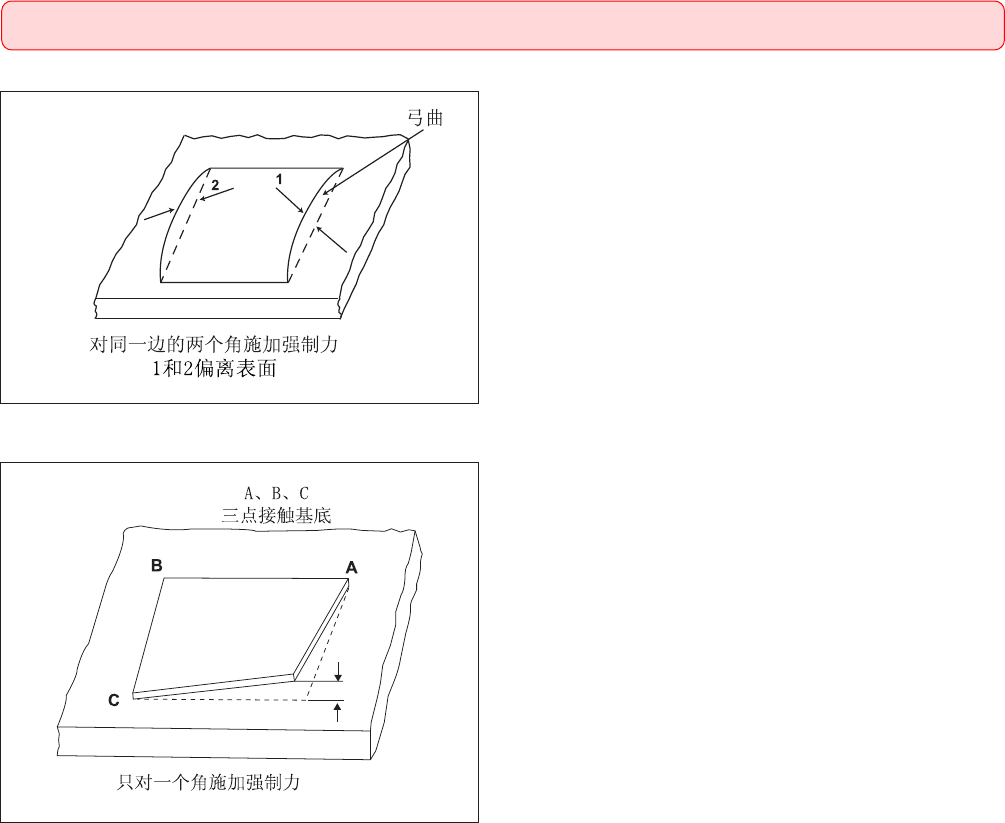
Flatness of printed boards is determined by two characteristics of the product; these are known as bow and twist. The bow condition is char-
acterized by a roughly cylindrical or spherical curvature of the printed board while its four corners are in the same plane (see Figure 211a).
Twist is the printed board deformation parallel to the diagonal of the printed board such that one corner is not in the same plane to the other
three (see Figure 211b). Circular or elliptical printed boards must be evaluated at the highest point of vertical displacement. Bow and twist
may be influenced by the printed board design as different circuit configurations or layer construction of multilayer printed boards can result
in different stress or stress relief conditions. Printed board thickness and material properties are other factors that influence the resulting
printed board flatness.
Bow and Twist Bow, twist, or any combination thereof, shall be determined by physical measurement and percentage calculation in
accordance with IPC-TM-650, Method 2.4.22. End products shall be assessed in the delivered form.
印制板的平整度是由产品的两种特性来确定的:即弓曲和扭曲。弓曲的状况通过把印制板的四个角处在同一平面上,大致成圆柱
形或球面弯曲进行确定;而扭曲是板的变形平行于板的对角线,板的一个角不与其它三个角在同一平面上。(见图211b)圆形或
椭圆形的印制板必须在最高点作垂直位移的评定。弓曲和扭曲可能会受印制板设计的影响,因为不同的布线或多层印制板的层结
构可能导致产生不同的应力或应力消除的状况。印制板的厚度及材料性能是影响印制板平整度的其他因素。
⼸曲及扭曲 弓曲、扭曲或其组合应当按IPC-TM-650测试方法2.4.22中的物理测量方法进行测量并计算百分比。成品板应当按照
接收态的形态进行评估。
2.11 Flatness(平整度)
2.11 Flatness(平整度)
73IPC-A-600H-2010 2010年4月
Acceptable - Class 1,2,3(可接受条件 - 1,2,3级)
• For printed boards using surface mount components, the bow and
twist shall be 0.75% or less.
• For all other printed boards, bow and twist shall be 1.50% or less.
• 对于采用表面贴装元器件的印制板,弓曲和扭曲应当小于等
于0.75%。
• 对于所有其它印制板,弓曲和扭曲应当小于等于1.50%。
Nonconforming - Class 1,2,3(不符合条件 - 1,2,3级)
• Defects either do not meet or exceed above criteria.
• 缺陷不符合或超出上述要求。
图211a
图211b
x
x
x
x
2.11 Flatness(平整度)
2.11 Flatness (cont.)(平整度(续))
74 IPC-A-600H-20102010年4月

The purpose of this section is to provide acceptability requirements for those characteristics which are internal to the printed board. These
include the following characteristics in the base material, PTHs, internal conductive copper pattern, treatments to the internal copper, and
internal ground/power/thermal planes, as described below:
• Subsurface imperfections in printed board material, such as delamination, blistering, and foreign inclusions.
• Subsurface imperfections to multilayer printed boards, such as voids, delamination, blistering, cracks, ground plane clearance and layer to
layer spacing.
• PTH anomalies, including size, annular ring, nailheading, plating thickness, plating voids, nodules, cracks, resin smear, inadequate or
excessive etchback, wicking, inner layer (post) separation, and solder mask thickness.
• Internal conductor anomalies, such as over or under etch, conductor cracks and voids, uneven or inadequate oxide treatment, and foil thick-
ness.
• Visual observations made on cross-sections only.
本章的目的是为印制板各种内部特性提供可接受性要求。这些内部特性包括在基材、镀覆孔、内层铜导电图形、内层铜箔的处理、
内部接地层/电源层/散热层内的特性,如下:
• 印制板材料表面下的瑕疵,如分层、起泡和外来夹杂物。
• 多层印制板表面下的瑕疵,例如空洞、分层、起泡、裂纹、接地层的余隙和层间的间距。
• 镀覆孔的异常,包括孔的尺寸、环宽、钉头、镀层厚度、镀层空洞、结瘤、裂缝、树脂钻污、凹蚀不足或过蚀、芯吸、内层与
孔壁分离及阻焊膜厚度等。
• 内层导体的异常,例如蚀刻过度或不足、导体裂缝及空洞、氧化处理不均匀或不充分,以及铜箔厚度等。
• 仅对显微切片进行目检观察。
3
INTERNALLY OBSERVABLE CHARACTERISTICS(内部可观察特性)
Introduction(引⾔)
75IPC-A-600H-2010 2010年4月