IPC-A-600H-2010 中文版 印制板的可接受性 (1).pdf - 第75页
T arget Condition - Class 1,2,3 (⽬标条件 - 1,2,3级) • Conductor width meets dimensional requirements of artwork or procurement documentation. • 导 体 宽度 及 间距 满 足照 相 底 版 或采 购 文件的 尺寸 要求。 Acceptable - Class 2,3 (可接受条件 - 2,3级) • A…

Printed boards shall meet the dimensional requirements specified on the procurement documentation such as printed board periphery, thick-
ness, cutouts, slots, notches and printed board edge contacts. The accuracy, repeatability and reproducibility of the equipment used to verify
the characteristics of printed boards should be 10% or less of the tolerance range of the dimensions being verified.
印制板应当满足采购文件规定的尺寸要求,如板的周边、厚度、切口、开槽、缺口及印制板边接触片等。用于验证印制板这些特
性的设备的精度、可重复性及可再现性应该为所验证尺寸公差范围的10%或更小。
2.10.1 Conductor Width and Spacing(导体宽度和间距)
This section covers acceptability requirements and criteria for conductor width and spacing. Acceptable conductor width and spacing is a
measure of how well the printed board fabrication process is reproducing the master image, which basically determines the width and spac-
ing requirements for the conductive patterns. Unless these characteristics are violated, edge definition itself is not necessarily a characteris-
tic for acceptance or nonconformance; however, it can be considered a process indicator, requiring review of manufacturing procedures. In
addition it may be an important consideration for controlled impedance circuits. Procurement documentation should establish edge definition
requirements for applications of these types. When required, measurements of conductor edge definition are made in accordance with IPC-
TM-650, Method 2.2.2.
本节包括导体宽度和间距的可接受性要求及准则。导体宽度和间距的可接受性是印制板制造工艺复现原始底片好坏的一种度量,
原始底片 已基本上确定了导电图形的最小宽度和间距要求。除非违反了这些特征,导体边缘的精确度不必作为验收或拒收的特
性,但却可作为一种制程警示,要求对生产工艺作出审核。此外,对控制阻抗电路,可能是一项需要考虑的重要因素。此类用途
的印制板应该在采购文件中规定边缘精确度要求。有要求时,按IPC-TM-650测试方法2.2.2测量导体边缘精确度。
2.10 PATTERN DEFINITION – DIMENSIONAL(图形精确度 – 尺⼨要求)
Introduction(引⾔)
66 IPC-A-600H-20102010年4月
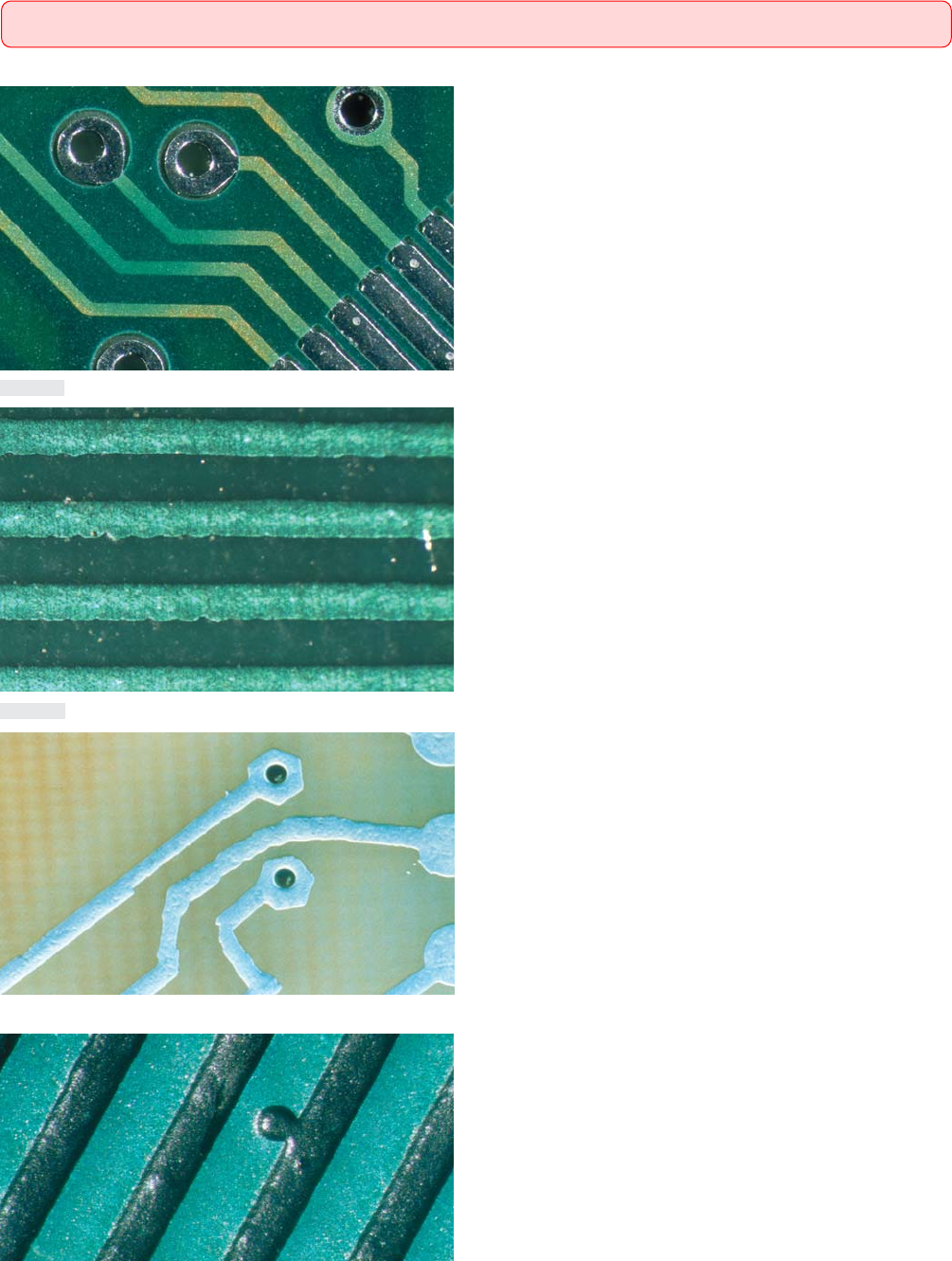
Target Condition - Class 1,2,3(⽬标条件 - 1,2,3级)
• Conductor width meets dimensional requirements of artwork or
procurement documentation.
• 导体宽度及间距满足照相底版或采购文件的尺寸要求。
Acceptable - Class 2,3(可接受条件 - 2,3级)
• Any combination of isolated edge roughness, nicks, pinholes, and
scratches exposing base material that reduces the conductor width
by 20% of the minimum value or less.
• There is no occurrence (edge roughness, nicks, etc.) greater than
10% of the conductor length or more than 13.0 mm [0.512 in],
whichever is less.
• 孤立的导体边缘粗糙、缺口、针孔及暴露基材的划伤等缺陷
的任何组合使导体宽度的减小量小于等于最小宽度的20%。
• 缺陷(边缘粗糙、缺口等)总长度不大于导体长度的10%,
或不超过13mm[0.512in],取两者中的较小者。
Acceptable - Class 1(可接受条件 - 1级)
• Any combination of isolated edge roughness, nicks, pinholes, and
scratches exposing base material that reduces the conductor width
30% of the minimum value or less.
• There is no occurrence (edge roughness, nicks, etc.) greater than
10% of the conductor length or more than 25.0 mm [0.984 in],
whichever is less.
• 孤立的导体边缘粗糙、缺口、针孔及暴露基材的划伤等缺陷
的任何组合使导体宽度的减小量小于等于最小宽度的30%。
• 缺陷(边缘粗糙、缺口等)总长度不大于导体长度的10%,
或不超过25mm[0.984in],取两者中的取较小者。
Nonconforming - Class 1,2,3(不符合条件 - 1,2,3级)
• Defects either do not meet or exceed above criteria.
• 缺陷不符合或超出上述要求。
图21011a
图21011b
图21011c
图21011d
2.10 PATTERN DEFINITION – DIMENSIONAL(图形精确度 – 尺⼨要求)
2.10.1.1 Conductor Width(导体宽度)
67IPC-A-600H-2010 2010年4月
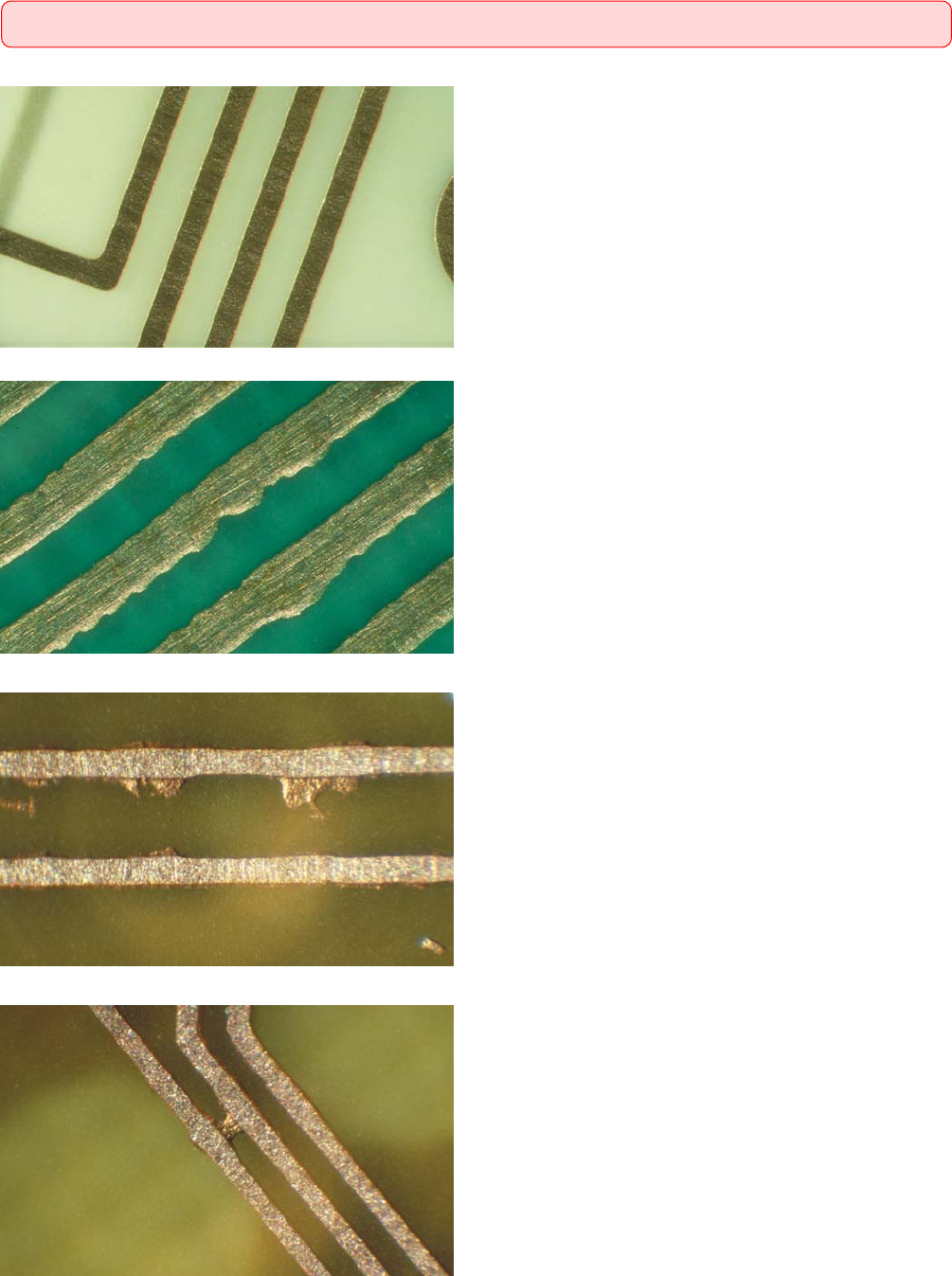
Target Condition - Class 1,2,3(⽬标条件 - 1,2,3级)
• Conductor spacing meets dimensional requirements of the pro-
curement documentation.
• 导体间距满足采购文件的尺寸要求。
Acceptable - Class 3(可接受条件 - 3级)
• Any combination of edge roughness, copper spikes, etc., that does
not reduce the specified minimum conductor spacing by more
than 20% in isolated areas.
• 任何孤立区域内导体边缘粗糙、铜刺等缺陷的任意组合未使
规定的最小导体间距的减少大于20%。
Acceptable - Class 1,2(可接受条件 - 1,2级)
• Any combination of edge roughness, copper spikes, etc., that does
not reduce the specified minimum conductor spacing by more
than 30% in isolated areas.
• 任何孤立区域内导体边缘粗糙、铜刺等缺陷的任意组合未使
规定的最小导体间距的减少大于30%。
Nonconforming - Class 1,2,3(不符合条件 - 1,2,3级)
• Defects either do not meet or exceed above criteria.
• 缺陷不符合或超出上述要求。
图21012a
图21012b
图21012c
图21012d
2.10 PATTERN DEFINITION – DIMENSIONAL(图形精确度 – 尺⼨要求)
2.10.1.2 Conductor Spacing(导体间距)
68 IPC-A-600H-20102010年4月