IPC-A-600H-2010 中文版 印制板的可接受性 (1).pdf - 第53页
This section covers acceptability criteria for marking of printed boards. Marking of printed boards provides a means of identification and aids in assembly. Legends screened over metal will generally degrade in a solder …
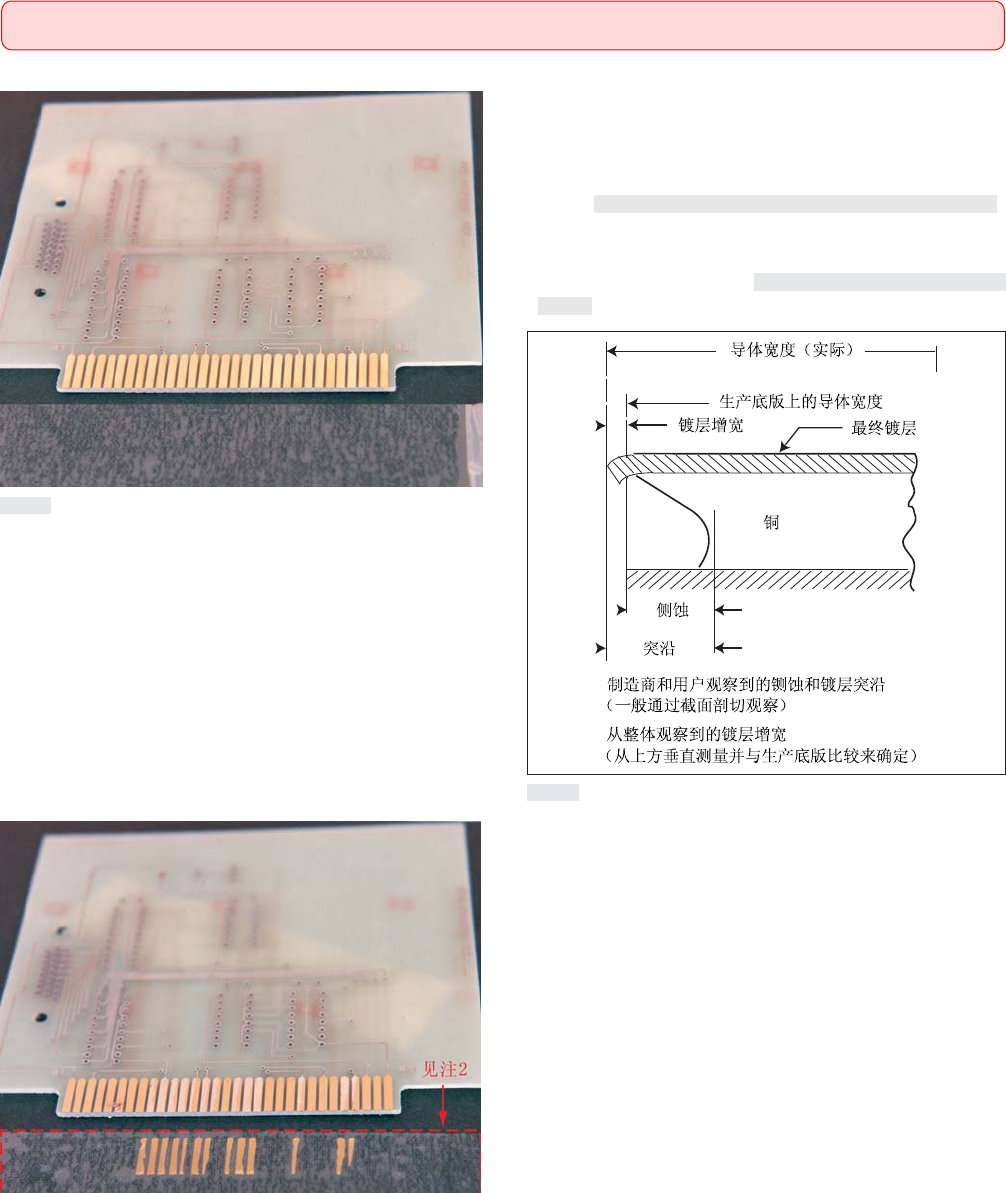
Target/Acceptable - Class 1,2,3(⽬标/可接受条件 - 1,2,3级)
• Good plating adhesion as evidenced by tape test. No plating
removed. If overhanging metal breaks off and adheres to the tape,
it is evident of overhang or slivers, but not of plating adhesion
failure. Figure 273b provides an example of overhanging metal.
• 经胶带测试证明镀层具有良好的附着力,没有镀层脱落。如
果镀层突沿脱落并粘附到胶带上,则只说明有镀层突沿或镀
屑,并非镀层附着力不良。图273b给出了突沿金属的实例示
意图。
Nonconforming - Class 1,2,3(不符合条件 - 1,2,3级)
• Defects either do not meet or exceed above criteria.
• 缺陷不符合或超出上述要求。
Note 1: The adhesion of the plating shall be tested in accordance with IPC-TM-650, Method 2.4.1, using a strip of pressure sensitive tape
applied to the surface and removed by manual force applied perpendicular to the circuit pattern.
Note 2: Plating that has adhered to the tape.
注1:镀层附着力应当按IPC-TM-650测试方法2.4.1进行测试,用一条压敏胶带压贴到镀层表面上,然后沿垂直于电路图形方向以
手用力撕离胶带。
注2:镀层粘附到胶带上。
图273a
图273c
图273b
2.7 PRINTED CONTACTS(印制接触⽚)
2.7.3 Adhesion of Overplate(外镀层附着⼒)
44 IPC-A-600H-20102010年4月
This section covers acceptability criteria for marking of printed boards. Marking of printed boards provides a means of identification and aids
in assembly. Legends screened over metal will generally degrade in a solder process or stringent cleaning environments. Legends over metal
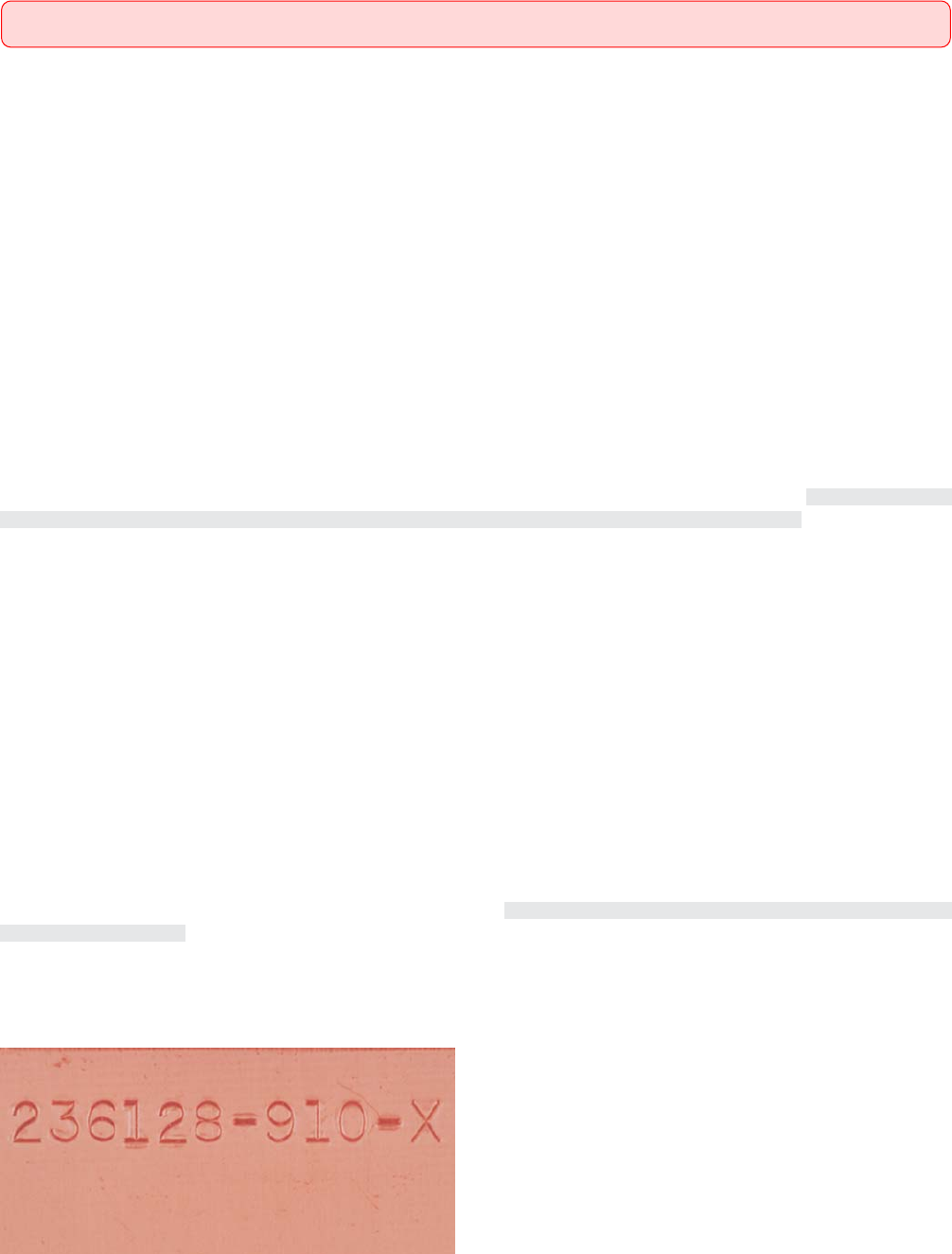
are not recommended. When use of legends over solderable surfaces is required, an etched legend is target condition. Minimum requirements
should be specified on the procurement documentation. Examples of the marking addressed by this section are:
• Assembly or fabrication part numbers when a requirement of the procurement documentation. Each individual board, each qualification
board, and each set of quality conformance test circuitry (as opposed to each individual coupon) shall be marked in order to ensure trace-
ability between the boards/test circuitry and the manufacturing history and to identify the supplier (logo, etc.).
• Component insertion locators, when a requirement of the procurement documentation.
• Manufacturing sequence number when required by the work order.
• Revision letter when the part number is a requirement of the procurement documentation.
• Designator for test points or adjustment points.
• Polarity or clocking indicators.
• U.L. designator.
The procurement documentation (artwork) is the controlling document for location and type of marking. The procurement documentation
revision letter to which the printed board is fabricated shall be marked on the board if part number marking is a requirement of the procure-
ment documentation. Marking on printed boards shall withstand all tests, cleaning and compatible processes to which the printed boards are
subjected and shall be legible (capable of being read and understood) as defined by the requirements of this document. If a conductive mark-
ing is used, the marking shall be treated as a conductive element on the printed board and shall conform to IPC-4781.
本节涵盖了印制板标记的可接受性准则。印制板的标记提供了识别的方法并在组装时提供帮助。网印在金属表面上的字符,通常
会在焊接过程中或严酷的清洗之后变质。因此,不建议在金属表面上印字符。当需要在可焊表面制作字符时,蚀刻字符为目标条
件。应该在采购文件中规定最低要求。本节所涉及的标记示例如下:
• 采购文件中要求的组装或制造部件号。每一块单独板、每一块鉴定测试板及每套质量一致性测试电路(相对于每块单独的附连
板)均应当标识,以便追溯板/测试电路及制造历史,并识别供应商(商标等)。
• 采购文件中要求的元器件插装位置。
• 加工单中要求的制作顺序号。
• 采购文件中要求的部件号的版本字符。
• 测试点或调节点的指示符号。
• 极性或方位的指示符号。
•U
L标志。
采购文件(照相底图)是规定标记位置和类型的控制文件。如果采购文件中要求标识部件号,则所制造的板上应当标记有该采
购文件的版本字符。印制板上的标记应当能够经受所有的测试、清洗,并与其它工艺制程相兼容,并按本标准要求规定,在经受
测试及有关制程后,板面上的标记应当仍可识别(能读出与理解)。当采用导电标记时,应当把标记作为印制板上的导电要素对
待,且应当符合IPC-4781。
图28a
2.8 MARKING(标记)
Introduction(引⾔)
45IPC-A-600H-2010 2010年4月

The marking information on printed boards (part reference designations), shall be permanent and be capable of withstanding the environmen-
tal tests and cleaning procedures specified for the printed board. Marking shall be legible within the requirement of this document. The board
shall be inspected at no greater magnification than 2X. When conductive inks are used they should meet the specifications of the IPC-6010
series.
This section has general requirements for all marking (including laser, labels, bar coding, etc.) and specific criteria for the following types of
marking:
• Etched Markings.
• Screened or Ink Stamped Markings.
Unless otherwise specified, each individual printed board, each qualification board, each set of quality conformance test circuitry (as opposed
to each individual coupon) is marked in accordance with the procurement documentation, with the date code and manufacturer's identifica-
tion (e.g., cage code for military, logo, etc.). The marking is produced by the same process as used in producing the conductive pattern, or by
use of permanent fungistatic ink or paint, or by vibrating pencil marking on a metallic area provided for marking purposes or a permanently
attached label. Conductive markings, either etched copper or conductive black ink are considered as electrical elements of the printed board
and should not reduce the electrical spacing requirements. All markings are to be compatible with materials and parts, legible for all tests, and
in no case affect board performance.
Although it is acceptable to use impression stamp markings on unused portions of panels, they are not allowed on finished printed boards.
Engraved marking or impression stamps and any mark that cuts into the laminate is handled in the same manner as a scratch.
2.8 MARKING(标记)
Introduction(引⾔(续))
46 IPC-A-600H-20102010年4月