IPC-A-600H-2010 中文版 印制板的可接受性 (1).pdf - 第83页
The purpose of this section is to provide acceptability requirements for those characteristics which are internal to the printed board. These include the following characteristics in the base material, PTHs, internal con…
Acceptable - Class 1,2,3(可接受条件 - 1,2,3级)
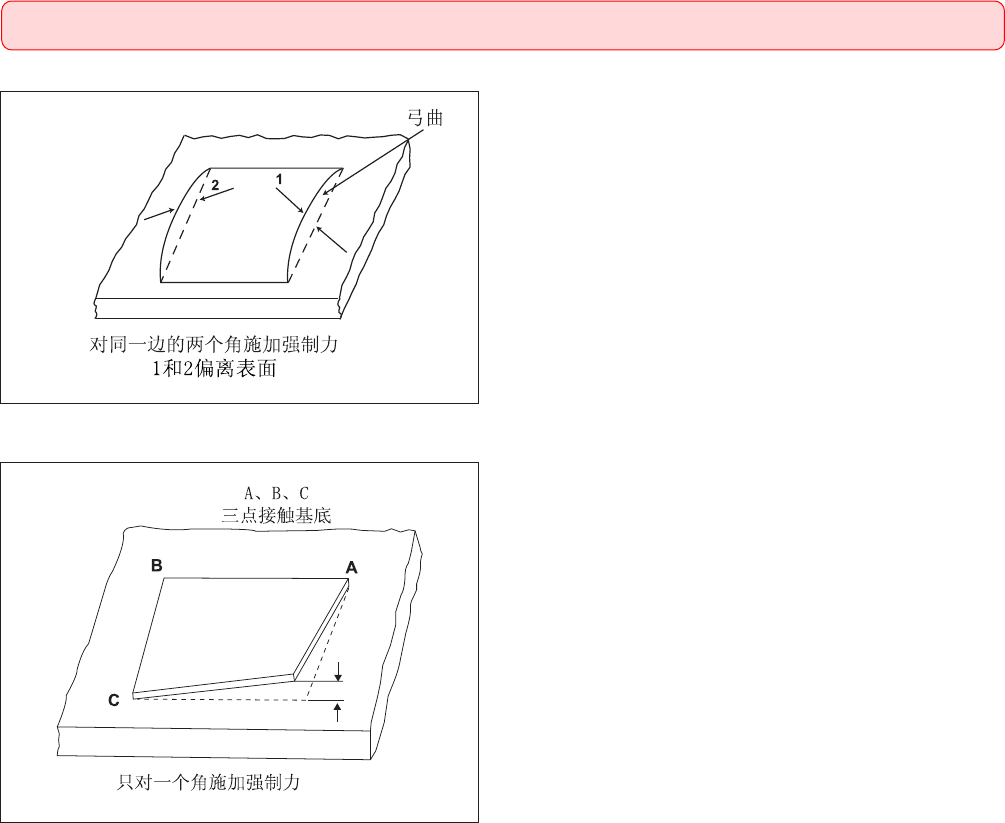
• For printed boards using surface mount components, the bow and
twist shall be 0.75% or less.
• For all other printed boards, bow and twist shall be 1.50% or less.
• 对于采用表面贴装元器件的印制板,弓曲和扭曲应当小于等
于0.75%。
• 对于所有其它印制板,弓曲和扭曲应当小于等于1.50%。
Nonconforming - Class 1,2,3(不符合条件 - 1,2,3级)
• Defects either do not meet or exceed above criteria.
• 缺陷不符合或超出上述要求。
图211a
图211b
x
x
x
x
2.11 Flatness(平整度)
2.11 Flatness (cont.)(平整度(续))
74 IPC-A-600H-20102010年4月

The purpose of this section is to provide acceptability requirements for those characteristics which are internal to the printed board. These
include the following characteristics in the base material, PTHs, internal conductive copper pattern, treatments to the internal copper, and
internal ground/power/thermal planes, as described below:
• Subsurface imperfections in printed board material, such as delamination, blistering, and foreign inclusions.
• Subsurface imperfections to multilayer printed boards, such as voids, delamination, blistering, cracks, ground plane clearance and layer to
layer spacing.
• PTH anomalies, including size, annular ring, nailheading, plating thickness, plating voids, nodules, cracks, resin smear, inadequate or
excessive etchback, wicking, inner layer (post) separation, and solder mask thickness.
• Internal conductor anomalies, such as over or under etch, conductor cracks and voids, uneven or inadequate oxide treatment, and foil thick-
ness.
• Visual observations made on cross-sections only.
本章的目的是为印制板各种内部特性提供可接受性要求。这些内部特性包括在基材、镀覆孔、内层铜导电图形、内层铜箔的处理、
内部接地层/电源层/散热层内的特性,如下:
• 印制板材料表面下的瑕疵,如分层、起泡和外来夹杂物。
• 多层印制板表面下的瑕疵,例如空洞、分层、起泡、裂纹、接地层的余隙和层间的间距。
• 镀覆孔的异常,包括孔的尺寸、环宽、钉头、镀层厚度、镀层空洞、结瘤、裂缝、树脂钻污、凹蚀不足或过蚀、芯吸、内层与
孔壁分离及阻焊膜厚度等。
• 内层导体的异常,例如蚀刻过度或不足、导体裂缝及空洞、氧化处理不均匀或不充分,以及铜箔厚度等。
• 仅对显微切片进行目检观察。
3
INTERNALLY OBSERVABLE CHARACTERISTICS(内部可观察特性)
Introduction(引⾔)
75IPC-A-600H-2010 2010年4月
This section covers the acceptability requirements of dielectric materials. Dielectric materials are evaluated after thermal stress. Requirements
for evaluations made in the as received condition should be stated on the procurement documentation.
本节涵盖了介质材料的可接受性要求。在热应力测试后对介质材料进行评定。应该在采购文件中规定接收态下的评定要求。
3.1.1 Laminate Voids/Cracks (Outside Thermal Zone)(层压板空洞/裂缝(受热区外))
Target Condition - Class 1,2,3(⽬标条件 - 1,2,3级)
• Uniform and homogeneous laminate.
• 层压板均匀一致。
图311a
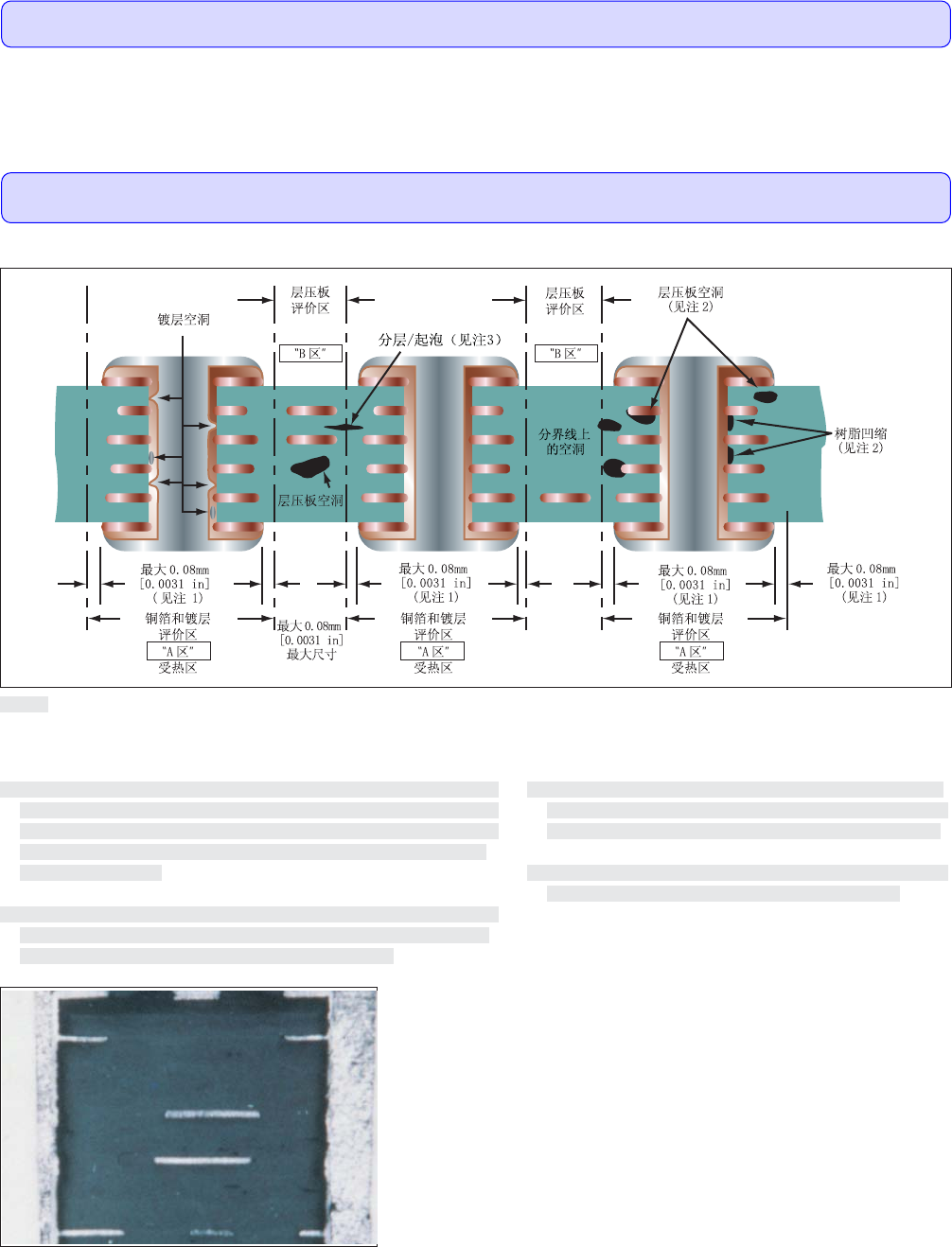
Notes:
1. The thermal zone extends 0.08 mm [0.0031 in] beyond the end of the land,
either internal or external, extending furthest into the laminate area.
2. Laminate anomalies or imperfections that exist entirely in the Zone A area
are not evaluated on specimens which have been exposed to thermal stress
or rework simulation. Boundary line voids/cracks that overlap Zone A and
Zone B as shown in Figure 311e or are entirely in Zone B shall meet the
requirements of 3.1.1.
3. Delamination/Blistering is evaluated in both Zone A and Zone B.
4. Laminate anomalies or imperfections in the non-evaluation areas (at either
end of the microsection specimen) are not evaluated on specimens which
have been exposed to thermal stress or rework simulation.
注:
1. 受热区是指从内层或外层中最靠外的焊盘边缘向层压板延
伸0.08mm[0.0031in]所包含的区域。
2. 经过热应力或模拟返工后,A区内出现的层压板异常或瑕
疵不做评价。如图311e所示,跨连了A区和B区或完全在B
区内的分界线上的空洞/裂缝则应当满足3.1.1节的要求。
3. A区和B区均进行分层/起泡的评定。
4. 经过热应力或模拟返工后,样板上非评价区(显微切片试
样的任一端)出现的层压板异常或瑕疵不做评价。
图311b
3.1 DIELECTRIC MATERIALS(介质材料)
Introduction(引⾔)
76 IPC-A-600H-20102010年4月
Visual observations made on cross-sections only.(仅对显微切片进行目检观察。)