IPC-A-600H-2010 中文版 印制板的可接受性 (1).pdf - 第29页
Measling: Measling manifests itself in the form of discrete white squares or ‘‘crosses’’ below the surface of the base material, and is usu- ally related to thermally induced stress. Measles are subsurface phenomena that…
This presentation was then given to the assembly standards groups
for their consideration. The request was made that the requirements
in the bare printed board and assembly documents be changed to
track with each other.
The leadership of the assembly standards groups concurred that the
industry now had test data that addressed their original concerns
regarding the potential of measles to promote CAF failures. They
also agreed that the documents should be amended to eliminate the
conflicting measles requirements. The groups jointly drafted the
words, comments, and instructions for all documents regarding
measles and these were presented to the committee membership at
the 2007 IPC Midwest Conference. Copies of the test protocol sum-
mary are available through the IPC.
第三届IPC蓝带委员会关于⽩斑的概述
2004年,由于内部导电阳极丝(CAF)生长造成的印制板基
材质量退化问题在IPC印制板组装标准工作组(包括7-31b
IPC-A-610和5-22a国家焊接标准任务工作组)中成为了讨论
的焦点。据观察,电路密度、运行速度、通带、工作电压的
降低在有利于结晶或CAF生长的条件下均对电路的运行有影
响。
随着电流设计中细线条导体的增加和导体间距的减少,组装
标准工作组 对印制板基材中白斑的作用提出了疑问,认为
其是CAF生长的潜在催化剂。
多年来,IPC电子生产的标准中均未涵盖对印制板和/或组装
板中白斑现象的限制。从理论上讲,白斑可能在导体之间连
续呈现,也可能存在于整块印制板。大家注意到了这种允许
规定是基于30年前在当时电路设计上的研究。大家认识到有
需要针对当今的生产设计和产品环境重新考虑白斑的要求.
在此期间,为了引起对这一潜在问题的关注,IPC对组装文件
作了变更,变更涵盖了对3级组装件中白斑外观的合格/不合
格(缺陷)的准则。
除了考虑采用IPC-6012中3A级(军用和航空)要求,否则在
组装文件中建立的关于白斑的新准则比印制板文件中规定的
要求更严格。IPC-6012中3A级不允许在这些行业领域的裸板
上出现白斑,但是,按照6012生产的3级印制板出现白斑时,
如用于组装3级产品,通常是不可接受的。这一要求的矛盾引
起了IPC技术活动执行委员会(TAEC)的关注,在该委员会
的指导下,两个工作组一起努力找到了解决方案,根据测试
数据,使文件中的验收准则达到一致。
在印制板标准委 员 会 的 领导下,成立了新的白斑蓝带委员
会。该委员会设计并进行了实验以确定白斑是否是实际整机产
品中CAF失 效的原因。该实验程序于2006年后期完成,并于
IPC
2007
印制板展览会/APEX期间提交给印制板委员会。其
测试的总结性证据说明白斑不是CAF生长的起因,也不是出现
CAF的整机产品中CAF失效的促成原因。
该报告后期已提交给组装标准工作组,提请他们考虑更改组
装文件,以使裸印制板文件和组装文件的要求互相一致。
组装标准工作组的领导一致同意,提出现在行业中已有测试
数据解决了他们对潜在白斑引发CAF失效的最初顾虑。委员
会同时 同 意对文件进行修订从而排除对白斑要求的矛盾之
处。工作组联合起草了所有文件中关于白斑的文字、意见和
建议,并于2007年IPC中西部会议期间提交给委员会成员。该
测试程序总结可通过IPC获得。
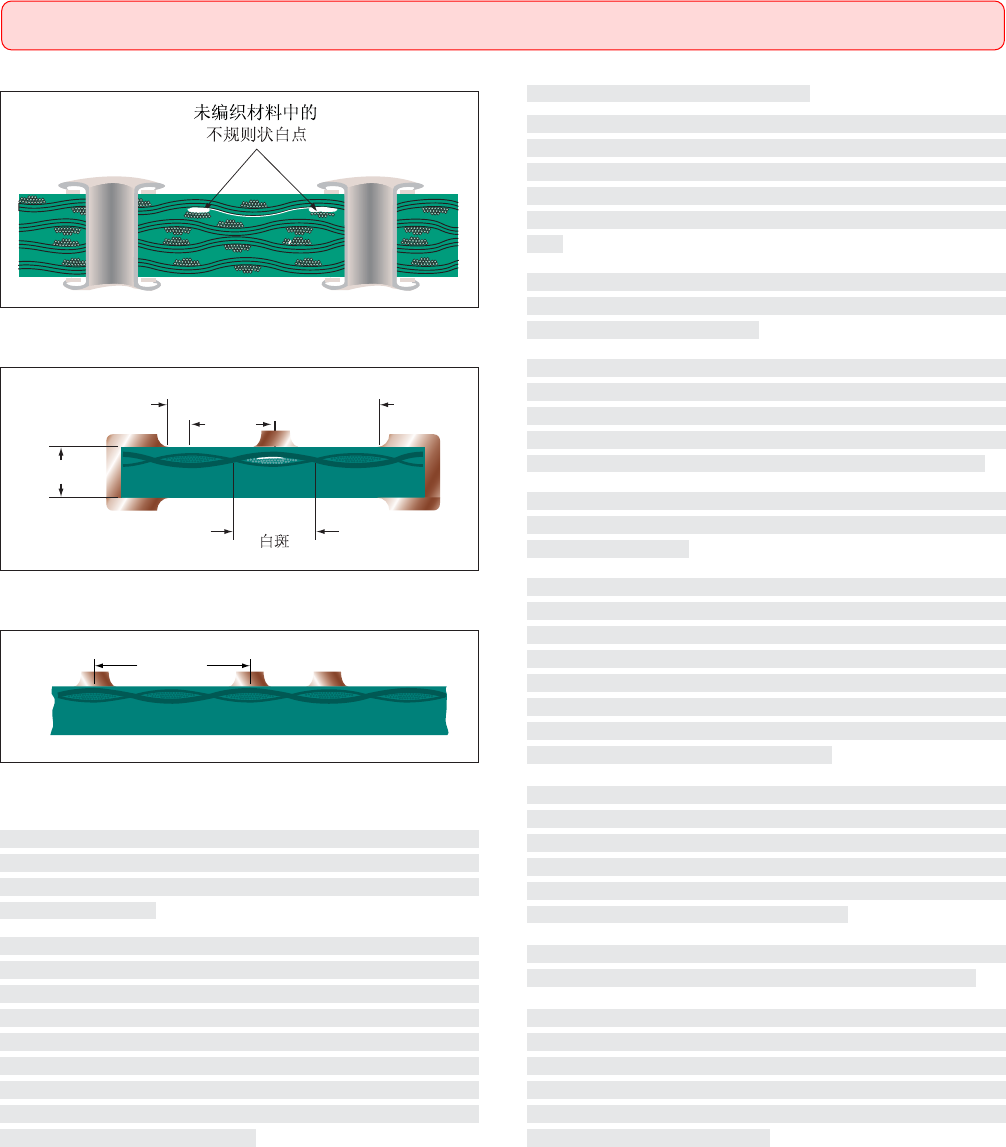
图23b ⽩斑跨接了导电图形的案例
注:此图仅⽤作说明状况,并不要求做显微剖切评价。
0.35 mm
[0.0138 in]
0.25 mm
[0.00984 in]
0.40 mm
[0.0157 in]
1.00 mm
[0.040 in]
图23c 两个表⾯导体之间潜在失效机理的案例
注:此图仅⽤作说明状况,并不要求做显微剖切评价。
0.80 mm
[0.031 in]
+-+
图23a 微裂纹案例
注:此图仅⽤作说明状况,并不要求做显微剖切评价。
2.3 BASE MATERIAL SUBSURFACE(基材表⾯下)
Introduction (cont.)(引⾔(续))
20 IPC-A-600H-20102010年4月
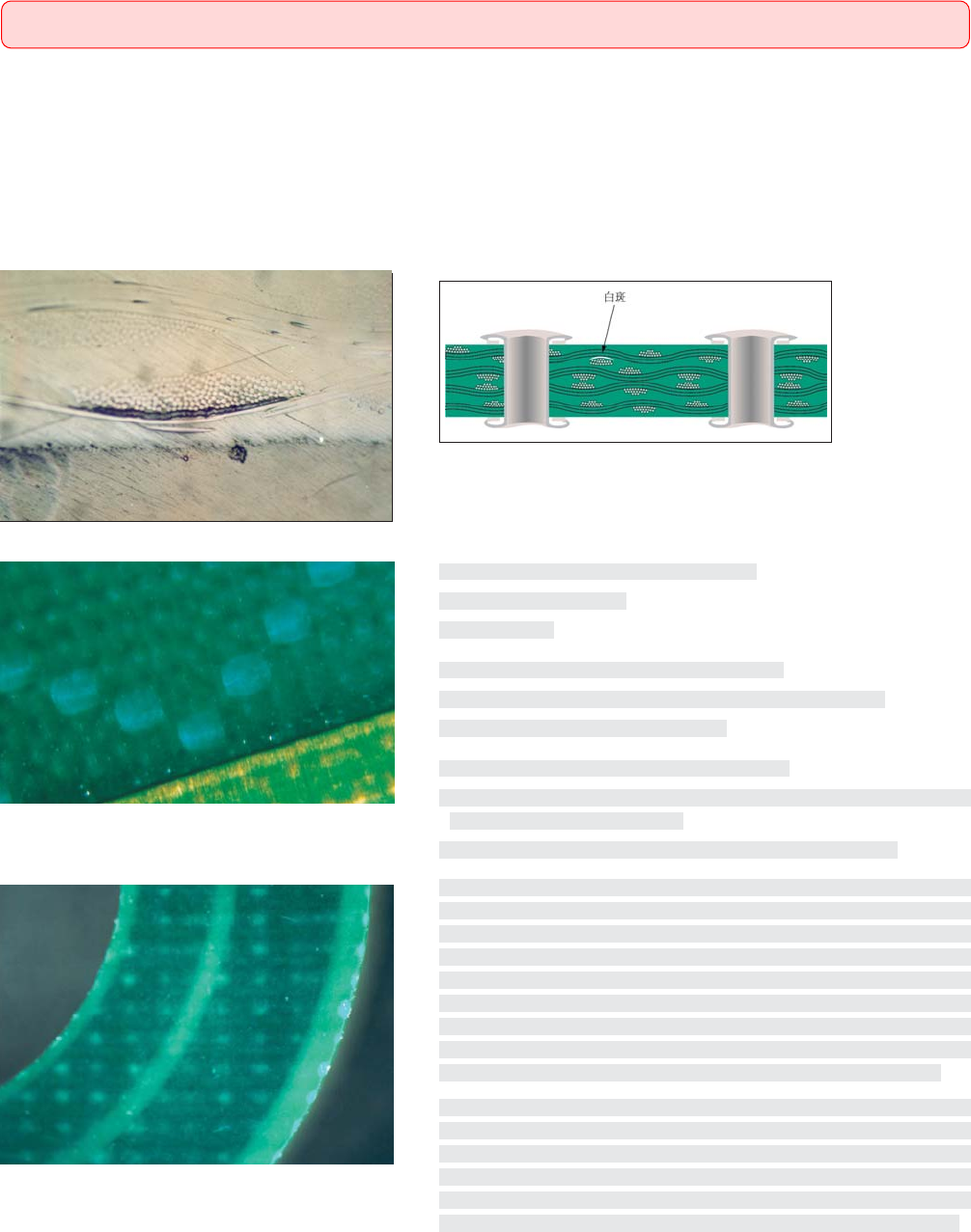
Measling: Measling manifests itself in the form of discrete white squares or ‘‘crosses’’ below the surface of the base material, and is usu-
ally related to thermally induced stress. Measles are subsurface phenomena that have been found in new laminated materials and in every
board type made from woven fiber reinforced laminates at one time or another. Since measles are strictly subsurface phenomena and occur
as a separation of fiber bundles at fiber bundle intersections, their apparent positions relative to surface conductors have no significance.
⽩斑:白斑表现为基材表面下不连续的白色方块或“十字”纹,其形成通常与热应力有关。白斑是一种基材表面下现象,在新层
压基材上和织物增强层压板制成的各种板上都时有发生。由于白斑绝对出现在表面下并且是在纤维束交叉处发生分离而出现,因
此,其出现的位置相对于表面导体毫无意义。
Target - Class 1,2,3(⽬标条件 - 1,2,3级)
• No evidence of measling.
• 无白斑迹象。
Acceptable - Class 1,2(可接受条件 - 1,2级)
• The criteria for measling is that the printed board is functional.
• 对白斑的准则是印制板仍具有功能。
Process Indicator - Class 3(制程警⽰ - 3级)
• Measled areas in laminate substrates exceed 50% of the physical spacing
between noncommon conductors.
• 层压基材中白斑面积超过非公共导体之间实际间距的50%。
Note: Measling is an internal condition which does not propagate as a
result of thermal testing that replicates future assembly processes and has not
been conclusively shown to be a catalyst for CAF growth. Delamination is an
internal condition which may propagate under thermal stress and may be a
catalyst for CAF growth. The IPC-9691 user's guide for CAF resistance test-
ing and IPC-TM-650, Method 2.6.25, provide additional information for
determining laminate performance regarding CAF growth. Users who wish to
incorporate additional criteria for measle conditions may consider incorporat-
ing the provisions of IPC-6012, Class 3A which does not allow measles.
注:白斑是层压板中的一种内部现象,不会由于模拟组装制程的热应力
测试而扩展,同时也无明确结论显示它是阳极导电丝(CAF)生长的诱
因。分层是一种在热应力作用下可能扩展的内部现象,同时也可能是
CAF生长的诱因。关于耐CAF测试,IPC-9691用户指南和IPC-TM-650测
试方法2.6.25均提供了确定层压板 CAF生长性能的其他信息。希望加
入白斑状况其他要求的用户可考虑纳入不允许白斑出现的3A级要求。
Note: Measles are observed from the surface. Cross-sections are for illustration purposes.
注:
白斑可从表面观察。剖面图仅用于图示。
图231b
注:此图仅⽤作说明状况,并不要求做显微剖切评价。
图231d
图231a
图231c
2.3 BASE MATERIAL SUBSURFACE(基材表⾯下)
2.3.1 Measling(⽩斑)
21IPC-A-600H-2010 2010年4月
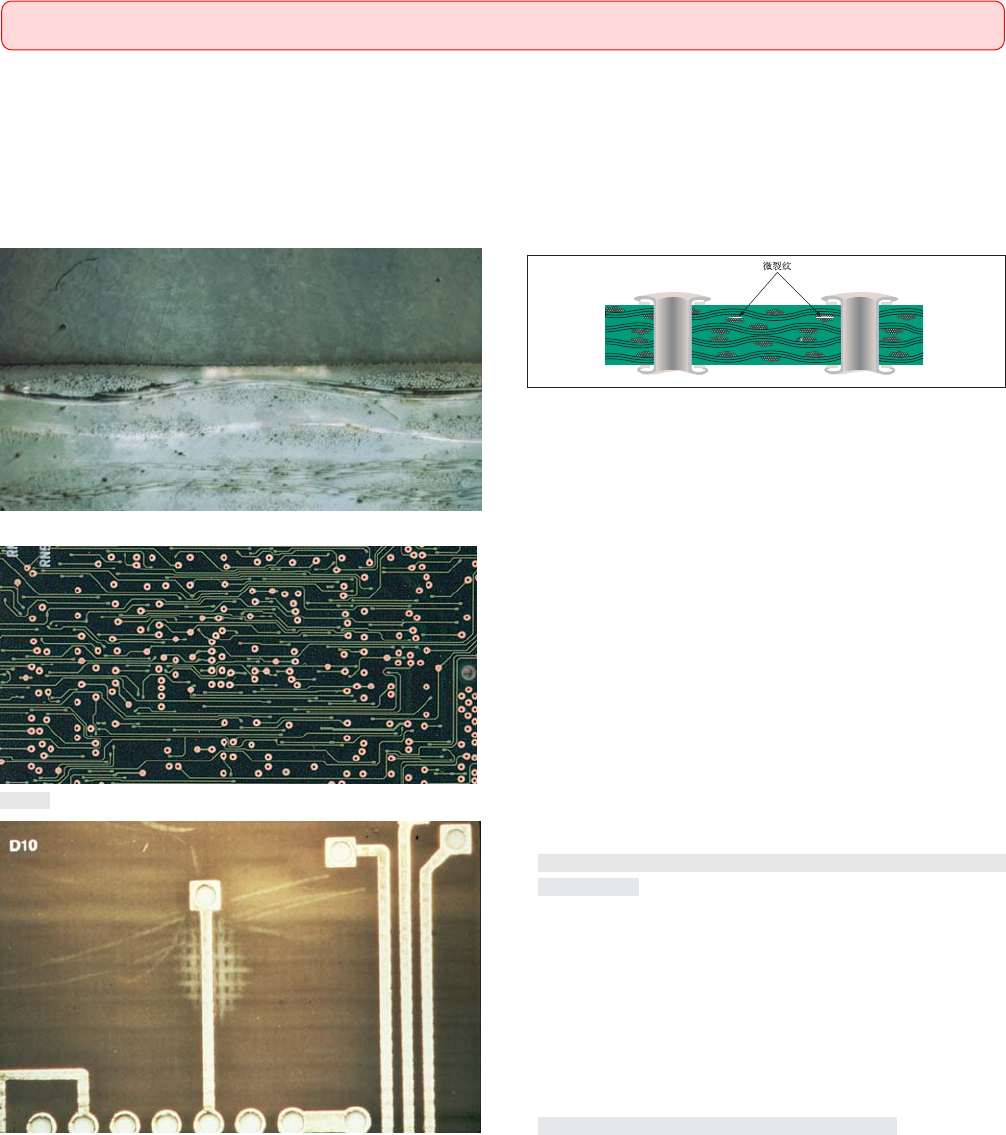
Crazing: An internal condition occurring in the laminated base material in which the fibers within the yarn are separated. This can occur at
the weave intersections or along the length of the yarn. This condition manifests itself in the form of connected white spots or ‘‘crosses’’
below the surface of the base material, and is usually related to mechanically induced stress. When the crosses are connected the condition is
evaluated as follows:
微裂纹:层压基材内纤维发生分离的一种内部状况。微裂纹可在纤维交织处或沿纤维丝长度方向出现。微裂纹状况表现为基材表
面下相连的白点或“十字纹”,通常与机械应力有关。当十字纹相互连接时,微裂纹状况评定如下:
Target Condition - Class 1,2,3(⽬标条件 - 1,2,3级)
• No evidence of crazing.
• 无微裂纹迹象。
Acceptable - Class 2,3(可接受条件 - 2,3级)
• The imperfection does not reduce the conductor spacing below
the minimum.
• The distance of crazing does not span more than 50% of the dis-
tance between adjacent conductive patterns that are not electri-
cally common.
• No propagation as a result of thermal testing that replicates the
manufacturing process.
• Crazing at the edge of the printed board does not reduce the mini-
mum distance between printed board edge and conductive pat-
tern; or more than 2.5 mm [0.0984 in] if not specified.
• 瑕疵未使导体间距减少至低于最小导体间距。
• 微裂 纹 的 跨 距 不大于相邻非电气共接导电图形之间距离的
50%。
• 没有因为模拟制造过程的热测试而扩大。
• 印制板边的微裂纹未减少板边与导电图形间的最小距离,若
未规定最小距离时,则微裂纹不大于2.5mm[0.0984in]。
Note: Crazing is observed from the surface. Cross-sections are for illustration purposes only.
注:
微裂纹可从表面观察。剖面图仅用于图示。
图232b
注:此图仅⽤作说明状况,并不要求做显微剖切评价。
图232d
图232a
图232c
2.3 BASE MATERIAL SUBSURFACE(基材表⾯下)
2.3.2 Crazing(微裂纹)
22 IPC-A-600H-20102010年4月