IPC-A-600H-2010 中文版 印制板的可接受性 (1).pdf - 第80页
Unsupported Hole: A hole within a printed board that does not contain plating or other type of conductive reinforcement. ⾮⽀撑孔: 印制板中不 包 含 镀层 或其它类 型 导电 增 强材料的 孔 。 T arget Condition - Class 1,2,3 (⽬标条件 - 1,2,3级) • Holes are…
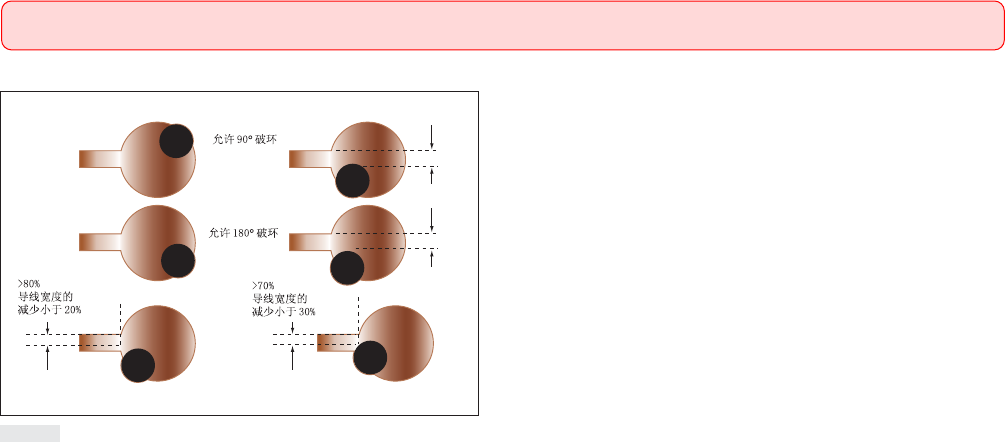
Acceptable - Class 2(可接受条件 - 2级)
• 90° breakout or less (see item A in Figure 2103d).
• If breakout occurs at the conductor to land junction area, the land/
conductor junction is not reduced by more than 20% of the mini-
mum conductor width specified on the engineering drawing or the
production master nominal. The conductor junction should never
be less than 0.050 mm [0.0020 in] or the minimum line width,
whichever is smaller (see item C in Figure 2103d).
• Minimum lateral spacing is maintained.
• 破环小于或等于90°(见图2103d中的A项)。
• 如破环发生在焊盘与导体的连接区,则导体宽度的减少不大
于工程图纸或生产底版中标称的最小导体宽度的20%。导体
连接处绝不应该小于0.050mm[0.0020in],或不应该小于最小
线宽,取两者中的较小者(见图2103d中的C项)。
• 满足导体之间最小侧向间距要求。
Acceptable - Class 1(可接受条件 - 1级)
• 180° breakout or less (see item B in Figure 2103d).
• If breakout occurs at the conductor to land junction area, the con-
ductor is not reduced by more than 30% of the minimum conduc-
tor width specified on the production master nominal (see item D
in Figure 2103d).
• Form, fit and function are not affected.
• Minimum lateral spacing is maintained.
• 破环小于等于180°(见图2103d中的B项)。
• 如破环发生在焊盘与导体的连接区,导体宽度的减少不大于
生产底版中标称的最小导体宽度的30%。(见图2103d中的D
项)
• 外形、安装和功能未受影响。
• 满足导体之间最小侧向间距要求。
Nonconforming - Class 1,2,3(不符合条件 - 1,2,3级)
• Defects either do not meet or exceed above criteria.
• 缺陷不符合或超出上述要求。
图2103d
A
B
A
B
C
D
2.10 PATTERN DEFINITION – DIMENSIONAL(图形精确度 – 尺⼨要求)
2.10.3 External Annular Ring – Supported Holes (cont.)(⽀撑孔的外层环宽(续))
71IPC-A-600H-2010 2010年4月
Unsupported Hole: A hole within a printed board that does not contain plating or other type of conductive reinforcement.
⾮⽀撑孔:印制板中不包含镀层或其它类型导电增强材料的孔。
Target Condition - Class 1,2,3(⽬标条件 - 1,2,3级)
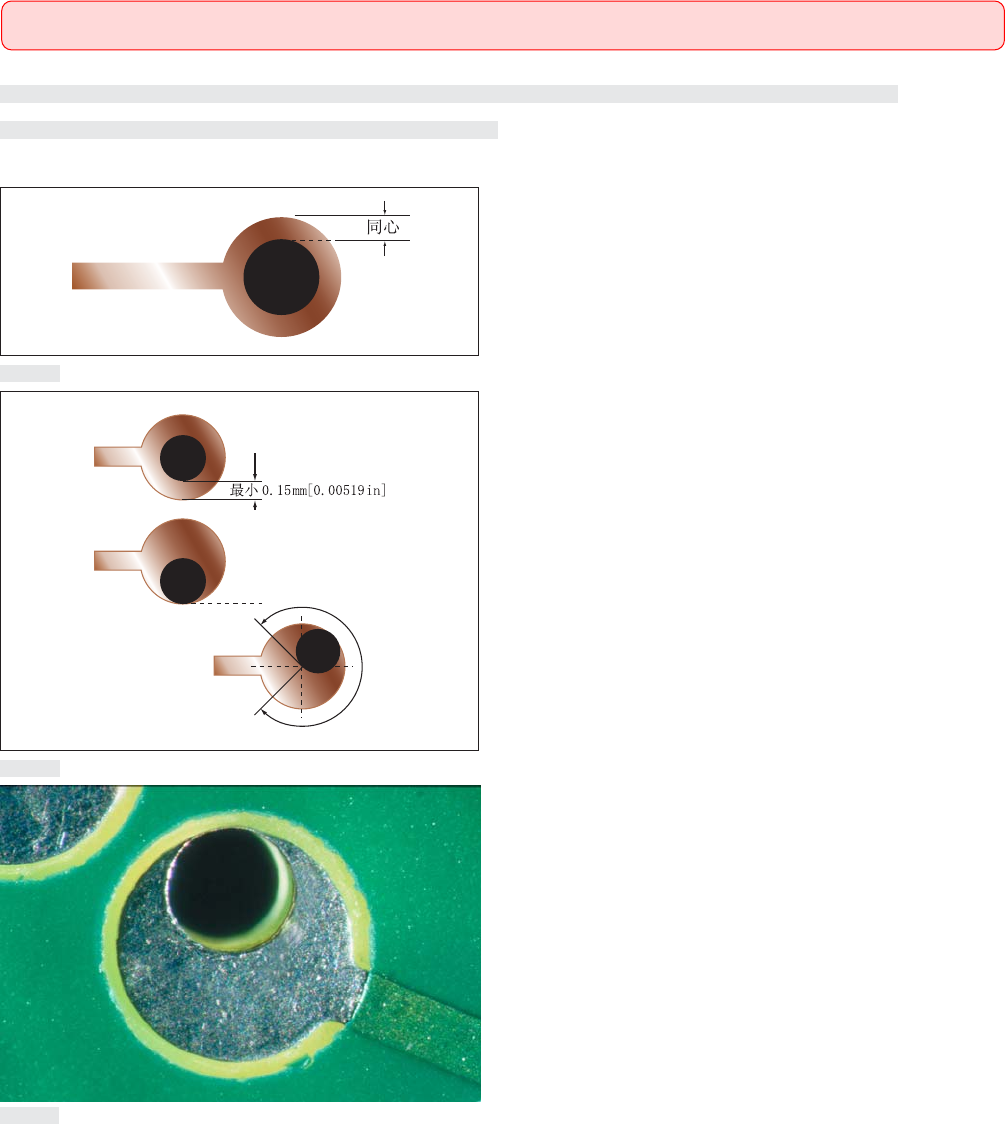
• Holes are centered in the lands.
• 孔位于焊盘中心。
Acceptable - Class 3(可接受条件 - 3级)
• Annular ring measures 0.15 mm [0.00591 in] or more in any
direction. (See item A in Figure 2104b) The minimum external
annular ring may have a 20% reduction of the minimum annular
ring at the measurement area due to defects such as pits, dents,
nicks, pinholes or splay.
• 任 意方向 的 环宽均不小于0.15mm[0.00591in](见图2104b
中的A项)。测量区域内的最小外层环宽,由于诸如麻点、
凹坑、缺口、针孔或斜孔等缺陷的存在,可以再减少20%。
Acceptable - Class 2(可接受条件 - 2级)
• 90° breakout is allowed. (See item B in Figure 2104b.)
• If breakout occurs at the conductor to land junction area, the con-
ductor is not reduced by more than 20% of the minimum conduc-
tor width specified on the engineering drawing or the production
master nominal.
• 90°破环是允许的(见图2104b中的B项)。
• 如破环发生在焊盘与导体的连接区,导体宽度的减少不大于
工程图纸或生产底版标称最小导体宽度的20%。
Acceptable - Class 1(可接受条件 - 1级)
• 90° breakout is allowed. (See item C in Figure 2104b.)
• If breakout occurs at the conductor to land junction area, the con-
ductor is not reduced by more than 30% of the minimum conduc-
tor width specified on the production master nominal.
• 90°破环是允许的(见图2104b中的C项)。
• 如破环发生在焊盘与导体的连接区,导体宽度的减少不大于
工程图纸或生产底版标称最小导体宽度的30%。
Nonconforming - Class 1,2,3(不符合条件 - 1,2,3级)
• Defects either do not meet or exceed above criteria.
不符合条件 - 1,2,3级
• 缺陷不符合或超出上述要求。
图2104a
图2104b
A
B
C
图2104c
2.10 PATTERN DEFINITION – DIMENSIONAL(图形精确度 – 尺⼨要求)
2.10.4 External Annular Ring – Unsupported Holes(⾮⽀撑孔的外层环宽)
72 IPC-A-600H-20102010年4月
Flatness of printed boards is determined by two characteristics of the product; these are known as bow and twist. The bow condition is char-
acterized by a roughly cylindrical or spherical curvature of the printed board while its four corners are in the same plane (see Figure 211a).
Twist is the printed board deformation parallel to the diagonal of the printed board such that one corner is not in the same plane to the other
three (see Figure 211b). Circular or elliptical printed boards must be evaluated at the highest point of vertical displacement. Bow and twist
may be influenced by the printed board design as different circuit configurations or layer construction of multilayer printed boards can result
in different stress or stress relief conditions. Printed board thickness and material properties are other factors that influence the resulting
printed board flatness.
Bow and Twist Bow, twist, or any combination thereof, shall be determined by physical measurement and percentage calculation in
accordance with IPC-TM-650, Method 2.4.22. End products shall be assessed in the delivered form.
印制板的平整度是由产品的两种特性来确定的:即弓曲和扭曲。弓曲的状况通过把印制板的四个角处在同一平面上,大致成圆柱
形或球面弯曲进行确定;而扭曲是板的变形平行于板的对角线,板的一个角不与其它三个角在同一平面上。(见图211b)圆形或
椭圆形的印制板必须在最高点作垂直位移的评定。弓曲和扭曲可能会受印制板设计的影响,因为不同的布线或多层印制板的层结
构可能导致产生不同的应力或应力消除的状况。印制板的厚度及材料性能是影响印制板平整度的其他因素。
⼸曲及扭曲 弓曲、扭曲或其组合应当按IPC-TM-650测试方法2.4.22中的物理测量方法进行测量并计算百分比。成品板应当按照
接收态的形态进行评估。
2.11 Flatness(平整度)
2.11 Flatness(平整度)
73IPC-A-600H-2010 2010年4月