LCX_UserManual_en_08_1.pdf - 第119页
General instrument functions R&S ® LCX Series 1 19 User Manual 1 179.2260.02 ─ 08 9 General instrument functions The general instrument settings include basic instrument functions, regardless of the selected operatin…
Instrument functions
R&S
®
LCX Series
118User Manual 1179.2260.02 ─ 08
Executing a binning measurement
A binning measurement requires that you configure the test signal and all settings nec-
essary for your measurement before. You cannot change a parameter while the mea-
surement is running.
In addition, you need a trigger event that you can initiate manually with the [Trig.] key
at the front, or by a trigger signal assigned to the [Trigger Input] connector at the back.
This example assumes that you have set up the measurement and aligned the instru-
ment, see e.g., "Basic measurement steps" on page 34 and Section 7, "Performing
measurements", on page 65.
To start the measurement:
1. Create the binning file, see "Configuring a binning file" on page 116.
2. Load the binning file according to "Loading the binning file" on page 117.
3.
To activate the binning function, turn
"Enable".
4. Press the [home] key.
The R&S LCX switches to measurement mode "triggered" automatically. The
[Meas. Mode] key lights up.
5. Connect a sample component to the terminals of the test fixture.
6. Start the first measurement with a trigger signal, e.g., press the [Trig.] key.
7. Wait until the measurement is complete.
When completed, and you have enabled the end of the measurement control sig-
nal, the R&S LCX highlights the EOM bin.
8. Remove the sample component.
9. Repeat step 5 to step 8 until you have measured all components.
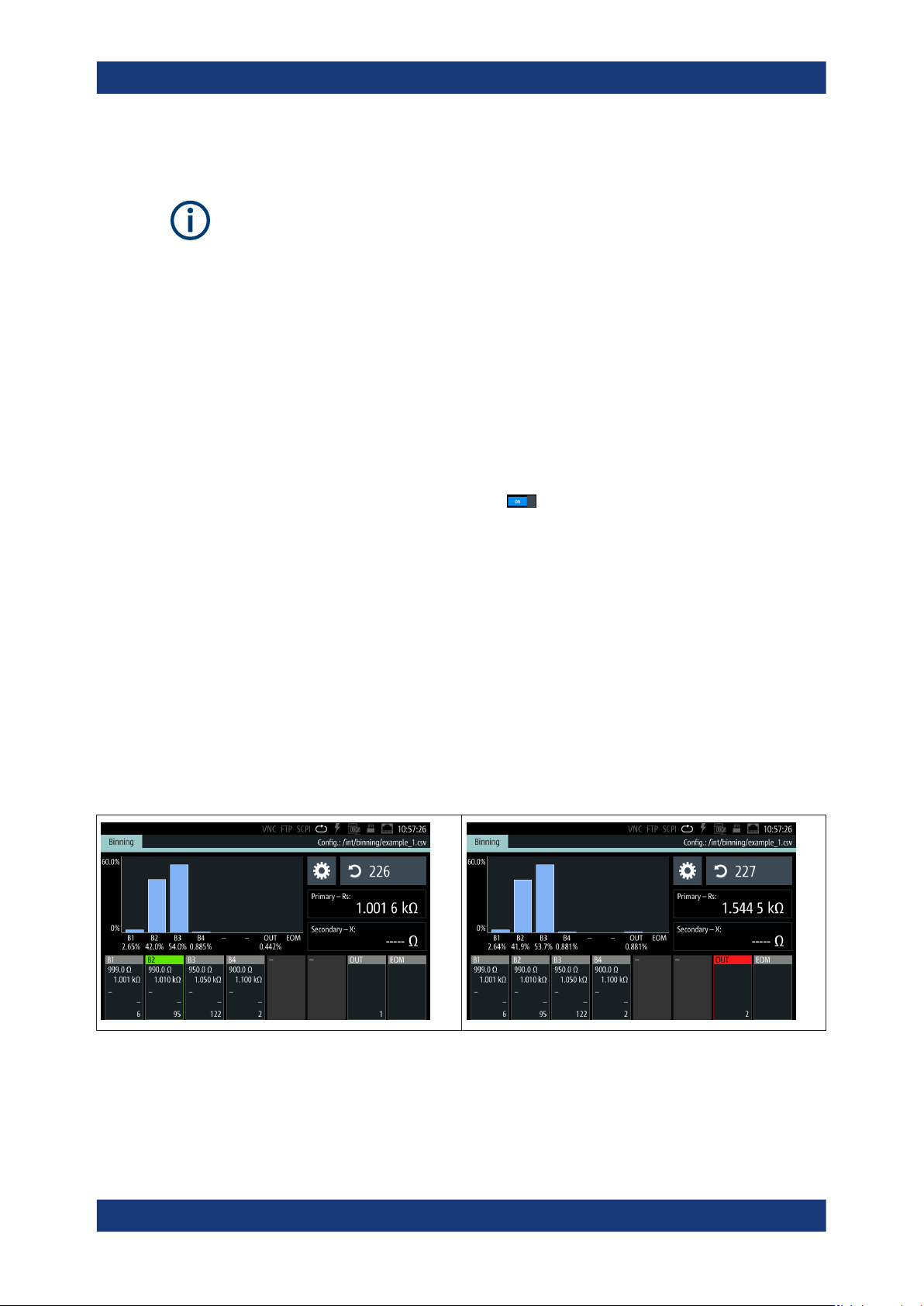
According to the reading, the R&S LCX sorts a component into the corresponding
bin and highlights it. In addition, it indicates the summed number of components
sorted into it, and displays the distribution graphically in the histogram.
Specific instrument functions
General instrument functions
R&S
®
LCX Series
119User Manual 1179.2260.02 ─ 08
9 General instrument functions
The general instrument settings include basic instrument functions, regardless of the
selected operating mode and measurement. Some of these settings like screen display
and peripherals are initially configured at the setup of the instrument, according to per-
sonal preferences and requirements. However, you can individually adjust the settings
at any time, for example, for specific applications.
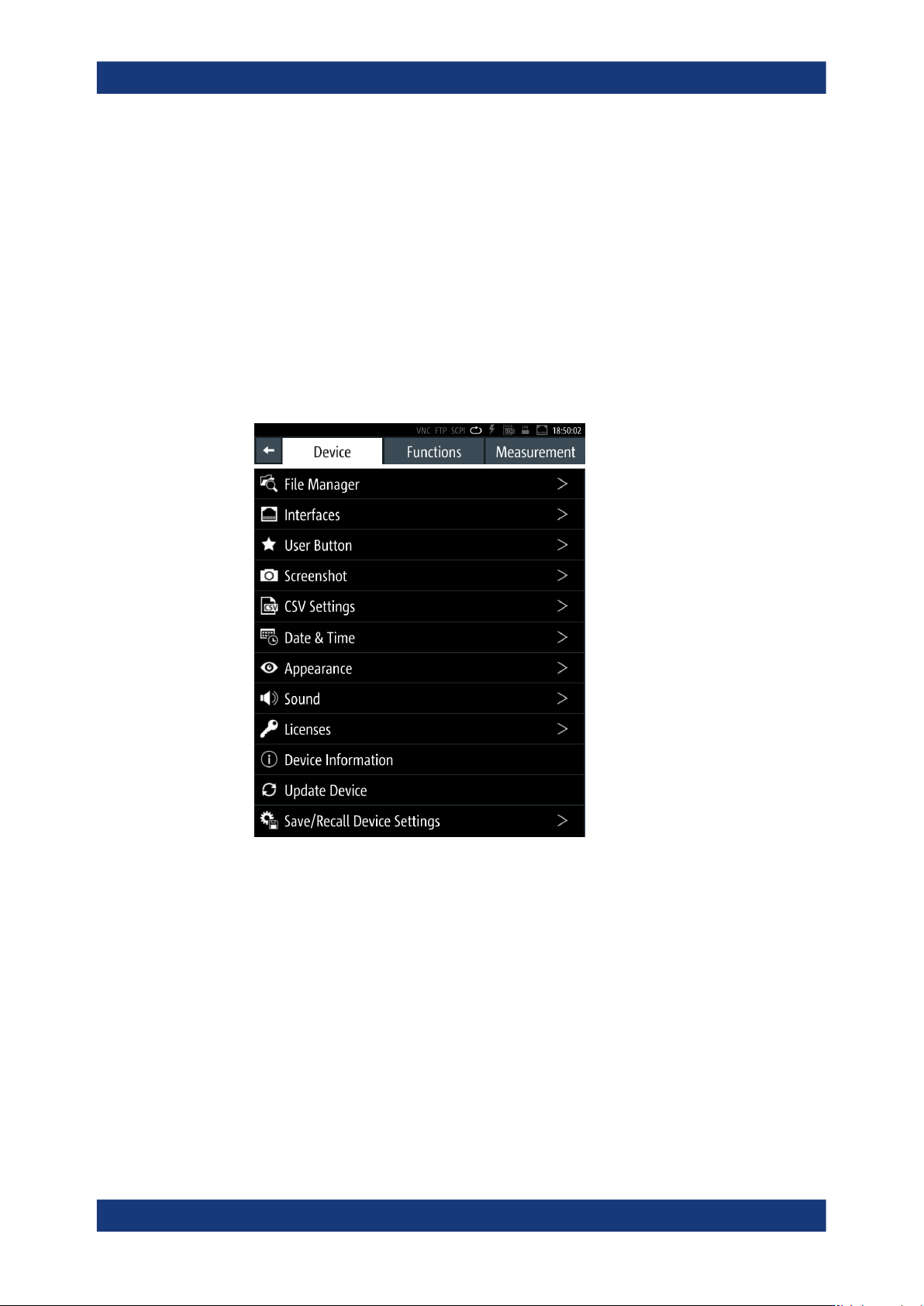
Access:
1. Press the [settings] key at the front panel.
2. Select the "Device" tab.
Figure 9-1: Device menu
3. Select the corresponding setting in the list.
The required remote commands are described in Section 11.18, "SYSTem subsystem",
on page 231.
● File and data management................................................................................... 120
● Interfaces.............................................................................................................. 125
● User button............................................................................................................127
● Screenshot............................................................................................................128
● CSV settings......................................................................................................... 131
● Date & time........................................................................................................... 132
● Appearance...........................................................................................................133
● Sound....................................................................................................................134

General instrument functions
R&S
®
LCX Series
120User Manual 1179.2260.02 ─ 08
● Licenses................................................................................................................135
● Device information................................................................................................ 138
● Update device....................................................................................................... 140
● Save/recall............................................................................................................ 142
● Customizing general instrument settings.............................................................. 146
9.1 File and data management
9.1.1 Accessing, retrieving and handling data
Depending on the origin and content, this description distinguishes between the follow-
ing data types:
●
Operational data
●
Non-operational data
Operational data (data for intended use)
Your instrument uses and creates this data because of its intended use and according
to the settings and configuration you have made. Thus, this data makes up most of the
data that the R&S LCX creates, such as user files that contain user-defined configura-
tions or data, like instrument settings or measurement data. See also "Types of data
files" on page 121.
The R&S LCX saves this data in the configuration file, see Section 9.12, "Save/recall",
on page 142.
You can access, retrieve and delete user files, see Section 9.1.4, "Using the file man-
ager", on page 123.
Non-operational data (usage data)
The R&S LCX generates this data during and through its use. Such data is collected,
e.g., for troubleshooting and to help our customer support center find solutions quickly.
The R&S LCX generates this data continuously and in real-time; this data is saved on
the product. The product is not capable of storing this data on a remote server.
The R&S LCX generates the following data:
●
Environmental conditions
●
Hardware component metadata
On demand, this data is stored in a ZIP file containing files in TXT format. The volume
of the non-operational data depends on the usage of the product and typically amounts
to about 1 kbyte.
You can access and retrieve this data, see Section 9.10.2, "Using the dump file func-
tion", on page 139.
File and data management