LCX_UserManual_en_08_1.pdf - 第122页
General instrument functions R&S ® LCX Series 122 User Manual 1 179.2260.02 ─ 08 Filenames The R&S LCX assigns generic filenames to internally created files, composed of an identification of the function, if appl…

General instrument functions
R&S
®
LCX Series
121User Manual 1179.2260.02 ─ 08
For additional information on the different memory types of your product and on how to
protect sensitive data, see the "Instrument security procedures" document.
9.1.2 About the file system
The R&S LCX uses files to save all instrument data, e.g., instrument configuration and
settings, measurement data or screenshots of the current settings displayed on the
screen. Known from common file explorers, the "File Manager" function enables you to
transfer, copy and delete files from or to the internal and external memory directories,
see Section 9.1.3, "File manager settings", on page 122.
In general, it is distinguished between the file groups system data and user data. Due
to security reasons, system data files and the system directory are not accessible. The
scope of this section is only to files with user data. It provides an overview of the
R&S LCX file system and covers the following topics:
●
"Types of data files" on page 121
●
"File memory location" on page 121
●
"Filenames" on page 122
●
"File extensions" on page 122
●
"File handling" on page 122
●
"File contents" on page 122
Types of data files
Data files include device settings, measurement configurations and records, screen-
shots, hardware and firmware configurations, and various system information.
Depending on the content, user data is roughly categorized in the following data types:
●
Settings: instrument settings of a measurement configuration saved for later reuse,
see Section 9.12, "Save/recall", on page 142.
●
Measurement readings: recorded measurement results saved for evaluation, see
Section 8.8.3, "Logging", on page 101 or Section 8.8.5, "Binning", on page 110.
●
Instrument configuration: firmware, with open source acknowledgment (OSA), and
support files containing information on the installed hard- and software versions for
service purposes, see e.g.,Section 9.11, "Update device", on page 140 and Sec-
tion 9.10, "Device information", on page 138.
File memory location
The R&S LCX saves user files on the internal memory or if connected, on a memory
stick.
You save files in the directory /int/... on the internal memory, or the /USB1A/...
directory on the memory stick. Depending on the data file, the instrument automatically
creates the corresponding subdirectory in the selected memory location.
File and data management

General instrument functions
R&S
®
LCX Series
122User Manual 1179.2260.02 ─ 08
Filenames
The R&S LCX assigns generic filenames to internally created files, composed of an
identification of the function, if applicable, and a time stamp. For user-specific files, you
can assign a dedicated filename. You can compose a filename of any length, with all
characters allowed, i.e. letters, numbers and, with some exceptions, also special char-
acters. The instrument blocks unauthorized characters in the on-screen keyboard auto-
matically.
File extensions
The R&S LCX distinguishes the file extensions according to the specific file content.
The file extensions are predefined, see Section 9.1.5, "Data and file types",
on page 125.
File handling
To access files and the file system of the R&S LCX or to use the general file manage-
ment functions such as copying and moving data, see Section 9.1.3, "File manager
settings", on page 122.
To transfer files from and to the instrument or to exchange files, use one of the follow-
ing alternatives:
●
Connect a memory stick to one of the USB A interfaces. The instrument recognizes
automatically a connected memory stick and assigns the /USB1A/... drive to it.
●
Connect the R&S LCX to a LAN, see Section 10, "Network operation and remote
control", on page 149.
An instrument connected to a LAN supports the standard file transfer method (ftp
protocol) from a remote client. Using the remote file transfer, you can access
operational files, settings, documents, log files and the contents on the USB mem-
ory, see "Remote file access (FTP)" on page 151.
File contents
To keep the file size small and to speed up processing times, the R&S LCX does not
save the entire instrument settings, but rather the settings that differ from the preset
state.
9.1.3 File manager settings
With the "File Manager" functions, you can exchange files between the internal and an
external memory, provided you have connected a USB memory device.
Access:
1. Press the [settings] key at the front panel.
2. In the "Device" tab, select "File Manager".
File and data management
General instrument functions
R&S
®
LCX Series
123User Manual 1179.2260.02 ─ 08
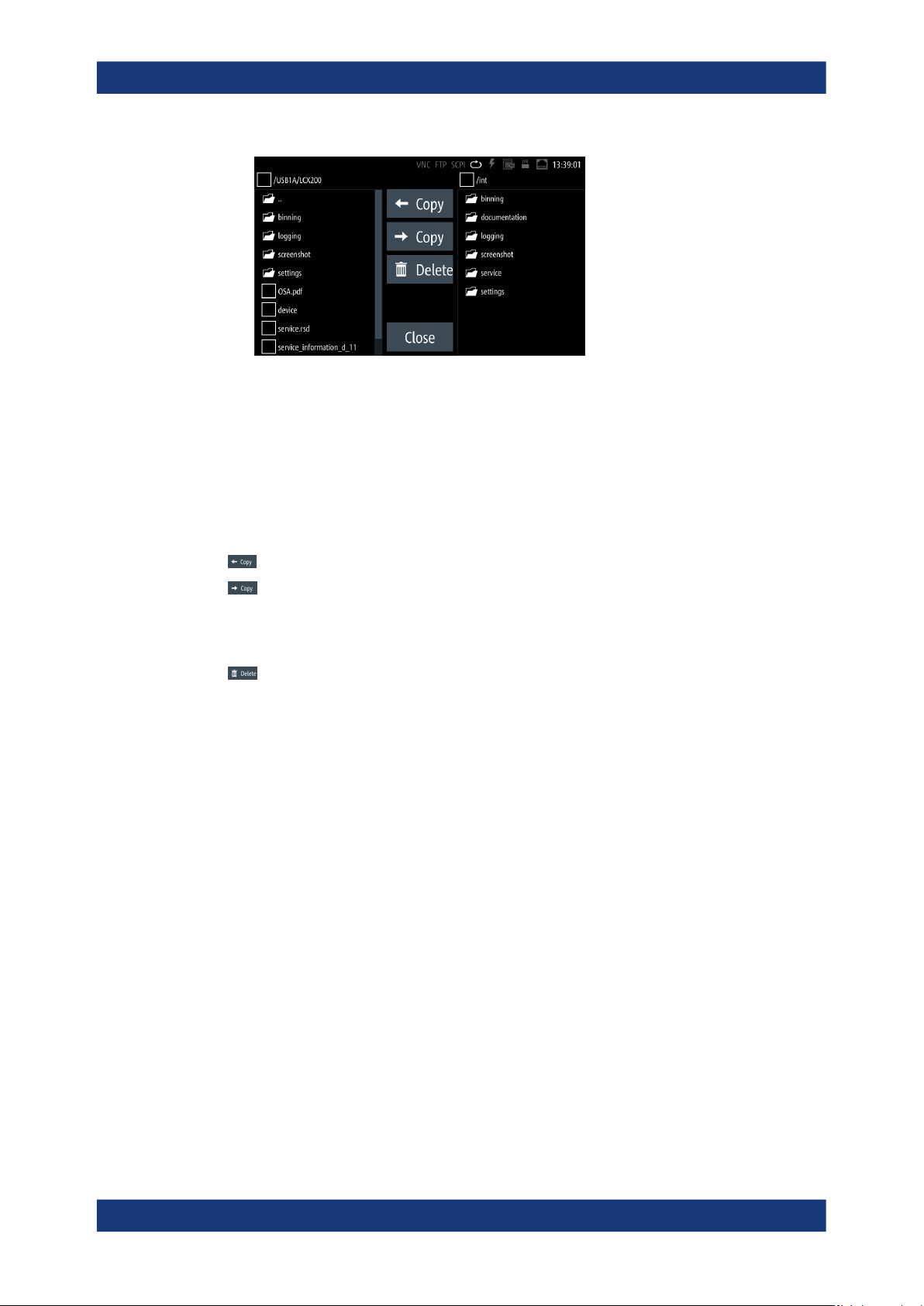
Figure 9-2: File manager dialog
The "File Manager" dialog shows a navigator of the memory directories, and you
can copy or delete files, as known from common file explorers. The functions provi-
ded are self-explanatory in conjunction with the softkeys labeled accordingly.
How to: see Section 9.1.4, "Using the file manager", on page 123.
Copy
Copies selected files to a destination directory.
Copy from internal memory to USB.
Copy from USB to internal memory.
Delete
Removes selected files from the directory.
Deletes the selected file.
Remote command:
DATA:LIST? on page 198
DATA:DELete on page 198
9.1.4 Using the file manager
We assume that the functions provided in the file manager dialog are known. Hence
this section only shows specific functions that are not recognizable at first glance.
Retrieving file information
To view information on the selected file:
1. Select [settings] > "Device" > "File Manager".
2. Select the directory.
3. Tap and hold the file of interest.
The R&S LCX shows the metadata of the selected file.
File and data management