LCX_UserManual_en_08_1.pdf - 第153页
Network operation and remote control R&S ® LCX Series 153 User Manual 1 179.2260.02 ─ 08 composed of the specific IP address of the instrument and some network and VISA- specific keywords. TCPIP::<host address>…
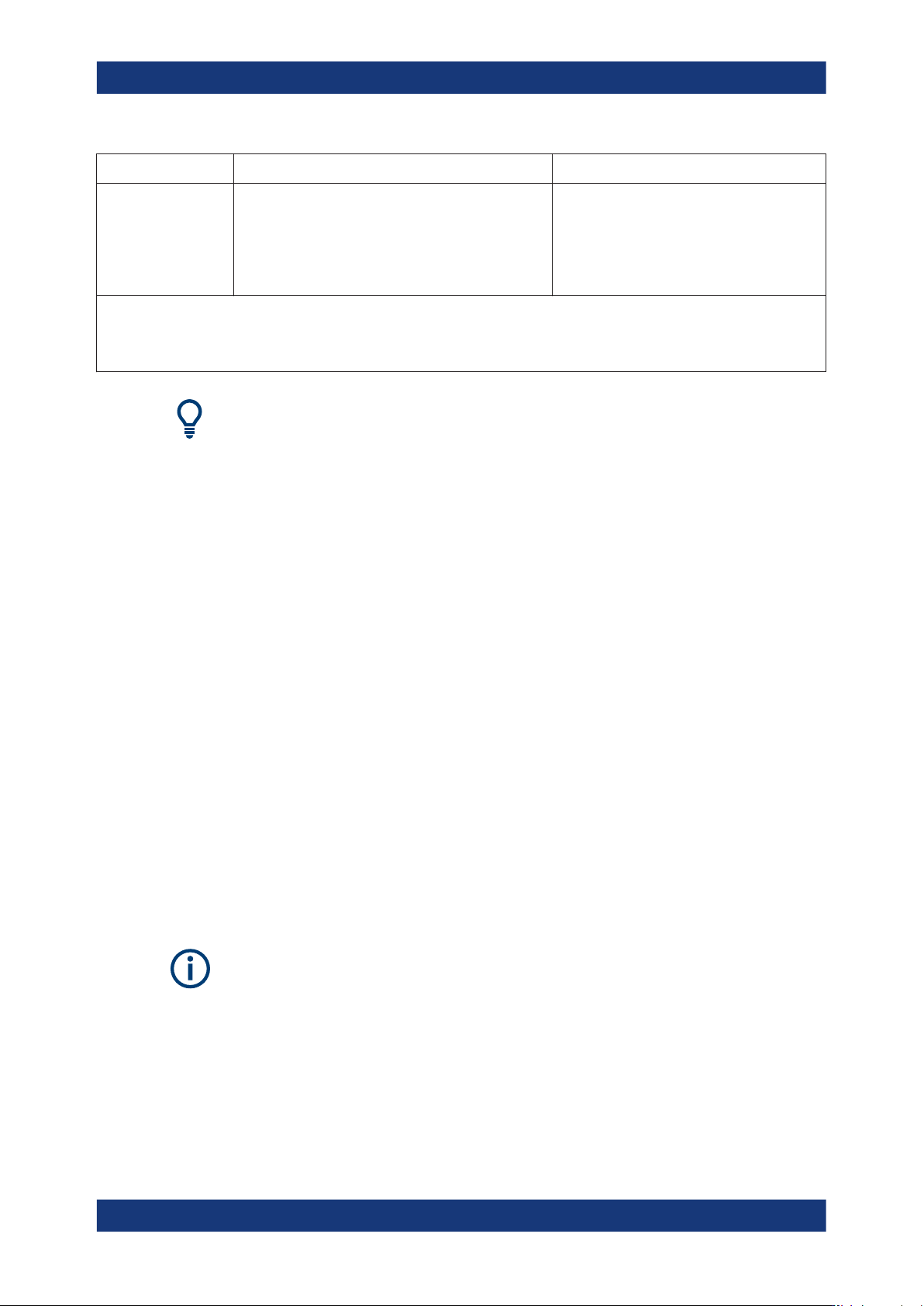
Network operation and remote control
R&S
®
LCX Series
152User Manual 1179.2260.02 ─ 08
Interface
Protocols, VISA
*)
address string and library
Remarks
GPIB (IEC/IEEE Bus
Interface)
(option R&S NG-B105
●
–
GPIB::<address>[::INSTR] (no secondary
address)
VISA (optional)
The optional GPIB bus interface according to
standard IEC 625.1/IEEE 488.1 is at the rear
panel of the instrument.
For a description of the interface, see Sec-
tion 10.2.3, "GPIB interface (IEC/IEEE bus
interface)", on page 155.
*
) VISA (Virtual Instrument Software Architecture) is a standardized software interface library providing input and output functions to
communicate with instruments. A VISA installation on the controller is a prerequisite for remote control over LAN and USB inter-
face. For remote control over socket communication VISA installation is optional. When using socket communication or the GPIB
interface, VISA installation is optional. For basic information, see Remote control via SCPI.
Rohde & Schwarz provides the standardized I/O software library R&S VISA for down-
load at the Rohde & Schwarz website http://www.rohde-schwarz.com/rsvisa.
How to: see Section 10.4, "Connecting the R&S LCX for remote access", on page 167
and Section 10.5, "Adjusting interface addresses", on page 169
● LAN interface........................................................................................................ 152
● USB interface........................................................................................................154
● GPIB interface (IEC/IEEE bus interface)...............................................................155
● Status reporting system........................................................................................ 156
10.2.1 LAN interface
To be integrated in a LAN, the instrument is equipped with a LAN interface, consisting
of a connector, a network interface card and protocols.
The network card can be operated with the following interfaces:
●
10 Mbit/s Ethernet IEEE 802.3
●
100 Mbit/s Ethernet IEEE 802.3u
For remote control, the PC and the instrument must be connected over the LAN inter-
faces to a common network with TCP/IP network protocol. The instruments are con-
nected with a commercial RJ45 cable (shielded or unshielded twisted-pair category 5).
The TCP/IP network protocol and the associated network services are preconfigured
on the instrument. Software for instrument control and (for specified protocols only) the
VISA program library must be installed on the controller.
Identifying instruments in a network
If several instruments are connected to the network, each instrument has its own IP
address and associated resource string. The controller identifies these instruments by
the resource string.
10.2.1.1 VISA resource strings
The VISA resource string is required to establish a communication session between
the controller and the instrument in the LAN. The resource string is a unique identifier,
Remote control interfaces and protocols

Network operation and remote control
R&S
®
LCX Series
153User Manual 1179.2260.02 ─ 08
composed of the specific IP address of the instrument and some network and VISA-
specific keywords.
TCPIP::<host address>[::<LAN device name>][::INSTR]
TCPIP = designates the network protocol
host address = designates the IP address or hostname of the instrument
[::LAN device name] = defines the protocol and the instance number of a subinstrument
[::INSTR] = indicates the instrument resource class (optional)
The IP address (host address/computer name) is used by the programs to identify and
control the instrument. It is automatically assigned by the DHCP server the first time
the device is registered in the network. Optionally, you can also assign its LAN device
name.
The R&S LCX indicates the IP address in the Section 10.3.2, "LAN settings",
on page 161 dialog. You can also adjust the IP address manually, see "Assigning the
LAN interface addresses manually" on page 169.
The following section lists the characteristics of the VISA resource strings for the corre-
sponding interface protocols. The emphasized characters determine the protocol.
For description of the protocols refer to Remote control via SCPI.
VXI-11
TCPIP::<host address>[::inst0][::INSTR]
[::inst0]
= LAN device name that indicates that the VXI-11 protocol is used (optional).
[::inst0] selects the VXI-11 protocol by default and can be omitted.
Example:
TCPIP::192.1.2.3::INSTR
Socket communication
TCPIP::<host address>::<port>::SOCKET
port
= determines the used port number
SOCKET = indicates the raw network socket resource class
Socket communication requires the specification of the port (commonly referred to as
port number) and of "SOCKET" to complete the resource string.
Basically, instruments from Rohde & Schwarz use port number 5025 for socket com-
munication.
Example:
TCPIP::192.1.2.3::5025::SOCKET
Remote control interfaces and protocols

Network operation and remote control
R&S
®
LCX Series
154User Manual 1179.2260.02 ─ 08
To assign a user-specific port number, see Section 10.5, "Adjusting interface
addresses", on page 169.
FTP communication
ftp://<host address>[::<port>]
port = determines the used port number
By default, instruments from Rohde & Schwarz use port number 21 for FTP communi-
cation.
Example:
ftp://192.1.2.3/
To assign a user-specific port number, see "Assigning the FTP port address manually"
on page 171.
VNC communication
vnc://<host address>[::<port>]
port
= determines the used port number
By default, instruments from Rohde & Schwarz use port number 5900 for VNC commu-
nication.
Example:
vnc://192.1.2.3
To assign a user-specific port number, see "Assigning the VNC port manually"
on page 170.
10.2.2 USB interface
For remote control using USB, the PC and the instrument must be connected over the
USB B interface.
The USB B connector is at the rear panel of the instrument.
Software for instrument control and the VISA program library must be installed on the
controller. VISA detects and configures the Rohde & Schwarz instrument automatically
when the USB connection is established. You do not have to install a separate driver.
You can communicate with the instrument over the USB TMC class or the CDC class
protocols:
●
USBTMC
(USB Test & Measurement Class Specification) is a protocol that is built on top of
USB for communication with USB devices, like GPIB. It defines class code informa-
tion of the instrument that identifies its functionality to load the respective device
Remote control interfaces and protocols