80S-2080F480F4-680F5 User’s Manual.pdf - 第633页
11 Station Extensions/Options SIPLACE 80S-20/F4/F4-6/F5 User’s M anual 11.7 Dispenser Flux Application Unit for S IPLACE 80F4/F4-6/F5 Edition 03/98 from S oftware Version SR.404.xx 11 - 36 Fig. 11.7.1 Flux application - …
SIPLACE 80S-20/F4/F4-6/F5 User’s Manual 11 Station Extensions/Options
Edition 03/98 from Software Version SR.404.xx 11.7 Dispenser Flux Application Unit for SIPLACE 80F4/F4-6/F5
11 - 35
11.7 Dispenser Flux Application Unit for SIPLACE 80F
4
/
F
4
-6/F
5
11.7.1 General Comments
If flip-chip components are to be processed properly and reliably, a flux must be applied before the compo-
nent is inserted. This ensures that the soldering process which follows runs smoothly and dependably.
Once the flip-chip component has been picked up by the IC head and positional measurement carried out,
flux is applied to the placement position on the board. The quantity of flux which is to be applied can be spec-
ified for each package form.
Immediately following application of the flux the IC head inserts the flip chip. The IC head holds the flip-chip
component firmly in place on the board for a period of time which can be programmed and which is specific to
the package form. This causes the component to dry onto the flux and thus not be able to ‚float away‘.
Once all flip-chip components have been inserted, a programmable period of waiting follows, after which the
board conveyor is activated and the board transported onwards.
11.7.2 Function
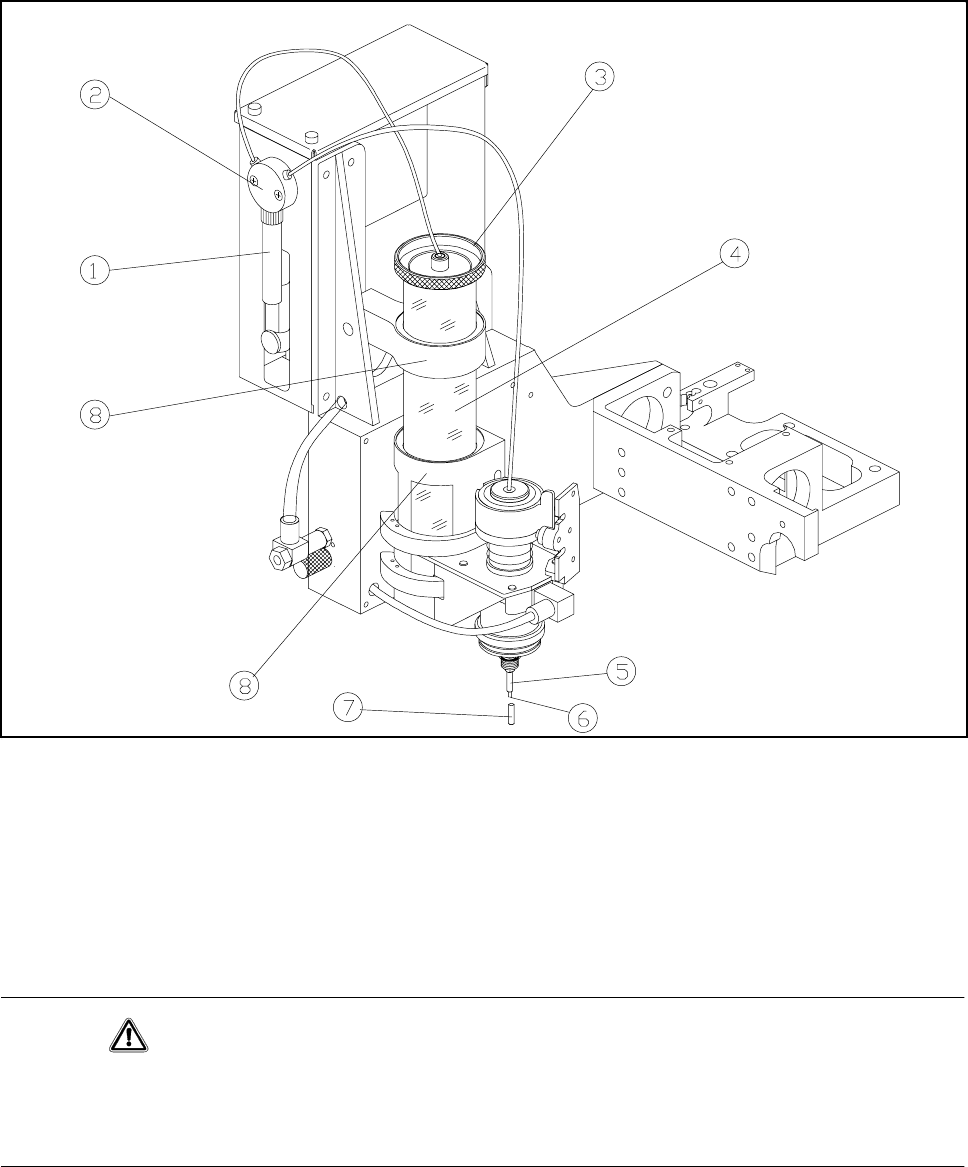
The centrifuge tube is filled with flux and functions as a reservoir. The flux is sucked into the syringe via the
valve by means of a pump. The syringe now dispenses the preset amount of flux onto the placement position
via the valve and the tip of the dispensing needle.
11 Station Extensions/Options SIPLACE 80S-20/F4/F4-6/F5 User’s Manual
11.7 Dispenser Flux Application Unit for SIPLACE 80F4/F4-6/F5 Edition 03/98 from Software Version SR.404.xx
11 - 36
Fig. 11.7.1 Flux application - overview
- Key to Fig. 11.7.1
1 Syringe 2 Valve
3 Reservoir lid 4 Reservoir (centrifuge tube)
5 Centering nozzle 6 Tip of the dispensing needle
7 Cover cap 8 Holder
CAUTION
If you expect the flux application unit to remain out of use for some time (more than approximately 1 hour), the
cover cap must be pulled over the centering nozzle. This prevents the flux crystallizing and clogging the cen-
tering nozzle.
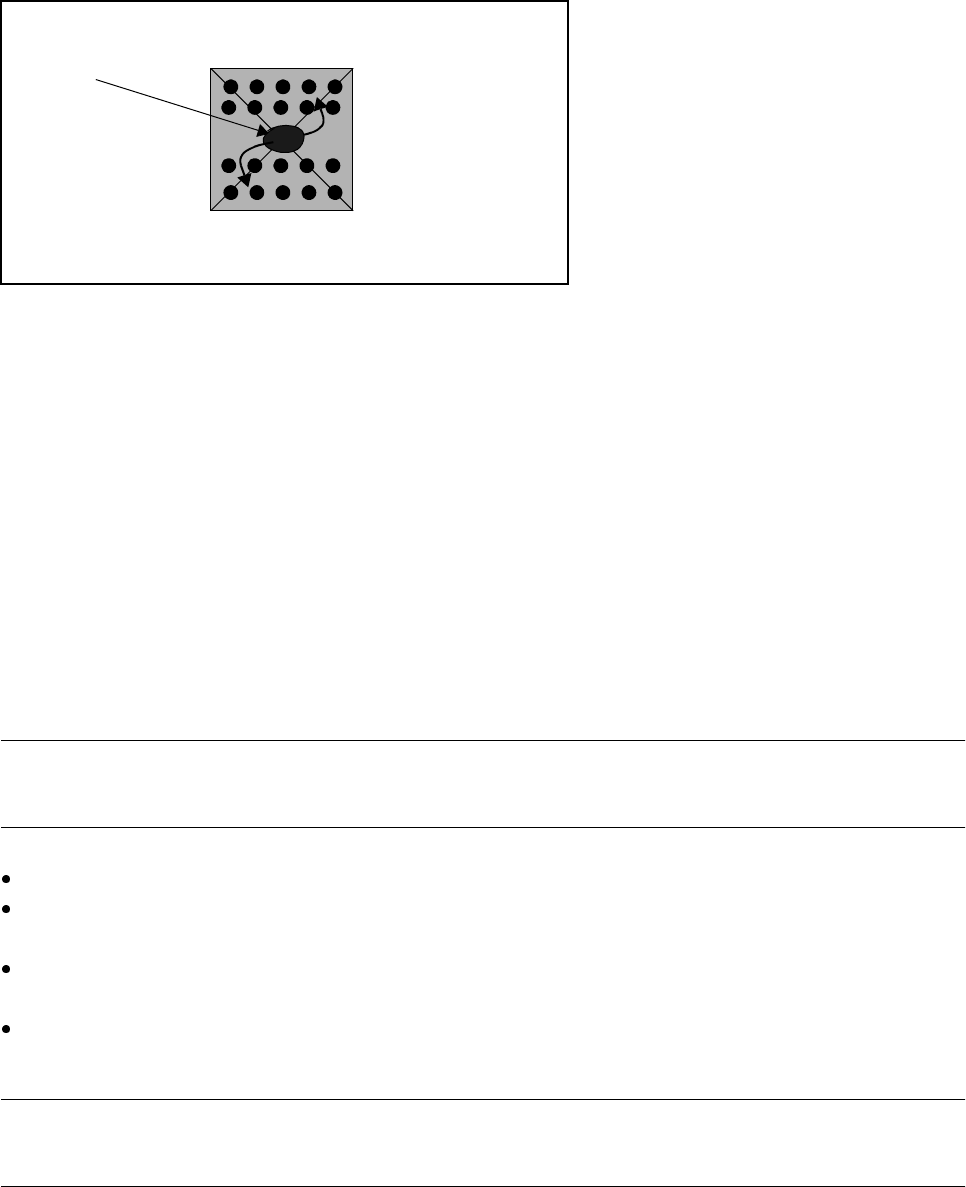
The flip-chip component is placed into the placement position and held there for a specified period of time so
that the flux can dry to touch-dry.
SIPLACE 80S-20/F4/F4-6/F5 User’s Manual 11 Station Extensions/Options
Edition 03/98 from Software Version SR.404.xx 11.7 Dispenser Flux Application Unit for SIPLACE 80F4/F4-6/F5
11 - 37
Fig. 11.7.2 Sketch diagram of a component with flux
- Key to Fig. 11.7.2
1 Flux flows towards the leads
The PCB then remains in the machine for a variable period in order to ensure that the flux has dried fully.
Input of the requisite parameters is described in Section 11.7.6.1, ’Package Form List and Parameters’.
11.7.3 Refilling with Flux
When the quantity of flux in the reservoir is getting low a warning is issued at the station computer. Even after
this warning it is possible to continue placement for a while. You should not allow placement to continue until
the reservoir is empty otherwise unwanted downtimes may be the result.
NOTE
The reservoir must be filled outside the machine to prevent any flux getting spilt in the machine.
Move the fluxer head into the Refill position. See Section 11.7.6.4 "Single Functions"
Pull the reservoir upwards and out of the holder. Twist off the reservoir lid. See Fig. 11.7.1 "Flux applica-
tion - overview"
Top up the reservoir with flux, replace the lid and put the reservoir back in its holder. See Fig. 11.7.1 "Flux
application - overview". Make sure that the reservoir is seated firmly in the holder.
Using the Single functions, rinse the flux applicator head until the hose and the syringe contain no more air
and the flux emerges in a continuous stream. See Section 11.7.6.4 "Single Functions".
PLEASE NOTE
In all your work, make sure that there are no bubbles of air anywhere in the dispensing needle.
1