YCP10 Users_E.pdf - 第117页
4-21 4 Daily operation 9. Rolling operation In rolling operation, the squeegee head moves back and forth repeatedly in order to roll and agitate solder on the mask until it becomes suitable for printing. Rolling operatio…
4-20
4
Daily operation
4
Clamp the mask.
With the mask kept in contact with the left corner on the rear of the printing table, turn the mask clamp
switch located on the right of the machine clockwise to clamp the mask.
c
CAUTION
Be careful not to pinch or crush fingers between the mask frame and mask clamps.
5
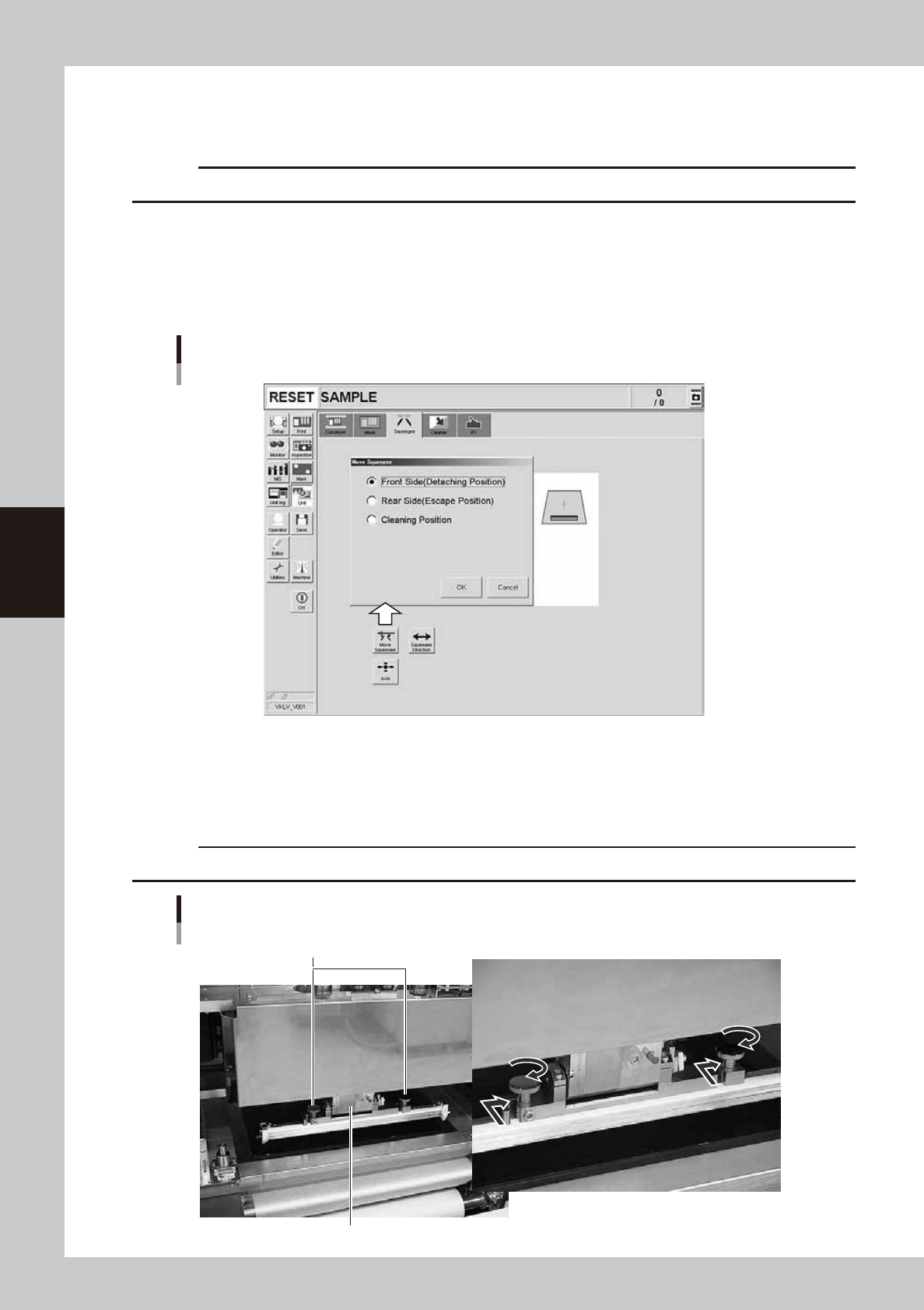
Move the squeegee head to the attach/detach position.
1. After closing the upper door and canceling emergency stop, press the [Move Squeegee] button.
The "Move Squeegee" screen appears.
2. Select the "Front Side" position (attach/detach position) and press the [OK] button.
The squeegee head moves to the front side (towards you).
"Move Squeegee" screen
64409-N1-10
e
6
Press the emergency stop button and open the upper door.
7
Install the squeegee to the squeegee head.
Fit the mount knobs into squeegee head holder and tighten them as below.
c
CAUTION
Be sure to use squeegees specified for use with the YCP10.
Attaching the 3S squeegee
Mount knobs
Squeegee holder
63418-N1-00
4-21
4
Daily operation
9. Rolling operation
In rolling operation, the squeegee head moves back and forth repeatedly in order to roll and agitate solder
on the mask until it becomes suitable for printing. Rolling operation is recommended in cases where you first
print after supplying solder on the mask or when solder has been left on the mask for a long time while not in
operation.
n
NOTE
The board surface becomes soiled during rolling operation, so we recommend covering the board surface with a
transparent sheet (available as option). After rolling operation, clean the backside of the mask by automatic or
manual cleaning.
1
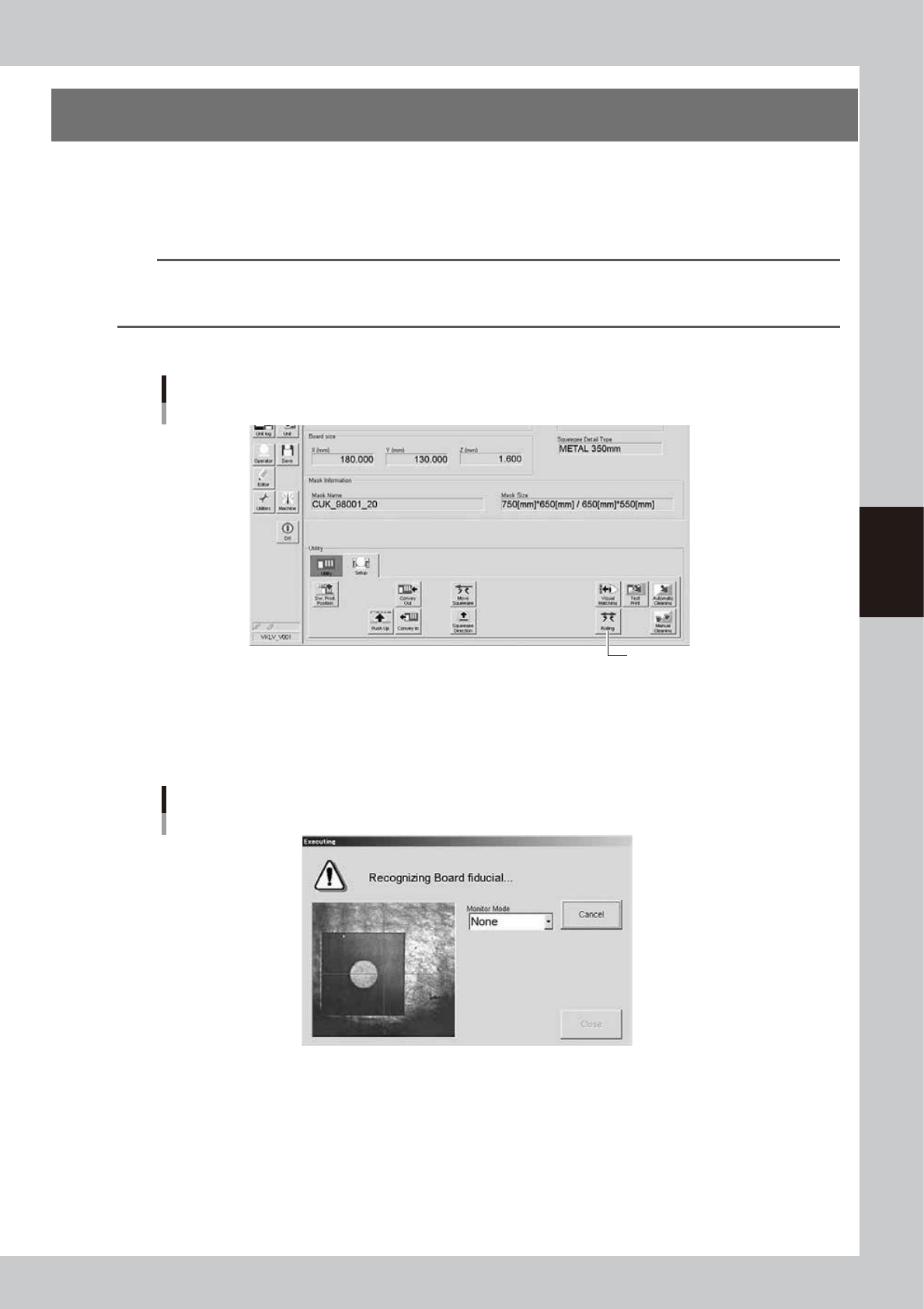
Press the [Rolling] button on the [Setup] tab of the Setup screen.
[Rolling] button
[Rolling] button
64410-N1-10
2
Follow the message on the screen to load a board on the conveyor.
This step is skipped when a board has already been clamped on the conveyor.
After the board has been clamped on the conveyor, the board fiducial mark and mask fiducial mark will
be automatically recognized. (This mark recognition is skipped if the fiducial mark is not used.)
Fiducial mark recognition screen
64411-N1-00
4-22
4
Daily operation
3
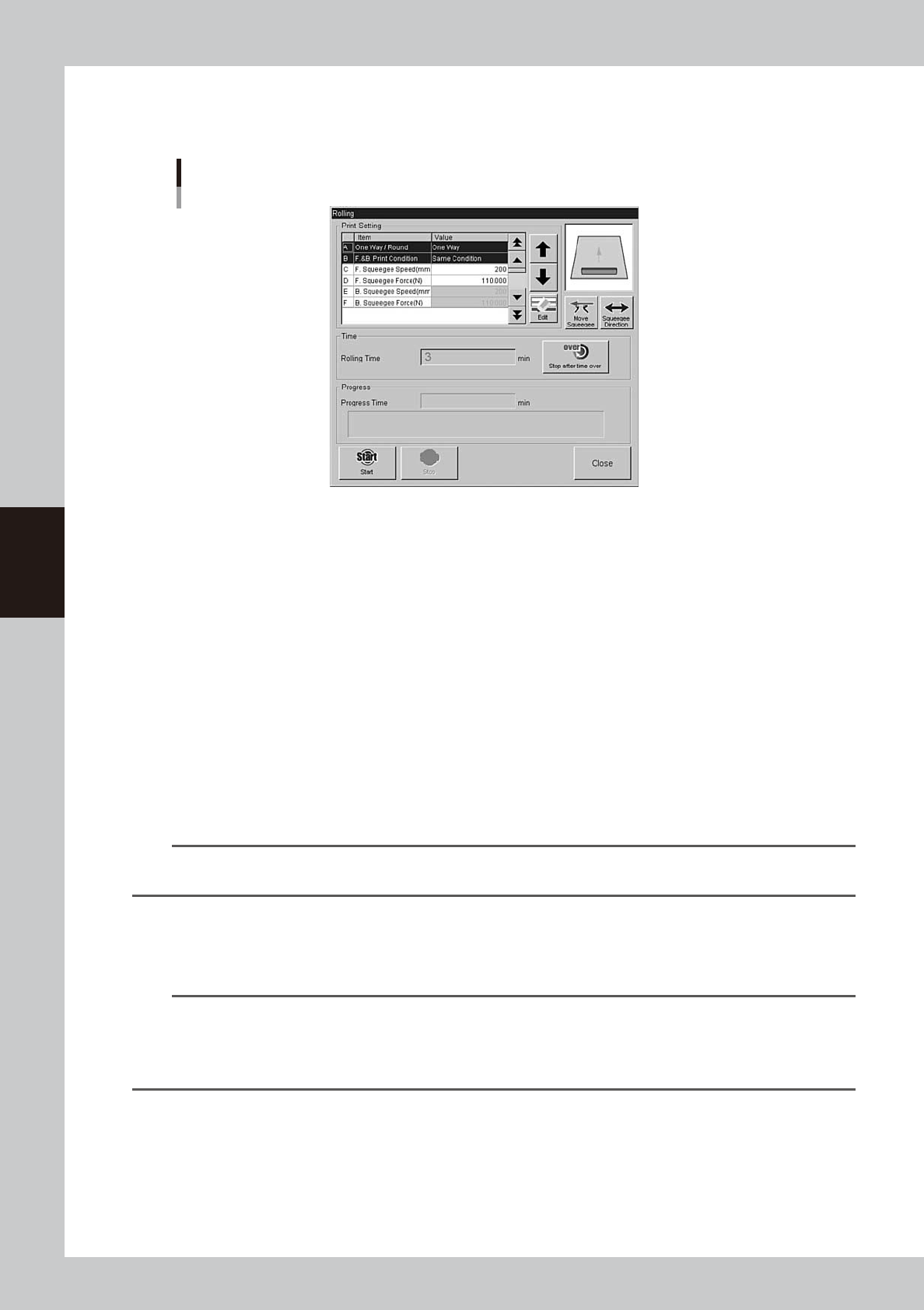
Check that the "Rolling" screen appears.
After mark recognition is complete, the mark recognition screen automatically closes. The conveyor
table then moves to the printing position and is fixed, and the "Rolling" screen appears as shown below.
"Rolling" screen
64412-N1-00
4
Move the squeegee head to the escape position.
When the squeegee head is at the front position, press the [Move Squeegee] button to move the
squeegee head to the escape position (inward position). Use the [Squeegee Direction] button if needed
to change the movement direction.
e
5
Supply solder on the mask.
After pressing the emergency stop button, open the upper door and supply solder on the mask.
6
Cancel emergency stop.
Close the upper door, cancel the emergency button and press the [READY] button on the operation
panel.
7
Start rolling operation.
1. Press the [Stop after time over] button and enter the rolling time.
2. Press the [Start] button.
Rolling operation starts and will automatically stop when the time you set is reached.
n
NOTE
Check the scraped state of the solder on the mask during rolling operation, and if necessary, adjust the settings as in
the next step.
8
Adjust the settings by checking the rolling state.
Press the [Stop] button on the "Rolling" screen to temporarily stop the rolling operation, and enter the
optimum values in the Squeegee Pressure and Squeegee Speed parameters.
n
NOTE
Set the Squeegee Speed and Squeegee Pressure parameters by checking how solder on the mask is scraped during
rolling operation. If the solder is not sufficiently scraped, increase the squeegee pressure and reduce the squeegee
speed. But, note that an excessive squeegee pressure level will cause the solder to spread beyond the required area
or will scrape away the solder too much.