YCP10 Users_E.pdf - 第270页
Chapter 3 Lubrication points Contents 1. Lubrication grease and tool 3-1 1.1 Applicable grease 3-1 1.2 Grease gun 3-1 2. List of lubrication points 3-2 2.1 X-, Y -, and Z-axis 3-2 2.1.1 X1-axis and X2-axis 3-2 2.1.2 Y-ax…
2-22
2
Inspection and maintenance
5
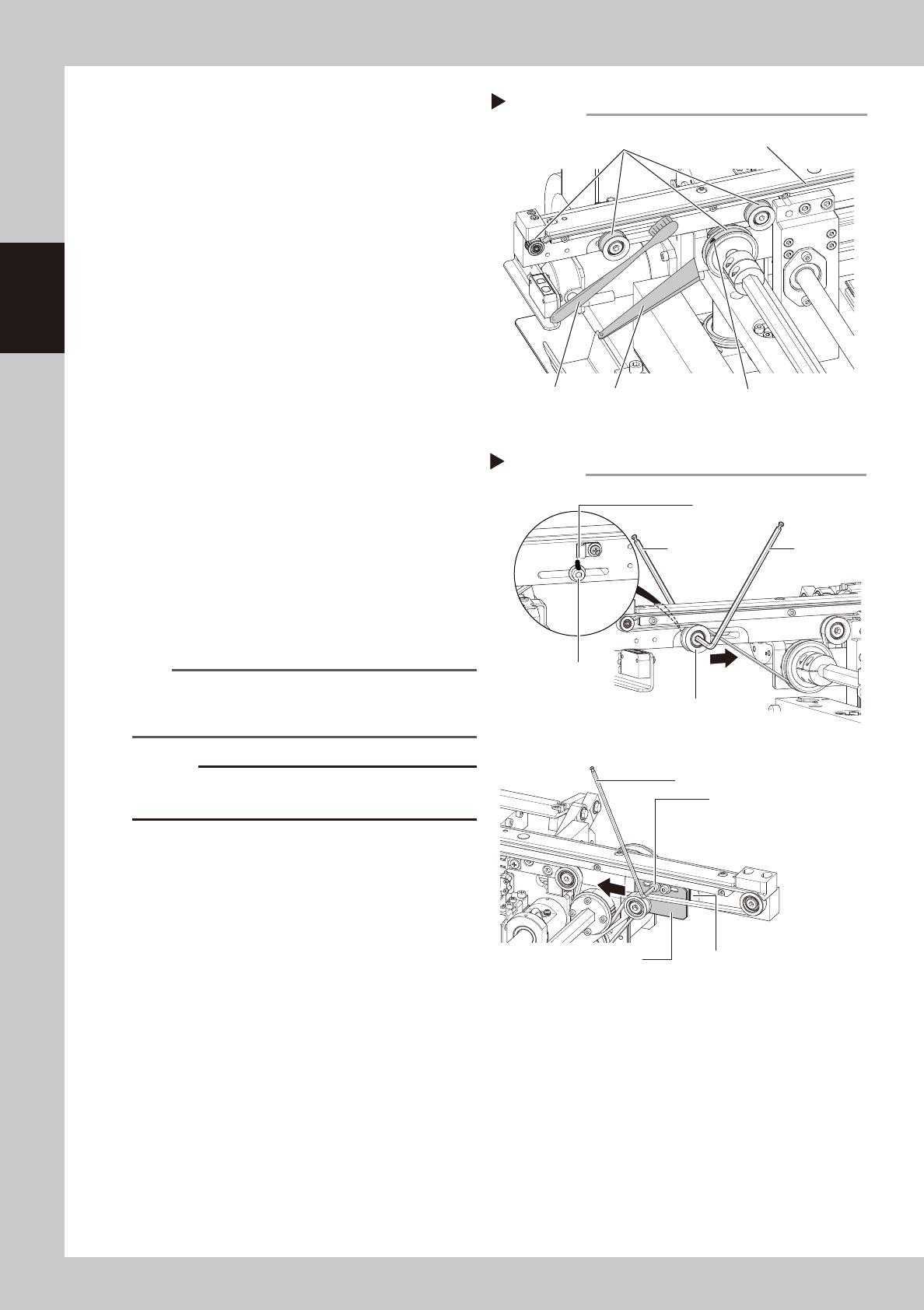
Clean the guide and pulleys.
1. Use a vacuum assembly (option) to
suction the belt wear debris on the belt
guide and sensors, etc.
2. Use a plastic spatula or similar tool to
remove the belt wear debris adhering to
the pulley surface.
3. Use a brush or similar tool to remove the
belt wear debris caught in the belt
guides.
53218-N1-00
6
Attach a new belt.
1. Temporarily fit a new belt onto the pulley.
2. Return the coupling to its original position
and tighten the bolt.
<Type A>
3. Move the tensioner (pulley) to marked
position and then tighten bolts.
4. If belt is loose, adjust position of tensioner
(pulley) and apply tension again.
<Type B>
3. Move the tension adjustment bolt to
marked position and then tighten bolts.
4. If belt is loose, adjust position of tension
adjustment bolt and apply tension again.
53219-N1-00
n
NOTE
Make sure to use a tension meter for adjustment. See
"2.3 Adjusting the conveyor belt tension" in this chapter
for how to measure the belt tension.
c
CAUTION
Make sure not to tighten tensioner mounting bolt and
tension adjustment mounting bolt excessively.
7
Check the belt rotating condition.
1. Cancel emergency stop.
2. On the [Unit]-[Conveyor] tab, press the
[Convey In] and [Convey Out] buttons to
turn on the conveyor motor and check
the belt rotation.
3. If the slip of the motor pulley, the belt
rotation fluctuation and the deflection
are excessive, adjust the tensioner
(pulley) position and transfer a board
again and check the condition.
8
Return the mask guide plate to its
original position.
Attach the mask guide plate to conveyor by
tightening 4 bolts with hex wrench (3 mm).
Cleaning guide and pulleys
Step 5
Plastic spatula
Pulley surfaces
Brush
Belt guide
Belt wear debris
Applying belt tension
Step 6
Tensioner
Tensioner
mounting bolt
Hex wrench
(4 mm)
Marking
Marking
<Type A>
<Type B>
Hex wrench
(5 mm)
Tension adjustment plate
mounting bolt
Tension adjustment plate
Hex wrench (3 mm)
Tightening torque: 5.5 N•m
Tightening torque: 5.5 N•m

Chapter 3 Lubrication points
Contents
1. Lubrication grease and tool 3-1
1.1 Applicable grease 3-1
1.2 Grease gun 3-1
2. List of lubrication points 3-2
2.1 X-, Y-, and Z-axis 3-2
2.1.1 X1-axis and X2-axis 3-2
2.1.2 Y-axis 3-3
2.1.3 Z-axis 3-4
2.2 Printing head 3-5
2.2.1 SY-axis 3-5
2.2.2 SZ-axis 3-5
2.3 Conveyor unit 3-6
2.3.1 PU-axis 3-6
2.3.2 MX-axis 3-6
2.3.3 W-axis (Conveyor auto width adjustment) 3-7
2.4 Vision camera unit 3-8
2.4.1 CX-axis 3-8
2.5 Suction-blower unit 3-9
2.5.1 Blower hose guide 3-9
2.6 Cleaning unit 3-9
3-1
3
Lubrication points
1. Lubrication grease and tool
This section describes the lubrication points of each unit as well as the lubrication intervals and procedures.
n
NOTE
See “Safety instructions” at the beginning of this manual for instructions on how to handle grease.
1.1 Applicable grease
When greasing the lubrication points, be sure to use appropriate grease specified by YAMAHA as listed below.
n
Specified grease
Parts List Designation
:
GREASE PACK (NSL)
Parts No. : K48-M3856-00X
c
CAUTION
If grease other than that specified is used, this may cause damage to the machine.
1.2 Grease gun
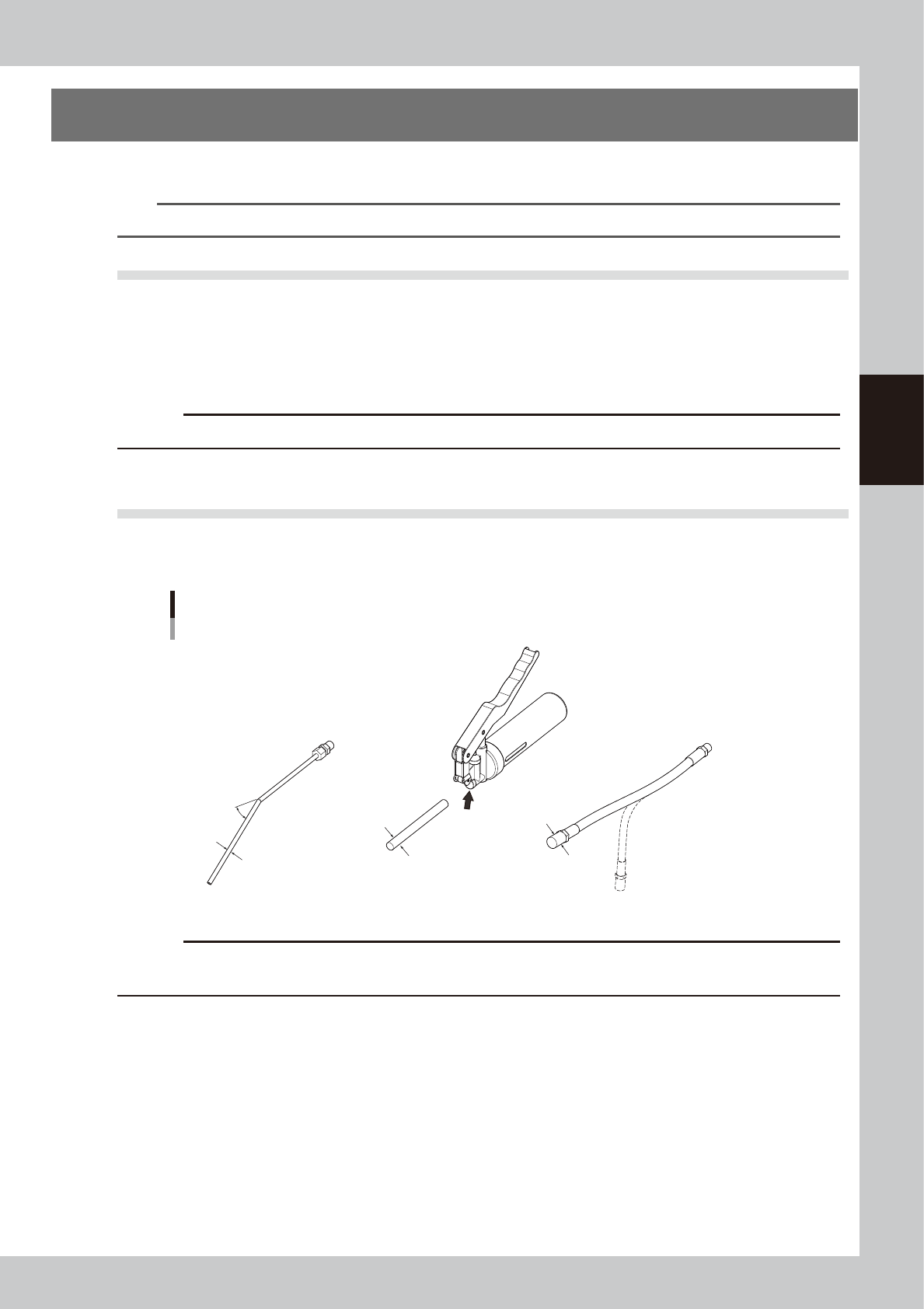
Select an appropriate nozzle suitable for the lubrication point from three kinds of nozzles shown below and
attach it to the grease gun to apply the grease. Change the nozzle according to the greasing instructions.
Grease gun
Grease gun
30°-bent type nozzle
Standard nozzle
Change the
nozzle here.
Chuck flexible type nozzle
30°
Outside diameter
of tip: φ14
Outside diameter
of tip: φ10
Outside diameter
of tip: φ5
53301-N1-00
c
CAUTION
Prepare different nozzles by grease. If two or more kinds of grease with different characteristics are mixed in the nozzle
and it is applied, this may cause the machine performance to lower.