3OM-1003-005.pdf - 第122页
(C03) Placement Data (O-data) The set parameters can be used to create a repetitive pattern pro- gram. Fig. 3B1 10 Edit Window (Example) (C03_01) O-No. Shown are the step Nos. of the placement data (O). These step Nos. a…
(b) Block Sorting FunctionWhen components requiring different tact time
(different X/Y table speeds) are used in a repetitive pattern program
and unit P.C.B.'s are finished one by one in normal sequence, the
tact time of component placement on the second and subsequent
multi-unit P.C.B.'s is reduced to the lowest one of the first unit P.C.B.,
greatly deteriorating the productivity.However, this block sorting func-
tion can be used to place high-speed components (components to
be placed at high speed) first of all the others on all unit boards of a
multi-unit P.C.B., improving productivity.Refer to "3.6 Repetitive Pat-
terns (Block Sorting Enabled)" for a concrete example.
(c) Confirm that "0" (zero) is set in the "X [mm]", "Y [mm]", "Z=theta", "H
[mm]", and "Fdr No." text boxes of the last line (last step No.) and set
"E", "P", or "Q".
(C02_10) Comment
Set a comment for each step No.
Up to 32 characters (alphanumerics and marks) can be used.
(a) The automatic operation is not affected by these comments.
(b) The comments can be used to check "Ref. No." printed on the upper
surfaces of P.C.B’s.
(C02_11) X1 [mm], Y1 [mm]
Set the coordinates of the first fiducial mark for the local recognition
mode in each text box.
Unit: mm
(C02_12) X2 [mm], Y2 [mm]
Set the coordinates of the second fiducial mark for the local recogni-
tion mode in each text box.
Unit: mm
(C02_13) FM1, FM2
Set parameters for "FM1" (First Fiducial Mark No.) and "FM2" (Sec-
ond Fiducial Mark No.) related to the local recognition mode.
Select the mark Nos. (Mark #) specified in the P.E.C. recognition mark
data of the operation data.
2.5 Placement Data
0305-001 2-52 AIL01EDTP
Comment
Fig. 3B106
Fig. 3B107
X1 [mm]
Y1 [mm]
010.000
010.000
Fig. 3B108
X2 [mm]
Y2 [mm]
050.000
050.000
Fig. 3B109
FM1
FM2
01
01
Note
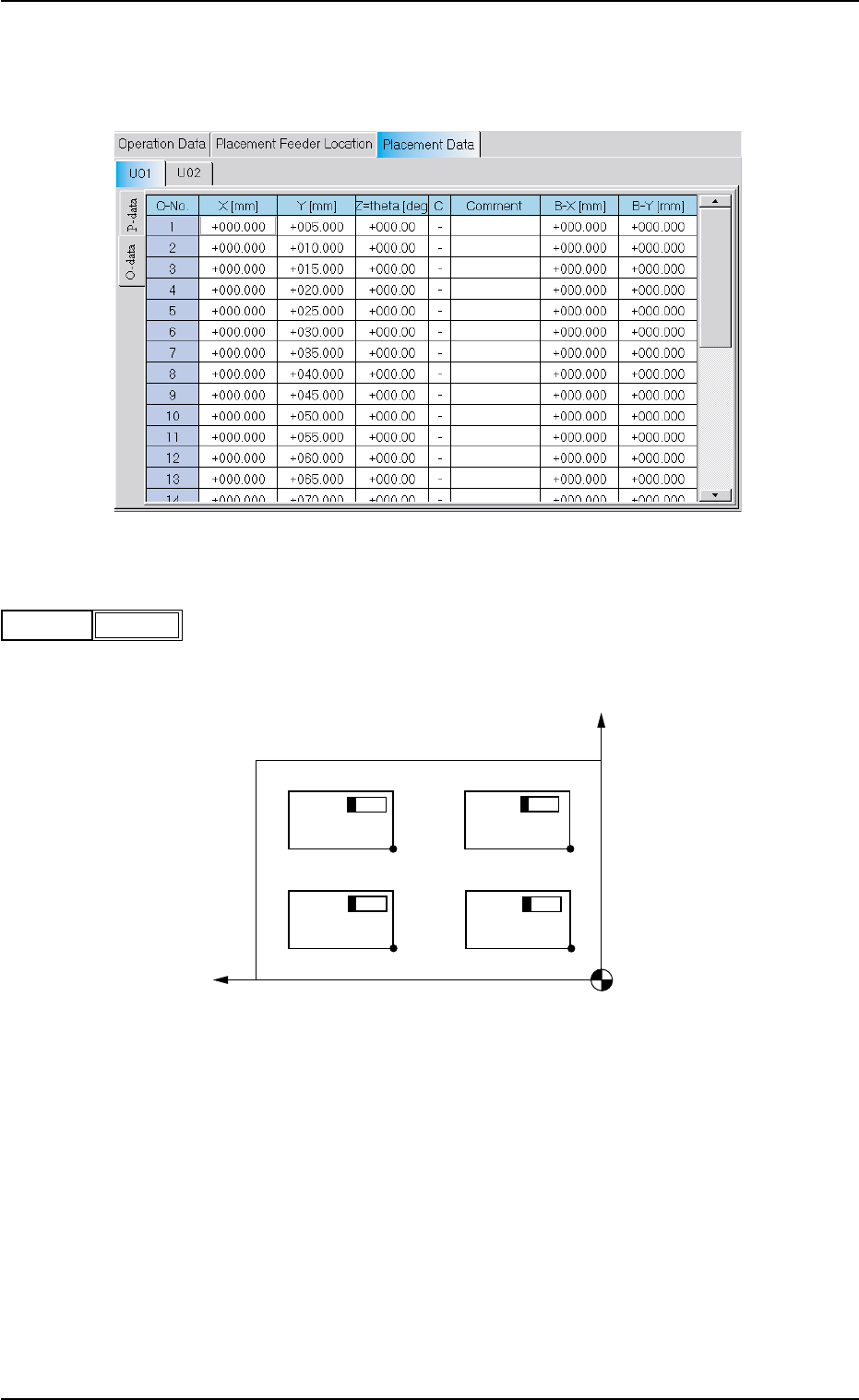
(C03) Placement Data (O-data)
The set parameters can be used to create a repetitive pattern pro-
gram.
Fig. 3B110 Edit Window (Example)
(C03_01) O-No.
Shown are the step Nos. of the placement data (O).
These step Nos. are regarded as repetitive pattern Nos.
Parameters must be entered in each line (pattern).
Fig. 3B112 Example of Repetitive Pattern Program
O-No.4
Pattern 3Pattern 4
Pattern 2 Pattern 1
O-No.3
O-No.2
O-No.1
2.5 Placement Data
0305-001 2-53 AIL01EDTP
1
O-No.
Fig. 3B111
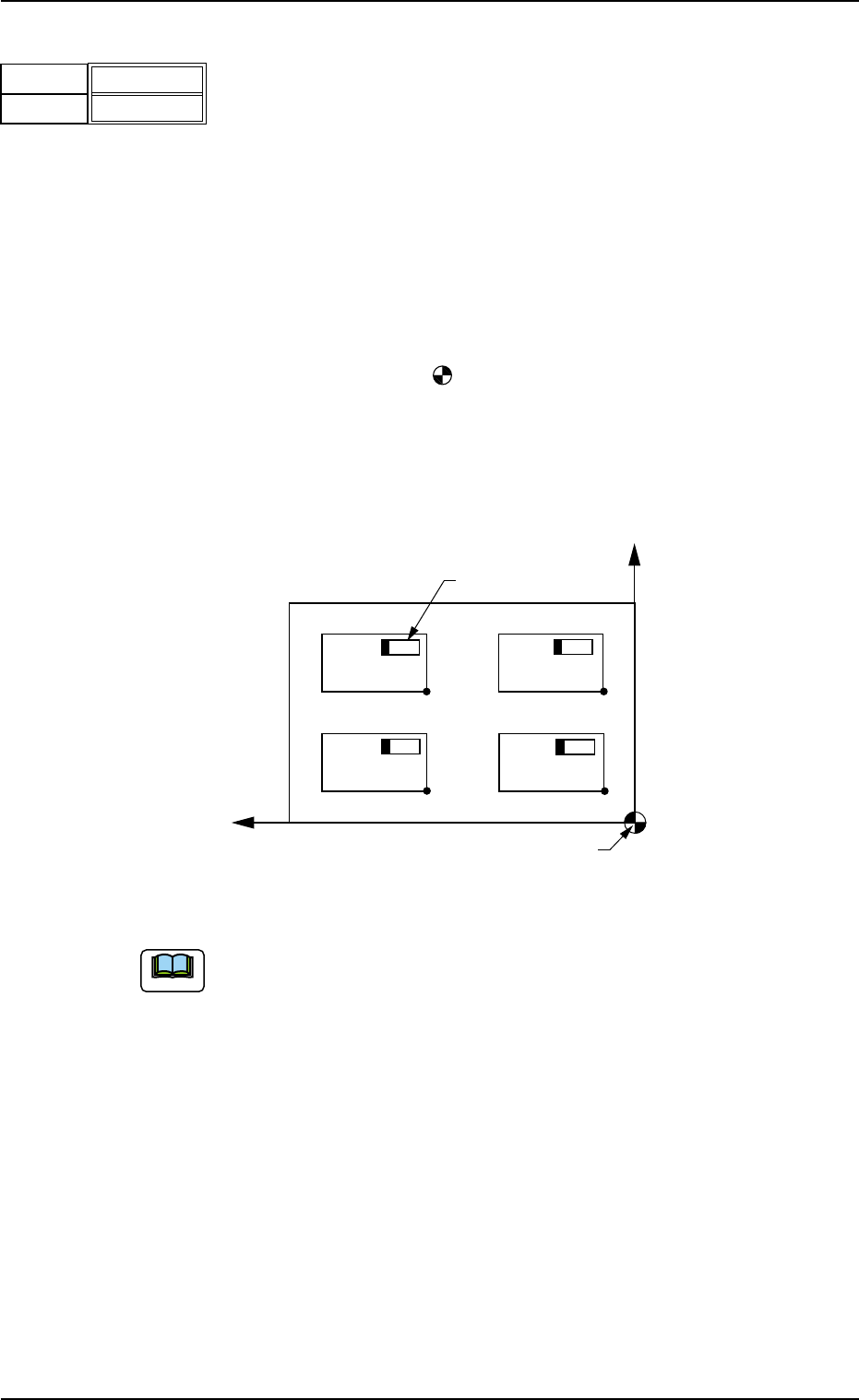
(C03_02) X [mm] and Y [mm]
Set the coordinates of each pattern origin (O
01
through On) based on
the placement coordinate reference point (N
0
).
Unit: mm
A pattern origin refers to the reference coordinates of a repetitive pat-
tern.
The pattern origins (reference coordinates) must be determined, re-
garding the "Z=theta" data as "0°" (described in "(C03_03)" and lo-
cated at corners on the same side as the placement coordinate refer-
ence point (N
0
).
N
0
: The center of is the placement coordinate reference.
O
01
: Pattern Origin of Pattern 1
O
02
: Pattern Origin of Pattern 2
O
03
: Pattern Origin of Pattern 3
O
04
: Pattern Origin of Pattern 4
Fig. 3B114 Example of Repetitive Patterns
Do not set any coordinates in the last line (last step No.).
Keep them as "000.000".
Placement Coordinate Reference (No)
O
04
Y
X
O
03
O02 O01
Component
Pattern 3Pattern 4
Pattern 2
Pattern 1
2.5 Placement Data
0305-001 2-54 AIL01EDTP
Fig. 3B113
X [mm]
Y [mm]
010.000
010.000
Note