00196625-03_AI_SX12_PCB_Barcode_de_en.pdf - 第200页
Annex General Notes About the Barcode Structure of 2D Barcodes 200 PCB Barcode LP-Barcode 4.3.2 Structure of 2D Barcodes Barcode types: 1. "Stacked" codes, these are essentially one-dimensional barcod es that a…
Annex
Structure of 1D Barcodes General Notes About the Barcode
PCB Barcode LP-Barcode 199
4.3 General Notes About the Barcode
In this day and age, increasing numbers of components, individual components, semi-finished and end
products are being uniquely identified with a barcode, which makes them easier to check. This, in turn,
makes it easier to control production, stock-keep and to trace components in the event of errors. Both
one-dimensional (1D, e.g. barcodes) and two-dimensional (2D, e.g. data matrix codes) codes can be
used.
4.3.1 Structure of 1D Barcodes
Barcode types include 2/5 interleaved, Codabar, Code 39, Code 128, EAN 8, EAN 13 for industrial ap-
plications.
The 1D barcode scanner reads the barcode using a red light laser diode and a rotating mirror wheel,
which creates a red scanning line that is visible to the human eye.
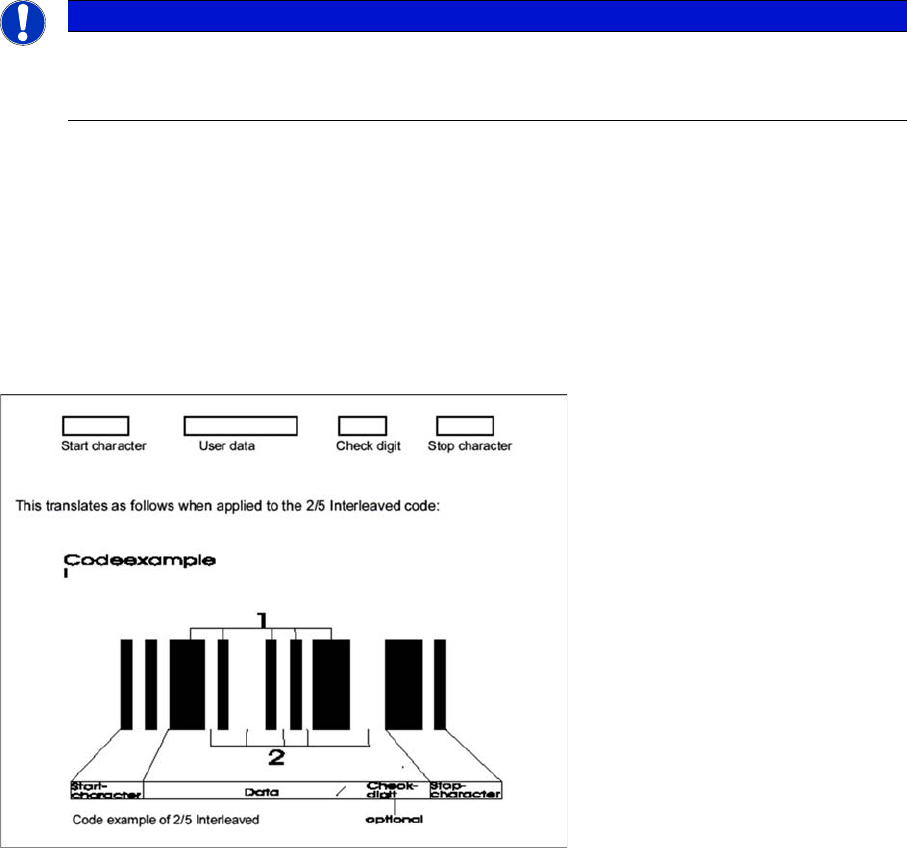
The structure of a barcode, the number of black lines and white gaps for each character to be coded is
fixed for each barcode type. The information is located in both the lines and the gaps of a barcode. But,
in general, the following structure can be defined for a barcode.
Structure of a 1D barcode
Advantages:
▪ Up to 50 characters can be encoded, depending on the type of code.
▪ Barcodes can be read and scanned very reliably with the optical scanning system.
▪ Barcodes are cheap to produce.
▪ Barcode scanners are very cheap to buy.
Disadvantages:
▪ The print quality of a barcode on the labels is a decisive factor in the scanning result.
NOTICE
Barcode changeover
Before you use a new barcode, we recommend that you contact your SIPLACE Service team
and have the barcode tested in advance.
Annex
General Notes About the Barcode Structure of 2D Barcodes
200 PCB Barcode LP-Barcode
4.3.2 Structure of 2D Barcodes
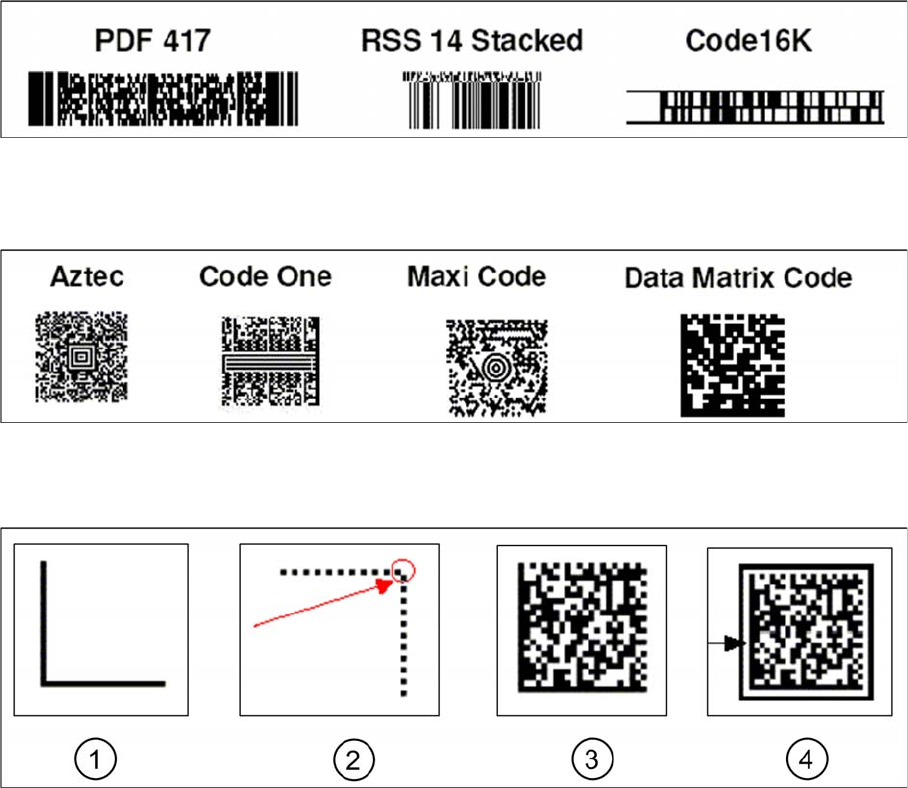
Barcode types:
1. "Stacked" codes, these are essentially one-dimensional barcodes that are printed directly over one
another. Typical stacked barcodes include the PDF 417, RSS-14 Stacked and the 16K code.
Stacked barcodes
2. 2D barcodes, known as "matrix codes" are another variant of the 2D barcodes. Again there are var-
ious types commonly used, such as Aztec code, Maxi code, Code One and the data matrix code.
2D barcodes
Data matrix code: The data matrix code consists of 4 main components.
4 main components of the data matrix code
Legend
1. The fixed dividing line ('corner’). This fixed dividing line is used for pattern recognition and to calcu-
late the rotary position of the data matrix code.
2. The non-closed border (opposite corner). This open corner is used to identify the number of lines
and gaps. This is known as the "matrix density“. On the ECC 200, the element in the top right-hand
corner is white.
3. The storage area. This contains the binary information in coded form. Depending on the cell size, it
also defines the number of possible items of information.
4. The 'rest zone'. This empty zone surrounds the data matrix code. It contains no information and is
not used for orientation. The width of the rest zone is one field or one line.
1. Corner 2. Opposite corner
3. Storage area 4. Rest zone
Annex
Structure of 2D Barcodes General Notes About the Barcode
PCB Barcode LP-Barcode 201
Advantages of data matrix code:
▪ Flexible in terms of the range of applications
▪ Very high information density in the smallest space (over 2000 characters)
▪ Scanning is possible from any angle
▪ Minimal requirements in terms of color contrast and print quality and thus suitable for direct labelers
(e.g. laser labelers or needle embossing) as these require less contrast than for barcodes.
▪ Error correction using the "Reed-Solomon" algorithm - up to 25 % of the code may be damaged.
Sample applications:
▪ Scanning permanent direct labels (e.g. on tools, motor components, drive parts, surgical instru-
ments, etc).
▪ Production / manufacturing (identification of electronic components, tools, etc.)
▪ Chemical and biomedical analysis instruments
▪PCBs
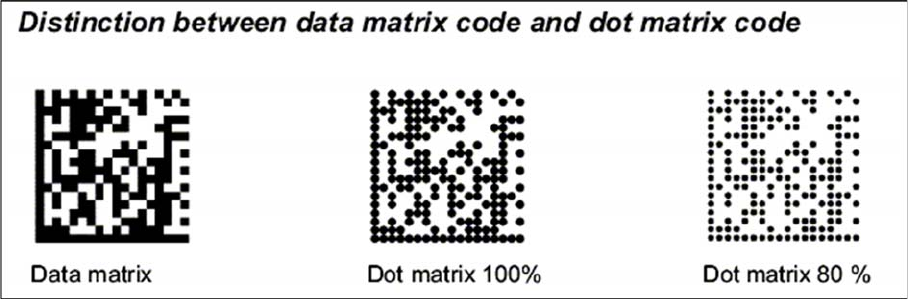
Data matrix - and DOT matrix barcodes