YSD_Users_E.pdf - 第108页
2-48 2 Basic operation 4.1.1 Adjusting the low-liquid sensor e 1 Pr ess the emergency stop button. The machine must be in emergency stop to ensure safety during work. 2 Check the amp signal output setting. Set the amp ou…
2-47
2
Basic operation
n
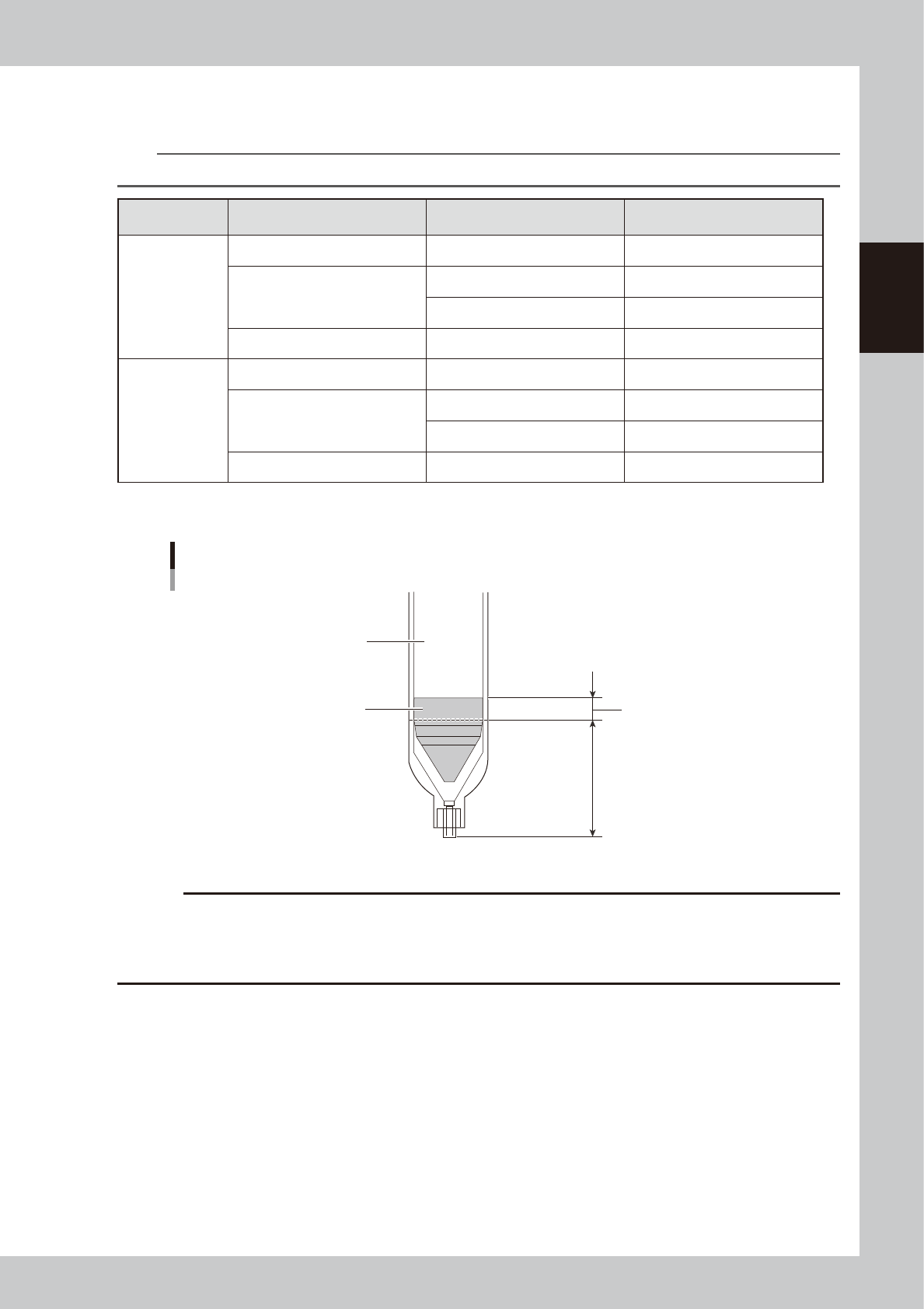
Applicable syringes and pistons
Operations of the syringes and pistons of the following type numbers have been verified.
n
NOTE
If the type number is unknown, contact the adhesive manufacturer.
Syringe capacity Syringe manufacturer / Type No. Piston manufacturer / Type No.
* Piston position when liquid
has run out [mm]
30cc
Musashi (PSY-30E) Musashi (PSY-30E) 5.7
Iwashita (PS30S)
Iwashita (PP30S) 2
Iwashita (PP30ND) 6
EFD (7012134) EFD (7012184) 2.7
10cc
Musashi (PSY-10E) Musashi (PSY-30E) 13.5
Iwashita (PS10S)
Iwashita (PP30S) 6
Iwashita (PP30ND) 11.5
EFD (7012112) EFD (7012178) 2.8
* Distance from the lower end of the piston when the low-liquid sensor detects that the liquid has run out.
Piston position when liquid has run out
Piston position when liquid
has run out [mm]
Piston position when sensor
detects that liquid has run out
Lower end of piston
(no liquid remaining)
Syringe (clear)
63217-N7-00
c
CAUTION
• The sensor may fail to detect whether the liquid has run out or not, depending on the liquid type and how the
piston scrapes the liquid .
• If the product label is affixed to a position that can be seen from the holder opening, the sensor may not detect
whether the liquid has run out or not.
2-48
2
Basic operation
4.1.1 Adjusting the low-liquid sensor
e
1
Press the emergency stop button.
The machine must be in emergency stop to ensure safety during work.
2
Check the amp signal output setting.
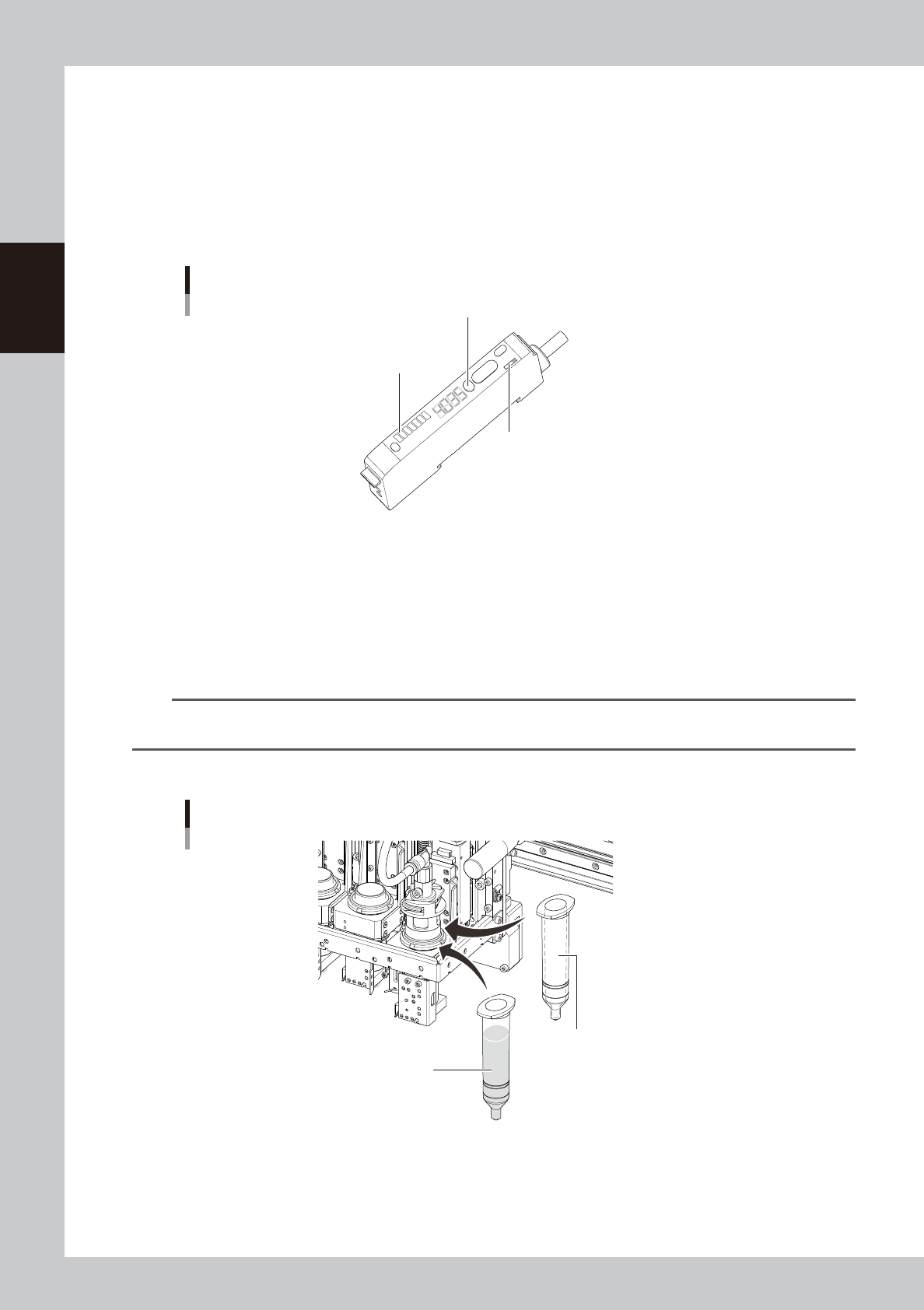
Set the amp output selector switch to the “L_ON” side so that the low-liquid sensor stays on when it is
detecting the dispensing liquid in the syringe.
Low-liquid sensor amp section
Auto SET button
Calibration indicator (orange)
Output selector switch
63212-N7-00
3
Adjust the low-liquid sensor level.
1. Set the empty syringe into the head section.
2. Check that the optical axis of the sensor is at a position 5 mm above the piston in the syringe.
3. Allow the sensor beam to strike the syringe.
The holder in which the syringe is set contains 4 openings. Rotate the R-axis so that the sensor faces
the opening where the highest value is obtained.
n
NOTE
If the sensor height needs to be adjusted, loosen the two bolts holding the sensor bracket and slide the sensor up or
down.
4. Press the Auto SET button on the amp and check that the calibration indicator is lit up.
Setting the syringe
Step 3
Empty syringe
Step 4
Syringe full of liquid
63213-N7-00
2-49
2
Basic operation
4
Adjust the sensor level when the liquid still remains.
1. Set the syringe full of liquid into the head assembly.
c
CAUTION
If the product label affixed to the syringe is large so that it covers the lower part of the syringe, peel it off from the lower
half of the syringe.
If the product label covers the lower part of the syringe, the low-liquid sensor cannot detect whether adhesive has run
out or not.
2. Allow the sensor beam to strike the syringe.
The holder in which the syringe is set contains 4 openings. Rotate the R-axis so that the sensor faces
the opening where the lowest value is obtained.
3. Press the Auto SET button on the amp and check that the calibration indicator turns off.
5
Check the sensor ON/OFF operation.
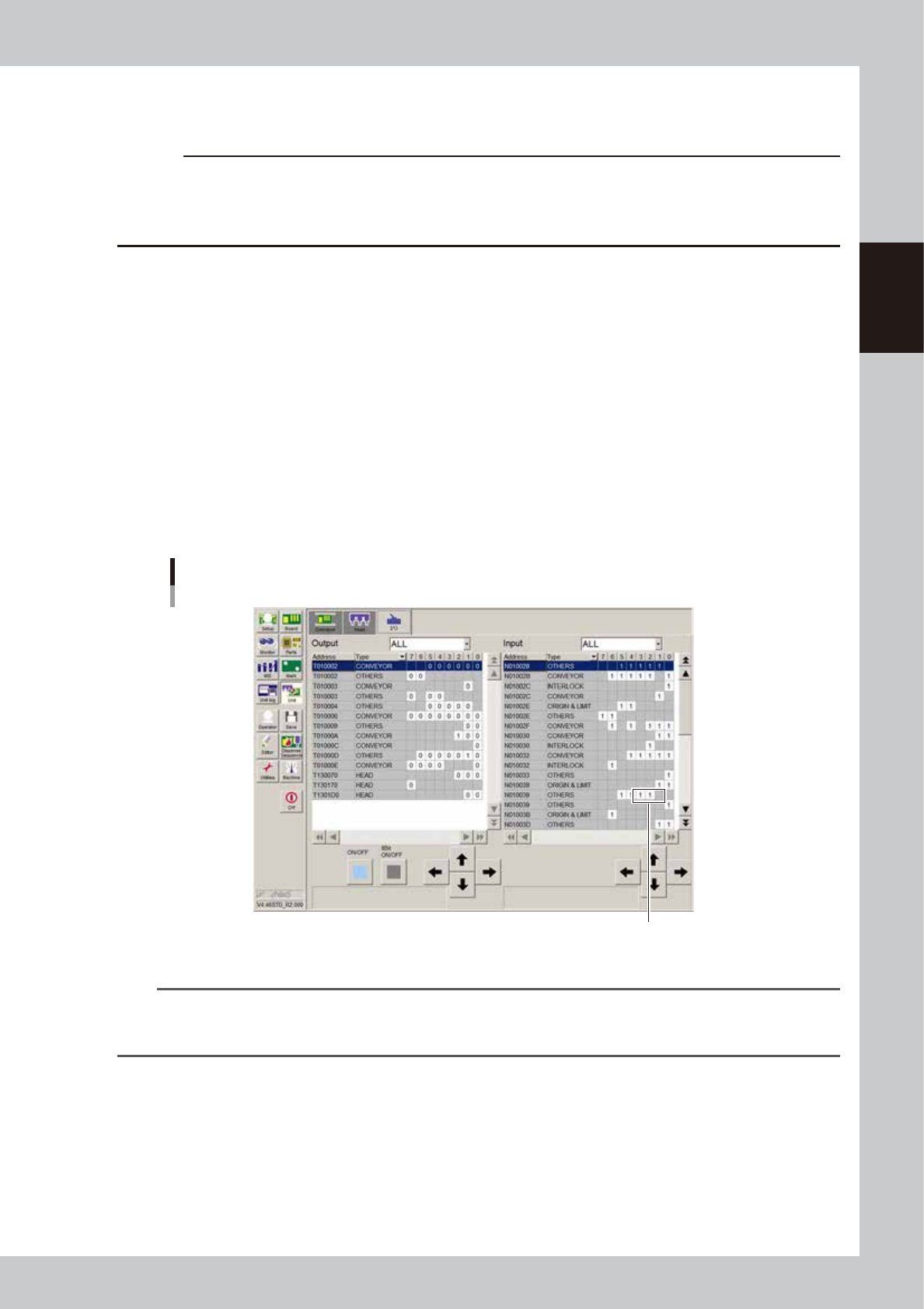
1. Open the [Unit]-[I/O] tab.
2. Move the piston of the empty syringe up and down across the sensor optical axis, and check that
the I/O monitor for the sensor switches as follows.
Head 1 :N130101
Head 2 :N130102
Head 3 :N130103
When liquid is detected (liquid remains) :1
When no liquid is detected (no liquid remains) :0
Sensor ON/OFF check
Check here.
64242-N7-00
n
NOTE
• When using the low-liquid sensor, set the maximum liquid amount for the dot station to "0".
• When the amp output selector switch is set to “L_ON”, if the sensor cannot correctly detects whether the liquid
remains or not, see “4.1 Remaining amount detection angle setting” in Chapter 3.