YSD_Users_E.pdf - 第212页
5-23 5 Creating the board data 4.4.1 Board fiducial function T he board fiducial function corrects the positioning error of the entire board by using a pair of fiducial marks. T his function is particularly effective in …
5-22
5
Creating the board data
4.4 Fiducial parameters
The fiducial function corrects local distortion or warps on a board that may occur from errors in machining the
board outline and locate pin holes, or board clamping mechanism fluctuations, using recognition results of the
fiducial marks provided on the board.
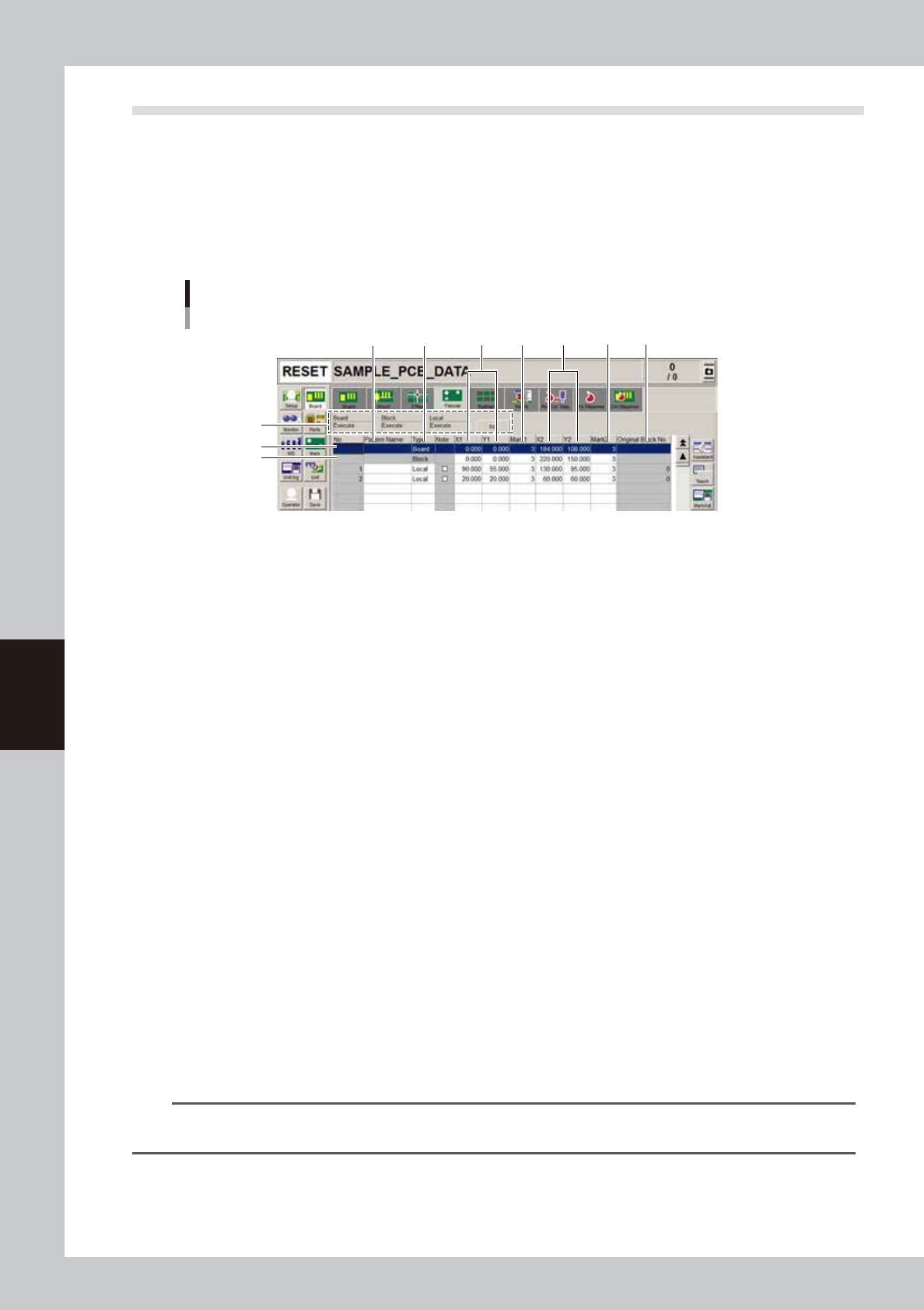
Selecting the [Fiducial] tab opens the screen for setting fiducial mark parameters and their coordinates. Set
these parameters as explained below when using the fiducial function. Two or four fiducial marks are used as a
set, but it is okay if each mark is different in shape. Fiducial mark data must be registered in the mark
information beforehand. (See "5. Creating the mark information" in this chapter.)
4
1
5 6 87 9
2
3
10
Fiducial parameter
64511-N7-00
1. Board, Block, Local
Fiducial functions are broadly classified into three types: “Board” fiducial function specified for a board, “Block” fiducial
function specified for each block of a multi-block board, and “Local” fiducial function related to mounting data. The
fiducial function you wan to use should be set to “Execute”. To change the setting, press the [Edit] button on the right end.
2. Board
On the top line of the parameter list, set the board fiducial mark data.
3. Block
On the second line of the parameter grid set the block fiducial mark data.
4. Pattern Name
Enter the fiducial mark name here. (Names cannot be entered on the top and second lines.)
5. Type
On the third or subsequent lines, specify the type of fiducial function you want to use, by selecting from among “”Point”,
“Local”, “4Local-M” and “4Local-S”.
6. X1, Y1
Enter the XY coordinates of Mark 1 relative to the board origin in millimeter. You can perform teaching with the [Teach]
button.
7. Mark 1
Enter the mark No. for Mark 1 (mark No. registered as fiducial mark in the mark information).
8. X2, Y2
Enter the XY coordinates of Mark 2 relative to the board origin in millimeter. You can perform teaching with the [Teach]
button.
9. Mark 2
Enter the mark No. for Mark 2 (mark No. registered as fiducial mark in the mark information). When this mark is identical
with Mark 1, enter “0”.
n
NOTE
Although you can enter the XY coordinates of each mark by teaching, we recommend using the accurate design
data because the fiducial mark settings directly affect the mounting accuracy.
10.
Original Block No.
Shows the block No. that was automatically allocated to each block after block distribution (with note data) was
performed. For details on block distribution (with note data), refer to "2.2.1 Block offset distribution" in Chapter 7.
5-23
5
Creating the board data
4.4.1 Board fiducial function
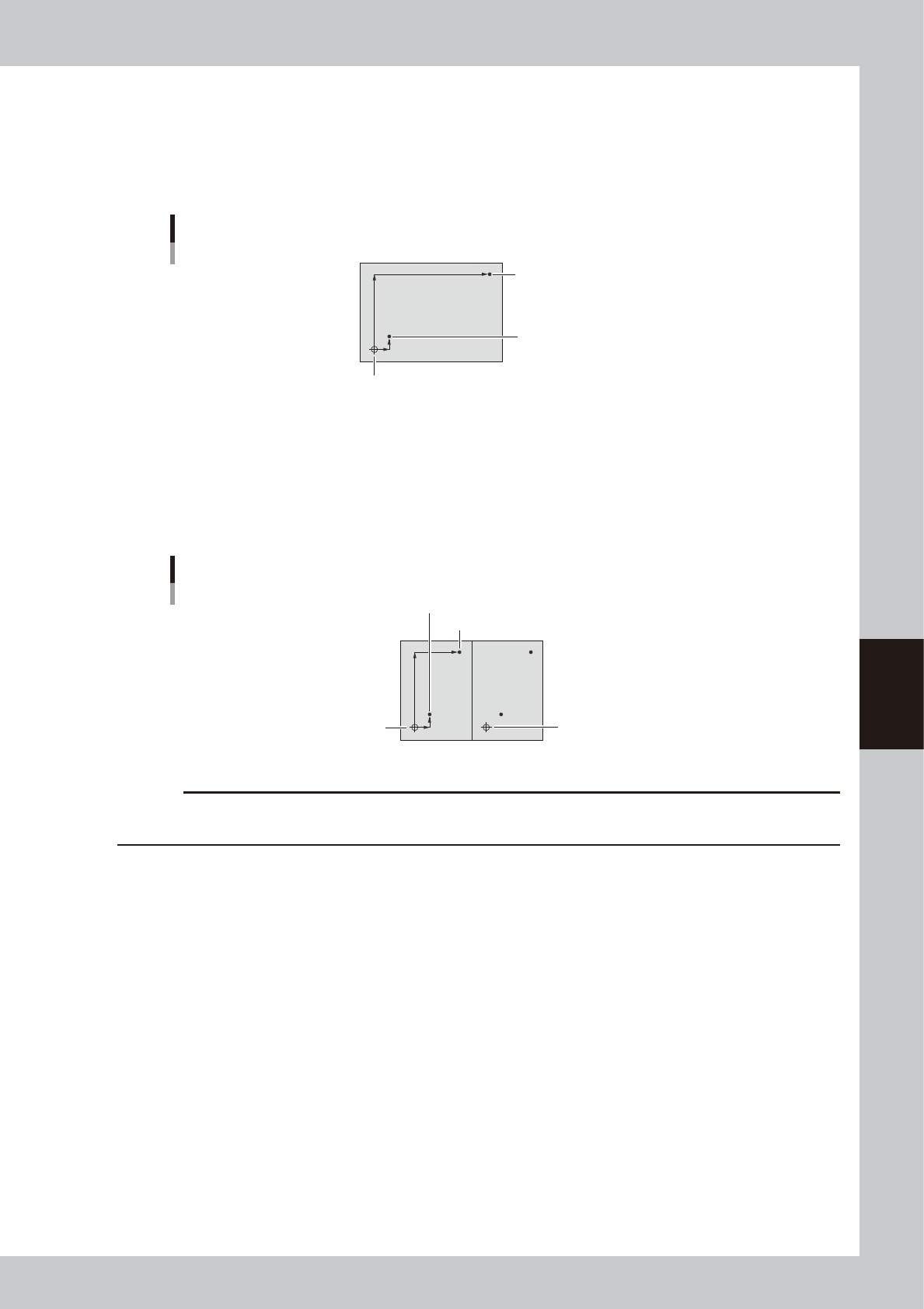
The board fiducial function corrects the positioning error of the entire board by using a pair of fiducial marks.
This function is particularly effective in correcting the positioning error caused by board clamping mechanism
fluctuations. As shown in the figure below, a pair of fiducial marks must be diagonally located on the entire
board.
Mark 1 (X1, Y1)
Mark 2 (X2, Y2)
Board fiducial marks
Board origin
63509-N7-00
4.4.2 Block fiducial function
The block fiducial function corrects the positioning error of each block on a multi-block board, by using a pair
of fiducial marks provided in the block. This function is also effective in correcting the positioning error caused
by board clamping mechanism fluctuations.
As shown in the figure below, a pair of fiducial marks must be diagonally located in each block.
Mark 1 (X1, Y1)
Mark 2 (X2, Y2)
Reference block origin
Block fiducial marks
Block repeat No.2
63510-N7-00
c
CAUTION
The block fiducial function can only be used for board data (i.e. multi-block board data that uses the block offset
function) for which block fiducial of the offset information has been set.
5-24
5
Creating the board data
4.4.3 Local fiducial functions
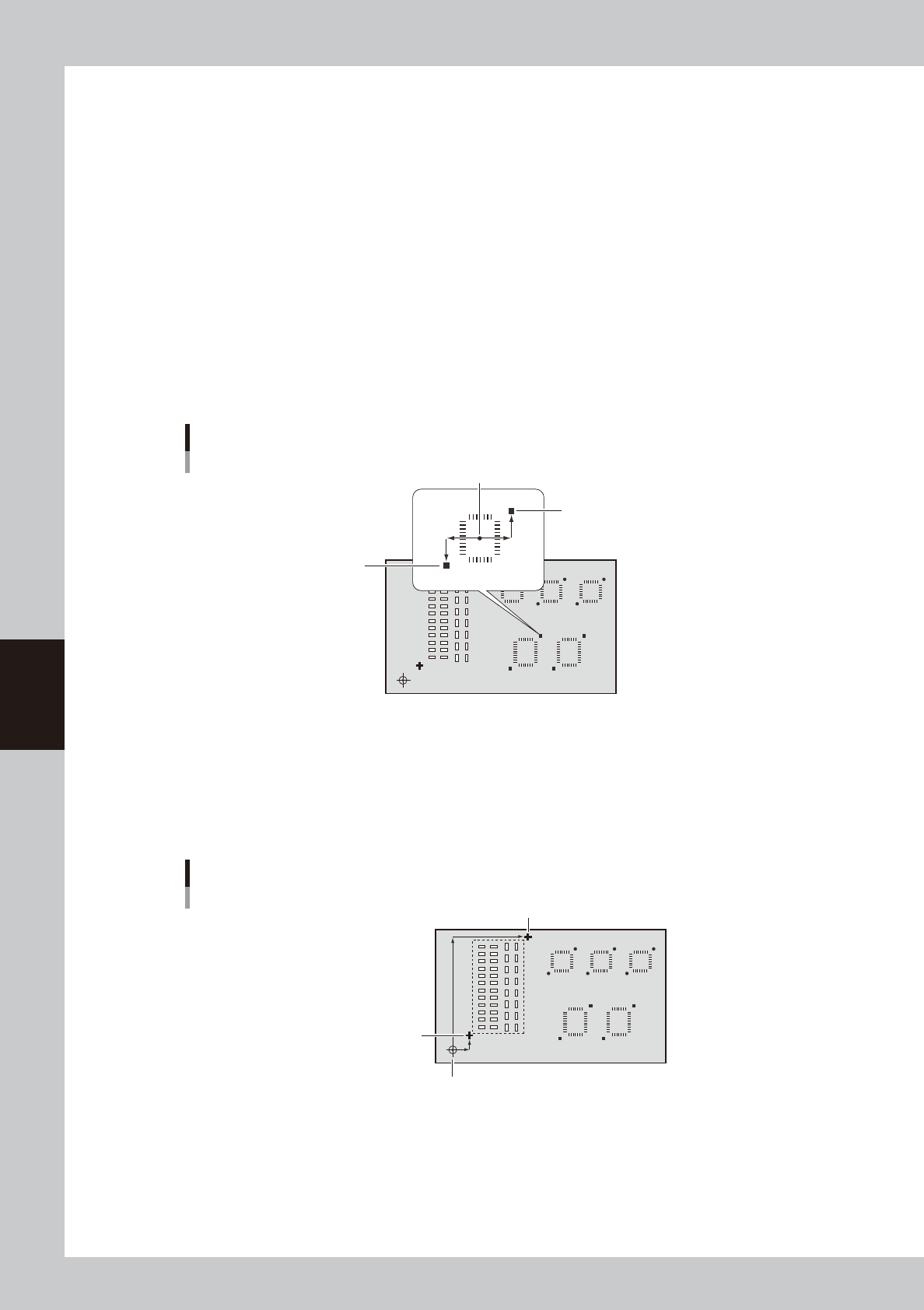
There are three kinds of local fiducial functions relating to mount data: “point fiducial”,
“local fiducial” and
“4-point fiducial” functions. These are generally called the local fiducial functions.
The local fiducial functions are used to enhance the local mounting position accuracy of individual mount
data, rather than improving the mounting position accuracy on an entire board or block as is done by the board
fiducial or block fiducial function.
1. Point fiducial function
The point fiducial function is used to enhance the mounting position accuracy only of a specific component. In general,
as the board size becomes larger, the land pattern layout tends to become inaccurate due to flexing, twist and expansion/
shrinking of the board. Therefore, the point fiducial function is effective when mounting QFP components with a fine
lead pitch on a large board. (Note that the board and block fiducial functions are not effective in this case, although they
are useful in correcting a positioning error caused by the board clamping fluctuations.) The point fiducial function uses a
set of two fiducial marks diagonally located across the land patterns on which you want to improve mounting position
accuracy. It is okay if these two marks are different in shape, but use the same marks for the same type of component.
Mounting center
Point fiducial marks
Mark 1 (X1, Y1)
Mark 2 (X2, Y2)
63511-N7-00
2. Local fiducial function
The local fiducial function improves the mounting position accuracy of two or more components within a specified area,
by using a pair of fiducial marks. This function is also effective in correcting the mounting position errors when two or
more different types of boards are supplied on the same transfer pallet. The local fiducial marks must be arranged
diagonally across the specified area, but can be different in shape from each other.
Board origin or block offset
Mark 1 (X1, Y1)
Local fiducial marks
Mark 2 (X2, Y2)
63512-N7-00