YSD_Users_E.pdf - 第67页
2-7 2 Basic operation 2. Operation screen and buttons The basic configuration and operation methods of the software screens are explained in this section. Please read through this section before operating the machine. n …

2-6
2
Basic operation
3
Move the machine to the origin position.
When the move-to-origin dialog box appears, press [OK].
4
Press the [OK] button when the shutdown confirmation dialog box appears.
e
5
Press the emergency stop button.
When the emergency stop dialog box appears, press the emergency stop button and then press the
[OK] button.
6
Turn off the power switch on the machine.
When the message "Ready to shut down" appears, press the [OK] button and then turn off the power
switch on the lower right of the machine.
c
CAUTION
If you turn off the power without following the correct sequence, the data may be damaged.
2-7
2
Basic operation
2. Operation screen and buttons
The basic configuration and operation methods of the software screens are explained in this section. Please
read through this section before operating the machine.
n
NOTE
Because standard specification systems have no keyboard or mouse, all operations are performed from the touch-
panel. A dialog box displays at parameter input operations, and the desired operations and inputs can then be
performed with the touch-pen.
2.1 Basic configuration of operation screen
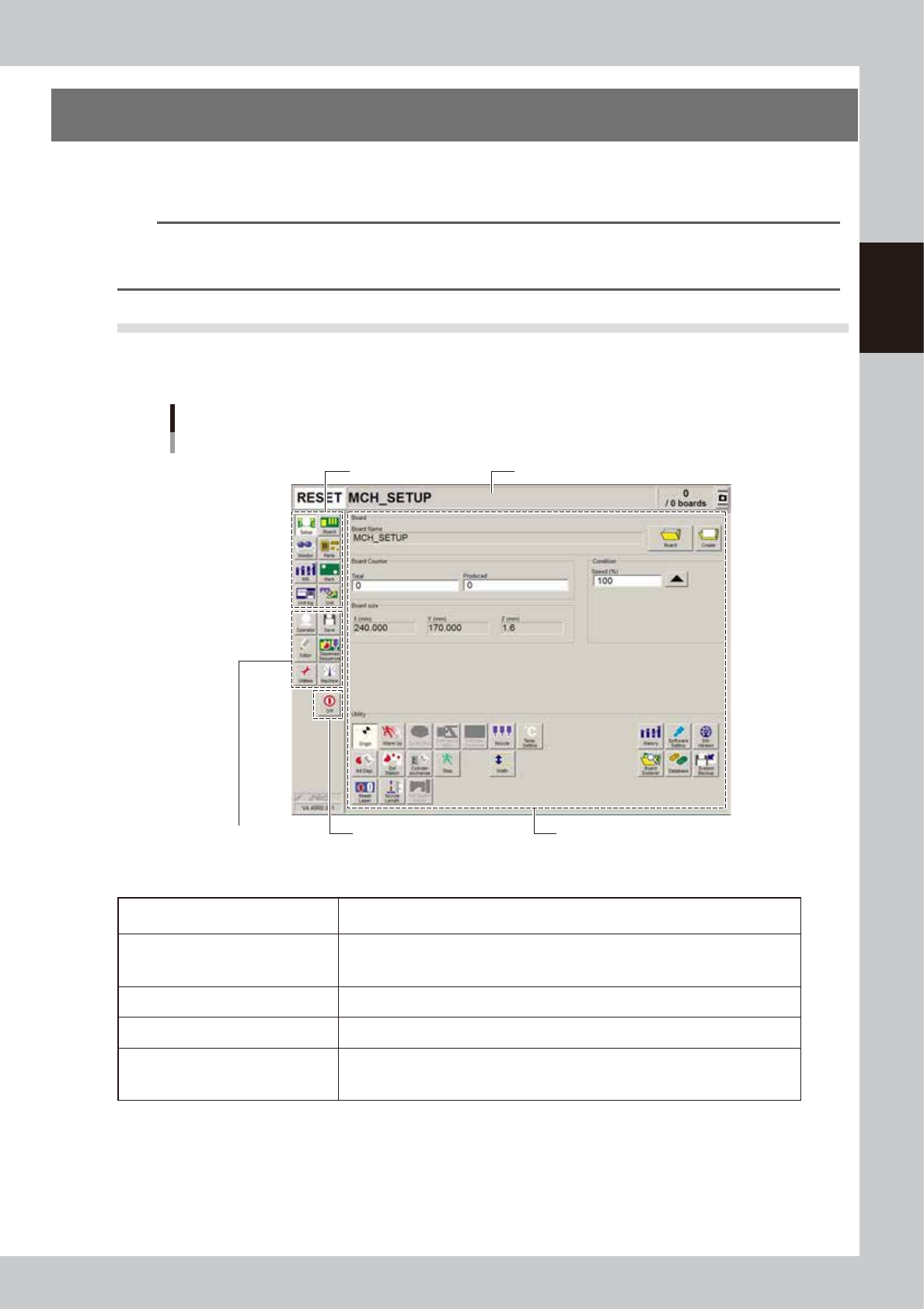
The operation screen can be divided into the "Status area", "Main menu button area" and "Submenu button and
parameter area" as shown below.
Operation screen basic configuration
Setup screen
Main menu button area 1
Main menu button area 2
Status area
Submenu button and parameter areaa
Main menu button area 3
64200-N7-10
n
Screen areas
Status area
Displays the current machine status on the left end, the selected board name in the
middle and the number of boards that have been produced on the right end.
Main menu button area 1
Shows the main menu buttons used to operate the machine.
The submenu button and parameter area will change according to the selected main
menu button.
Main menu button area 2 Shows the menu buttons used to call up auxiliary functions of the machine.
Main menu button area 3 Shows the [Off] button to turn off the machine.
Submenu button and parameter area
Displays the submenu buttons and parameters for machine operation and data
setting.
This area will change according to the selected main menu button.
2-8
2
Basic operation
n
Various buttons and parameter input fields
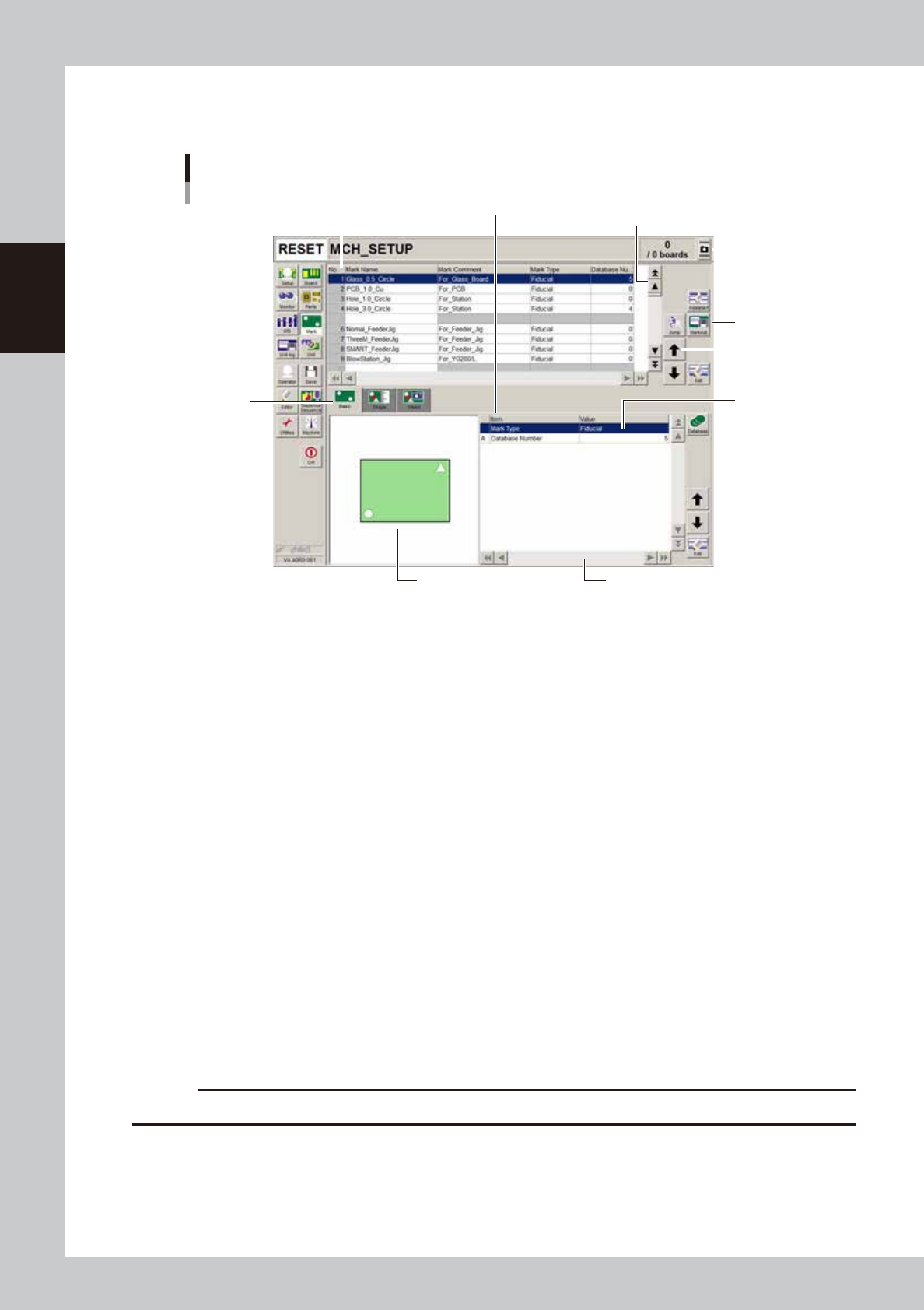
Various types of buttons, selection tabs and parameter input fields are used on the operation screen.
Operation screen example
Mark screen
1
1
2
3
4
5
6
7
Parameter listData No. list
64201-N7-00
1. Scroll bar and button (vertical and horizontal)
Use scroll bar or arrow buttons to see hidden items in the data No. list and parameter list.
2. Operation buttons
Press these buttons to open the next operation screen or dialog box.
3. Cursor up/down buttons
Use these buttons to move the cursor up or down through the data No. list and parameter list.
4. Parameter input field
Select, enter or edit parameters here. When a keyboard is used, double-click on the parameter input box to enter or edit
data.
When a touch screen (option) is used, press the [Edit] button on the lower right of the parameter list. The edit box then
pops up for data input and editing.
5. Selection tab
Select this tab to switch the parameter input screen.
6. Assistance screen
Shows an illustration or information useful for parameter input or editing. Alphabet characters shown in the parameter
list and in the illustration on this screen correspond to each other.
7. Capture button
Captures the displayed image. Captures a screen shot and saves it in a USB memory inserted into the machine’s USB port.
A “ScreenShot” folder is created in the root of the USB memory and the captured data (JPEG format) is stored in that
folder (maximum folder size is approx. 10MB), with a file name consisting of the date and time.
c
CAUTION
Always use a USB memory specified by YAMAHA to save the data.