VI User Manual.pdf - 第177页
Tools library Vision 2007 4.10 User Manua l Rev 01 7 - 15 7.3.2.2 Vector tool model creator Presentation Option av ailable on Vi-Pro model. Vector tool model c reator allows to cr eate model by using mouse on a real im a…
Tools library
7 - 14 Vision 2007 4.10 User Manual Rev 01
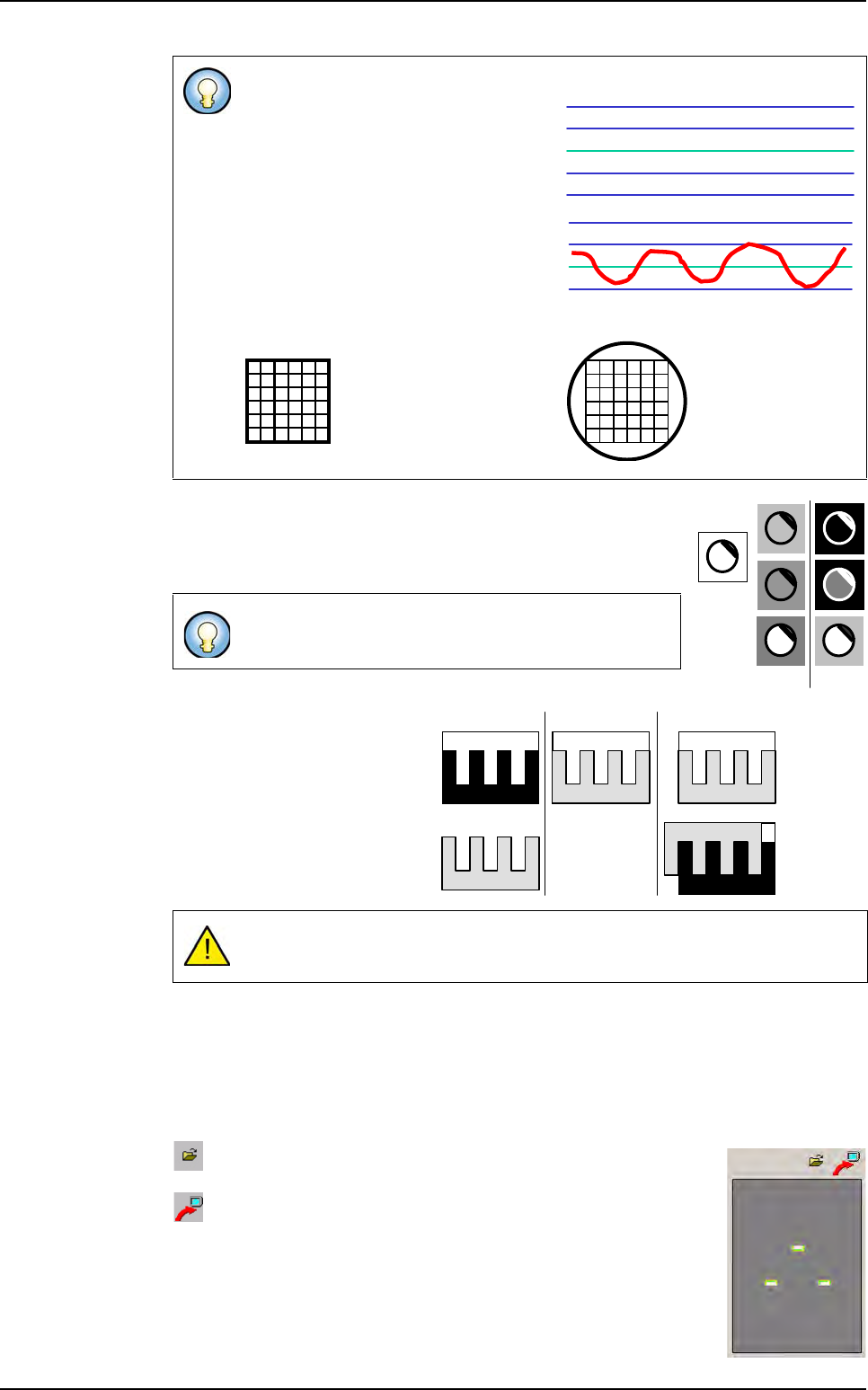
Tick Ignore polarity (C) to evaluate the transition vectors with
different polarities. The model's polarity is defined at each point
in the transitions as the transition direction (black => white or
white => black) and is not dependent on amplitude.
You can configure Vi-Pro to ig-
nore the model's polarity and only
use the shape vector information.
Polarity is a Vi-Pro parameter
which can make model corre-
spondence less ambiguous.
You should ignore polarity only
when the object is subject to po-
larity changes.
The Non uniform scale (D) tick box allows Vi-Pro to stretch the trained model in X or Y
and run a non-uniform scale. It can increase accuracy but is time consuming.
Tick Add position tolerance to the Vi-Pro search area (E) to add, the model's position
tolerances to the Vi-Pro search area at execution time.
Train image window
Save as you want the image extracted from Vi-Pro train and use
it as another synthetic image.
Load the Vi-Pro train in the COGNEX console.
Standard setting: between 0 and 1 (Max 6.0).
If you change the value to 0, only the
transitions near the straight line will be
detected. Detection accuracy is higher
but the transitions must be close to the
trained model.
If you change the value to 1, transitions
detected will be between 1 and -1 pix-
el. Accuracy is improved but the num-
ber of detections is reduced.
By default, Vi-Pro only recognizes models with the
same polarity as the trained model.
Incorrect use of this parameter may lead to false detections.
0*
* the model is perfect
1
0
-1
Elasticity = 0
If elasticity = 2,
then it detects
a circle!
Trained
model
Same
polarity
Different
polarity
Object
PatMax model
PatMax
using polarity
PatMax
ignoring polarity
Expected
correspondence
Incorrect
correspondence
Vi-Pro
Tools library
Vision 2007 4.10 User Manual Rev 01 7 - 15
7.3.2.2 Vector tool model creator
Presentation
Option available on Vi-Pro model.
Vector tool model creator allows to create model by
using mouse on a real image.
It is really easy and
fast, you just have to click on vertex along the shape.
Vector tool model creator is helpful for the vector
model programming. It is easier and faster to program
new model and more accurate if you directly enter the
component size in vertex table.
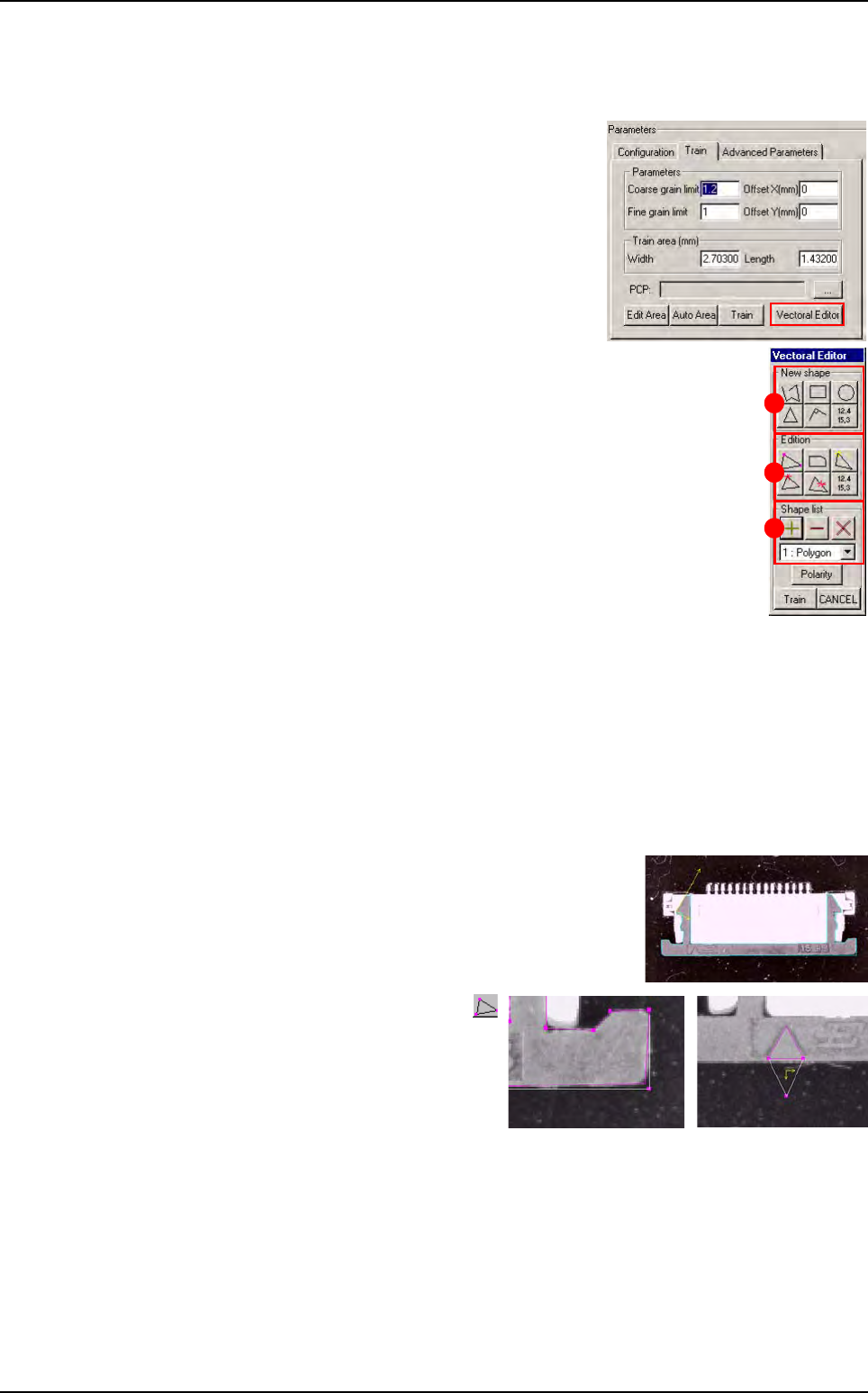
In Train tab, click on Vectoral Editor button, this win-
dow appears:
In New shape (1) part, buttons allow to add different kind of shape using
the mouse.
Several continuous segment (opened or closed shape)
A rectangle
A circle
A triangle
A square angle
Or if you know the exact component dimensions, click on button to enter
directly component vertex position in a table.
In Edition (2) part, buttons allow to edit vector.
In Shape list (3) part, buttons allow to manage several different and discontinuous
shapes in one model.
How to use Vector tool model creator ?
1. In Model description tab, create a Vi-Pro model and select the image.
2. In Vi-Pro tab, go to Train tab and click on Vectoral Editor button.
3. Create the shape with New shape button. Draw the
shape by using mouse on the image.To finish the
shape, double click.
4. To see and move a vertex press
button, then drag and drop the vertex
by clicking on it and move it.
1
2
3
Vi-Pro
Tools library
7 - 16 Vision 2007 4.10 User Manual Rev 01
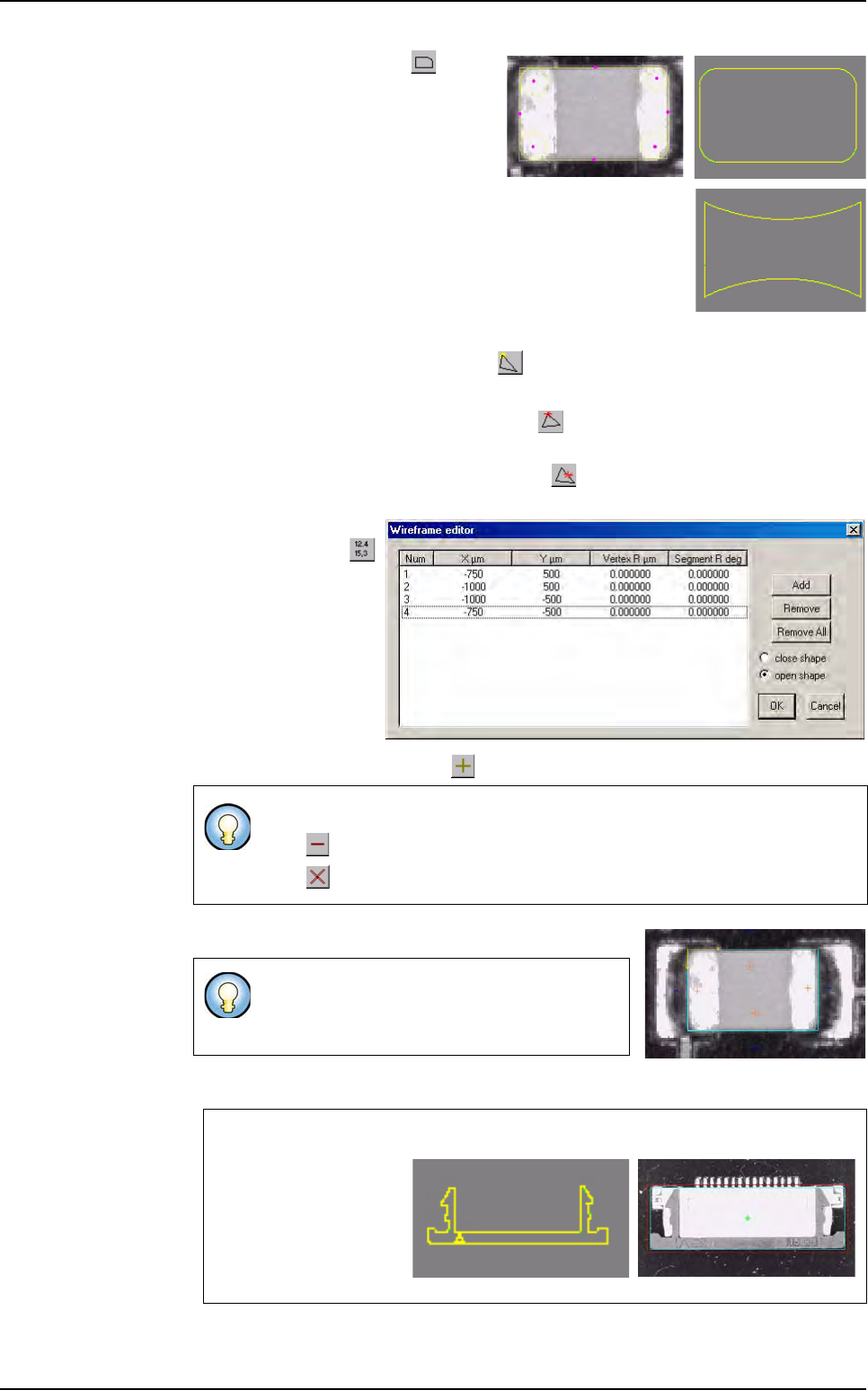
5. To round the shape, press button,
then click on the wanted vertex or seg-
ment and define the circle diameter.
6. To add or remove a vertex, and to remove a segment, several tools are available:
To add a vertex to the shape, press button, then click on the segment on which
the vertex is added, and move it to the wanted place.
To remove a vertex of the shape, press button, then click on the vertex to re-
move.
To remove a segment of the shape, press button, then click on the segment to
remove.
7. To edit the coordinates
of a vertex, press
button, the opposite
window appears in
which the vertex coor-
dinates are modified.
8. After the shape definition, press button to add it in the Shape list.
9. Click on Polarity button to reverse the vector polarity.
10. When the shape is OK, click on Train button to create the vector tool model.
For a same model, several shapes could be defined by using the Shape list.
Press button to remove a shape from the
Shape list.
Press button to remove all shapes from the
Shape list.
The old way of model programming used syn-
thetic image, so vector polarity was automati-
cally set during the training.
Example
This model is done with
2 shapes: 1 polygon
and 1 triangle.
The model is used like
a classical Vi-Pro mod-
el.
Model
with rouding vertex
Model
with rouding segment
Trained image
Vi-Pro