VI User Manual.pdf - 第266页
Optical Character Verification 8 - 4 Vision 2007 4.10 User Manual Re v 01 4. Check all p arameters: Zone number in which th e text will be inspected. Light level to use for the picture acquisition. Search Area posi…
Optical Character Verification
Vision 2007 4.10 User Manual Rev 01 8 - 3
8.2.2 Edit and configure a text object
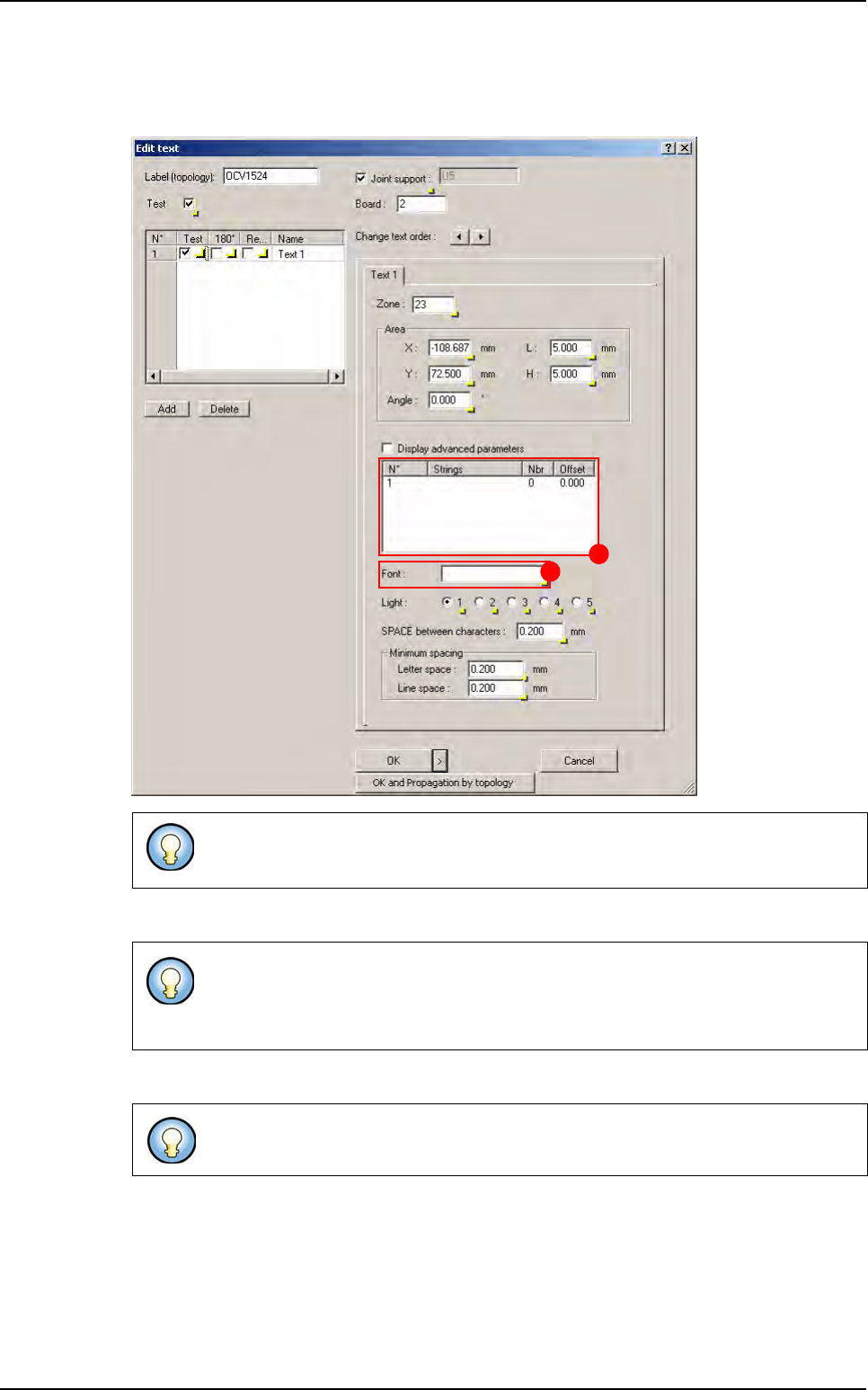
1. Select the edit from the tool bar and click on the text object to display the edition window.
2. Define the string (A) to verify (edit the box and add the lines to look for).
3. Enter the Font name (B) to be used in the library.
You can also use the find function (Ctrl + F) if you remember the label of the text you
want to edit.
The column Nbr corresponds to the minimum number of characters that needs to be
found to consider the string OK.
The column Offset corresponds to the shift of the line.
Each supplier can have a different font.
A
B
Creation procedure
Optical Character Verification
8 - 4 Vision 2007 4.10 User Manual Rev 01
4. Check all parameters:
Zone number in which the text will be inspected.
Light level to use for the picture acquisition.
Search Area position and size.
Space width character: defines the size of the space character.
Letter space is the minimum spacing between 2 characters.
Line space is the minimum space between 2 lines of text.
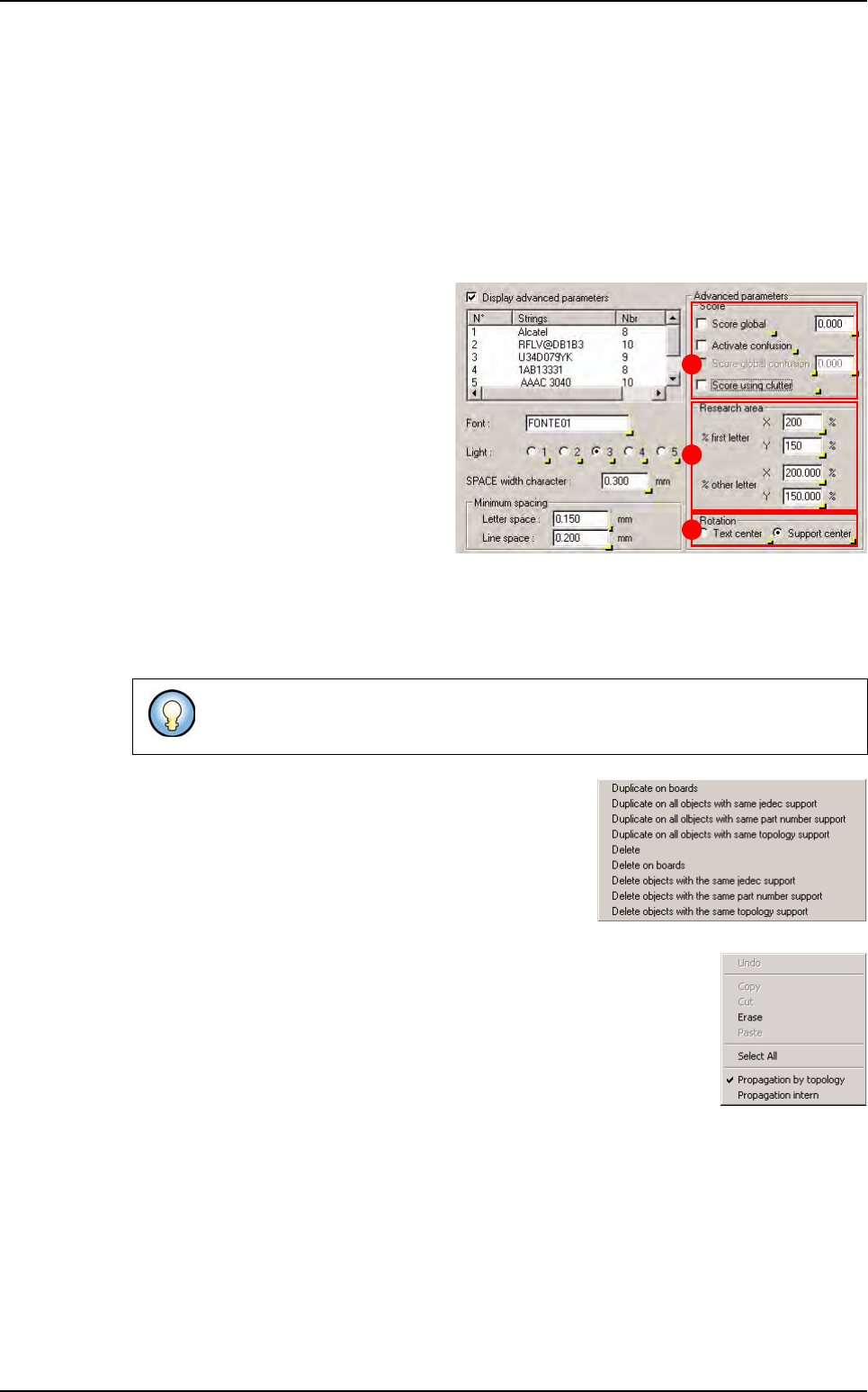
5. Tick Display advanced parameters to
check other settings:
In Score (A), define to use global pa-
rameters for all letters or individual
settings for each letter as defined in
the library.
Define the Research area (B) in % of
the train area, for the 1
st
letter of the
string and for the others letters
(These are the recommended val-
ues).
Define the Rotation origin (C) for the
test at 0° and 180°.
6. Click on Add to duplicate the selected object and create a link with different settings. The ex-
ecution will be in the defined order; as long as the text fails it will try with the next one. You
can change the order of execution with the change texts order button.
7. Right mouse click on the left side of the edition window to
see the following menu and be able to duplicate or delete
this label according to your selection.
Right mouse click in the edit box to select the propagation type (by topol-
ogy or intern) in order to propagate the value by the menu.
8. Tick Joint support to join the text to the component.
9. You can test or not each supplier, test each of them at 180° and realign each of them with the
component.
10. You can propagate this setting on all object with same topology. Click on > button (next to
OK control) and click on OK and propagation by topology.
This is useful if you have different suppliers for the same component. You can link
the different strings marked on all components.
A
B
C
Creation procedure
Optical Character Verification
Vision 2007 4.10 User Manual Rev 01 8 - 5
8.2.3 Train a font in the library
1. Open the library and
display the fonts
2. Create a new model
(make sure you use the
same name as defined
in the text object).
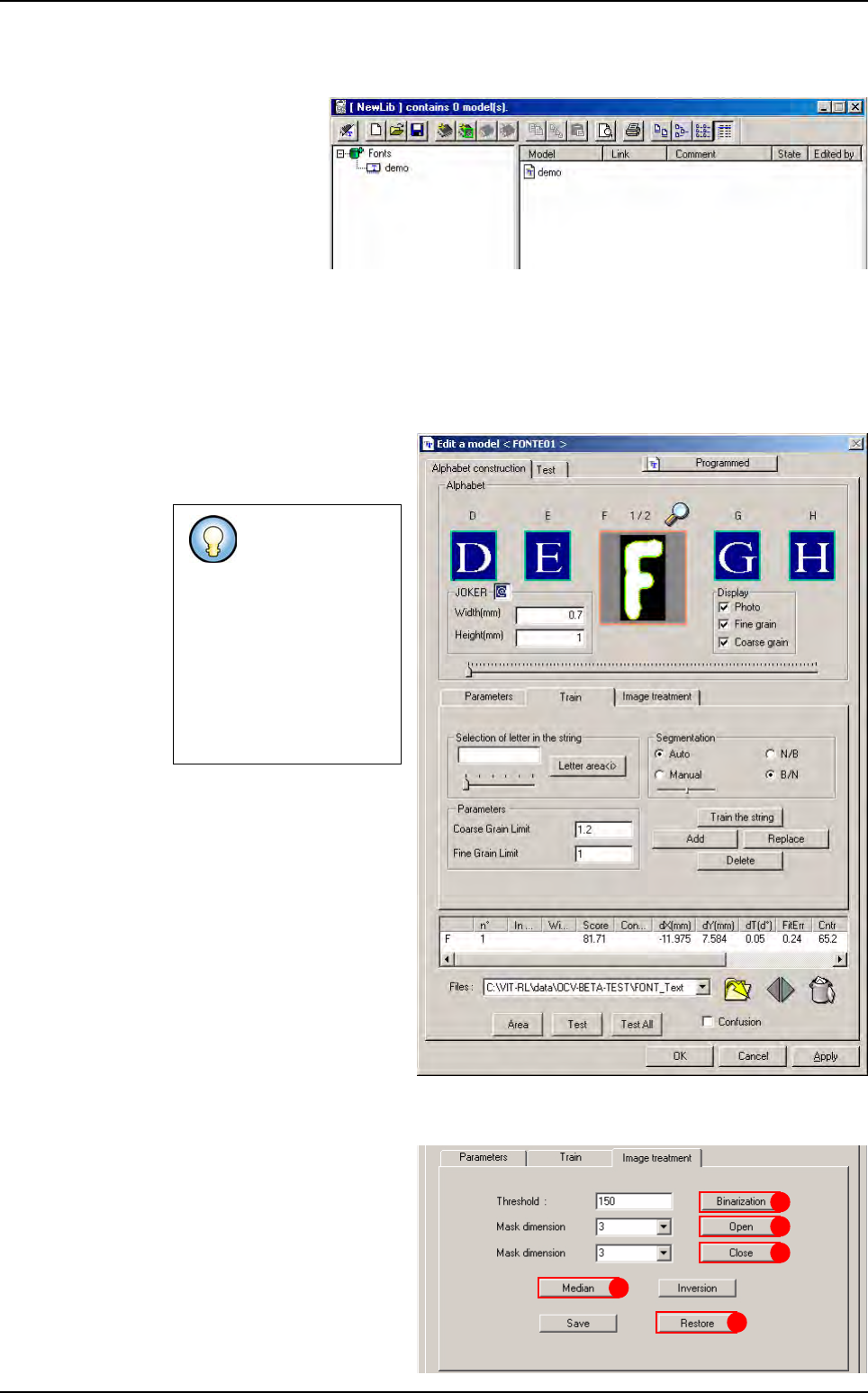
3. Edit the font model. The Edit a model window is composed of 2 tabs:
Alphabet construction: to train the characters and record the parameters.
Test: to test the settings on a real image.
8.2.3.1 Alphabet construction tab
Alphabet construction tab
permit to train the characters
and record the parameters
.
Before beginning the training,
select the picture of the string
that you have previously tak-
en.
You can open several pic-
tures and use the arrows
icons to swap from a picture
to another one. The dustbin
icon will remove pictures
from your list.
Image treatment tab
Go to the Image treatment
tab.
Use Binarization (A) to con-
vert the image into the binary
mode and create a synthetic
image.
It is recommended
to use a black and
white picture, wi-
thout noise, to
train the charac-
ters.
Use the Image
treatment tab to
get a correct bina-
ry picture.
A
B
C
D
E
Creation procedure