VI User Manual.pdf - 第240页
Tools library 7 - 78 Vision 2007 4.10 User Manual Re v 01 1. In Camera ( A ) section, select the cam era used to read the Data Matrix. The external ca mera takes picture dur ing the board loading. If you have cho- sen an…
Tools library
Vision 2007 4.10 User Manual Rev 01 7 - 77
7.12.5.2 DMatrix tab
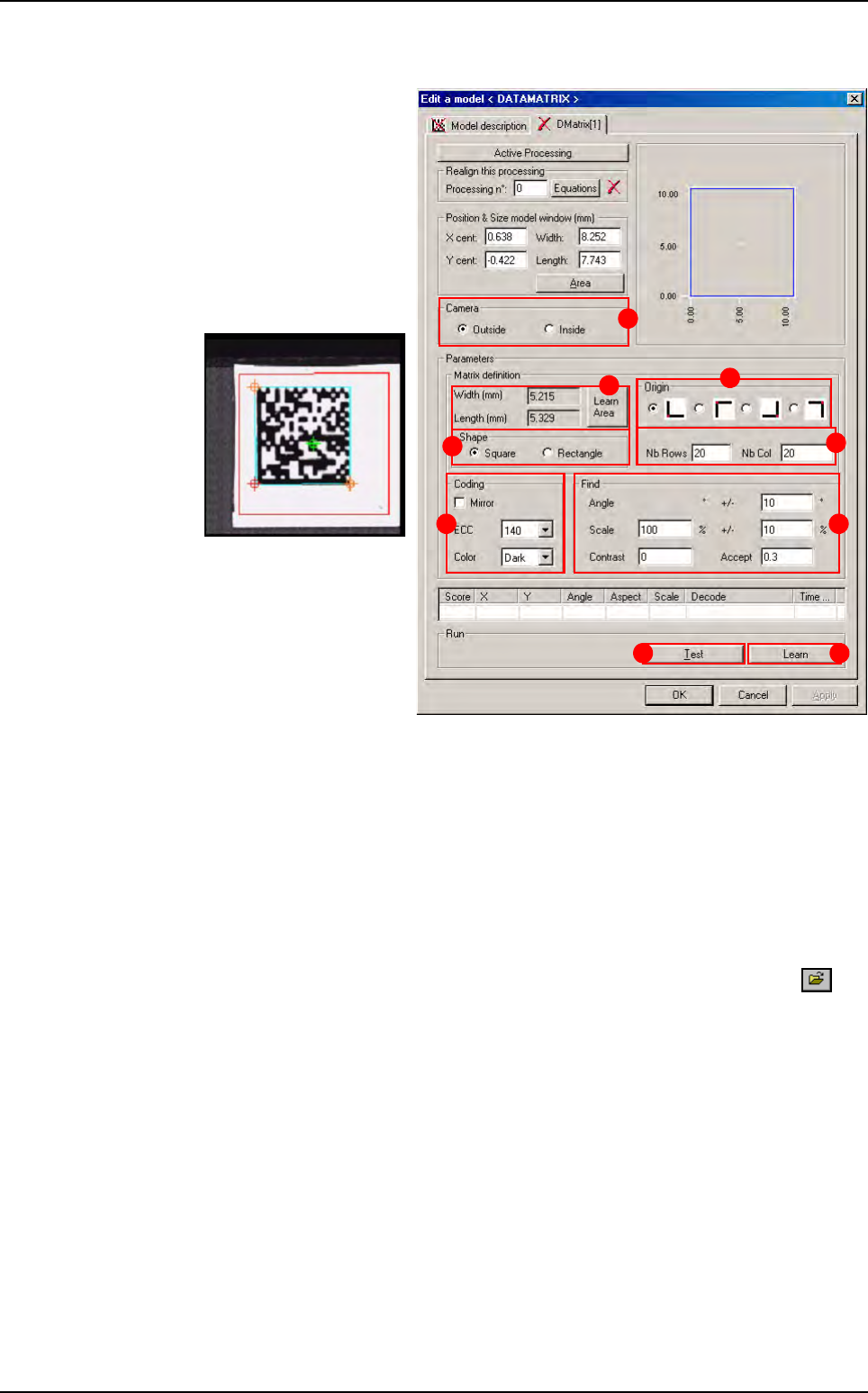
1.
In Camera (A) section,
select the camera used
to read the Data Matrix.
2. Adjust the tool learn
area around the Data
Matrix in the Cognex con-
sole, the search area will
automatically be setted
when pressing
Learn
Area
(B) button.
3. In Origin (C) section,
select the Data Matrix or-
igin position,
4. In Shape (D) section,
select the Data Matrix
shape.
5. Enter the number of
rows and columns (
E).
6. In Coding (F) section, select the coding type (ECC), and color.
7. Press Learn (G) button.
8. Once the model is learnt, press Test (H) button and adjust the detection parame-
ters (
I ): angle tolerance, scale, contrast and acceptance.
7.12.6 Data Matrix CVB model
7.12.6.1 Model description tab
1.
On the Model description tab, in the Edit a model window, click on the but-
ton. The .bmp file name to add in picture list window appears.
2. Select the image on which load the treatment.
3. Click on Edit area button to define the component size.
4. Choose the treatment operation: DMatrix CVB. A new DMatrix tab appears be-
hind the
Model description tab.
7.12.6.2 DMatrix tab
A
B
C
D
E
F I
GH
Data Matrix
Tools library
7 - 78 Vision 2007 4.10 User Manual Rev 01
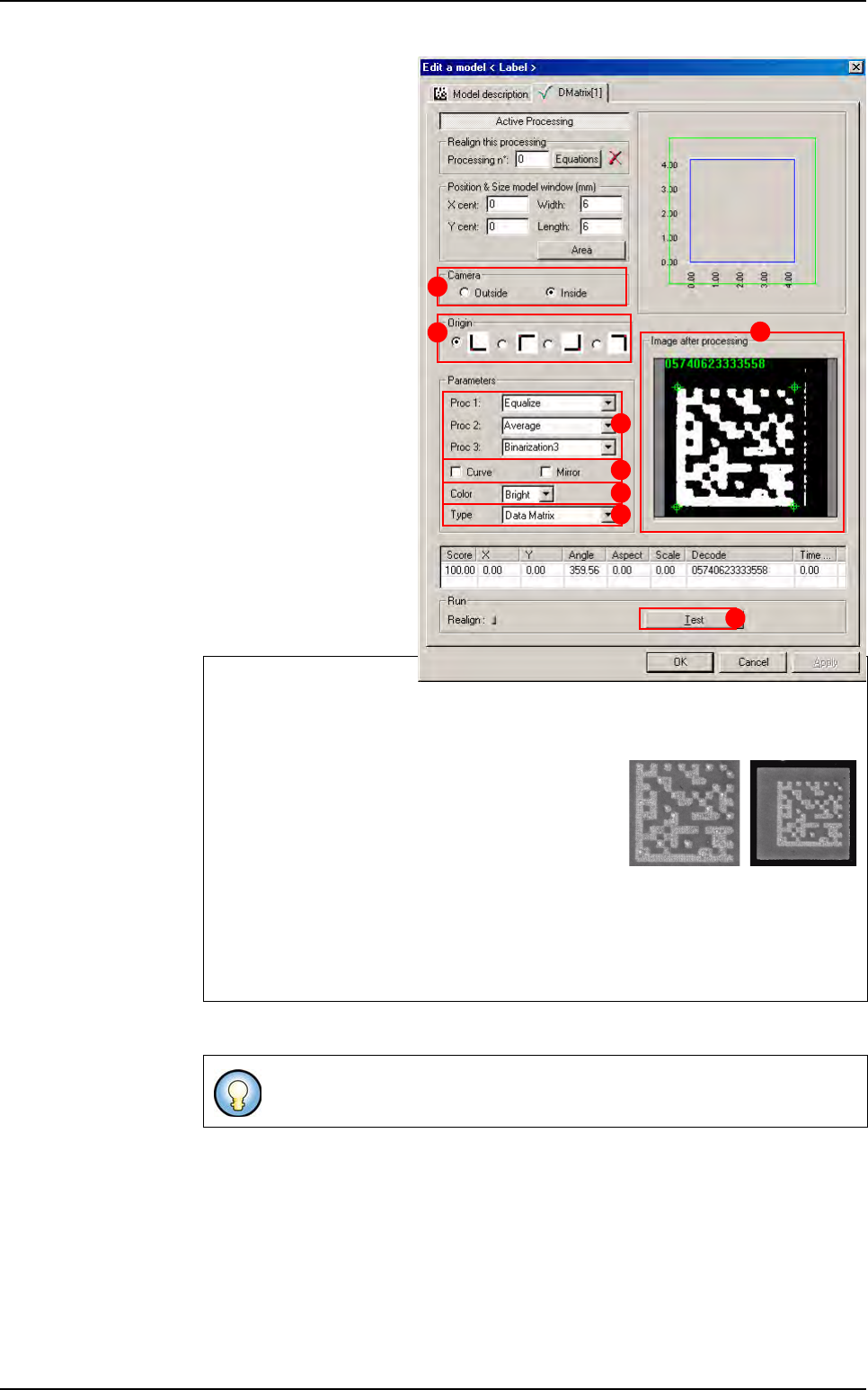
1. In Camera (A) section,
select the camera used to
read the Data Matrix. The
external camera takes
picture during the board
loading. If you have cho-
sen an external camera,
the search area is not
used, the software takes
care of the entire image.
2. In Origin (B) section,
you can select where is
the Data Matrix origin but
in most cases, the soft-
ware is able to find it it-
self.
3. In Parameters section,
when the picture is too
noisy to be decoded (ex:
Laser engraved data ma-
trix), it is possible to im-
prove the image quality.
Choose among the
Proc
...
(C) lists, the process-
ings to be executed on
the picture.
Tick
Curve or (and) Mirror (D) according to the Data Matrix type.
Select the Data Matrix
Color (E): dark on a bright background or bright on a dark bac-
kground.
Select the Data Matrix
Type (F) corresponding to the application.
Equalize: this processing increases the image dynamic to have pixel gray level
from 0 to 255.
Average
: this processing makes an average of the picture. It reduces the picture noise.
Binarization2: this processing computes 2 pixel
classes and returns a binary image based on these
2 classes.
Binarization3: this processing computes 3 pixel
classes and returns a binary image based on these
3 classes.
Inversion: this processing inverts the gray level scale. White pixels become black
and black become white.
Up to 3 processings will be applied one after the other.
Some Data Matrix are curved or (and) mirrored.
A
B
C
D
E
F
G
H
Data Matrix
Binarization2 Binarization3
Tools library
Vision 2007 4.10 User Manual Rev 01 7 - 79
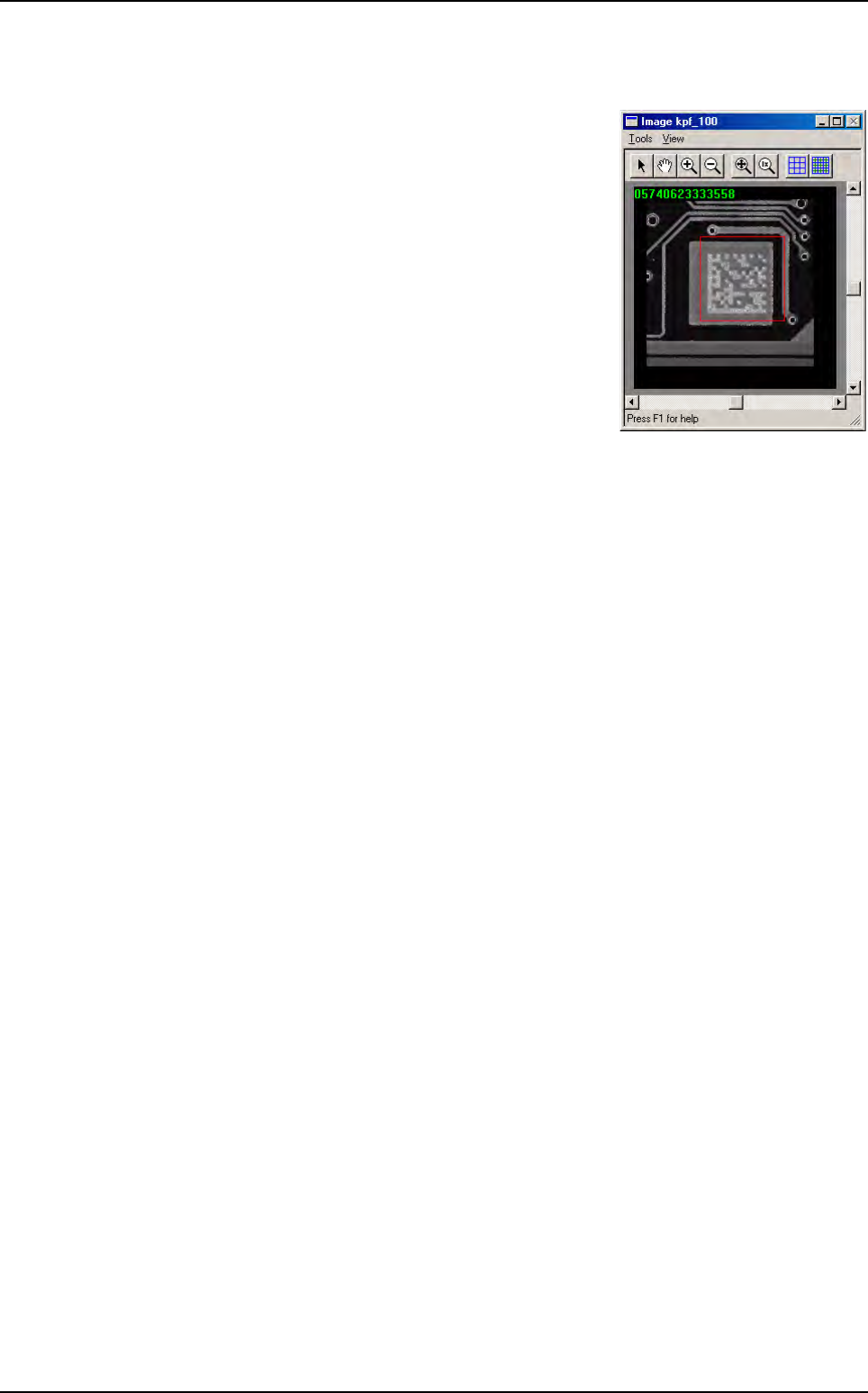
5. Press Test (G) button to lauch the Data Matrix reading test. The standard result
(score, XY position, theta, ...)
and the decoded character string are displayed.
You can also see the result in the COGNEX con-
sole
6. In Image after processing (H) section, the resulted image after processing is dis-
played to allow you to adjust the image processings.
Data Matrix