SL940-Install-Ops-Maintenance-7210918_B.pdf - 第37页
Safety 2-3 • Provide adequate spac e around t he coat ing sy stem to allow for m ovement of m aintenance and service per sonn el. Allow s pace f or acce ss doors and service pane ls to op en ful ly. • Make sur e all fac …

2-2 Safety
2.4 Basic Safety Precautions and Practices
Compliance with the following recommended precautions and practices will prevent personal injury or
damage to property during Select Coat SL-940E/SL-941E Series Conformal Coating System operation
and maintenance.
WARNING! CAUTION!
Failure to comply with any of the safety recommendations could cause serious
injury to the user or damage to the coating system.
2.4.1 Safety of Personnel
• Only trained personnel should be permitted to perform operation, maintenance, and
troubleshooting procedures.
• There should always be a second person present when performing maintenance on a system
that is powered up.
• Locate, identify, and obey all safety warning labels on your system before initial use. See 2.9
Safety Warning Labels for details.
• Immediately push the red Emergency Machine Off (EMO) button if personnel are in danger
of being injured.
• Lock out and tag out power and disconnect facility air to the coating system before
performing service or maintenance on the coating system. See 2.13 Lockout of Electrical and
Pneumatic Energy for details.
• Lock out and tag out power to upstream and downstream machines before performing service
or maintenance on the coating system.
• Do not wear loose clothing or jewelry while operating the system. Tie back long hair to
prevent it from being caught in moving parts.
• Do not touch the dispensing head (robot), conveyor, or other moving parts while the coating
system is operating.
• To prevent burn injury, wear thermal gloves when working around heater tooling and fluid
heaters.
• If your system is equipped with Laser Fan Width Control, use extreme care to avoid looking
directly at the laser beam or its reflection off of mirror-like surfaces. See 2.7 Laser Radiation.
• Make sure the main power cable and main air supply hose are securely connected before
operating the coating system.
• If in a confined room, ensure adequate and uninterrupted air ventilation, heating, and cooling
to meet environmental stress limits of personnel and the coating system.
• Where volatile organic compound (VOC) emissions can exceed safe limits, facility
ventilation and filtration systems must be operational.

Safety 2-3
• Provide adequate space around the coating system to allow for movement of maintenance and
service personnel. Allow space for access doors and service panels to open fully.
• Make sure all facility power sources are safely grounded.
• Routinely inspect all air hoses and electrical cables for damage.
• Make sure power cords and air supply hoses do not cross a walkway or aisle.
• Before attempting to lift a load, take into consideration facility lifting and transport
precautions. See 2.6 Lifting and Transport Precautions.
• Maintain a clean and orderly work area.
2.4.2 Material Safety
• Follow Material Safety Data Sheet (MSDS) recommendations for the proper handling,
cleanup, and disposal of all materials and fluids and their containers (i.e., syringes, cups,
reservoirs, etc.) used with the coating system.
• Make sure the coating system ventilation is ON during handling and cleanup of all materials
used with the coating system.
• Know the MSDS recommendations for treatment of injury resulting from exposure to
hazardous materials. See 2.4.4 High-Pressure Fluids.
• Always wear appropriate personal protective equipment (PPE) as recommended by facility
safety practices and the material manufacturer’s MSDS.
• When working with multiple fluids, refer to the MSDS to ensure the materials are
compatible.
• If possible, save or recycle unused materials. Refer to the MSDS before saving or recycling
unused materials.
2.4.3 Preventing Coating System and Workpiece Damage
• Immediately push the EMO button if coating system or a workpiece is in danger of
being damaged.
• Use standard Electrostatic Discharge (ESD) precautions when working near sensitive
components. Always wear a grounding strap and connect it to the ESD ground before
handling workpieces.
• Immediately contain and clean up any caustic or conductive fluid spills as recommended in
the material manufacturer’s MSDS. If fluid gets into internal portions of the machine,
immediately contact Asymtek Technical Support.
• Follow all recommended system maintenance procedures.
• Always keep the dispensing area clear of any fallen workpieces or obstacles.
• Ensure that no air intake or exhaust grilles are blocked when the system is in operation.
2-4 Safety
2.4.4 High-Pressure Fluids
High-pressure fluids, unless they are safely contained, are extremely hazardous. Always relieve fluid
pressure before adjusting or servicing high-pressure equipment. Fluids penetrating the skin can cause
toxic poisoning.
If you suffer a fluid injection injury, seek medical care immediately. If possible, provide a copy of the
MSDS for the injected fluid to the health care provider.
2.4.5 Halogenated Hydrocarbon Solvent Hazards
Do not use halogenated hydrocarbon solvents in a pressurized system that contains aluminum
components. Under pressure, these solvents can react with aluminum and explode, causing injury, death,
or property damage. Halogenated hydrocarbon solvents contain one or more of the following elements:
Element Symbol Prefix
Fluorine F “Fluoro-”
Chlorine Cl “Chloro-”
Bromine Br “Bromo-”
Iodine I “Iodo-”
2.5 Disposal
Dispose of equipment and materials used in operation and servicing in accordance with local regulations.
2.6 Lifting and Transport Precautions
1. Before attempting to lift a load, personnel should take into consideration the following
factors:
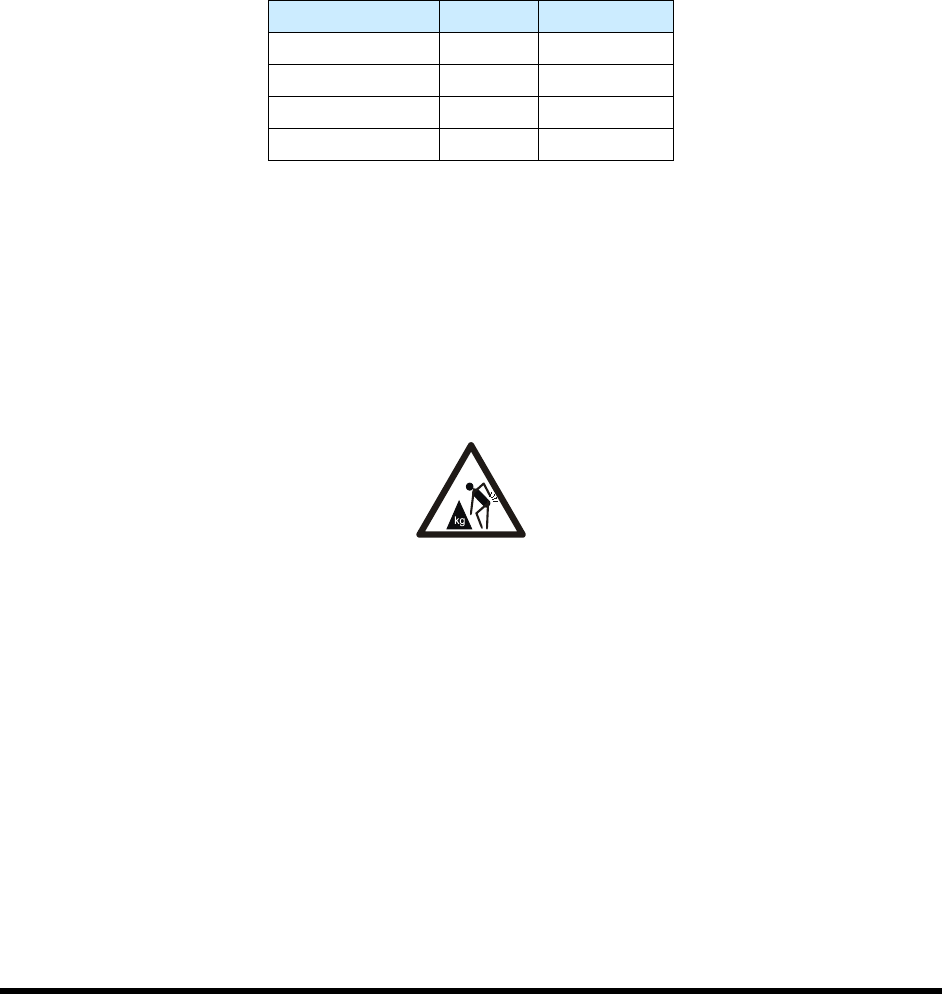
• Does the load display a lift hazard warning label as shown below?
• Is lifting and transporting equipment available that might make the task safer and
easier?
• Do you need to use personal protective equipment such as back supports and work
gloves?
• Do you need an assistant to help you lift or guide the load?
• Do you know the destination for the load and the route you have to follow?
• Has the load been prepared for lifting (doors closed, facility cables/air lines
disconnected, loose items secured, earthquake-bolts removed)?
2. When lifting, transporting, and lowering heavy or large loads, personnel should observe the
following precautions:
• Stand close to the load to be lifted and place your feet at shoulder width.
• Firmly grip the load and bring the load close to your body.