SL940-Install-Ops-Maintenance-7210918_B.pdf - 第38页
2-4 Safety 2.4.4 High - Pressure F luids High - pressure flui ds, unle ss they are sa fely conta ined, are ext rem ely haz ardous. A lways re lieve flu id pressure before ad justing or servi cing hi gh - pressure equipme…

Safety 2-3
• Provide adequate space around the coating system to allow for movement of maintenance and
service personnel. Allow space for access doors and service panels to open fully.
• Make sure all facility power sources are safely grounded.
• Routinely inspect all air hoses and electrical cables for damage.
• Make sure power cords and air supply hoses do not cross a walkway or aisle.
• Before attempting to lift a load, take into consideration facility lifting and transport
precautions. See 2.6 Lifting and Transport Precautions.
• Maintain a clean and orderly work area.
2.4.2 Material Safety
• Follow Material Safety Data Sheet (MSDS) recommendations for the proper handling,
cleanup, and disposal of all materials and fluids and their containers (i.e., syringes, cups,
reservoirs, etc.) used with the coating system.
• Make sure the coating system ventilation is ON during handling and cleanup of all materials
used with the coating system.
• Know the MSDS recommendations for treatment of injury resulting from exposure to
hazardous materials. See 2.4.4 High-Pressure Fluids.
• Always wear appropriate personal protective equipment (PPE) as recommended by facility
safety practices and the material manufacturer’s MSDS.
• When working with multiple fluids, refer to the MSDS to ensure the materials are
compatible.
• If possible, save or recycle unused materials. Refer to the MSDS before saving or recycling
unused materials.
2.4.3 Preventing Coating System and Workpiece Damage
• Immediately push the EMO button if coating system or a workpiece is in danger of
being damaged.
• Use standard Electrostatic Discharge (ESD) precautions when working near sensitive
components. Always wear a grounding strap and connect it to the ESD ground before
handling workpieces.
• Immediately contain and clean up any caustic or conductive fluid spills as recommended in
the material manufacturer’s MSDS. If fluid gets into internal portions of the machine,
immediately contact Asymtek Technical Support.
• Follow all recommended system maintenance procedures.
• Always keep the dispensing area clear of any fallen workpieces or obstacles.
• Ensure that no air intake or exhaust grilles are blocked when the system is in operation.
2-4 Safety
2.4.4 High-Pressure Fluids
High-pressure fluids, unless they are safely contained, are extremely hazardous. Always relieve fluid
pressure before adjusting or servicing high-pressure equipment. Fluids penetrating the skin can cause
toxic poisoning.
If you suffer a fluid injection injury, seek medical care immediately. If possible, provide a copy of the
MSDS for the injected fluid to the health care provider.
2.4.5 Halogenated Hydrocarbon Solvent Hazards
Do not use halogenated hydrocarbon solvents in a pressurized system that contains aluminum
components. Under pressure, these solvents can react with aluminum and explode, causing injury, death,
or property damage. Halogenated hydrocarbon solvents contain one or more of the following elements:
Element Symbol Prefix
Fluorine F “Fluoro-”
Chlorine Cl “Chloro-”
Bromine Br “Bromo-”
Iodine I “Iodo-”
2.5 Disposal
Dispose of equipment and materials used in operation and servicing in accordance with local regulations.
2.6 Lifting and Transport Precautions
1. Before attempting to lift a load, personnel should take into consideration the following
factors:
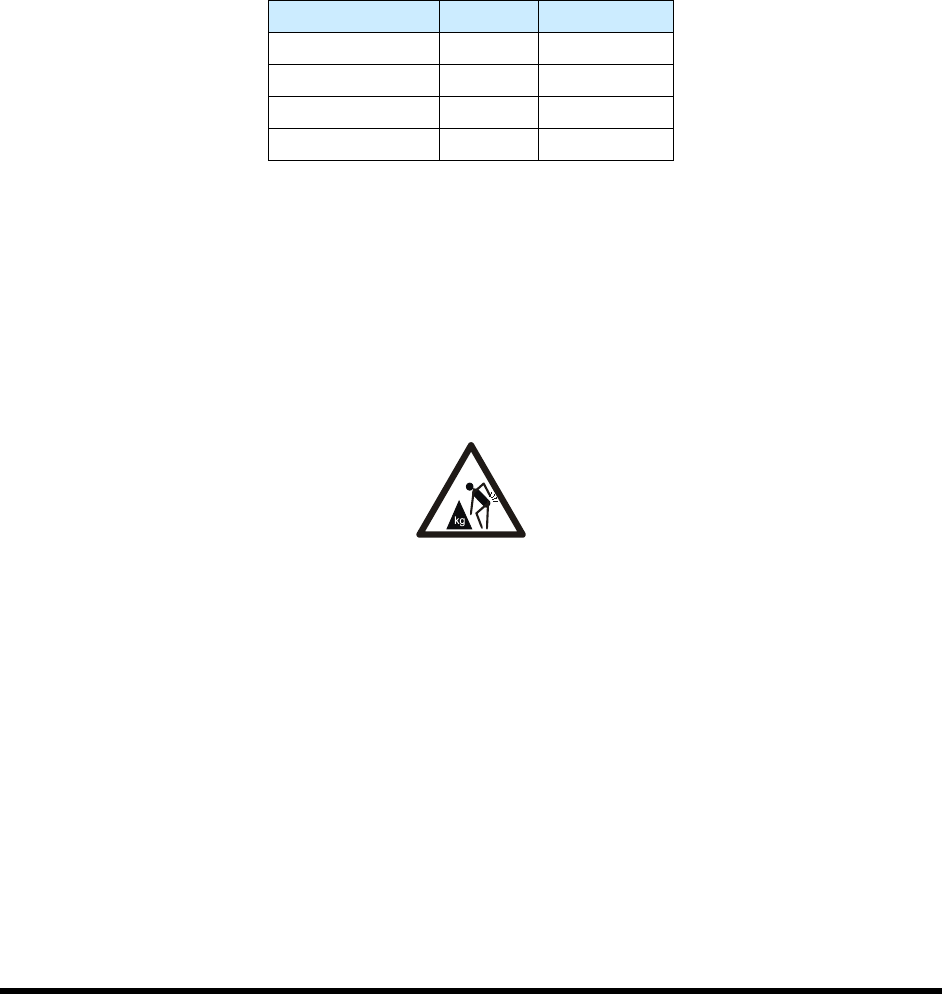
• Does the load display a lift hazard warning label as shown below?
• Is lifting and transporting equipment available that might make the task safer and
easier?
• Do you need to use personal protective equipment such as back supports and work
gloves?
• Do you need an assistant to help you lift or guide the load?
• Do you know the destination for the load and the route you have to follow?
• Has the load been prepared for lifting (doors closed, facility cables/air lines
disconnected, loose items secured, earthquake-bolts removed)?
2. When lifting, transporting, and lowering heavy or large loads, personnel should observe the
following precautions:
• Stand close to the load to be lifted and place your feet at shoulder width.
• Firmly grip the load and bring the load close to your body.
Safety 2-5
• Lift your head and shoulders first and with your back straight, use the strength of
your legs to slowly and smoothly raise yourself up.
• DO NOT twist your body. Change direction by first moving your feet.
• When transporting the load on a cart or a lifting device, reduce back strain by
pushing rather than pulling the load.
• When lowering the load, bend your knees, lower it slowly and smoothly, and keep
your fingers out from under the load.
2.7 Laser Radiation
The optional Laser Fan Width Control uses a Class II laser sensor. The following safety precautions
should be observed in addition to the standard coating system safety precautions.
• Operate the Laser Fan Width Control only according to the procedures described in the
instructions included. Failure to do so may result in injury due to exposure to the laser beam.
• DO NOT look directly at the laser beam.
WARNING! Looking directly at the laser beam may result in serious eye injury.
NOTE The laser beam is not harmful to the skin. There is no danger in exposing arms or hands
to the beam. The only possible health hazard is in exposing the eyes to the laser beam.
Table 2-1 Laser Fan Width Control Specifications
ORGANIZATION CLASSIFICATION
FDA CLASS II
IEC 60825-1 1998-01 CLASS 2
DIN EN 60825-1 1998-01 KLASSE 2
2.8 Earthquake Precautions
In the event of an earthquake, your coating system must be secured to prevent movement that could
cause injury to personnel and damage to the coating system and facility. Each coating system leveler
(foot) should be anchored to the floor. See 3.9 Anchoring the Coating System.
As a safety precaution, all hazardous electrical and pneumatic energy is automatically bled out of the
system if electrical power is lost.
WARNING! All personnel should follow facility earthquake safety guidelines.