00194440-10_SM_X-Series_Customer_en.pdf - 第137页
Service Work 3.4.6 Checking the Cable Routing Placement heads Service Manual SIPLACE X Series 137 Using a dummy plug ▪ The connector strip (1) needs to be covered. ▪ Use the "dummy plug" [00368931-xx] (2) for t…
Service Work
Placement heads 3.4.6 Checking the Cable Routing
136 Service Manual SIPLACE X Series
3.4.6
3.4.6 Checking the Cable Routing
Checking the Cable Routing
Cable routing on the SIPLACE D1/D2
Correct cable routing to and from the placement head is essential for long and accurate operation.
The high acceleration of the gantries can cause wear and damage to the connection leads.
▪ Covering free pins with plastic caps:
Flat ribbon cables and coax cables could be damaged by exposed pins, which is why all free pins
must be covered with plastic caps.
Use the dummy plugs [00368931-xx] for this.
▪ Optimum positioning of cable ties:
Cables ties should be positioned so that the cables can be fastened properly and are guided past
any sharp edges.
▪ Cable clamps for flat ribbon cables:
If run together, narrow flat ribbon cables should be placed under wider ones.
The cables should not be crossed under the clamp.
3.4.6.1
3.4.6.1 Cable Routing for Gantry Head Distributor Board
Cable Routing for Gantry Head Distributor Board
SIPLACE D1/D2 as example
CAUTION
Example illustration
In the event of service work, compare the arrangement of cables with that at another gantry.
The cable routing in this chapter is illustrated using the example of a D1/D2 machine, with the
intention of drawing your attention to the existing critical points on every machine.
CAUTION
Check the cable routing!
Incorrect cable routing or poor fixture of the connection cables can cause mechanical damage.
This can then lead to malfunctions, non-reproducable errors and machine standstill.
Position cable ties correctly.
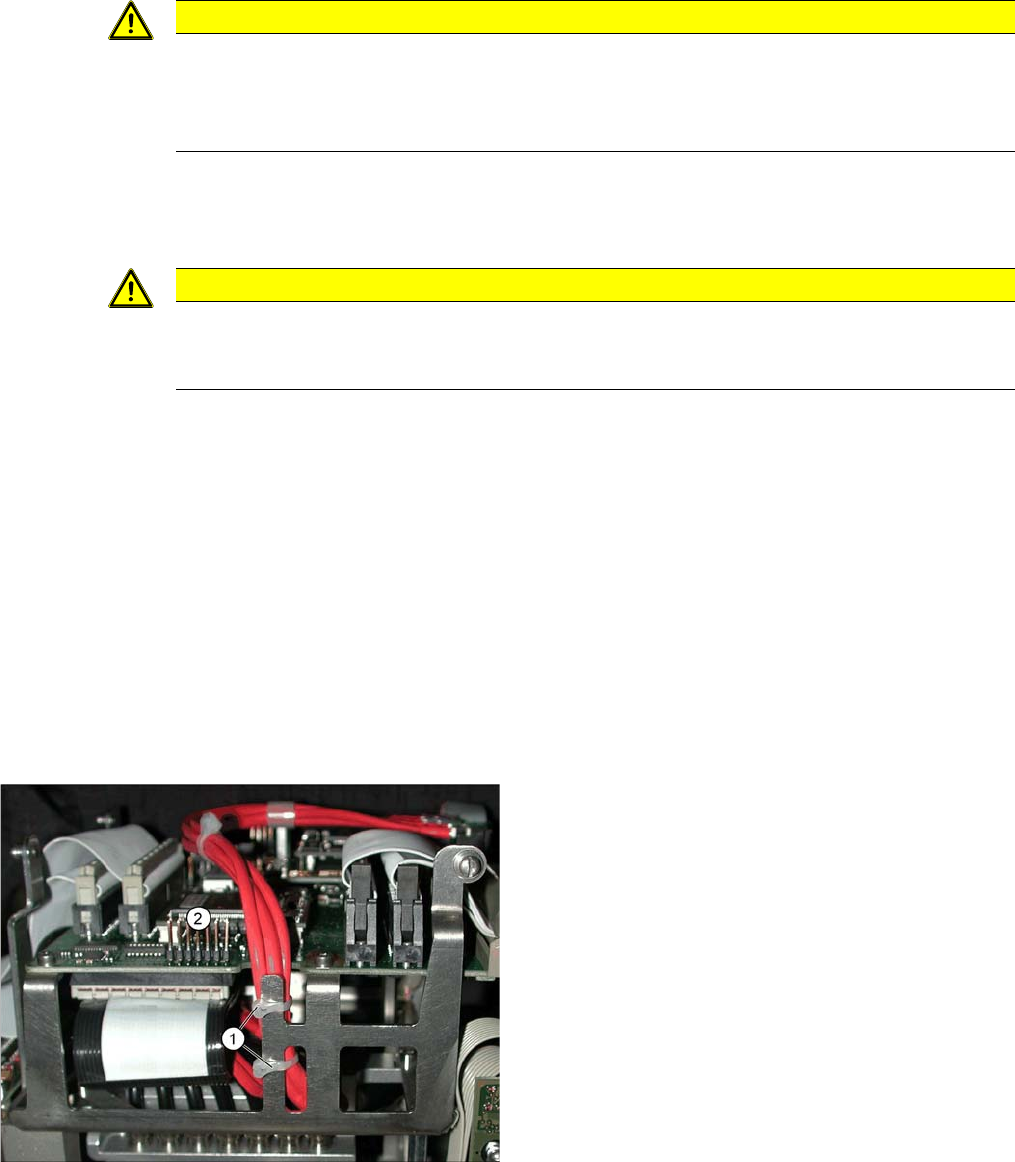
The coax camera cables to the gantry head distributor
need to be fixed with cables ties at the side.
The diagram shows the optimum position (1) for two ca-
ble ties, so that the cables do not touch the connector
strip (2).
▪ However, the connector strip (2) should still be fitted
with a dummy plug for safety purposes.
Service Work
3.4.6 Checking the Cable Routing Placement heads
Service Manual SIPLACE X Series 137
Using a dummy plug
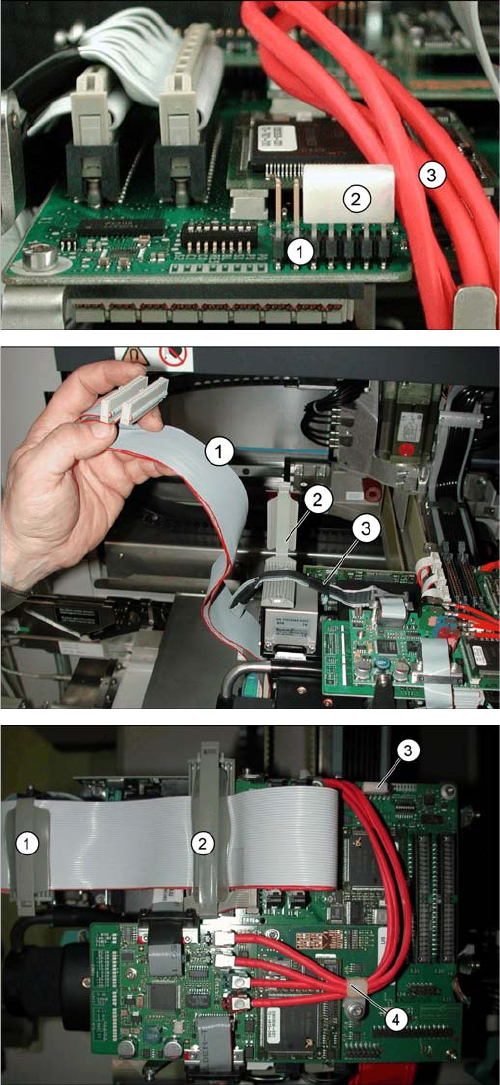
▪ The connector strip (1) needs to be covered.
▪ Use the "dummy plug" [00368931-xx] (2) for this.
▪ Position the dummy plug (2) so that the connectors
pointing towards the cable (3) to be protected are
covered.
Wide flat ribbon cables are run above narrow ones
▪ If run together, narrow flat ribbon cables (3) must be
run under wider ones (1).
▪ Finally, carefully close the clamp.
Cable clamps for flat ribbon cable
▪ The flat ribbon cable must be fixed with the clamps
(1) and (2). Use the "flat ribbon cable fastening
FCM3" 2 [03001829S01] for this.
▪ The narrower camera cable should be run under the
wide flat ribbon cable.
▪ Unused connector strips should be covered with a
plastic cap (3).
▪ The cable clamp (4) for the coax camera cables
needs to be fixed into place.
Service Work
Placement heads 3.4.6 Checking the Cable Routing
138 Service Manual SIPLACE X Series
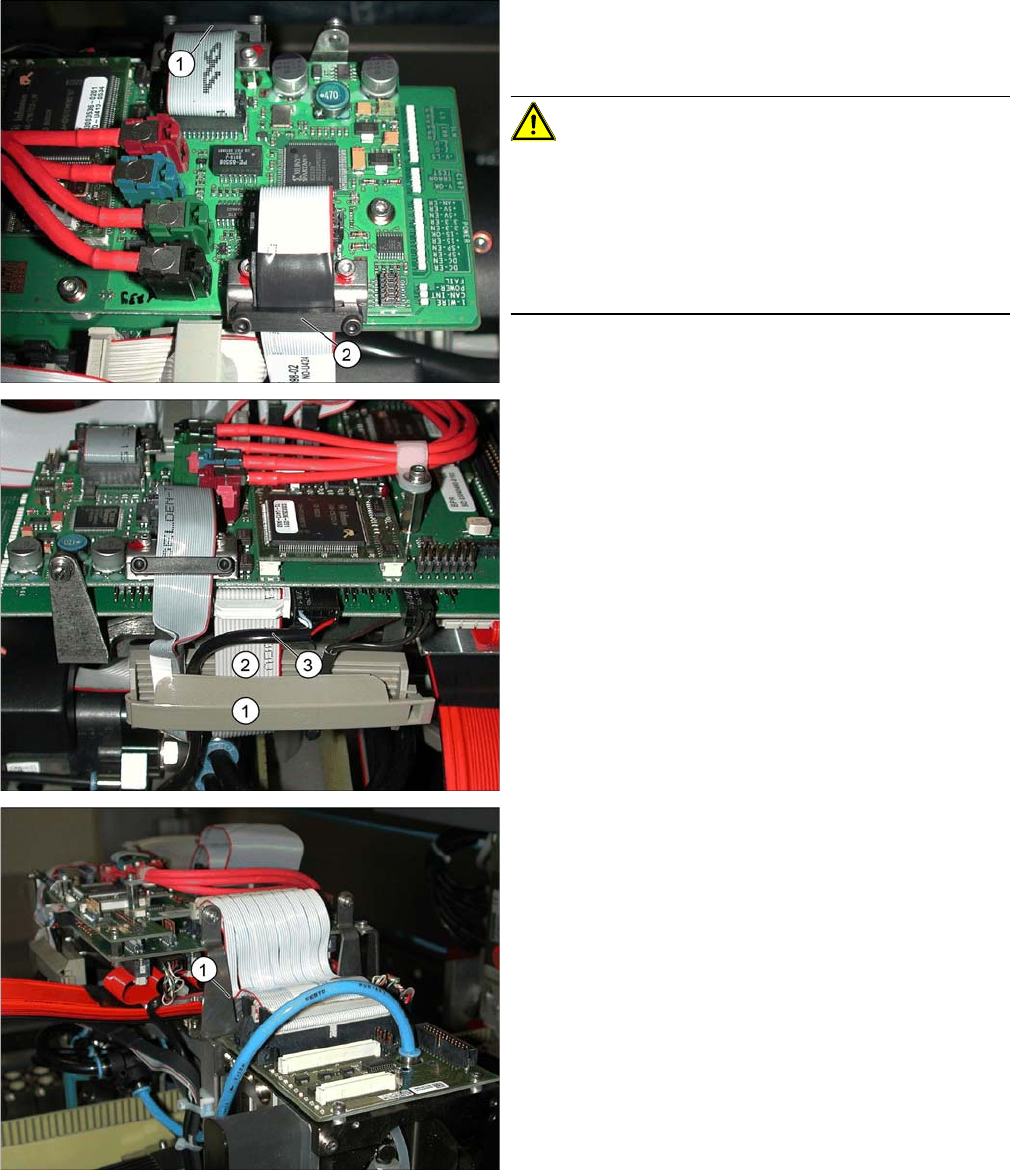
Fixture clamps
▪ The camera cables need to be fastened with fixture
clamps before the connector plugs.
CAUTION!
Do not pinch the cables!
If the camera cable is pinched at the side and damaged,
this could lead to a short circuit (40V) and, for example,
could damage the DC/DC converter.
Always fix cables with a clamp in the middle (2). Do not
overtighten the screws of the fixture clamp.
▪ Check that the clamps are fixed properly at points (1)
and (2).
Securing the connector strip with a cable clamp
▪ To ensure reliable connections, use a cable clamp
(1).
▪ Inside the cable clamp, the cables should be run next
to one another, see also items (2), (3).
Avoid damage from old supporting plates
▪ Old supporting plates have a gap which is too narrow
for the flat ribbon cable. This could lead to the flat rib-
bon cable insulation being damaged.
▪ If the flat ribbon cable rubs against the supporting
plate, see item (1), either replace the supporting plate
or reduce the width of the flat ribbon cable according-
ly in the vicinity of the gap (2).