YSP20_Users_E.pdf - 第143页
5-17 5 Creating and setting the data T o set the lighting for inspecting excess solder and flux spreading to the backside of the mask, press the [Light] button while the [Surface] button is depressed. Y ou can then chang…
5-16
5
Creating and setting the data
4.2 Mask data detail setting
l
Mask check positions
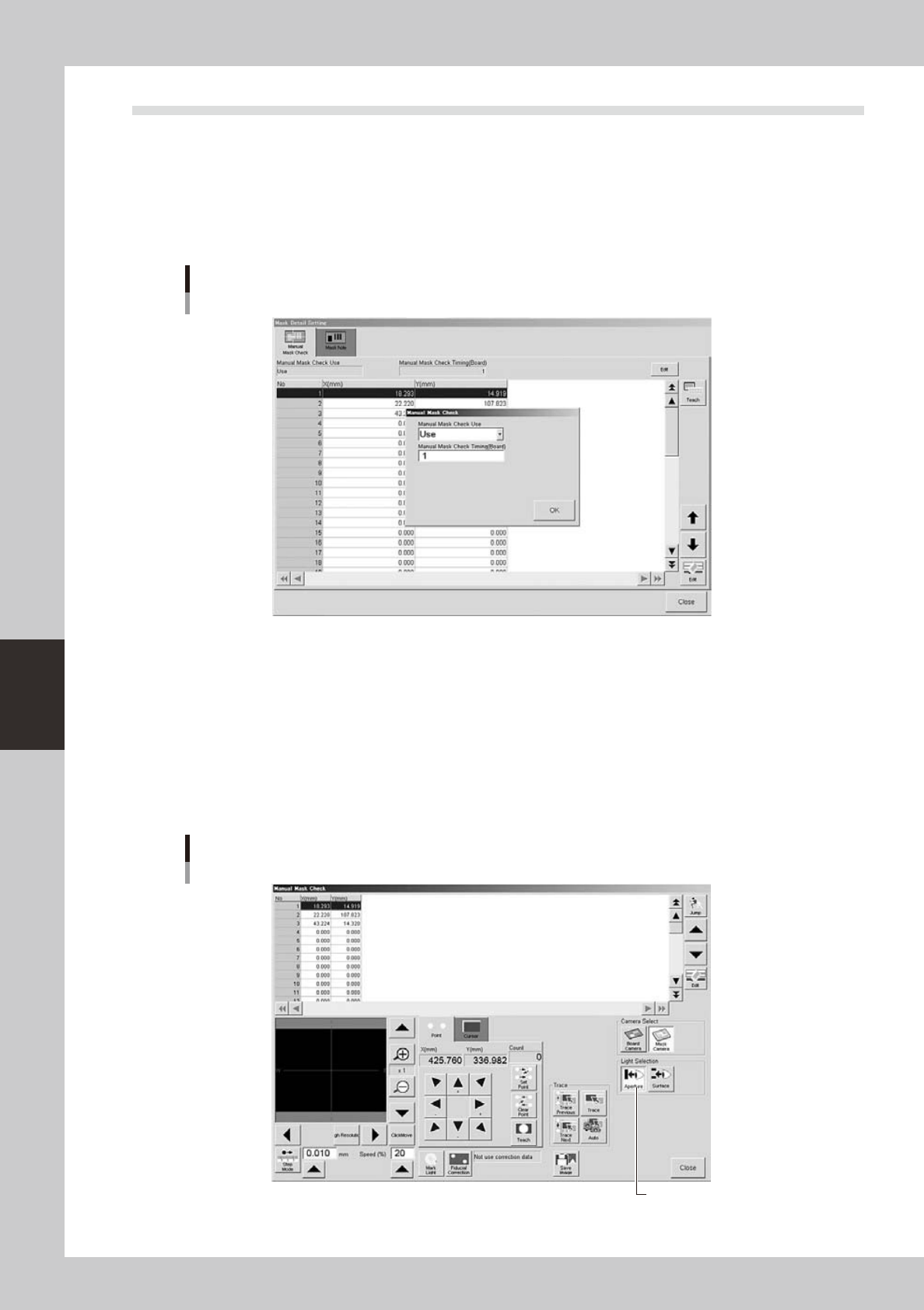
When you press the [Detail] button on the [Print]-[Mask] tab, the following dialog box appears for setting the mask check
positions. You can specify positions on the mask where you want make a visual check after solder printing. Pressing the
[Edit] button at the upper right opens the "Manual Mask Check" dialog box. Set whether to use this function or not. Also
set the board interval (number of boards) at which to make the visual check.
[Manual Mask Check] tab
64519-N3-10
l
Lighting setup for visual mask check
The lighting settings needed when making the mask aperture inspection (clogging inspection) and mask backside
inspection (inspection of excess solder spreading to backside) can be now separately set for each inspection and stored
as board data.
Pressing the [Teach] button after entering the mask inspection coordinates makes the following "Teach/Trace" window
appear. To set the lighting for the mask aperture clogging inspection, press the [Light] button while the [Aperture] button
is depressed. The lighting setup window then opens so you can change to a lighting level where you can easily check for
mask aperture clogging.
"Teach/Trace" window for visual mask check
[Aperture] button
[Aperture] button
64520-N3-10
5-17
5
Creating and setting the data
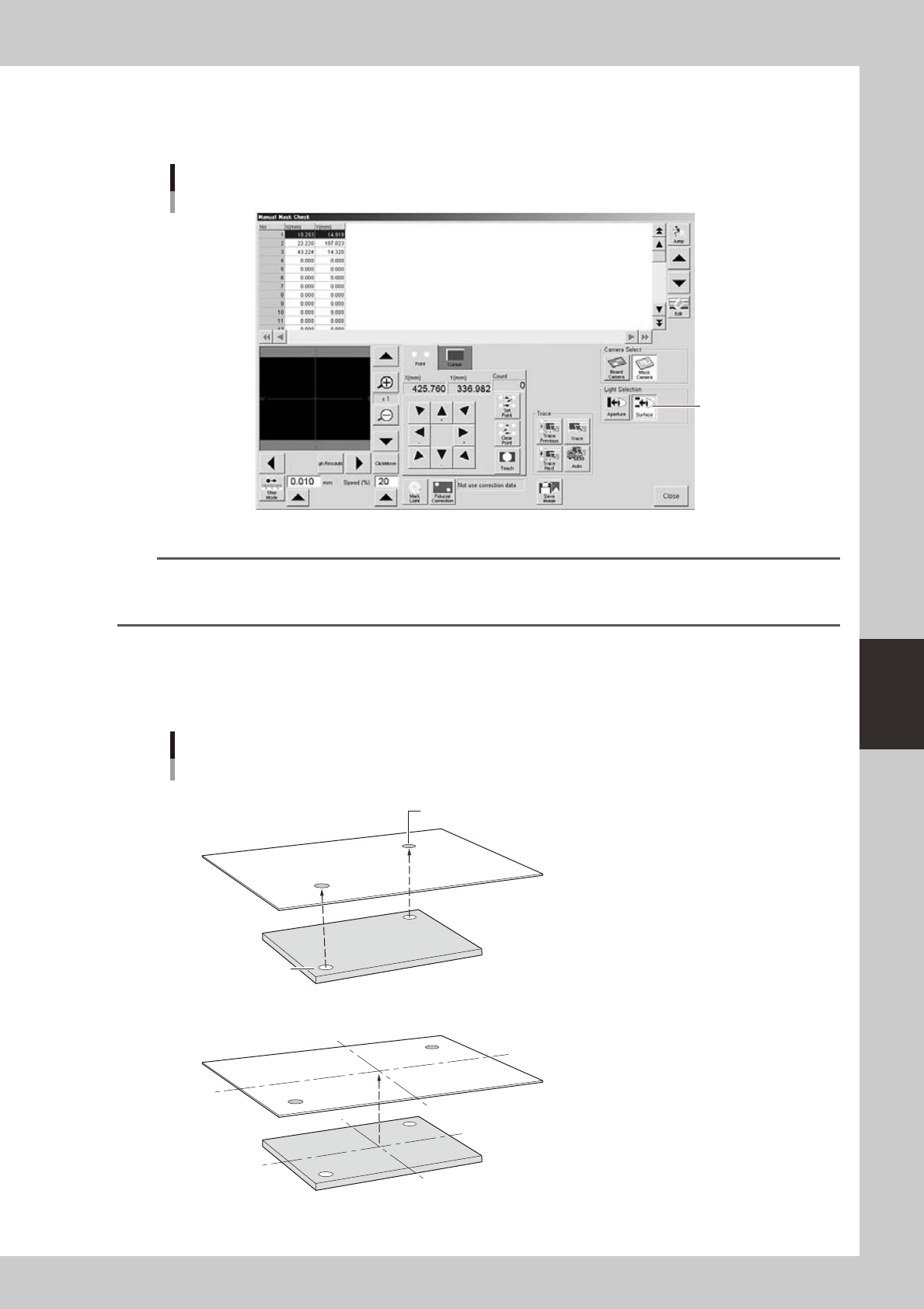
To set the lighting for inspecting excess solder and flux spreading to the backside of the mask, press the [Light] button
while the [Surface] button is depressed. You can then change to an optimum lighting level on the lighting setup window.
In either case, closing the window automatically stores the changes you made into the board data.
"Teach/Trace" window for visual mask check
[Surface] button
[Surface] button
64521-N3-10
n
NOTE
By storing the visual check lighting levels for the mask aperture and backside, you can switch to each lighting level by
just pressing the [Aperture] button for the mask aperture visual check or the [Surface] button for the mask backside
visual check.
l
Aligning the board and mask positions
When the board and mask each have positioning marks on both sides, the following two positioning methods can be
used.
Mask mark
N Board and mask mark positions are on the same coordinates
N Board and mask mark positions are on different coordinates
Board mark
Positioning marks on Board and mask
Image processing is first performed to detect
the amount of position shift with reference to
the theoretical mark positions on the Board and mask.
Based on this, the Board and mask positions
are determined so that their marks are exactly aligned.
Image processing is first performed to detect the
amount of position shift with reference to the
theoretical mark positions on the Board and mask.
Based on this, the Board and mask positions are
determined so that their centers are exactly aligned.
Then, angular positioning of the Board and mask is
corrected respectively, so that a line connecting
the two marks is aligned with the line connecting
the theoretical positions of the marks.
63513-N3-00
5-18
5
Creating and setting the data
l
Mask aperture coordinate setting
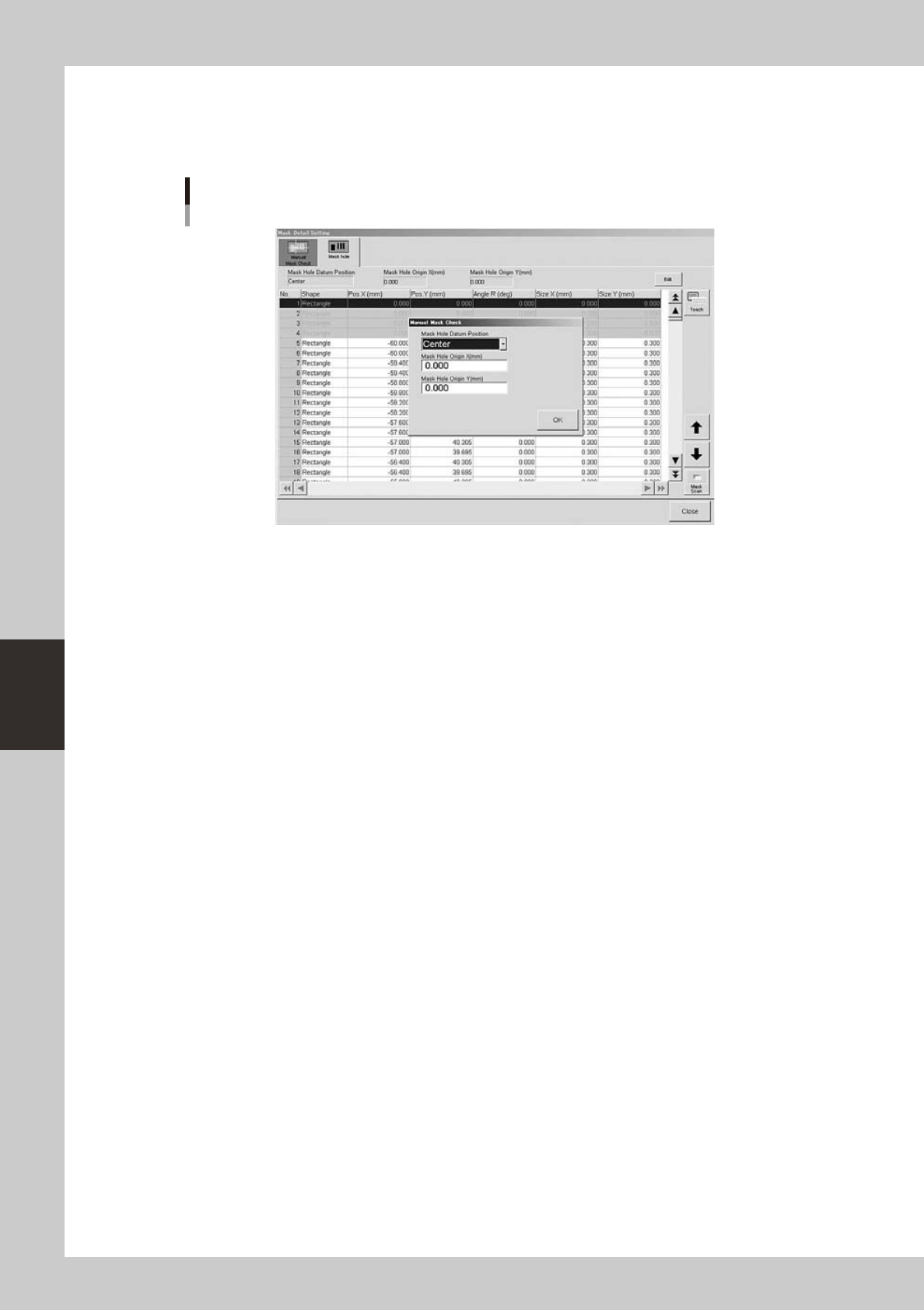
When you press the [Detail] button on the [Print]-[Mask] tab, the following dialog box appears for setting the mask
aperture coordinates.
[Mask Hole] tab
64554-N3-10
This function is available only for machines equipped with an optional print inspection camera.
For more information, refer to "2.3 Using the mask scan function" in Chapter 2 of the separate option manual "Solder-
print inspection".