YSP20_Users_E.pdf - 第246页
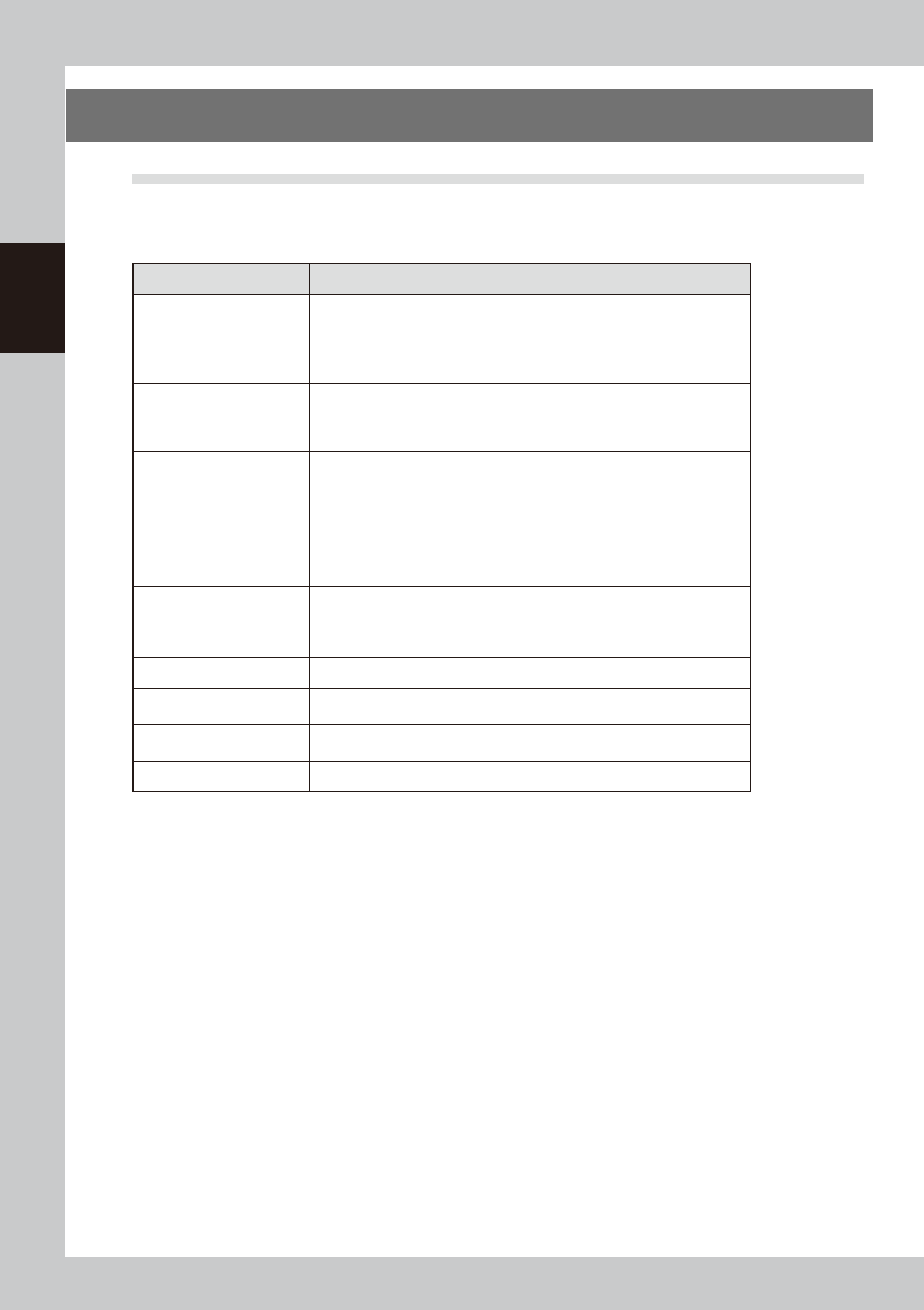
2-2 2 Inspection and maintenance 1. Daily maintenance items 1.1 Daily inspection T o prevent unwanted trouble, the follo wing points should be chec ked on a daily basis before and after using the machine. n Daily checkpo…

2-1
2
Inspection and maintenance
Before beginning work
In most cases, the maintenance work should be performed with the main power turned off.
However, some maintenance tasks are performed under emergency stop conditions with the power turned on.
In such cases, ensure adequate safety and press the emergency stop before beginning the maintenance work.
The power is turned on during maintenance where any servo-axis must be operated or machine operation
must be checked. In this case, also ensure adequate safety before beginning the maintenance.
When operating the machine, make sure the following conditions are satisfied.
n
Operating conditions
1. The supply air pressure is kept at its correct level.
2. All the safety covers are closed.
Be sure to observe the following precautions when performing the inspection or maintenance work.
n
Precautions
• Periodic inspection or maintenance work must be performed by or under the direction of person who has received
training from YAMAHA.
• Always turn off the power to the machine before inspecting mechanical components. If the power to the machine
needs to be turned on during inspection, make sure that no part of anyone's body comes within the machine movement
range.
• Be careful not to allow any foreign matter to enter the machine during inspection or maintenance work.
• Use only the lubricants and grease specified by YAMAHA or a YAMAHA sales representative.
• When replacing parts, always use parts approved by YAMAHA or a YAMAHA sales representative.
• Do not modify any parts in the machine. Modification may result in poor performance or threaten operator safety.
Be sure to observe the following precautions when replacing consumable parts.
n
Precautions
• Parts replacement must be performed by or under the direction of person who has received training from YAMAHA or a
YAMAHA sales representative.
• Always turn off the power to the machine before replacing consumable parts.
• Be careful not to allow any foreign matter to penetrate inside the machine during parts replacement.
• When replacing parts, always use parts approved by YAMAHA or a YAMAHA sales representative.
• Do not modify any parts in the machine. Modification may result in poor performance or threaten operator safety.
2-2
2
Inspection and maintenance
1. Daily maintenance items
1.1 Daily inspection
To prevent unwanted trouble, the following points should be checked on a daily basis before and after using
the machine.
n
Daily checkpoints
Checkpoints Check items
Air pressure
Check that “0.40MPa” and “0.33MPa” are shown at the upper and lower portions
of the air pressure display, respectively.
Air conditioner unit (option)
Check the drain tank once a day, especially in wet season with high humidity,
and drain the tank. When the tank is filled with water, an alarm buzzer sounds
and the air conditioner unit will stop after 10 minutes if left undrained.
Conveyor unit
Check that no foreign matter, solder or debris is on the conveyor rail, edge
clamp, edge plate, board flap, push-up jig (machine using optional push-up jigs),
push-up plate, etc.
Check that no matrix pins come loose from the push-up table.
Squeegee Squeegee head
Check that the mount knobs of the squeegee head are tightened firmly.
Check that the squeegee is securely attached to the squeegee holder. (The
squeegee mount knobs are tightened firmly.)
Check that there are no scratches, nicks and wear on the scraper.
Check that there are no foreign matter, debris and solder adhesion.
Remove the squeegees after work and clean them with cleaning paper or cloth.
(When using a urethane squeegee, do not immerse the squeegee in alcohol.
The urethane scraper may expand.)
Cleaning unit
Check that the cleaner gauze roll is set correctly. Check also that the cleaner
gauze is filled with cleaning alcohol.
Mask frame stopper pin
position
Check that the mask frame stopper pin position is correct.
Mask clamp Check that there are no foreign matter, debris and solder adhesion.
Mask
Check that there are no foreign matter, debris, solder adhesion, warp and
scratches.
Solder
Check that solder has returned to room temperature and is well agitated and
rolled.
Touch screen (option) Check that there are no scratches or grime on the screen surface.
l
Precautions when handling the touch screen
Take the following precautions when handling the touch screen (option).
• The touch screen surface is made of acrylic resin. Do not scratch its surface with a pointed tools or hard objects. Use
the finger pad to operate the buttons on the touch screen.
• To clean the touch panel surface, wipe gently with a soft cloth moistened with synthetic detergent diluted with water
and then wrung-out well. Never use volatile chemicals such as benzine, thinner or alcohol.
• To prevent dust adhesion due to static electricity, we recommend using an anti-electrostatic agent.
2-3
2
Inspection and maintenance
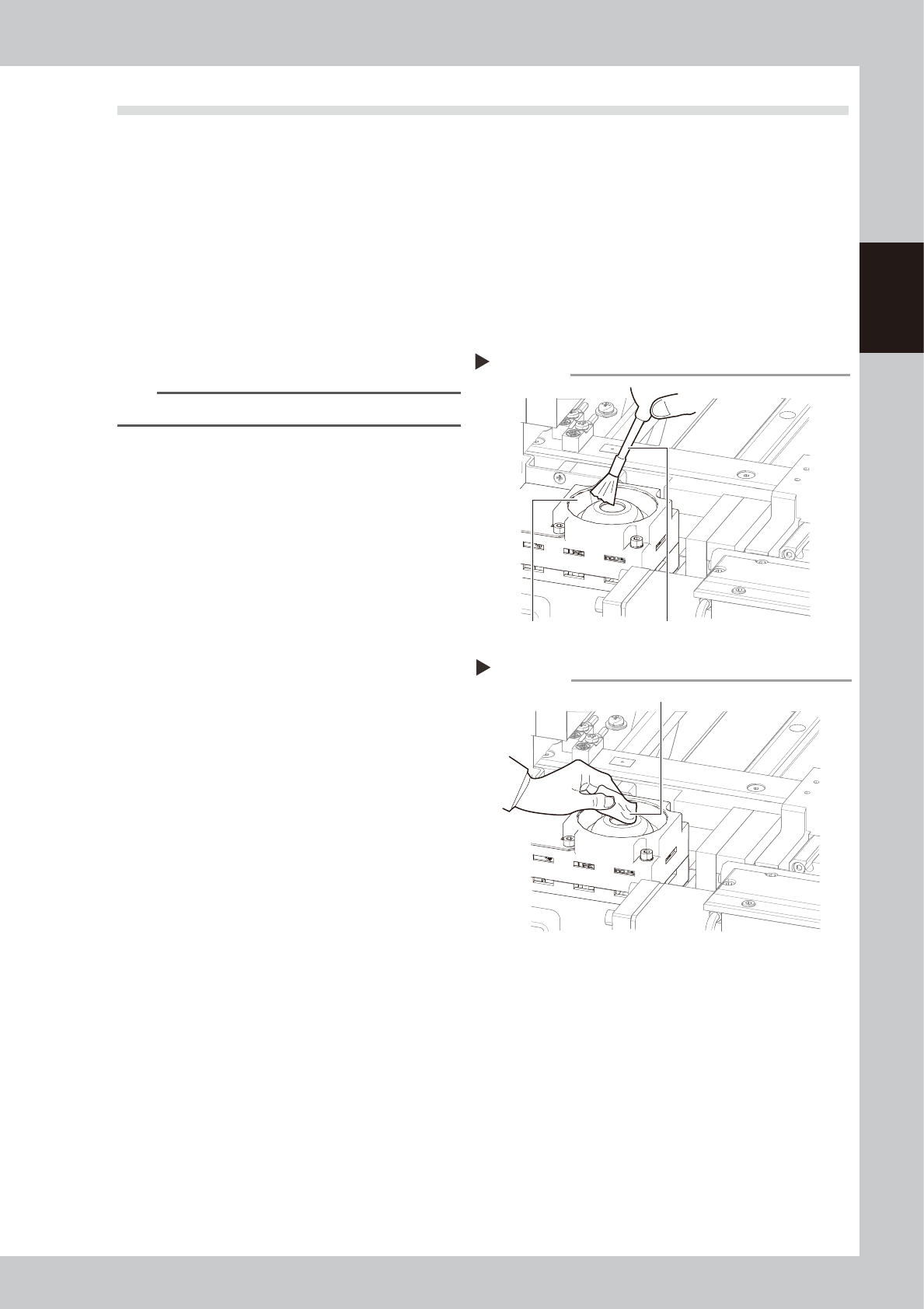
1.2. Cleaning the camera protective glass
Dirt or dust particles sticking to the protective glass of the mask (stencil) camera unit may cause recognition
errors.
e
To ensure the safety, make sure that the emergency stop button is pressed or the machine power switch is
turned off before starting this work.
n
Items to be prepared
• Lens blower brush (option)
• Lint-free cleaning cloth or paper towel
• Lens cleaner (option)
1
Remove dust on the protective glass
with the lens blower brush.
53201-N3-00
TIP
The lens blower brush is an optional part.
2
Wipe the protective glass with a
lint-free cleaning cloth.
Apply a few drops of lens cleaner to a
lint-free cleaning cloth and wipe the
protective glass.
53202-N3-00
Blowing off dust with the blower brush
Step 1
Lens blower brushProtective glass
Wiping the protective glass with a lint-free cleaning cloth
Step 2
Lint-free cleaning cloth