00197498-03_UM_SiplaceCA-Serie_EN.pdf - 第424页
7 Component and Die Handling User Manual SIPLACE CA-Series 7.2 SIPLACE X-Series Component Trolley From software version SC.708.0 Edition 12/2014 EN -DR AFT 424 7.2 SIPLACE X-Series Component T rolley [001 19722-xx] Compo…

User Manual SIPLACE CA-Series 7 Component and Die Handling
From software version SC.708.0 Edition 12/2014 EN -DRAFT 7.1 X Feeder Modules for SIPLACE X-Series
423
7.1.6.1 Description
The energy and data interface allows X feeder modules to be used outside the machine and setup
area. The interface consists of an aluminum frame with omega profile (item 7 in fig. 7.1 - 17
, page
420
) for holding and guiding the feeder modules. As with the X component trolley, the feeder mod-
ule is placed on the omega profile, with the slider guides, and is pushed forwards until the front
centering pin of the feeder module is fully inserted into the locating hole (item 9 in fig. 7.1 - 17
,
page 420
). The locking latch (item 8 in fig. 7.1 - 17, page 420) locks the feeder module in this po-
sition. To remove the feeder module, simply press the release button (item 1 in fig.
7.1 - 17
, page 420). The locking latch (item 8 in fig. 7.1 - 17, page 420) is pressed down and re-
leases the feeder module. Fold-out feet (item 6 in fig. 7.1 - 17
, page 420) stabilize the position of
the energy and data interface, particularly for wide feeder modules.
The electronics housing (item 5 in fig. 7.1 - 17
, page 420) holds the electronics control unit for the
energy and data interface. The operator panel (item 2 in fig. 7.1 - 17
, page 420) consists of start
and stop buttons and two status LEDs. Communication with a PC takes place via the data cable
(item 3 in fig. 7.1 - 17
, page 420). The power supply cable (item 4 in fig. 7.1 - 17, page 420) is
connected to the power supply unit provided.
7.1.6.2 Usage
The energy and data interface is used to check, maintain and repair X feeder modules. It can also
be used for setting up in advance for PCB production. In this case, the energy and data interface
is fixed to the base plate (item 10 in fig. 7.1 - 19
, page 422). The tape reel holder (item 11 in fig.
7.1 - 19
, page 422) is also mounted on the base plate. When a component tape is inserted, you
can check or reset the increment, pick-up position and conveyor speed. The detailed user manual
describes how to use the interface and the necessary servicing work.
7.1.6.3 Scope of Delivery
– Single Slot EDIF
– Power supply, 100 - 120 / 200 - 240 VAC, +30VDC, 4.3 A
– Base plate with tape reel arm
– User manual
7 Component and Die Handling User Manual SIPLACE CA-Series
7.2 SIPLACE X-Series Component Trolley From software version SC.708.0 Edition 12/2014 EN -DRAFT
424
7.2 SIPLACE X-Series Component Trolley
[00119722-xx] Component trolley for SIPLACE X-Series
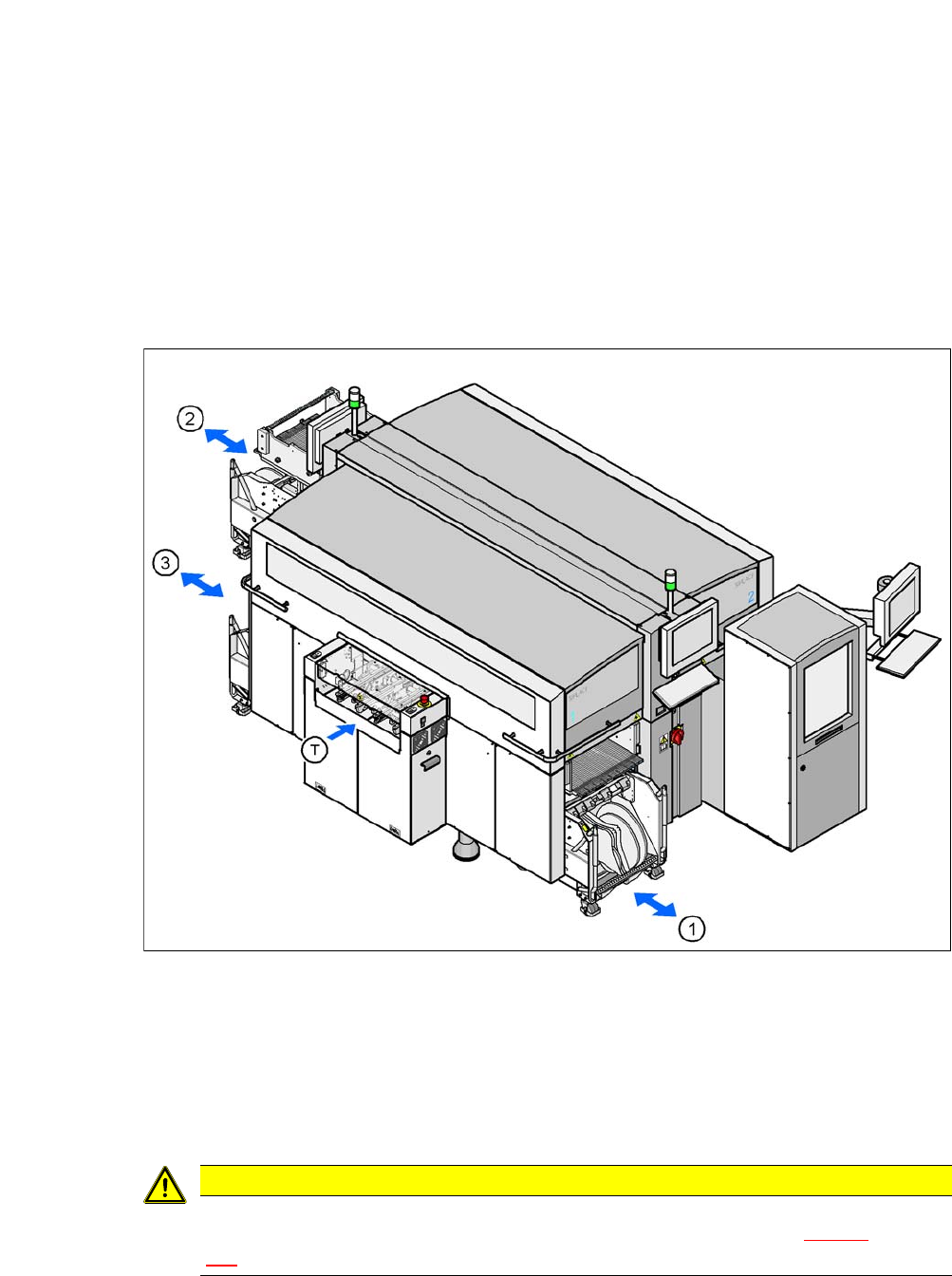
Up to three SIPLACE X-Series component trolleys can be docked onto the SIPLACE CA-Series
machines. The locations are numbered. The following diagram shows the CA4 with an SWS at
location 2 as an example.
7
Fig. 7.2 - 1 Component trolley locations, SIPLACE X-Series - example of SWS at location 2
(1) Location 1
(2) Location 3
(3) Location 4
(T) PCB direction of travel
7
CAUTION
The component trolleys for the SIPLACE SX1/SX2 may only be docked onto locations at
which the COT insert for the SIPLACE SX1/SX2 has been installed fig. 6.14 - 3
, page
389
).
User Manual SIPLACE CA-Series 7 Component and Die Handling
From software version SC.708.0 Edition 12/2014 EN -DRAFT 7.2 SIPLACE X-Series Component Trolley
425
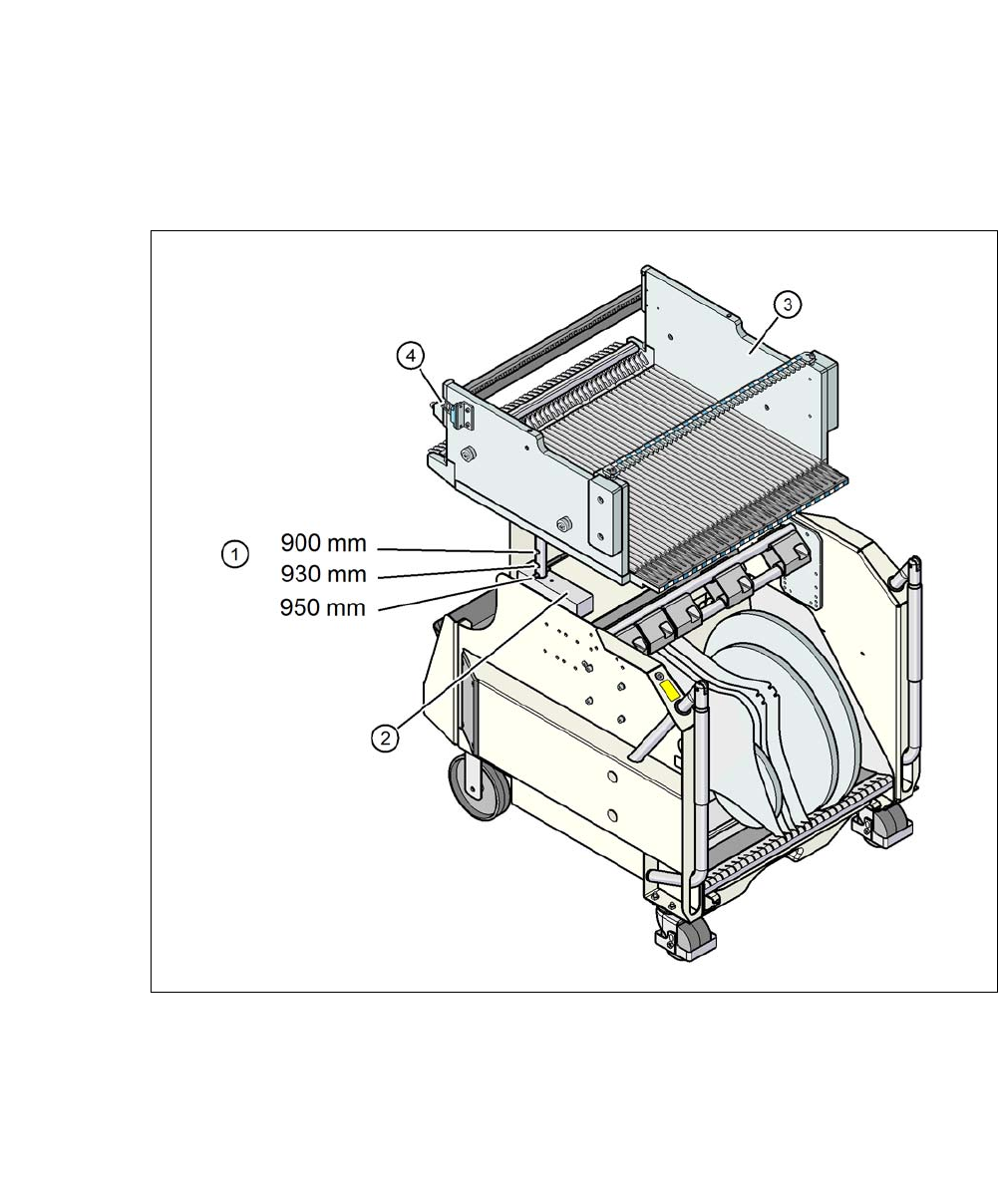
The component trolleys are stand-alone modules that can be set up with feeders at an external
setup area. This means that the production process only has to be interrupted briefly in order to
change the component trolley.
7
Fig. 7.2 - 2 Component trolley, SIPLACE X-Series, with a PCB conveyor height of 950 mm
7
(1) Holes in the guide columns for the PCB transport heights of 900, 930 and 950 mm.
(2) Support block
(3) Changeover table
(4) Contact for switching the safety switch in the COT insert