YRM20_Ope_E.pdf - 第135页
3. Displaying the production monitors 2-38 Chapter 2 Basic operation 3.9 Pick Rate W ar ning T his screen appears when using the pic kup rate w arning function. When clicking the tab to s witch the displa y , the screen …

3. Displaying the production monitors
2-37
Chapter 2 Basic operation
• No.
Displays the component No. (Parts screen data No.).
• Set No.
Displays the feeder set No.
• Parts Name
Displays the component name.
• Tape Type
The Tape Type shows the type of tape when the machine processes component tapes. It shows the
method of supplying components when processing tray components.
• X (mm), Y (mm)
Displays the amount of pickup position offset. The figure shown is the amount of error from the
nozzle center position towards the X-direction and Y-direction.
• Pick Rate (%)
Displays the component pickup rate of the nozzle for which the pickup position offset function is on
(enabled).
• Count
Displays the number of components that were picked and placed by the nozzle for which the pickup
position offset function is on (enabled).
• [All Reset] button
This button clears and resets pickup position offset data for all components shown on the monitor.
• [Current Reset] button
Clears and resets pickup position offset data for a component selected from among the components
shown on the monitor display.
3. Displaying the production monitors
2-38
Chapter 2 Basic operation
3.9 Pick Rate Warning
This screen appears when using the pickup rate warning function. When clicking the tab to switch the
display, the screen allows checking for a drop in the component pickup rate on each component or head.
The pickup rate is reset in real-time after mounting a group of components. However, if a particular
component or head is not used then its row will not appear on the display. Pickup rates can be monitored
by color during operation.
►
Display color
Color of
row
Status Pickup Rate Description
White 100% to [caution (yellow)]%
Pickup rate is above [caution (yellow)]% and
below (or equal to) 100%.
Yellow Caution
[caution (yellow)]% to [warning
(red)]%
Pickup rate is above [warning (red)]% and below
(or equal to) [Caution (yellow)]%.
Red Warning [warning (red)]% to 0%
Pickup rate is above (or equal to) 0% and below
(or equal to) [warning (red)]%.
If the machine setting of the stop control is set
to “Use”, the machine stops while generating an
alarm. The default setting is “Not Use”.
Pink
Watch-
and-wait
mode
Optional
When the pickup rate is [warning (red)]% or
less, pressing the [Current Check] or [All Check]
button enables "watch-and-wait" mode and the
color of the "red" row(s) changes to "pink".
Note that operation is not stopped in this mode
even if stop control setting is made.
n
NOTE
Numerical values (%) in brackets [ ] are machine data setting items. Accessing such parameters require the administrator
level of authority.
█
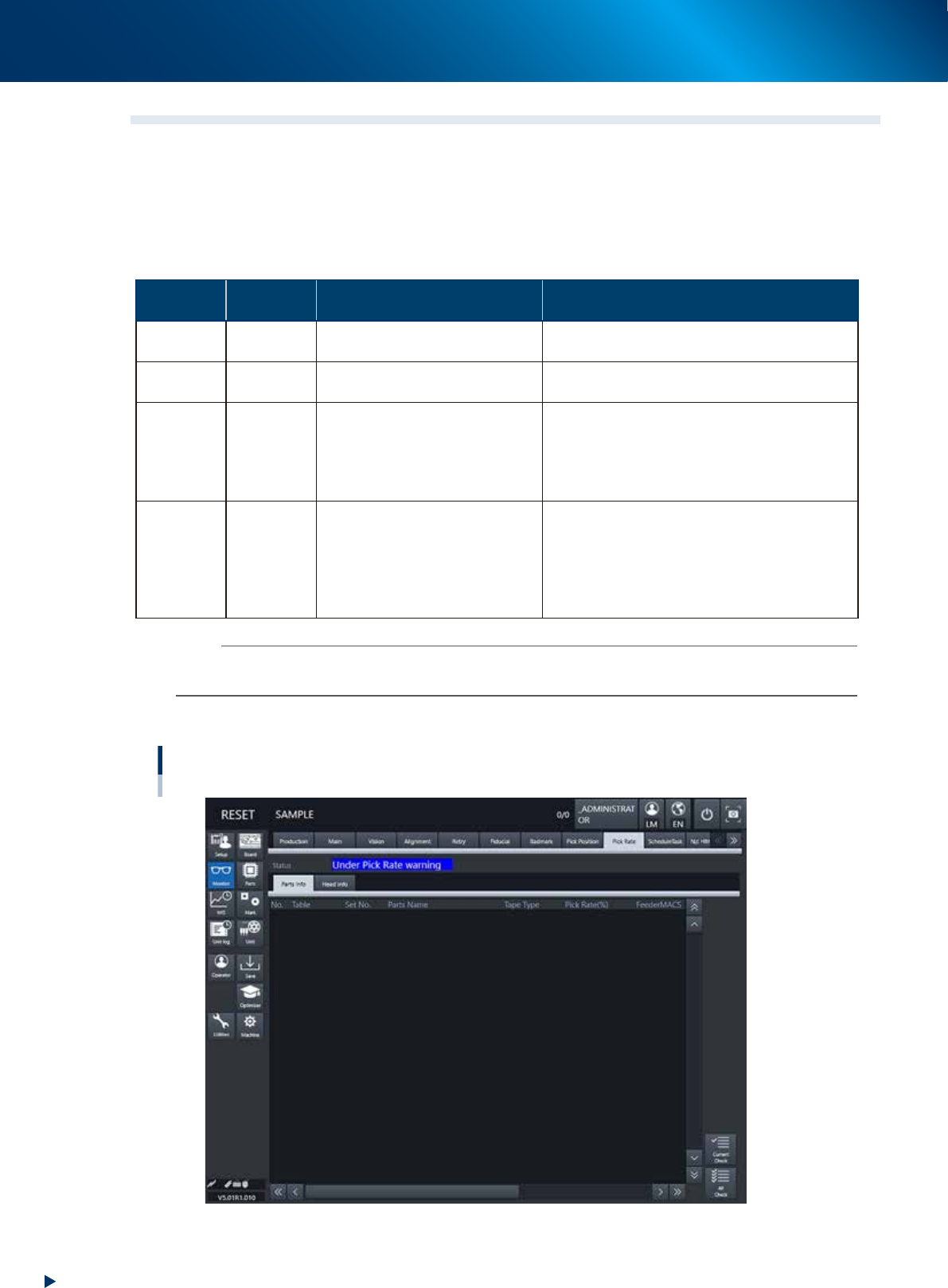
[Parts Info] tab
Monitor: Pick Rate Warning
Parts info
24220-KMX-00
3. Displaying the production monitors
2-39
Chapter 2 Basic operation
• No.
Displays the component No. (Parts screen data No.).
• Table
Displays the feeder table (feeder plate location) where the component feeder is installed.
• Set No.
Displays the feeder set position at which the component feeder is installed.
• Parts name
Displays the component name.
• Tape Type
The “Tape Type” shows the type of tape when the machine processes component tapes. It shows the
method of supplying components when processing tray components.
• Pick Rate (%)
Displays the pickup rate for each component. Rate is calculated by the following formula.
1 – ([Error count] ÷ [Number of components used]) = Pickup rate
• Feeder MACS
Displays the feeder MACS status.
• Offset X(mm), Y(mm)
Displays the offset amounts of the feeder MACS.
n
NOTE
The feeder MACS is a function that recognizes the mark at a specific location on the feeder to perform pickup offset
correction. This function normally applies to picking up components of 1005 or smaller.
█
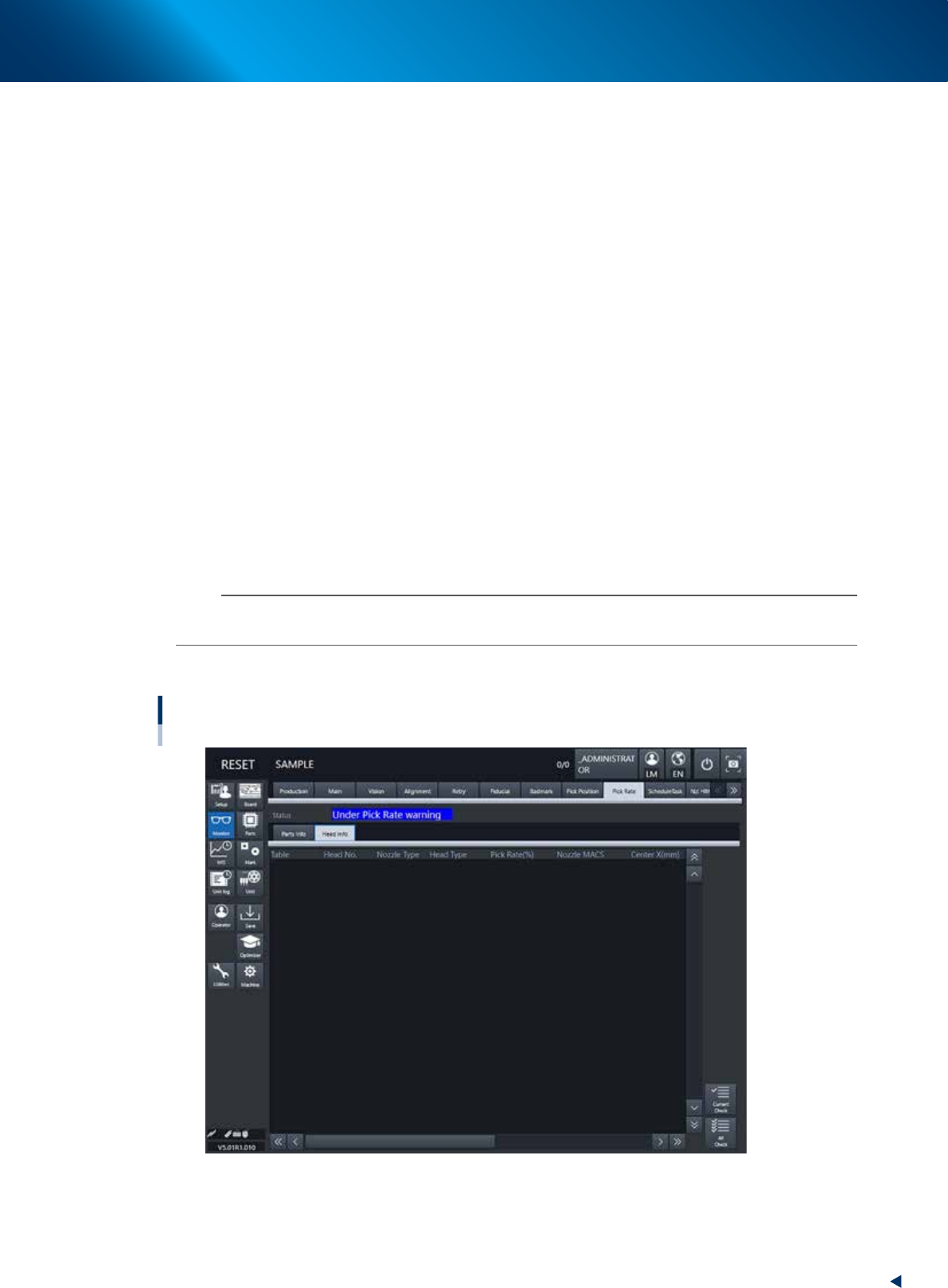
[Head Info] tab
Monitor: Pick Rate Warning
Head info
24221-KMX-00
• Table
Displays the corresponding table. This machine shows “Table A”.