YSP_Users_E.pdf - 第173页
5-17 5 Managing the data 5 Pr ess the [New] button and designate the database number . The database number input dialog box appears. Enter the database number under which the data wi ll be stored. Leave blank to store th…
5-16
5
Managing the data
2. Creating the user database
Registering marks in the user database will prove convenient if they are not included in the YAMAHA
database or they are used very frequently.
The user database should be registered in the user area of the database. The user database area can be
from No. 1 to No. 149 for the mark database. The registered data in this area will be retained even if the
software version is upgraded.
2.1 Copying the data into the database
To copy the component or mark data you created into the user database, follow these steps.
1
Select the board data name.
Press the [Board] button on the Setup screen and select the board data.
2
Open the Mark screen.
Press the [Mark] button in the main menu button area.
3
Select the copy source data.
Line up the cursor with the mark data you want to copy from.
4
Open the database list.
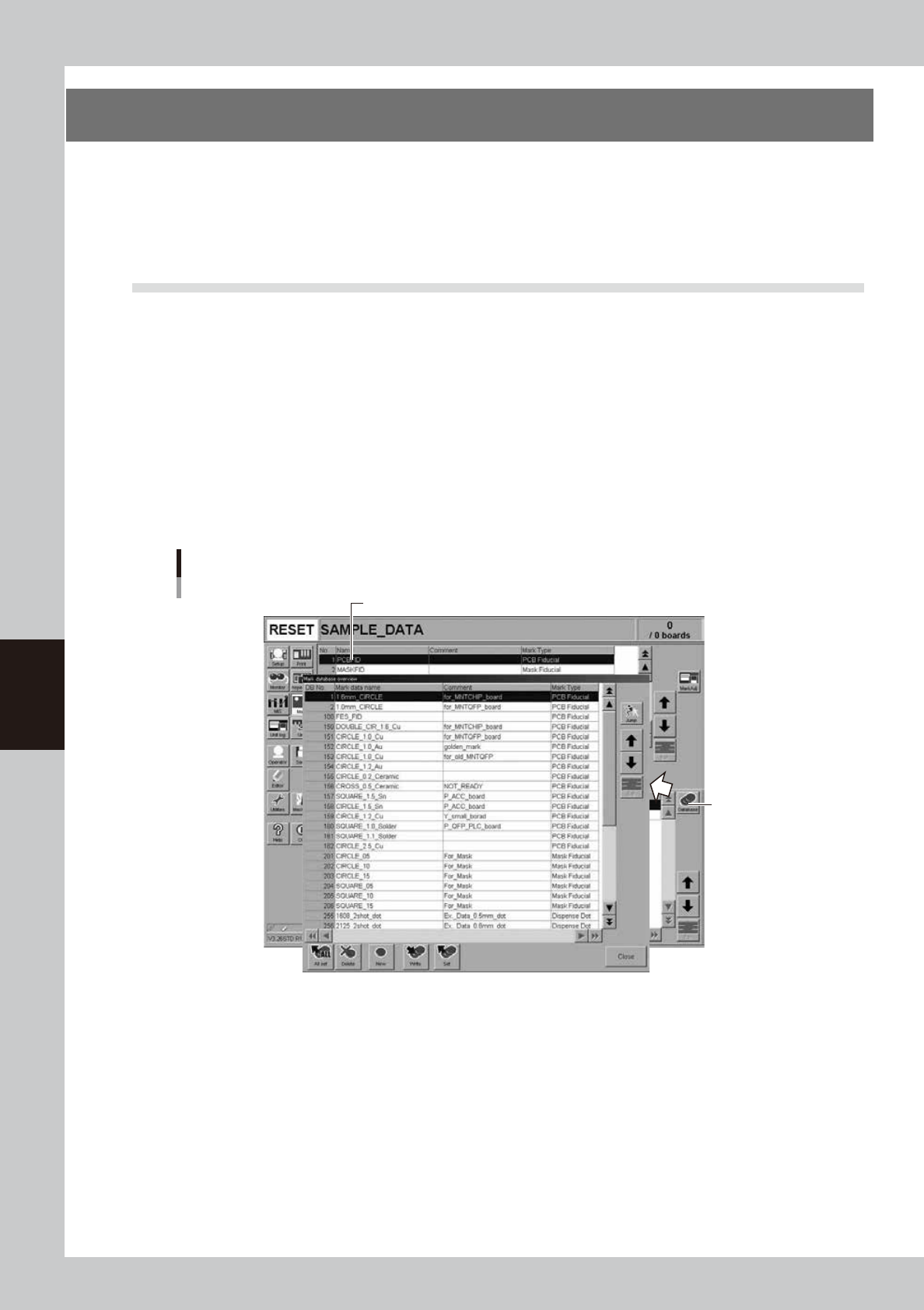
Press the [Database] button on the [Basic] tab. The database list appears.
Database list
Copy source
[Database] button
64505-L3-10
5-17
5
Managing the data
5
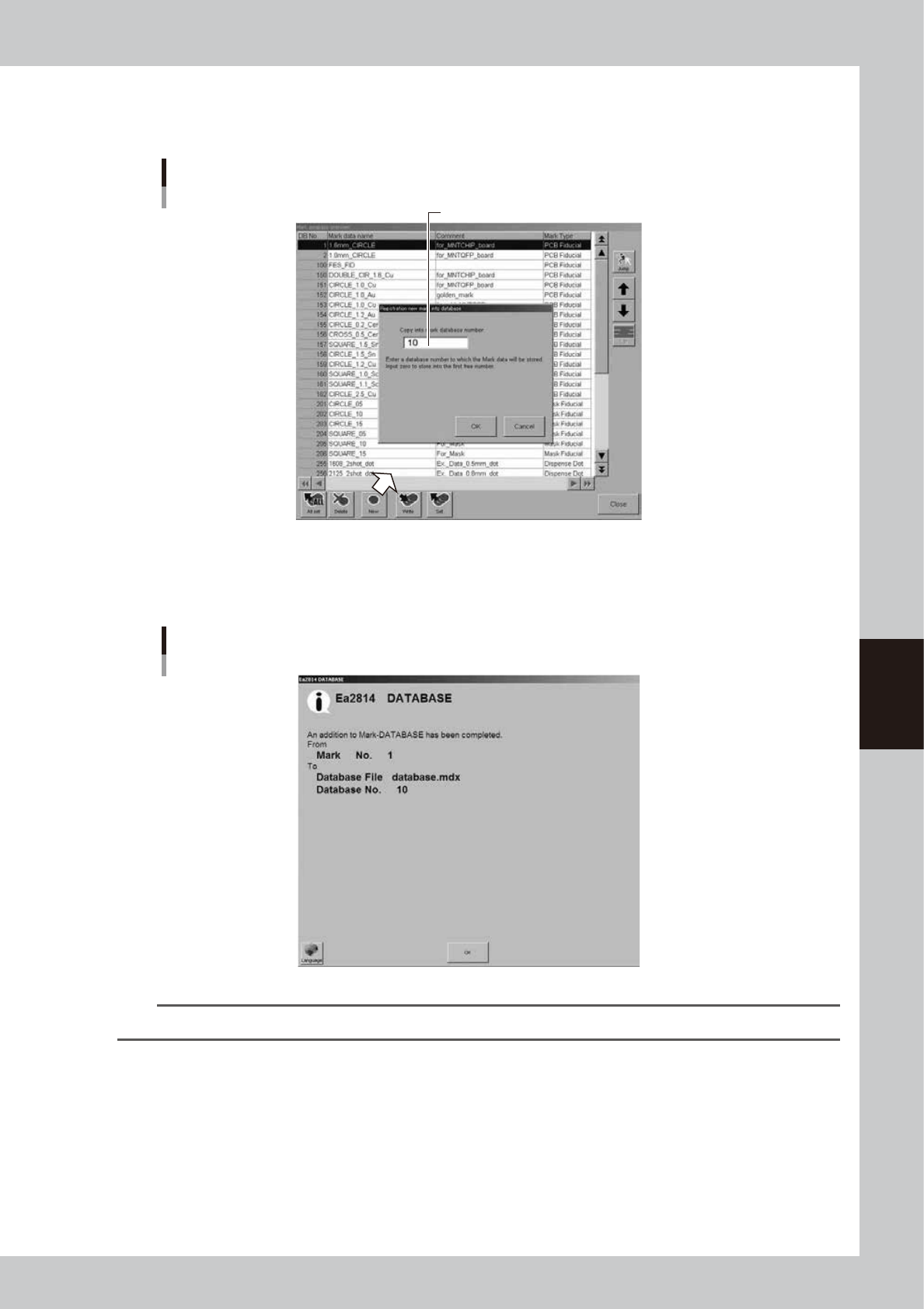
Press the [New] button and designate the database number.
The database number input dialog box appears. Enter the database number under which the data will
be stored. Leave blank to store the data in the first free number.
Database number input dialog box
Enter the database number where data should be copied.
64506-L3-10
6
Press the [OK] button to copy the data into the database.
All items of the selected data including the data name and comment will be copied. Press the [Clear]
button to return to the database list.
Database registration message
64507-L3-00
TIP
Repeat the above procedure when you want to copy other data into the database.
7
Press the [Close] button to close the database list.
5-18
5
Managing the data
3. Production log management
It is possible to collect, store, and display log data such as various types of production information and
errors that occurred during automatic operation.
This useful function allows you to collect daily operation conditions and production logs, and also supports
an automatic log data collection system through the network.
3.1 Production log types
This machine stores production logs per machine and per board data.
The production logs are broadly grouped into 2 types. One is a log history and the other is a machine operation
data count log.
3.1.1 Production log (MIS)
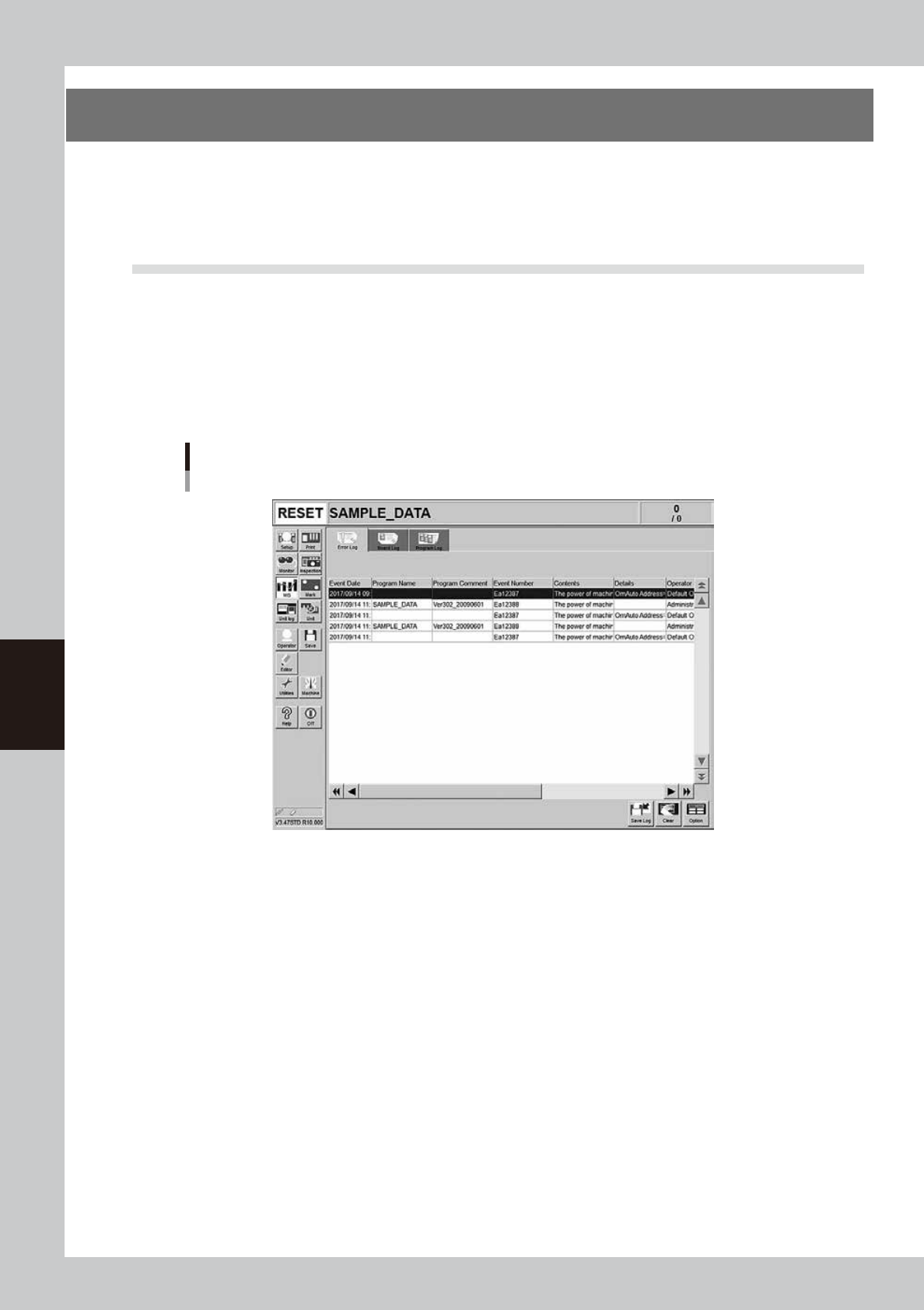
When pressing the [MIS] button, the production log screen appears that is separated by the [Error], [Board],
and [Program] tabs, allowing you to easily check the production log.
Production log ("MIS" screen)
[Error Log] tab
64550-L3-00
Error Log
Displays error and operation logs.
One error or one operation is listed in one data row. Up to 1000 rows can be displayed.
Board Log
Displays production logs per board.
One data row is used to record one board. Up to 1000 rows can be displayed.
Program Log
Displays production results per lot, with one lot treaded as the interval from the loading of a program (board data) until
switching over to the next program.
One data row is used to record one lot. Up to 1000 rows can be displayed.