JANETS_INM.pdf - 第234页
JaNets In structio n Manual 7. Program Editor 7- 27 T o create dat a for an RX - 7 ser ies, put a chec kmar k in the “ Use ” che ck box of t he “ RX - 7 series Vi- sion ” col umn. Y ou can set data relat ed to an RX - 7 …
JaNets Instruction Manual 7. Program Editor
7-26
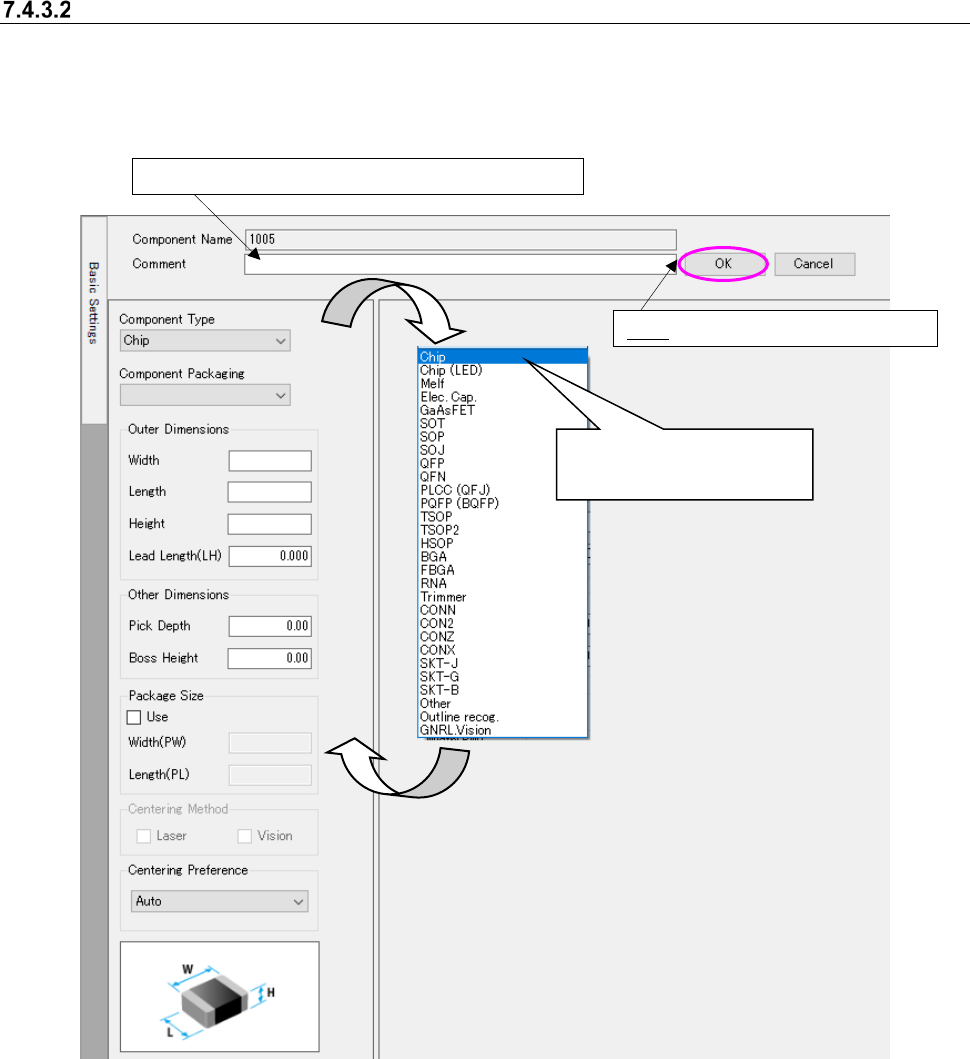
“Basic Settings” screen
This screen allows you to create the basic data such as the component type, component pack-
aging style, outer dimensions and centering method. When you double-click a line on the
“Placement Data list” or “Component data list” described above, this screen appears.
Figure 7.4-35 “Basic Settings” screen
[When a production line includes a JM series machine]
“Insertion component” and “INS electrolytic capacitor” are added to the component types.
[When a production line includes a JM series machine, a JX-350 and an RS-1]
Package Size is enabled. When the package size is used, the package size is used for the di-
mensions and outside dimensions of deciding default value.
OK: Validates the changed data.
You can enter up to 127 half-width characters here.
When you select “Chip,” its
bit map is displayed also.
JaNets Instruction Manual 7. Program Editor
7-27
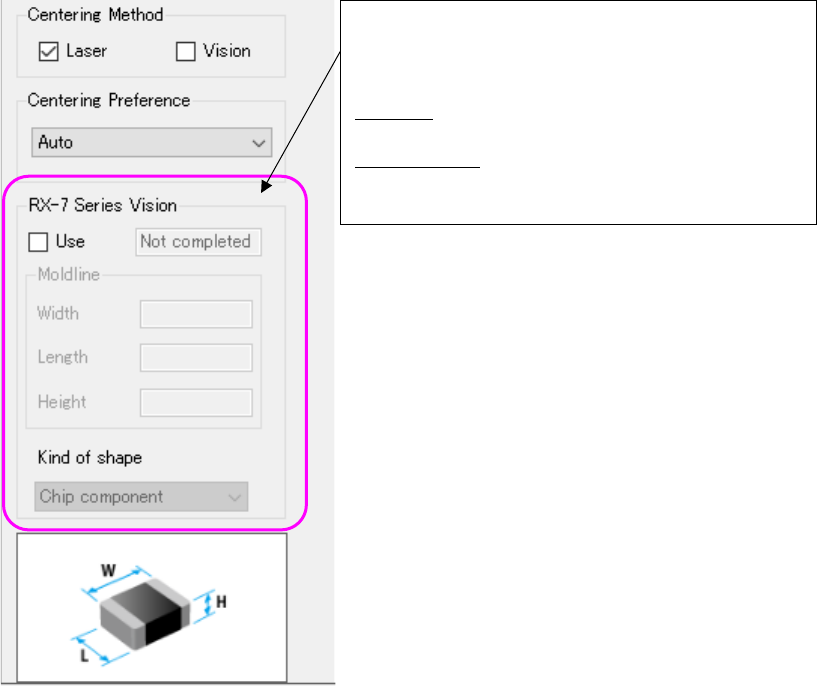
To create data for an RX-7 series, put a checkmark in the “Use” check box of the “RX-7 series Vi-
sion” column. You can set data related to an RX-7 series.
Figure 7.4-36 “Basic Settings” screen (RX-7 Series Vision)
To assign an RX-7 series you have to set data for an
RX-7 series. Therefore, put a checkmark in the “Use”
check box. The default setting for putting a checkmark
in this check box can be made on the “Set environ-
ments” screen.
Mold line: Set the dimensions of the molded section
as the size of the component body.
Kind of shape: Select the component shape type
defined with an RX-7 series
JaNets Instruction Manual 7. Program Editor
7-28
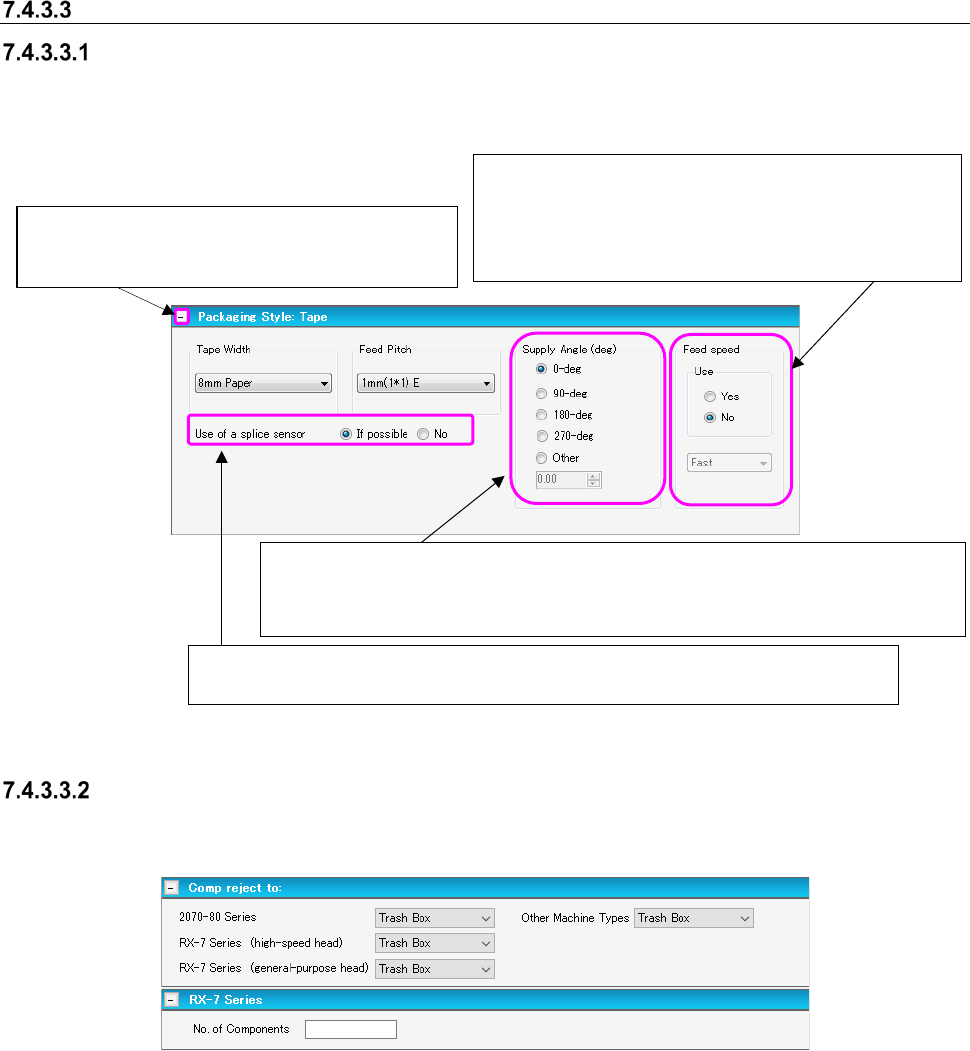
“Packaging Style” window
“Packaging Style (Tape)” window
When you select “Ta pe” in the “Component Packaging” field on the “Basic Settings” screen, and
select the “Component Data” from the tree view and then “Packaging Style,” the following screen
appears.
Figure 7.4-37 “Packaging Style (Tape)” window
“Comp reject to” column for the “Packaging Style (common to “Tape”/
“Stick”/“Tray”/“Bulk”)” window
This column allows you to enter where to discard a component.
Figure 7.4-38 “Comp reject to” column for the “Packaging Style (Tape)” window
* During the actual production, the component is discarded or returned to the location that you
specify here. However, this setting is not used for the optimization and the simulation of the
production. This means that this setting is not required when using a general feeder that is cre-
ated with the "Feeder Model Wizard".
* The menu items “RX-7 series (high-speed head),” “RX-7 series (general-purpose head)” and the
“RX-7 series Vision” panel are displayed only when you put a checkmark in the “Use” check box
of the “RX-7 series Vision” column.
The default value set in the “No. of Components” is decided depending on the setting on the “Set
environments” screen.
When you click this button, the input screen closes.
* This button functions in the same way on the
screens described below too.
Enter the angle for encapsulating a component against the component supply direc-
tion. Select the corresponding radio button, or enter the angle in the edit field.
* The operation for entering the “Supply Angle” is the same on the screens de-
scribed below too.
Feed speed: For each component, specifies the feeding
speed of the electric feeder. When “No” is selected, the
system uses the default speed defined for each electric
feeder.
* This function is available only when an electrical
feeder is used.
Set it whether you use a splice sensor for the detection of the splice joint.
* When use RF, please validate setting.