JANETS_INM.pdf - 第719页
JaNets In structio n Manual 19 T ra ceMonitor 19 - 20 19 -3-6-5 Sel ecting the range of the display period Y ou can select the r ange of the display peri od with dragg ing the desire d position of the graph wit h the mou…
JaNets Instruction Manual 19 TraceMonitor
19-19
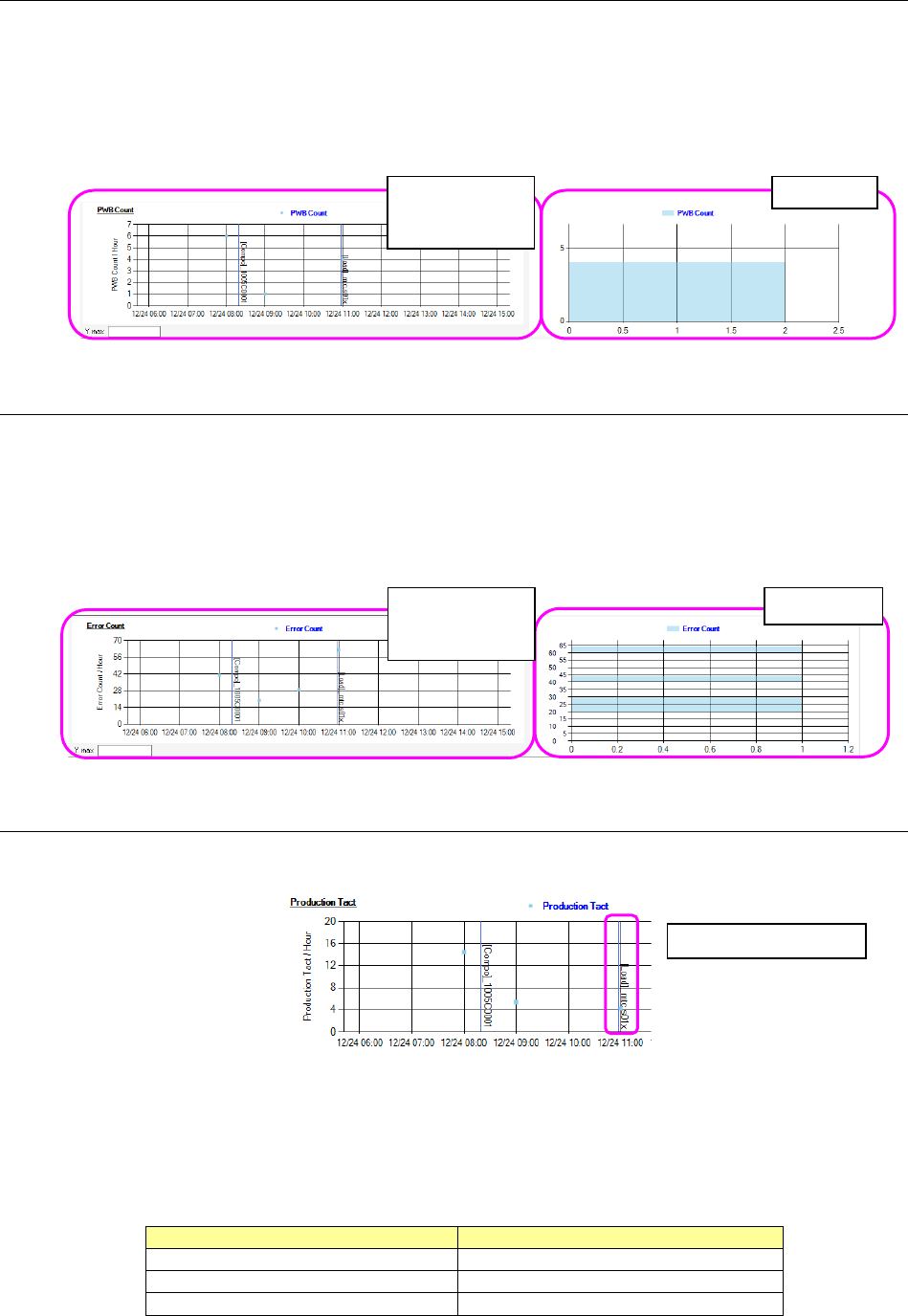
19-3-6-2 Information on the number of produced PWBs (PWB Count)
The “PWB Count” screen shows the total of the number of PWBs produced with each machine per
hour on a graph.
Data obtained within the display period is expressed in a form of histogram on the right side of the
graph.
When a production line is selected, a total value of PWBs produced with a machine assigned to the
end of the production line is displayed on the graph.
Figure 19-3-32 Information on the number of produced PWBs
19-3-6-3 Information on the number of errors (Error Count)
The “Error Count” screen shows the number of errors that occurred at the machine and was counted
per hour on a graph.
Data obtained within the display period is expressed in a form of histogram on the right side of the
graph.
When a production line is selected, the total of errors that occurred at each machine and was counted
per hour is displayed also.
Figure 19-3-33 Information on the number of errors
19-3-6-4 Event display
The event display shows description of an event at the occurrence date and time on the graph by
drawing blue vertical lines.
Figure 19-3-34 Event display
The following three types of events are displayed: change of a production program, teaching or
editing of a component and editing of machine data.
Each event is displayed as shown in the table below.
Table 19-3-10 Generated events
Event
Display
Change of a production program
[Load]_production program name
Teaching or editing of a component
[Compo]_component name
Editing of machine data
[MCData]
Histogram
Graph indicating
the number of
errors
Histogram
Graph indicating
the number of
produced PWBs
Displays a Load event
JaNets Instruction Manual 19 TraceMonitor
19-20
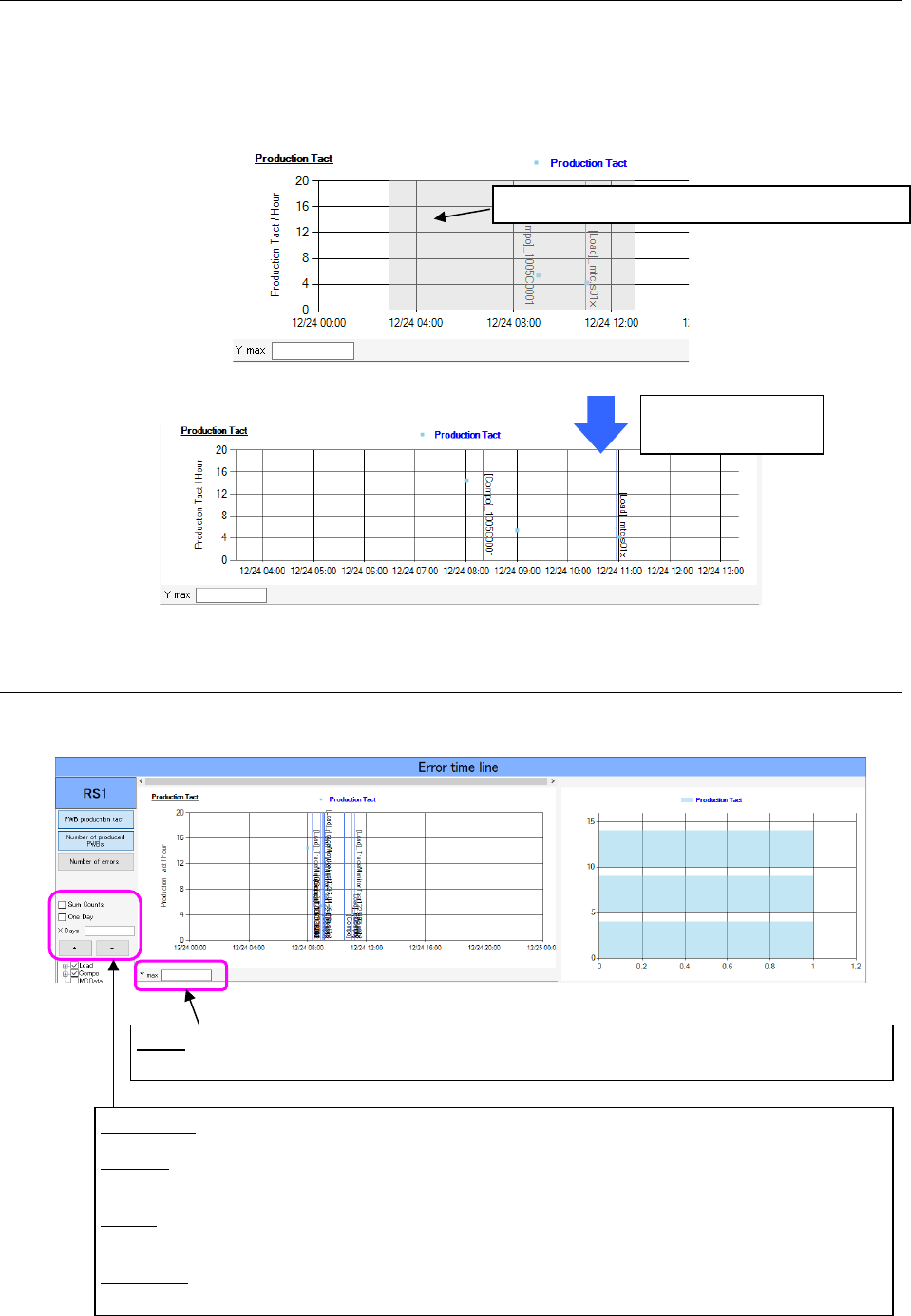
19-3-6-5 Selecting the range of the display period
You can select the range of the display period with dragging the desired position of the graph with
the mouse left button.
The shortest display range you can select is one hour.
Only if you do not check off the “One Day” check box, you can return the display range to the initial
range by pressing the mouse right button on the graph.
Figure 19-3-35 The range for the display period is being selected.
Figure 19-3-36 After the range for the display period is selected
19-3-6-6 Display option
You can change the displayed graph with the items on the left side of the screen: Sum Counts, One
Day and X Days and the setting of the item “Y max” displayed under each graph.
Figure 19-3-37 Display options of the timeline data
The range being selected is displayed in light gray.
Selection of the range
for the display period
Y max: Sets the maximum displayed value of the Y-axis of the graph and that of the histogram.
You can set this value for each graph.
Sum Counts: Changes the values of the graph to the integrated values.
One Day: Sets the display period in units of days. When you check off this check box, the
following items are disabled: “X Days” and +/- button operations.
X Days: Sets the display period in units of the entered number of days. The shortest display
period is 0.042 (one hour).
+/- buttons: Time-axis enlargement/reduction buttons. The + button enlarges the display period,
while the – button reduces the display period.
JaNets Instruction Manual 19 TraceMonitor
19-21
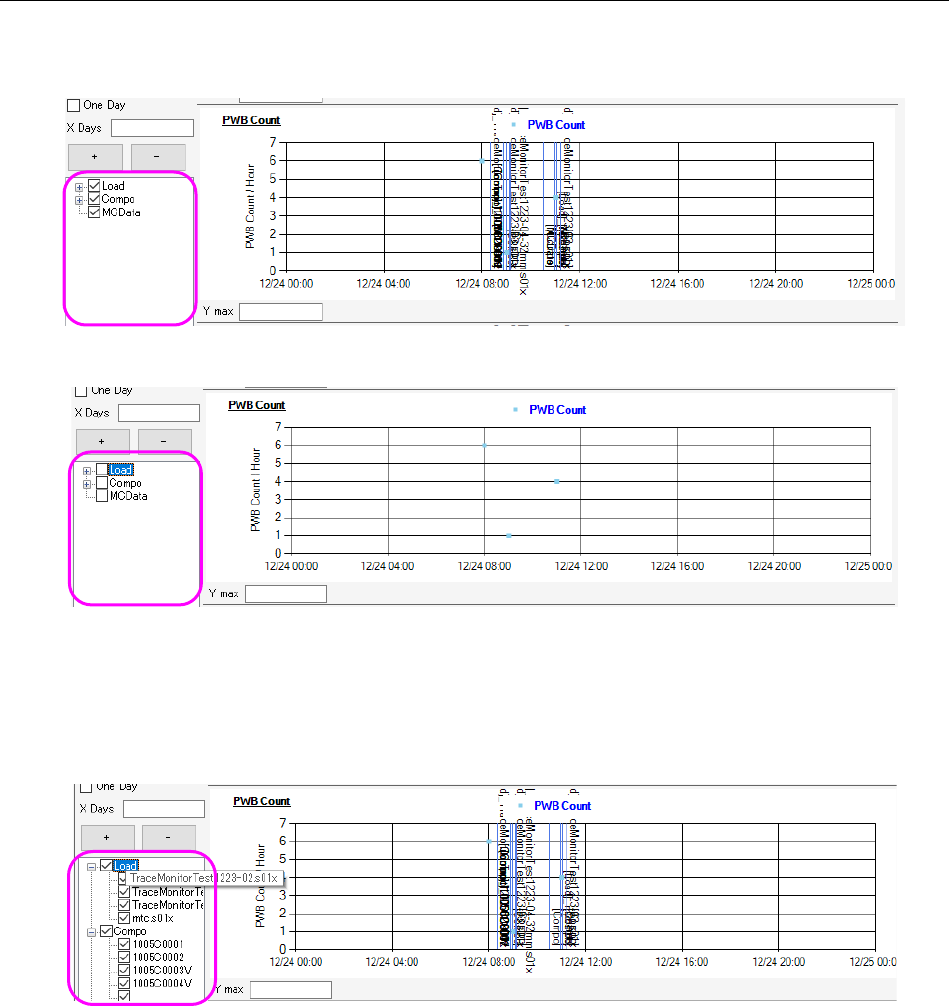
19-3-6-7 Filtering an event
Three types of event data are provided: [Load], [Compo] and [MCData]. You can display or hide
them with the corresponding check boxes.
Figure 19-3-38 Check boxes for filtering an event (when data is displayed)
Figure 19-3-39 Check boxes for filtering an event (when data is hidden)
In addition, TraceMonitor can filter events, [Load] event and [Compo] event, according to the
assigned parameters (production program name/component name) also.
Since any parameter is not assigned to [MCData], you can display or hide it only.
Figure 19-3-40 Filtering each event according to a parameter