JANETS_INM.pdf - 第373页
JaNets In structio n Manual 7. Program Editor 7- 166 RX -7 S eries options When you se lect the “ RX -7 S eries ” t ab from Mach ine T ype Spec ific, the f ollowing d ialog box ap- pears on the c areen. Figure 7.7 - 21 M…
JaNets Instruction Manual 7. Program Editor
7-165
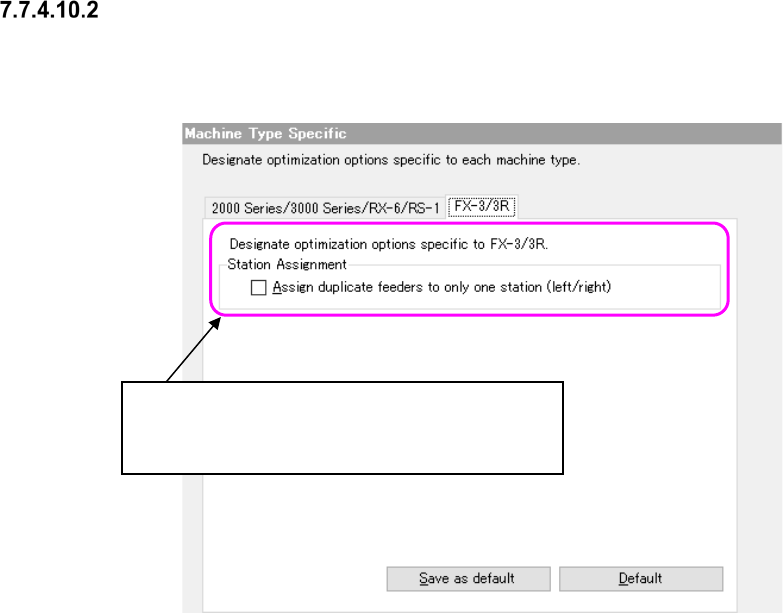
FX-3 Series options
The following screen is displayed by selecting the “FX-3 Series” tab in options peculiar to the
model.
Figure 7.7-20 Options peculiar to the model – FX-3 Series options
Division of station:
The following are choices for allocating the same
component to the left and right stations.
JaNets Instruction Manual 7. Program Editor
7-166
RX-7 Series options
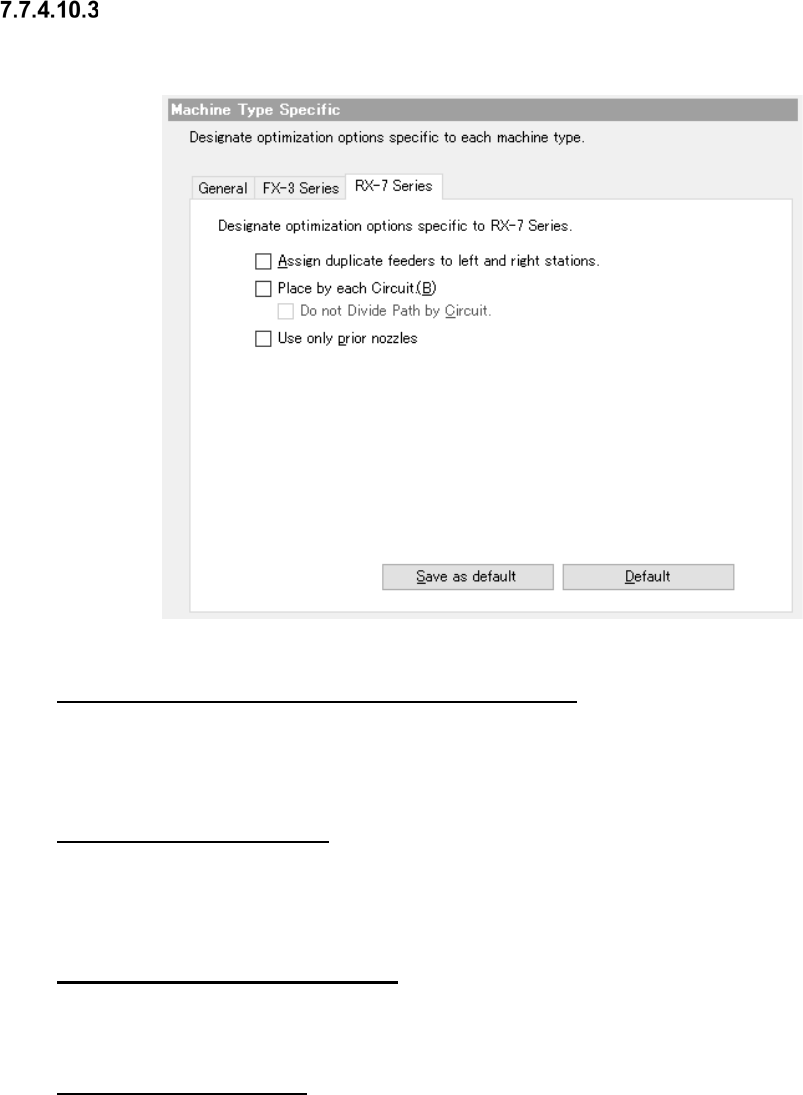
When you select the “RX-7 Series” tab from Machine Type Specific, the following dialog box ap-
pears on the careen.
Figure 7.7-21 Machine Type Specific RX-7 Series option
“Assign duplicate feeders to left and right stations.”
When this option is enabled, the same components may be assigned to a station on either side in
order to maintain right-and-left balance. The same components are not assigned to a station on
either side when this option is disabled.
“Mounting for each circuit”
If this option is enabled, and when two or more circuits exist in a mount step, components are kept
from being assigned to two or more different circuits in one cycle. For the reference circuit only, the
placement order is determined.
“No path division for each circuit”
Set whether path division (placement point) is performed or not between stations for each circuit.
This is available when “Placement for each circuit” is enabled.
“Use only prior nozzles.”
For placing components for which multiple shared nozzles are set, check off this item for optimi-
zation. When the check box of this item is OFF (unchecked), the nozzle to be used is automatically
selected through optimization.
JaNets Instruction Manual 7. Program Editor
7-167
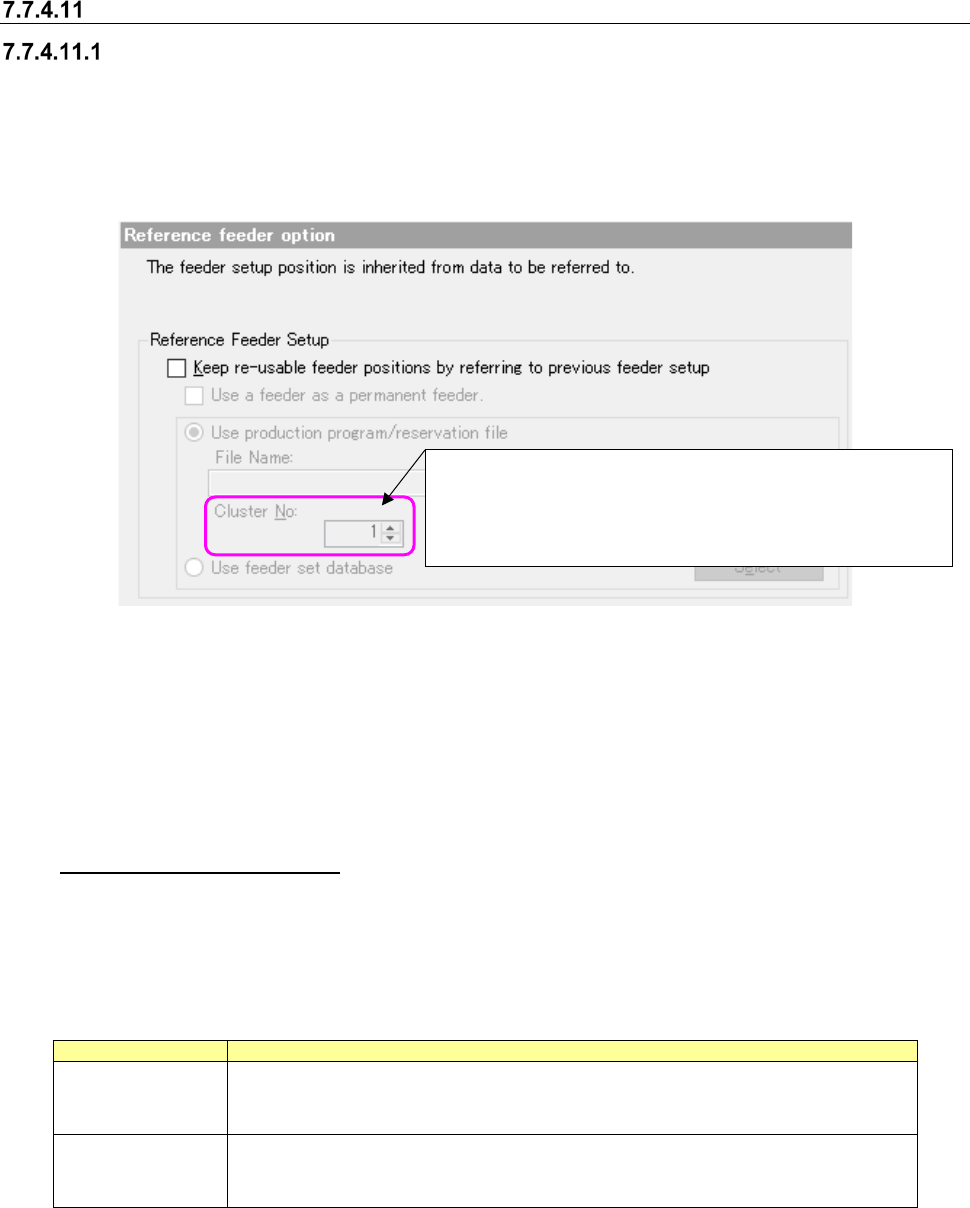
Reference feeder option
Reference Feeder Setup
The system refers to the feeder set information of other production programs or reservation files
and makes the feeder assignment of a production program contained in a reservation file that is to
be optimized common to the referred feeder set information.
* When a production line includes a JM series machine, the “Reference feeder option” cannot be
selected.
Figure 7.7-22 Reference Feeder Setup
When you select the <Browse> button, the system displays the dialog box for selecting a file. On
this dialog box, you can select a production program or a reservation file for the IS.
If you select a file whose line configuration is different from that of the active line set with the Job
Optimizer, the error message indicating that the selected file is different from that of the “Refer-
ence Feeder Setup” appears on the screen when you click the <Open> button on this dialog box.
Used as a permanent feeder
When you put a checkmark in this check box, the system regards the reference feeder setup as a
permanent feeder(s) that can be set with the Shopfloor Setup to execute the optimization function.
The differences between a permanent feeder and the reference feeder setup are shown in the ta-
ble below.
Table 7.7-6 Differences between a permanent feeder and the reference feeder setup
Item
Description
Permanent feeder
Occupies the corresponding place even when its component is not used.
Since the feeder is already located on the bank, any feeder resources are not con-
sumed.
Reference feeder
setup
Does not occupy the corresponding place when its component is not used, and
another component can be assigned to the place.
When this type feeder is assigned to the bank, the feeder resources are consumed.
Note the following points when you use this option.
- You have to register components that are to be used as a permanent feeder to the Compo-
nent database in advance.
- You cannot use both “a permanent feeder” and “Used as a permanent feeder in the reference
feeder setup” at the same time.
Specify a number in the range of 1 to the number of clusters in
a reservation file (up to 100).
The last cluster number in the reservation file is specified by
default.