JANETS_INM.pdf - 第266页
JaNets In structio n Manual 7. Program Editor 7- 59 Check Component Height Figure 7.4 - 84 “ Check Component Height ” screen T able 7.4 - 49 C heck it ems displa yed on th e “ Check Component Heigh t ” screen Item Descri…
JaNets Instruction Manual 7. Program Editor
7-58
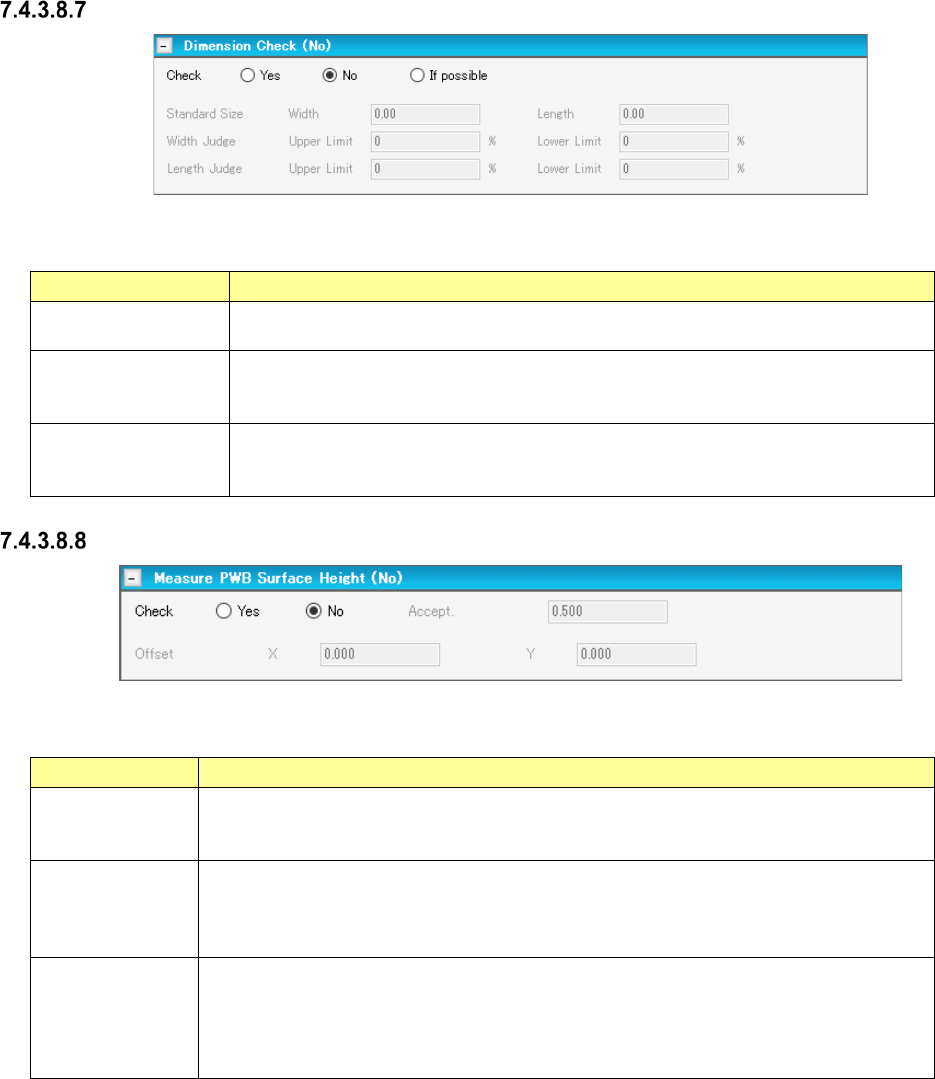
Dimension Check
Figure 7.4-82 “Dimension Check” screen
Table 7.4-47 Check items displayed on the “Dimension Check” screen
Item
Description
Check
Yes/No
Select whether to run a dimension check or not with the corresponding radio button.
The “No” radio button is selected by default.
Dimension check
Standard Size
You can enter these fields when you select the “Yes” or “If possible” radio button of the
menu item “Check.” Enter the reference size of a component. The outer dimen-
sions are entered here by default.
Dimension check
Width Judge/Length
Judge
You can enter these fields when you select the “Yes” or “If possible” radio button of the
menu item “Check.” Enter the ratio to the component size.
Input range: 1 to 100 % (Default value: 15 %).
PWB Surface Height
Figure 7.4-83 “Measure PWB Surface Height” screen
Table 7.4-48 Menu items displayed on the “Measure PWB Surface Height” screen
Item
Description
Check
Yes/No
Select whether to measure the height of the board surface on which a component is
placed with the corresponding radio button.
The “No” radio button is selected by default.
Measure PWB
Surface Height
Accept.
You can enter this field when you select the “Yes” radio button of the menu item “Check.”
Enter a judgment value for warpage of a board.
Input range: 0.00 to 5.00 mm
Default value: 0.50 mm
Measure PWB
Surface Height
Offset X, Y
You can enter these fields when you select the “Yes” radio button of the menu item
“Check.” Enter the offset from a component placement position to the component height
measurement position.
Input range: - 50.00 to 50.00 mm
Default value: 0.00 mm
JaNets Instruction Manual 7. Program Editor
7-59
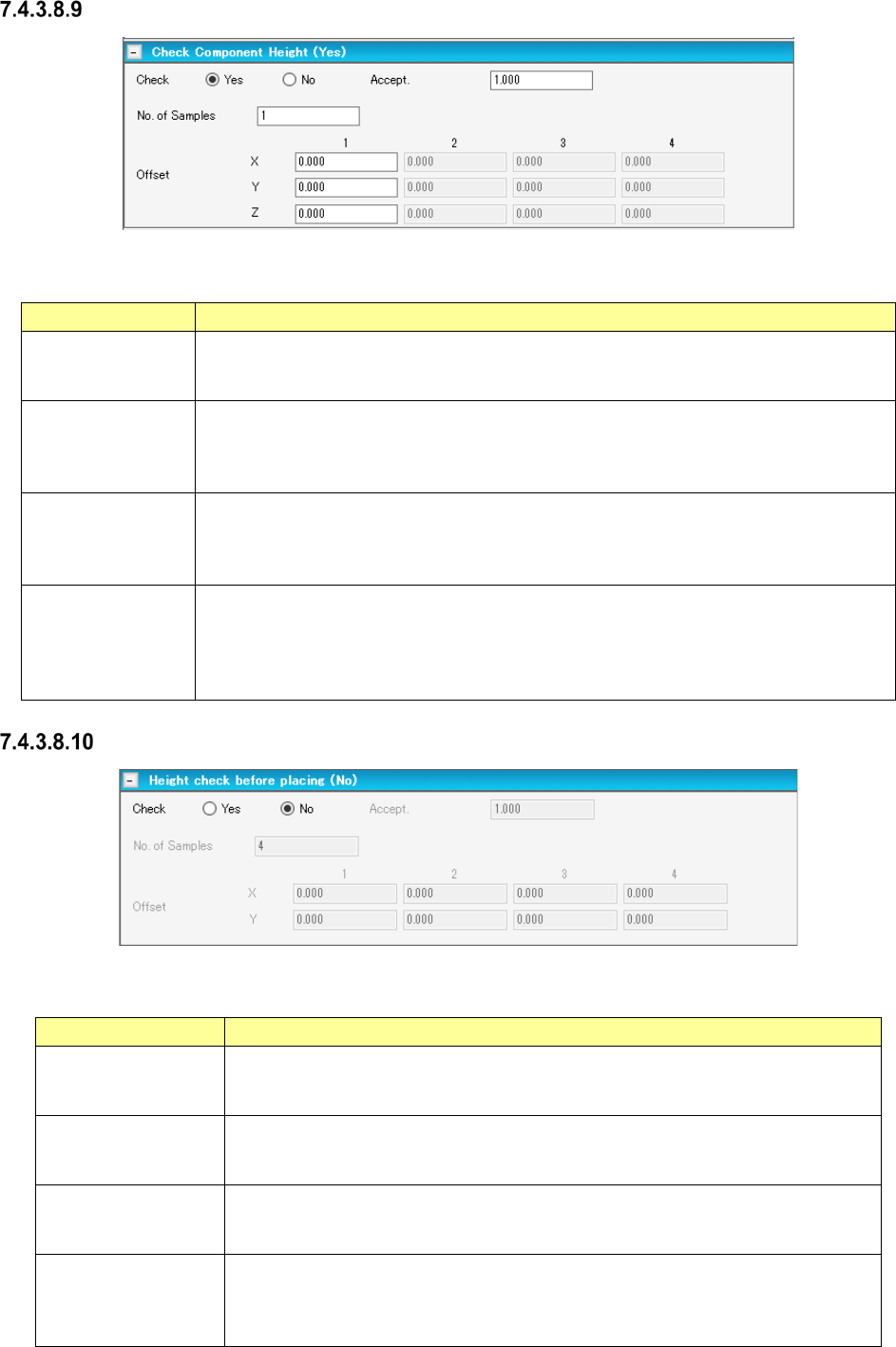
Check Component Height
Figure 7.4-84 “Check Component Height” screen
Table 7.4-49 Check items displayed on the “Check Component Height” screen
Item Description
Check
Yes/No
Select whether to run a placed component height check or not with the corresponding
radio button.
The “No” radio button is selected by default.
Check Component
Height
Accept.
You can enter this field when you select the “Yes” radio button of the menu item “Check.”
Enter the judgment value based on the measurement result by the HMS.
Input range: 0.00 to 5.00 mm
Default value: 0.50 mm
Check Component
Height
No. of Samples
You can enter this field when you select the “Yes” radio button of the menu item “Check.”
Enter the number of check positions of a component.
Input range: 1 – 4
Default value: 4
Check Component
Height
Offset X, Y, Z
You can enter these fields when you select the “Yes” radio button of the menu item
“Check.” Enter the offset (X, Y) from the center of the component.
You can enter the offset values also for the number of components specified with the
menu item “No. of Samples.”
Offset Z entering becomes capable only for the line containing JM-100.
Height check before placing
Figure 7.4-85 “Height check before placing” screen
Table 7.4-50 Check items displayed on the “Height check before placing” screen
Item
Description
Check
Yes/No
Select whether to run a placed component height check or not with the correspond-
ing radio button.
The “No” radio button is selected by default.
Height check before
placing
Accept.
You can enter this field when you select the “Yes” radio button of the menu item
“Check.” Enter the judgment value based on the measurement result by the HMS.
Input range: 0.00 to 5.00 mm Default value: 0.50 mm
Height check before
placing
No. of Samples
You can enter this field when you select the “Yes” radio button of the menu item
“Check.” Enter the number of check positions of a component.
Input range: 1 – 4 Default value: 4
Height check before
placing
Offset X, Y
You can enter these fields when you select the “Yes” radio button of the menu item
“Check.” Enter the offset (X, Y) from the center of the component.
You can enter the offset values also for the number of components specified with the
menu item “No. of Samples.”
JaNets Instruction Manual 7. Program Editor
7-60
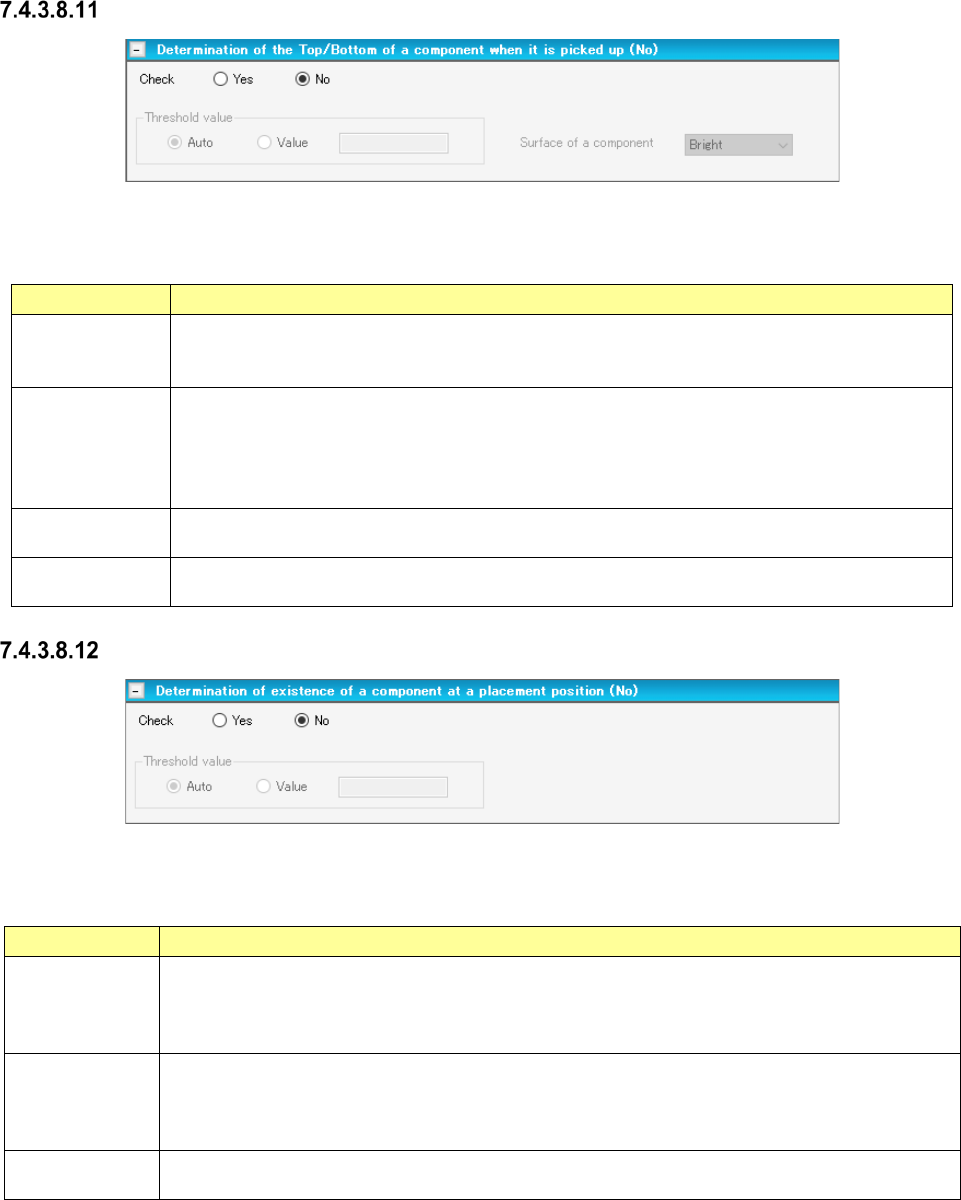
Determination of the Top/Bottom of a component when it is picked up
Figure 7.4-86 “Determination of the Top/Bottom of a component when it is picked up” screen
Table 7.4-51 Items displayed on the “Determination of the Top/Bottom of a component
when it is picked up” screen
Item Description
Check
Select with the corresponding radio button whether to decide the top/bottom of a component
when it is picked up.
The “No” radio button is selected by default.
Threshold value
Select whether a threshold value will be set automatically (Auto) or set by you (Value) with the
corresponding radio button.
The “Auto” radio button is selected by default.
When you select the “Value” radio button, the text box for entering a threshold value is
activated.
Threshold value
Value
Specify the threshold value for deciding the top/bottom of a component when it is picked up in
the range of 1 to 255. Default: 128
Surface of a
component
Select the surface of a component, “Bright” or “Dark.”
“Dark” is selected by default.
Determination of existence of a component at a placed position
Figure 7.4-87 “Determination of existence of a component at a placed position” screen
Table 7.4-52 Items displayed on the “Determination of existence of a component
at a placed position” screen
Item Description
Check
Select whether to decide if there is any component at a placement position with the corresponding
radio button.
When the length of the longer side of a component is 5.30 mm or less, the “Yes” radio button is
selected by default. When it exceeds 5.30 mm, the “No” radio button is selected by default.
Threshold value
Select whether a threshold value will be selected automatically (“Auto”) or set by you (Value) with
the corresponding radio button.
The “Auto” radio button is selected by default.
When you select the “Value” radio button, the text box for entering a threshold value is activated.
Threshold value
Value
Specify the threshold value for deciding the top/bottom of a component when it is picked up in the
range of 1 to 255. Default: 128