JANETS_INM.pdf - 第242页
JaNets In structio n Manual 7. Program Editor 7- 35 The items di splayed on t he v ision centeri ng screen are shown in the tabl e below . T able 7.4 - 13 Items displayed on the vision centeri ng screen ( RX -6 S eries )…
JaNets Instruction Manual 7. Program Editor
7-34
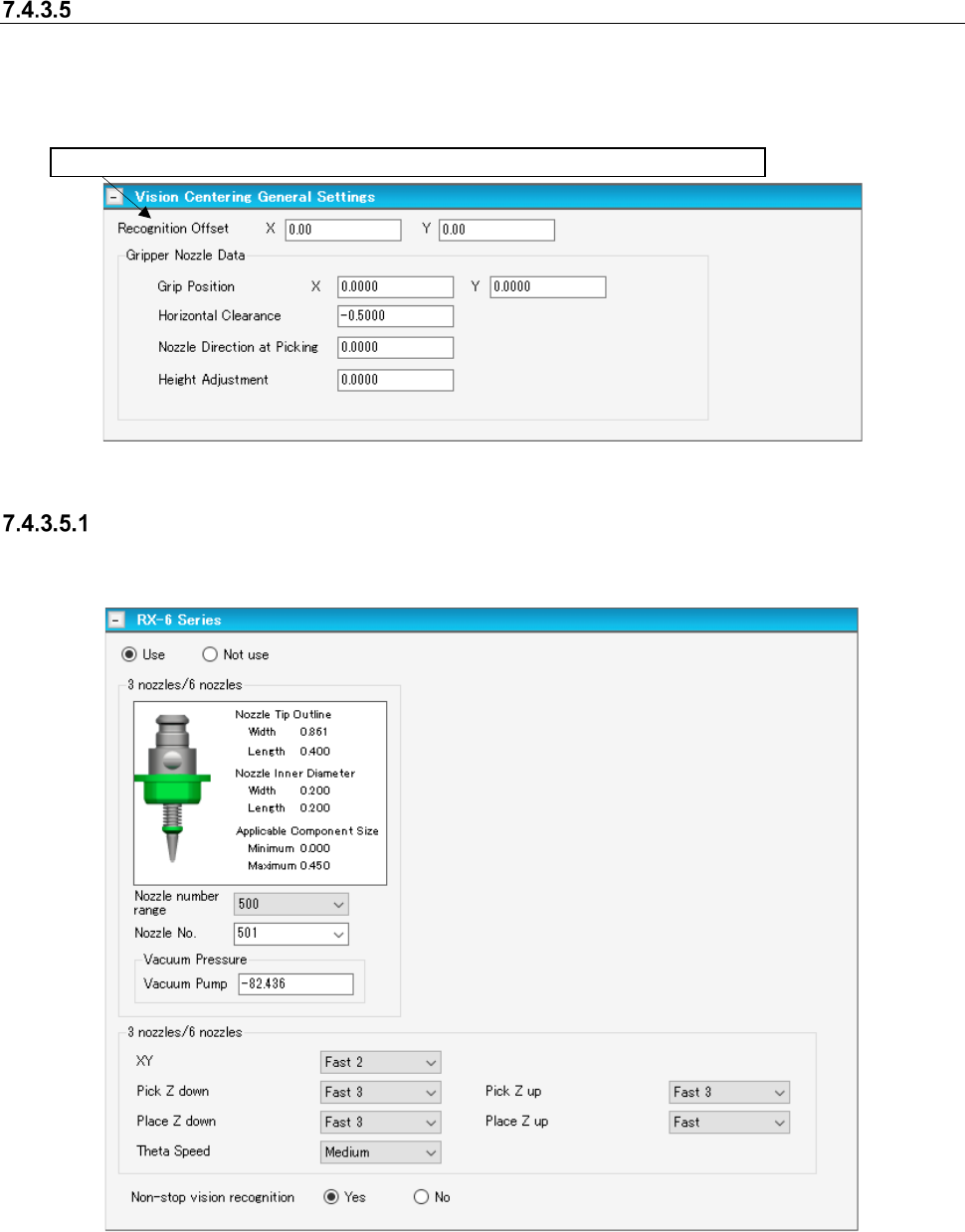
“Vision Centering General Settings” screen
When you check the “Vision” check box in the “Centering Method” column of the “Basic Settings”
screen, and select the “Component Data” from the tree view, and then the “Vision Centering,” the
following screen appears.
Figure 7.4-47 “Vision Centering General Settings” screen
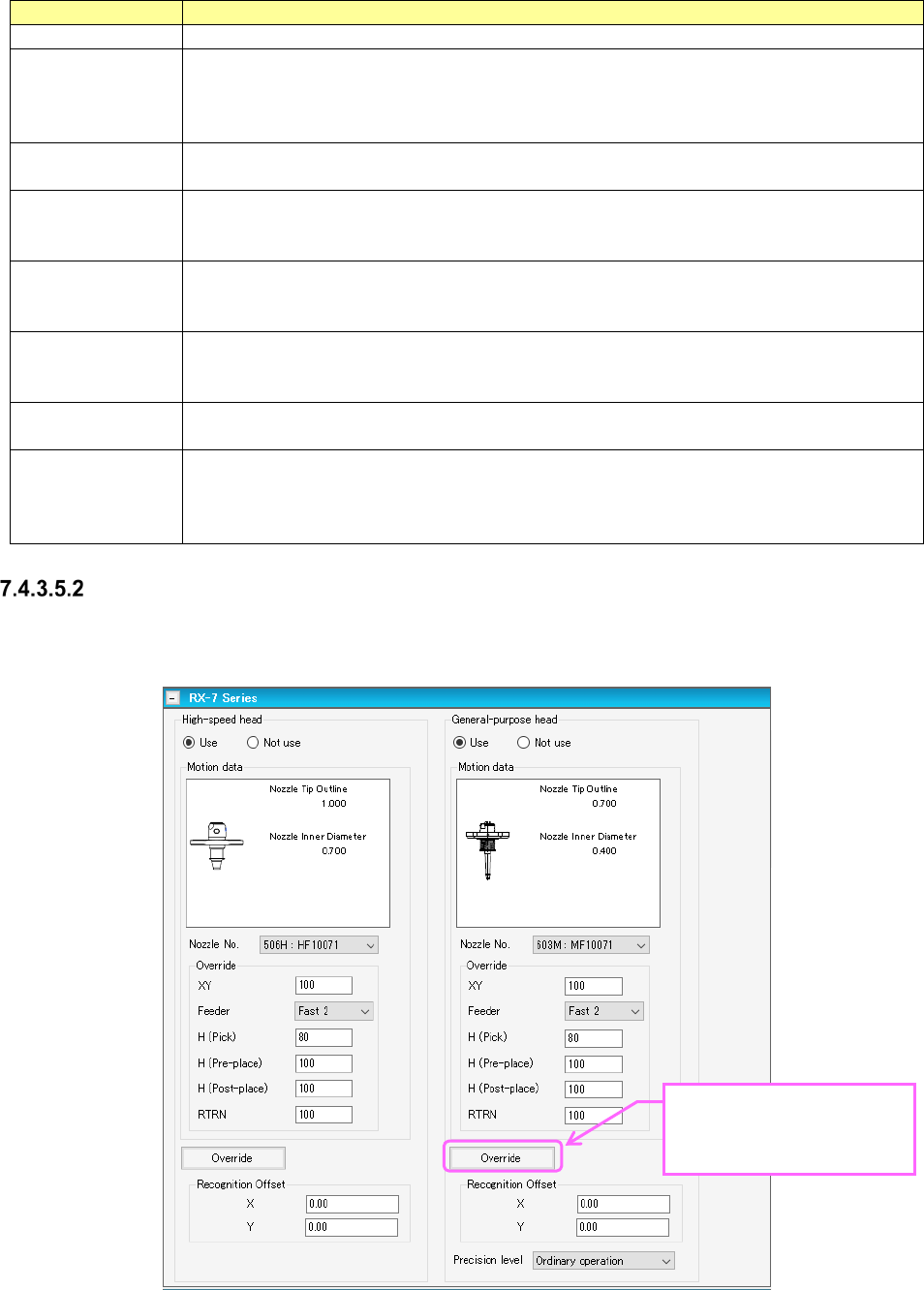
Vision centering
The typical vision centering screen of RX-6 series is shown below.
Figure 7.4-48 Example of the vision centering screen (RX-6 Series)
Enter an offset from the center of a component to be applied when it is recognized with a VCS.
JaNets Instruction Manual 7. Program Editor
7-35
The items displayed on the vision centering screen are shown in the table below.
Table 7.4-13 Items displayed on the vision centering screen (RX-6 Series)
Item
Description
Use/Not use
Select whether to use the vision centering information or not.
Nozzle No.
Select a nozzle number that is used to pick up a component from the drop-down list of the
combo box. The nozzle numbers set on the “Equipment Setup” screen of the Shopfloor Setup
application are displayed on the drop-down list.
The default value is decided according to the component type and the outer dimensions.
Vacuum Pressure
Vacuum Pump
Enter the vacuum pressure to be applied when a component is picked up.
The default value is decided according to the component type and the outer dimensions.
XY
Select the acceleration of the XY-axes to be applied from when image of a component is
obtained until when the axes move to the corrected placement position from the combo box.
The default value is decided according to the component type and the outer dimensions.
Pick Z down/up
Select the acceleration of the Z-axis to be applied when it moves down or up to pick up a
component.
The default value is decided according to the component type and the outer dimensions.
Place Z down/up
Select the acceleration of the Z-axis to be applied when it moves down or up to place a
component on a board.
The default value is decided according to the component type and the outer dimensions.
Theta Speed
Select the theta axis rotation speed from the combo box.
The default value is decided according to the component type and the outer dimensions.
Non-stop vision
recognition
Set whether to perform non-stop vision recognition. However, this setting is ineffective for
general-purpose components, components using transparent lighting, components exceeding
□33.5 mm, components with a lower XY speed than the low speed, and components of
recognition center offset or divided recognition.
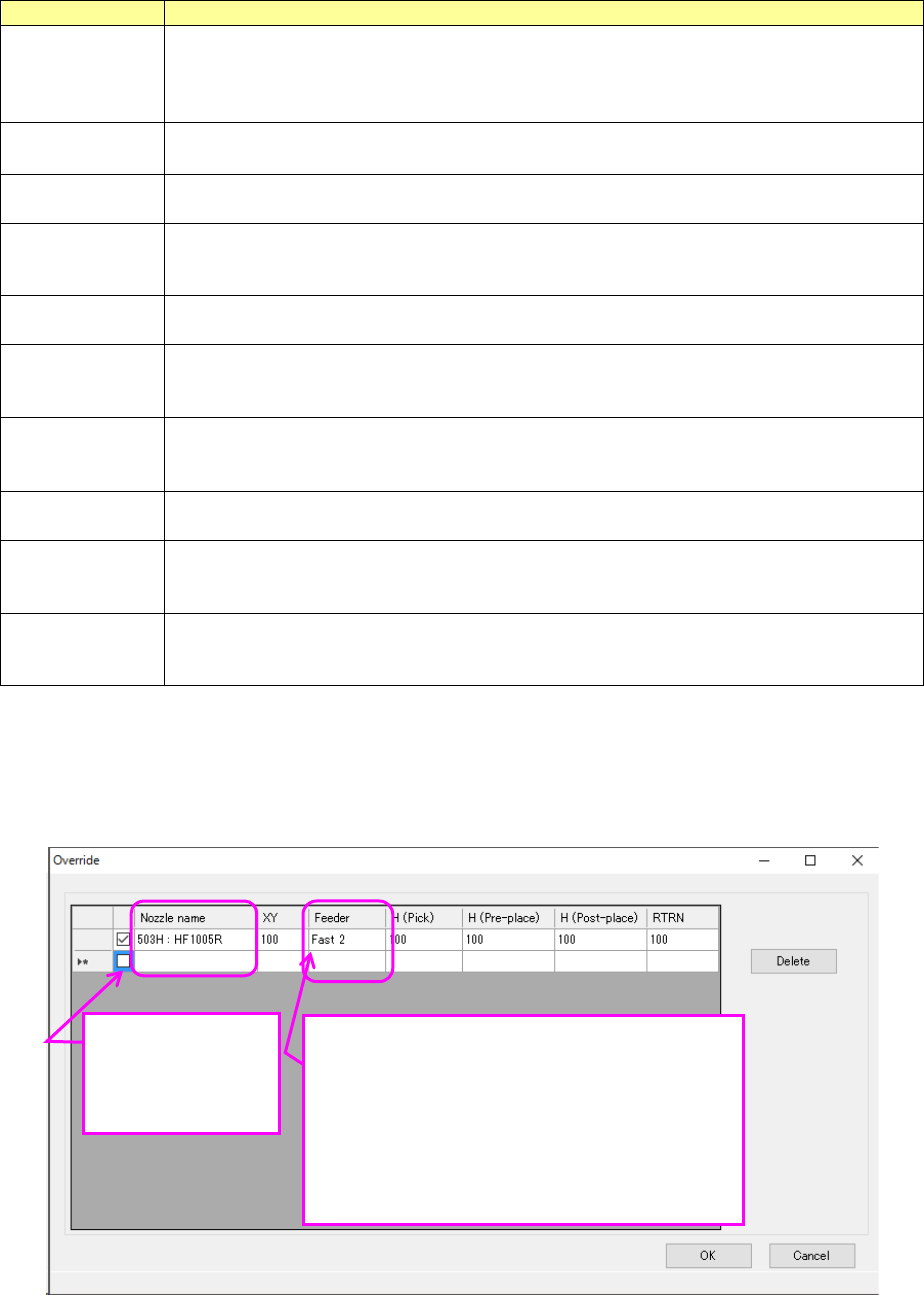
Vision centering (RX-7 Series)
For an RX-7 series, set vision centering data for a high-speed head and that for a general-purpose
head respectively.
Figure 7.4-49 Example of the vision centering screen (RX-7 Series)
Edits, adds or deletes a noz-
zle number and an override
that can be used with the
corresponding component.
JaNets Instruction Manual 7. Program Editor
7-36
Table 7.4-14 Items displayed on the vision centering screen (RX-7 Series)
Item
Description
Use/Not use
Select whether to use the RX-7 series vision centering information or not.
*If you select the “Not use” radio button, any centering data is not set when you use the
Program Editor to invoke Component data. Therefore, enable the vision centering function
with the Component Database first before invoking the Component data.
Motion data
Nozzle No.
Select a prior nozzle from the drop-down list located on the combo box.
Motion data
Override: XY.
Enter the XY override ratio
Input range:1 to 100
Motion data
Override: Feeder
Enter the feeder override ratio.
When the tape width is 8 mm, select the speed among “Fast 2,” “Fast,” “Middle,” Slow.”
When you use any other width tape, select the speed among “Fast 2,” “Middle” and “Slow.”
Motion data
Override: H(Pick)
Enter the override ratio of the Height (for picking up a component).
Input range:1 to 100
Motion data
Override:
H(Pre-place)
Enter the override ratio of the Height (applied before placing a component on a board).
Input range:1 to 100
Motion data
Override:
H(Post-place)
Enter the override ratio of the Height (applied after placing a component on a board).
Input range:1 to 100
Motion data
Override: RTRN
Enter the RTRN override ratio.
Input range:1 to 100
Recognition Off-
set X Y
Enter offset viewed from the center of a component when the component is recognized with a
VCS.
Input range: -999.99 to 999.99.
Precision level
Apply this level to a component whose height and position have to be set precisely when it is
placed on a board.
Select either “Ordinary operation” or “High-precision operation.”
When you press the <Override> button, the following screen appears.
Edit, add or delete a nozzle number and an override that can be used with the corresponding
component.
A nozzle whose check box a checkmark is put in is handled as a prior nozzle.
Figure 7.4-50 RX-7 Series “Override” setting screen
Specify the noz-
zle number.
Select one of the
imported nozzles
Enter the feeder override ratio.
When the tape width is 8 mm, select the
speed among “Fast 2,” “Fast,” “Middle,”
Slow.”
When you use any other width tape, select
the speed among “Fast 2,” “Middle” and
“Slow.”