2OM-1064-002.pdf - 第108页
3. Example of Pattern Program Creation 3.2.8 Data for Polar Coordinate Conversion Function When unit P .C.B.’ s are arranged at arbitrary angles on a multi-unit P .C.B., this function converts polar coordinates after par…

Order of Placement
(2.1) P-0001 and P-0002 of U02: O-0001 → P-0002 and P-0001 of U02: O-
0002 → P-0001 and P-0002 of U02: O-0003
(2.2) P-0005 and P-0006 (Block “0”) of U03
(2.3) P-0002 and P-0003 of U01: O-0001 → P-0003 and P-0002 of U01: O-
0002 → P-0002 and P-0003 of U01: O-0003 → P-0003 and P-0002
(Block “1”) of U01: O-0004
(2.4) P-0006 of U02: O-0001 → P-0006 of U02: O-0002 → P-0006 (Block
“1”) of U02: O-0003
(2.5) P-0005 and P-0006 of U01: O-0001 → P-0006 and P-0005 of U01: O-
0002 → P-0005 and P-0006 of U01: O-0003 → P-0006 and P-0005
(Block “2”) of U01: O-0004
(2.6) P-0008 and P-0009 of U01: O-0001 → P-0009 and P-0008 of U01: O-
0002 → P-0008 and P-0009 of U01: O-0003 → P-0009 and P-0008
(Block “5”) of U01: O-0004
(2.7) P-0008 and P-0009 (Block “5”) of U03
(2.8) P-0004 of U02: O-0001 → P-0004 of U02: O-0002 → P-0004 (Block
“7”) of U02: O-0003
(2.9) P-0002 and P-0003 (Block “9”) of U03
3. Example of Pattern Program Creation
9910-001 2-95 Tg0247-PM-PM
3. Example of Pattern Program Creation
3.2.8 Data for Polar Coordinate Conversion Function
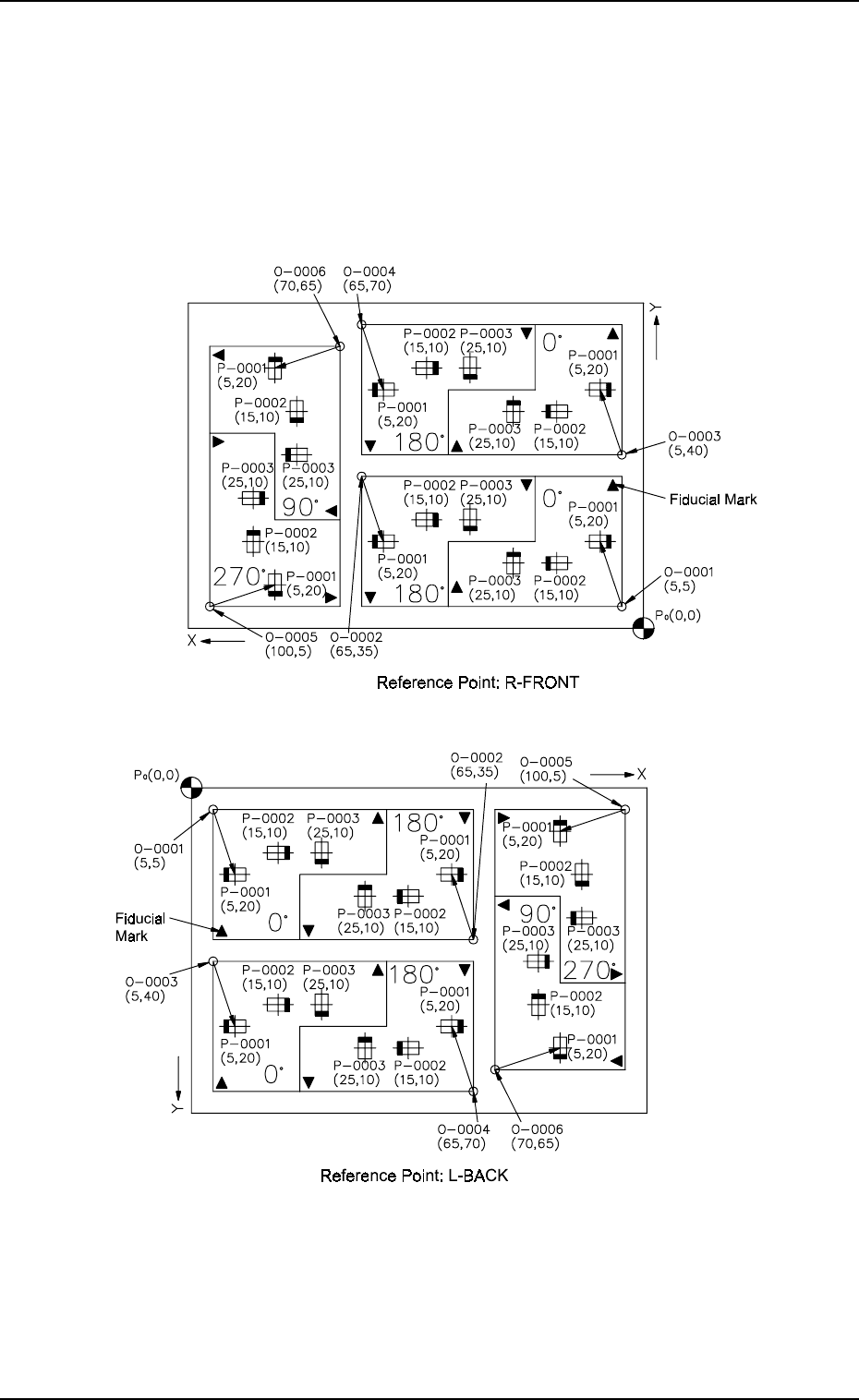
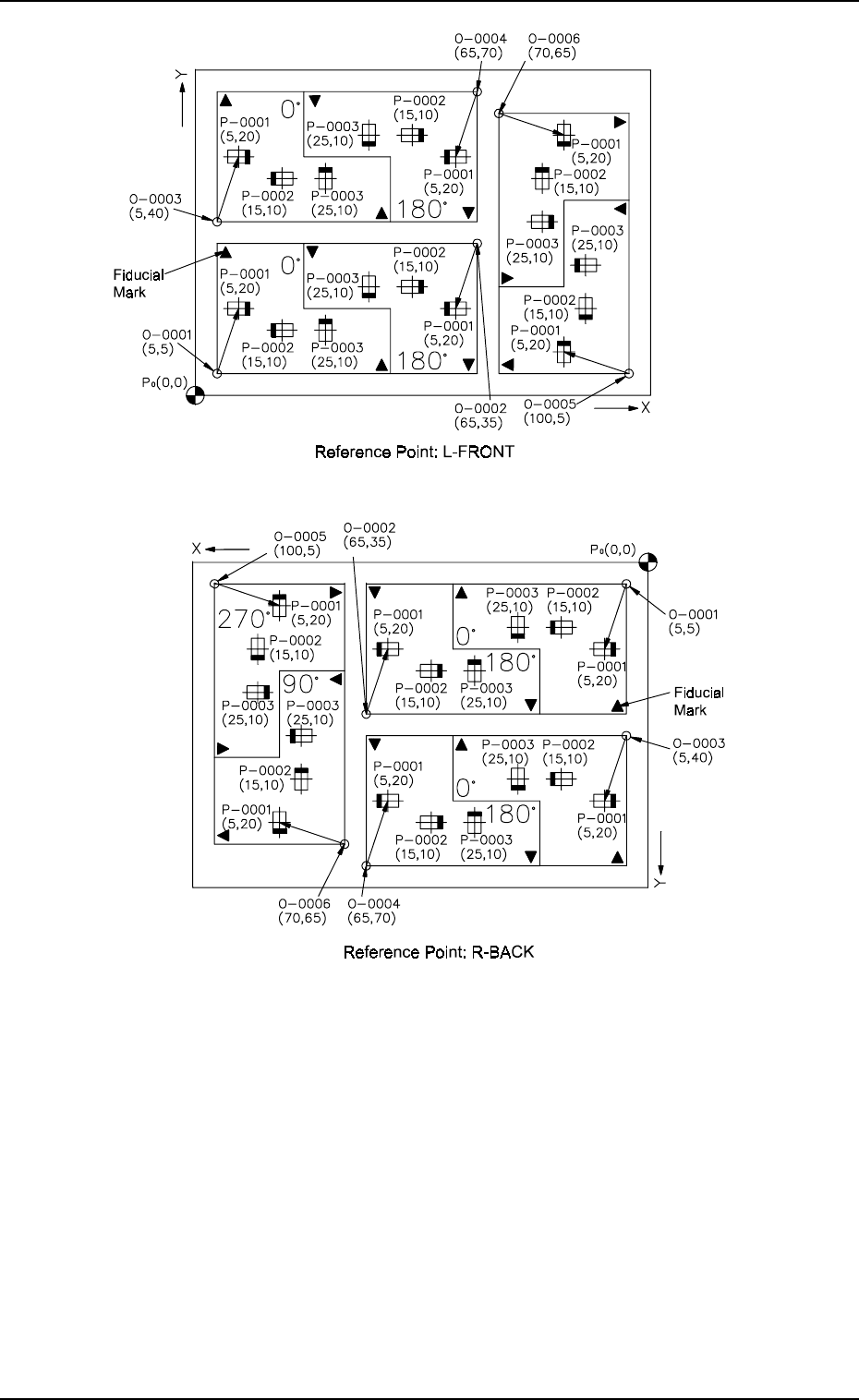
When unit P.C.B.’s are arranged at arbitrary angles on a multi-unit P.C.B., this
function converts polar coordinates after parameters (arrangement angle of
each pattern) are entered in the “Z (THETA)” data field of the placement data
(O).
(1) Pattern Sample
9910-001 2-96 Tg0247-PM-PM
Fig. 2.84-2
Fig. 2.84-1
3. Example of Pattern Program Creation
9910-001 2-97 Tg0247-PM-PM
Fig. 2.84-4
Notes: (a) Component placement coordinates must be measured from the
pattern origin.
(b) P
0
shows the P.C.B. positioning reference.
(c) “O-0001”, “O-0002”, “O-0003”, “O-0004”, “O-0005”, and “O-
0006” are called “Pattern Origins”. Each coordinate measured from
the P.C.B. positioning reference point must be entered.
(d) Measure the coordinates (distances) based on the pattern origins
and enter them for component placement.
Fig. 2.84-3