2OM-1064-002.pdf - 第115页
4. P A TTERN PROGRAM Display 4.1.3 PLACEMENT DA T A SORTING Display (1) Select the [NAME (XX/XX)] key of the program to be sorted and press the [PROGRAM OPTIMUM] key at the “P A TTERN PROGRAM” dis- play (Fig. 2.92). The …
4. PATTERN PROGRAM Display
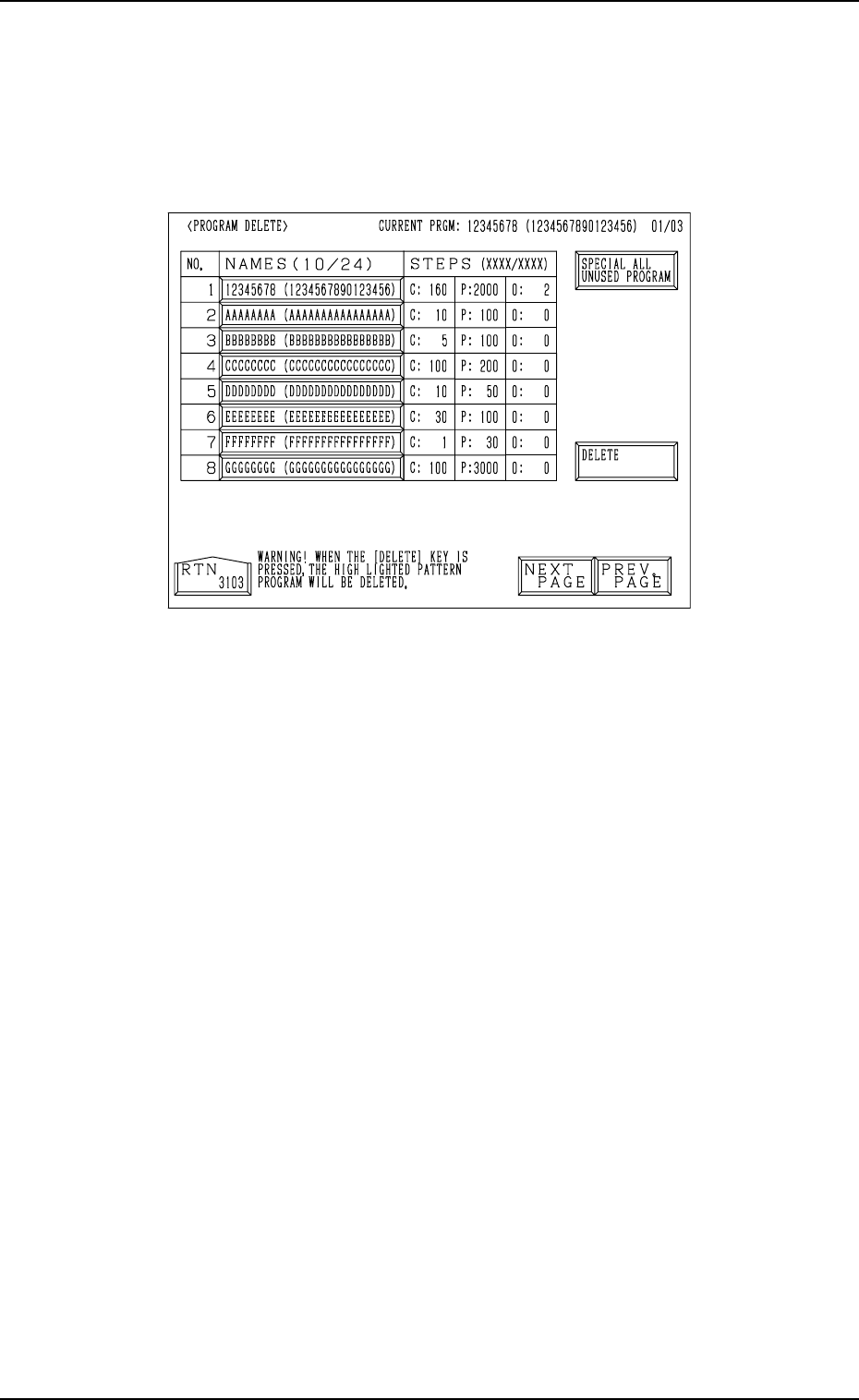
4.1.2 PROGRAM DELETE Display
(1) Select the pattern program to be deleted by pressing the desired “NAME
(XX/XX)” key at the “PATTERN PROGRAM” display (Fig. 2.92). Then,
press the [PROGRAM DELETE] key.
The following display appears on the screen.
0004-002 2-102 Tg0247-PM-PM
Fig. 2.94
(2) Check that the selected “NAMES (XX/XX)” key of the pattern program
to be deleted has turned blue.
Ref.: The pattern program data to be deleted can also be selected by
pressing the “NAMES (XX/XX)” key after the “PROGRAM DE-
LETE” display has opened.
(3) When the [DELETE] key is pressed, the selected pattern program is de-
leted.
To delete all pattern programs
(1) Press the [SPECIAL ALL UNUSED PROGRAM] key.
The [SPECIAL ALL UNUSED PROGRAM] key turns red and the
“NAMES (XX/XX)” keys turn blue.
(2) When the [DELETE] key is pressed, all pattern program data is deleted
and the program names are changed to “-------- (----------------)”, exclud-
ing the programs for the current production model.
• To cancel the program delete mode, press the [SPECIAL ALL UN-
USED PROGRAM] key again.
4. PATTERN PROGRAM Display
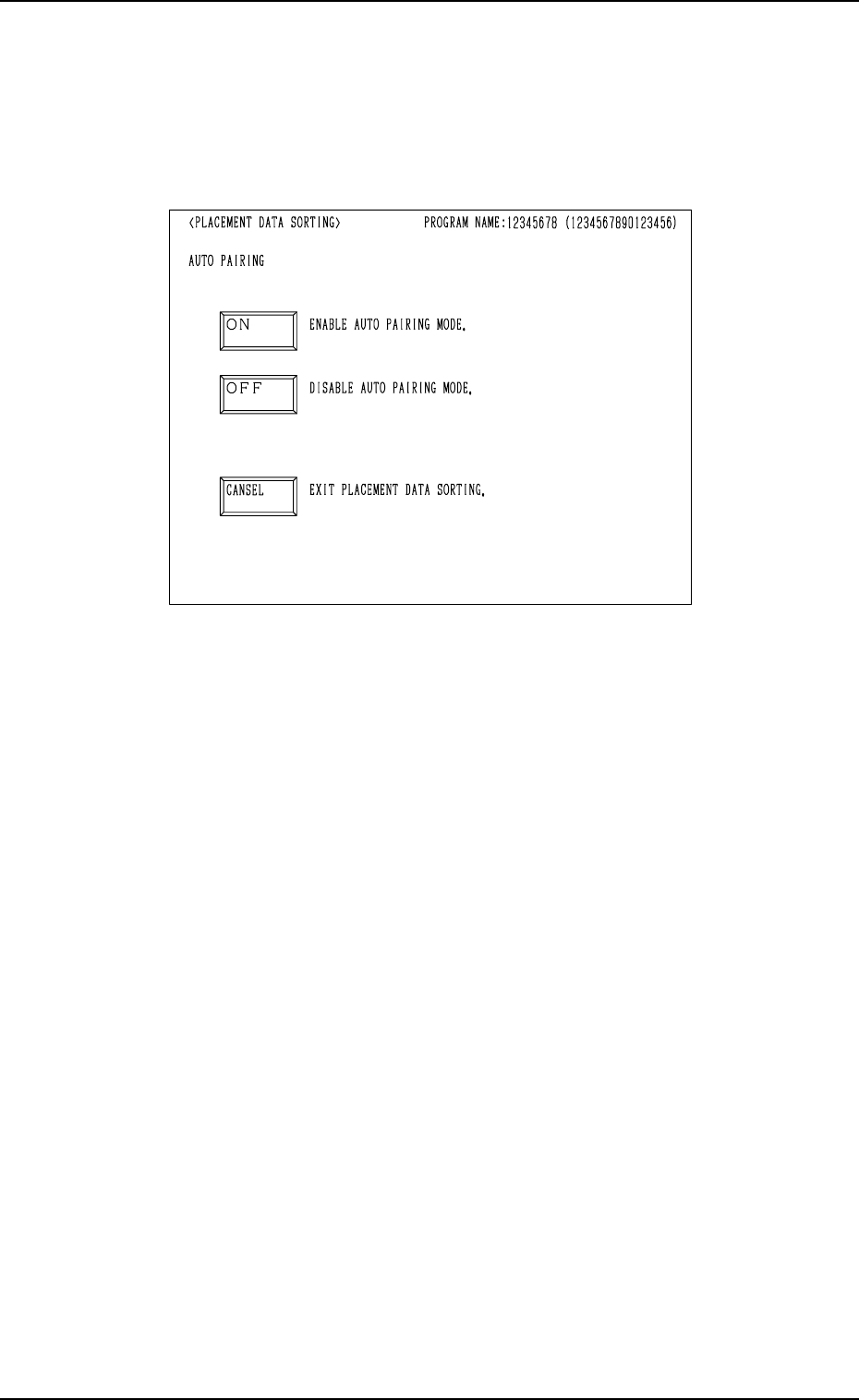
4.1.3 PLACEMENT DATA SORTING Display
(1) Select the [NAME (XX/XX)] key of the program to be sorted and press
the [PROGRAM OPTIMUM] key at the “PATTERN PROGRAM” dis-
play (Fig. 2.92).
The following display appears on the screen.
0004-002 2-103 Tg0247-PM-PM
Fig. 2.94-1
(2) Select the desired sorting method.
• When the [ON] key is pressed, the “S-DATA” of the placement data is
initialized and the pairing operations are performed automatically for
the simultaneous pick-up and pick-up priority functions. Then, the place-
ment steps (order) are sorted.
The system proceeds to Step (3).
• When the [OFF] key is pressed, the “S-DATA” of the placement data is
not initialized and the placement steps (order) are sorted.
The system proceeds to Step (3).
• When the [CANCEL] key is pressed, the program sorting function is
canceled.
(3) The program check operation is performed.
• When the program is checked “OK”, the system proceeds to Step (4).
• When the program is checked “NG” (No Good), the system proceeds
to Step (6).
(4) The program is sorted.
• When the program is checked “OK”, the system proceeds to Step (5).
• When the program is checked “NG”, the system proceeds to Step (6).
(5) The program check operation is performed again.
• When the program is checked “OK”, the sorting ends and the “PAT-
TERN PROGRAM EDIT” display appears on the screen.
• When the program is checked “NG”, the system proceeds to Step (6).
(6) The contents of errors are displayed.
Correct the placement data and re-perform the sorting.
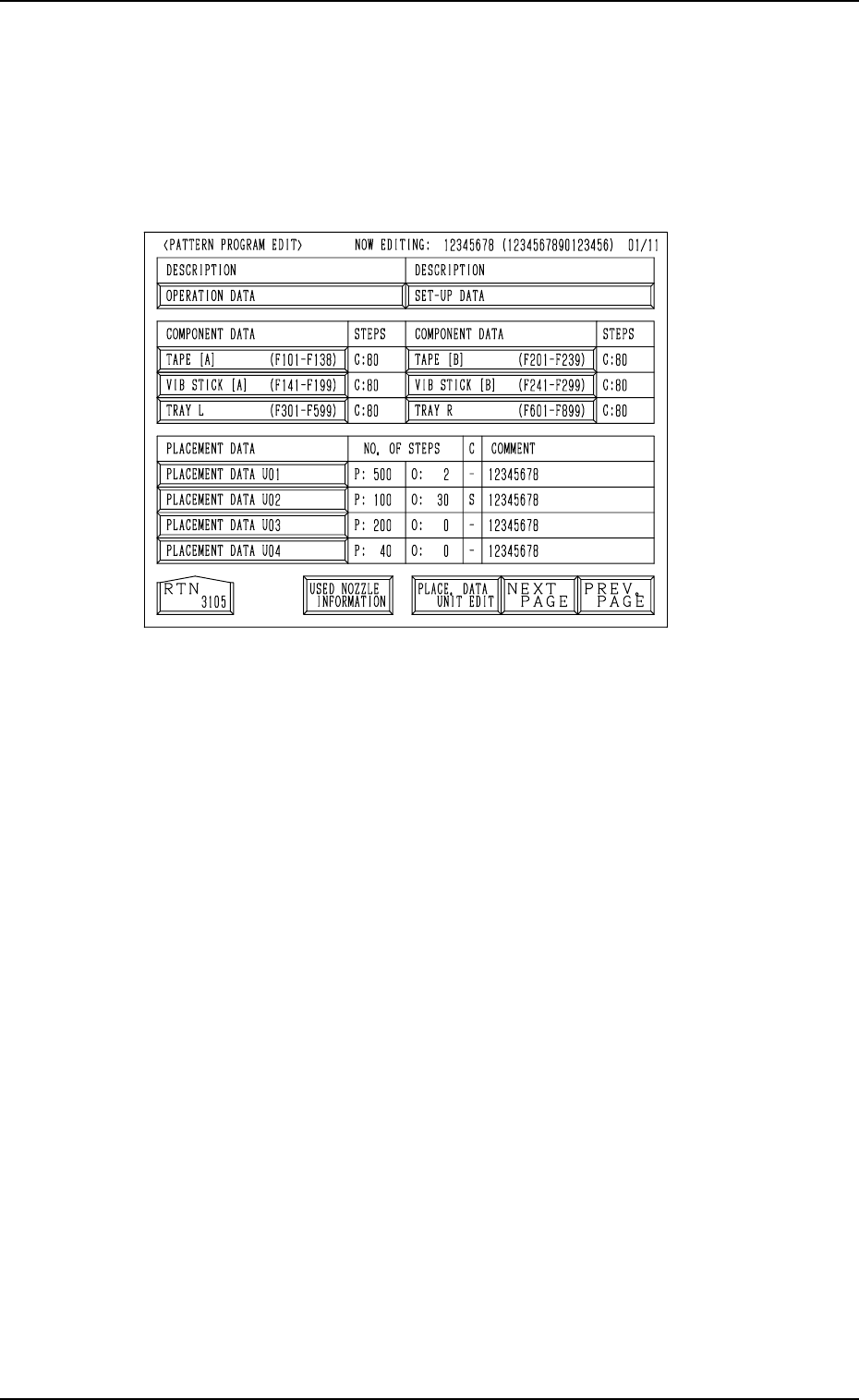
4.2 PATTERN PROGRAM EDIT Display
(1) Select the pattern program to be edited by pressing the desired “NAME
(XX/XX)” key at the “PATTERN PROGRAM” display (Fig. 2.92). Then,
press the [PROGRAM EDIT] key.
The following display appears on the screen.
Fig. 2.95
(2) Select the data to be edited.
(3) The corresponding display opens for editing.
(4) Edit parameters at each corresponding display.
(5) Open the “PATTERN PROGRAM EDIT” display again.
(6) When the [RTN] key is pressed after data editing, the “PATTERN PRO-
GRAM SAVE MODE” display appears on the screen.
Refer to “4.8 PATTERN PROGRAM SAVE MODE Display of Section
2” for details.
4. PATTERN PROGRAM Display
0004-002 2-104 Tg0247-PM-PM