2OM-1064-002.pdf - 第212页
• In the back lighting system, the brightness values are determined through automatic teaching operation based on the captured image of the nozzle dif fusion plate. The brightness is determined such that one lighting dev…
9910-001 5-41 Tg0247-PM-PM
11. COMPONENT RECOGNITION BRIGHTNESS Display
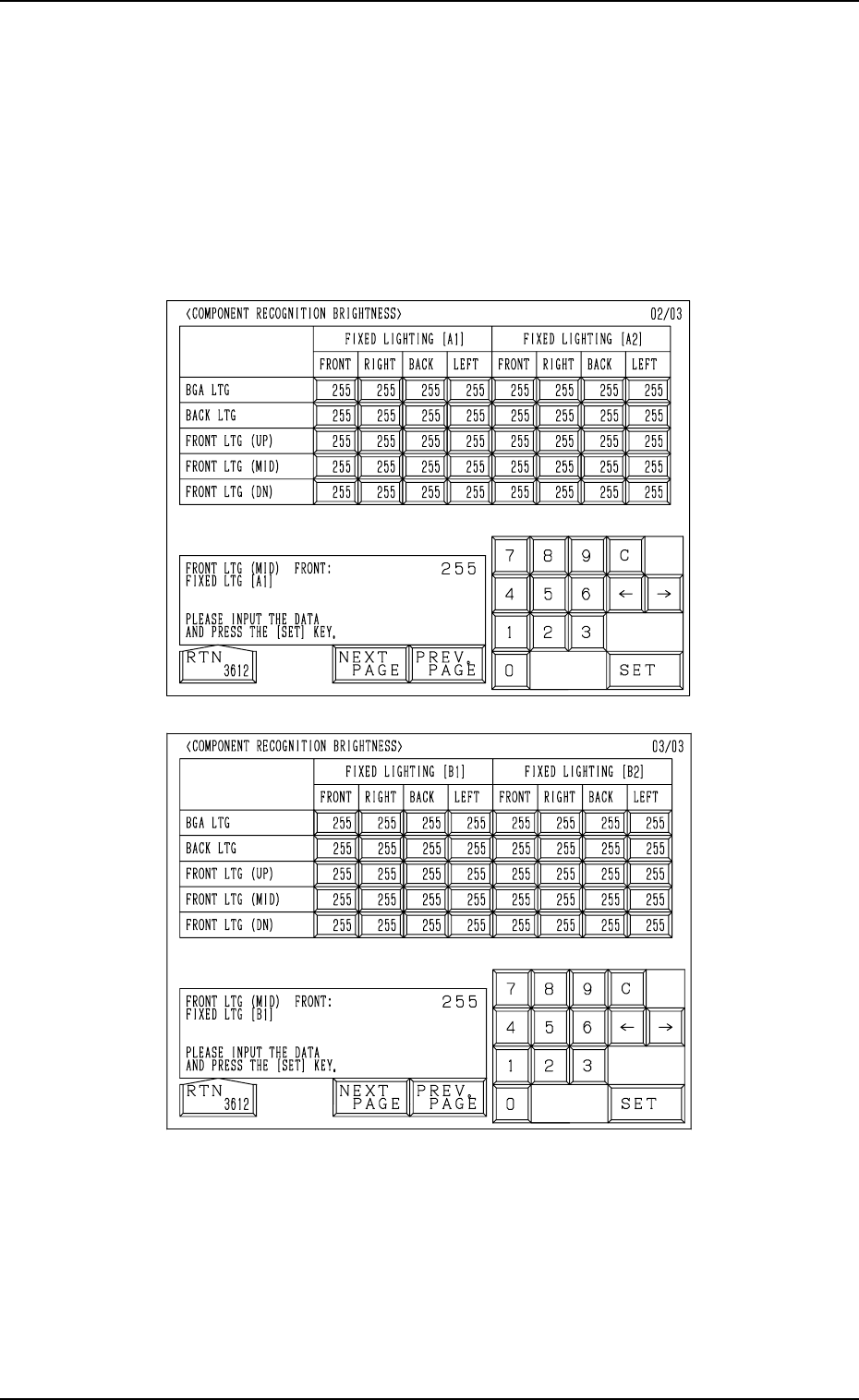
When the [NEXT PAGE] key is pressed at the “COMPONENT RECOGNI-
TION BRIGHTNESS” display (Fig. 5.37-1), the display (Fig. 5.37-2) appears
on the screen.
When the [NEXT PAGE] key is pressed at the display (Fig. 5.37-2), the dis-
play (Fig. 5.37-3) appears on the screen.
Note: The values in Figs. 5.37-2 and 5.37-3 are determined through auto-
matic teaching operation. It is not necessary for the customer to di-
rectly enter any values.
The values differ depending upon which machine is used.
These values are used only for your reference.
Fig. 5.37-3
The fixed lighting is the lighting system in which the four lighting devices are
installed on the main body of the machine. Each device has an ID name as
“A1”, “A2”, “B1”, and “B2”.
“BGA LTG”, “BACK LTG”, and “FRONT LTG (UP), (MID), (DN)” are in-
cluded in each lighting device.
The LEDs are grouped into four blocks and arranged at four corners (front,
right, rear, and left).
Fig. 5.37-2

• In the back lighting system, the brightness values are determined through
automatic teaching operation based on the captured image of the nozzle
diffusion plate.
The brightness is determined such that one lighting device emits lights in
good balance from 4 directions and the lights are illuminated with almost
the same brightness as that for the back lighting system of the other lighting
devices.
• The “BGA LTG” and “FRONT LTG (UP)” & “FRONT LTG (MID)” sys-
tems use a special jig to determine the brightness values through automatic
teaching operation.
The lights emitted in four directions are adjusted such that the lights re-
flected from the jig are obtained in good balance and illuminated with al-
most the same brightness as that for the BGA and front lighting (up and
middle) systems of the other lighting devices.
• The “FRONT LTG (DN)” system uses a special jig to determine the bright-
ness values through automatic teaching operation such that the lights are
illuminated with almost the same brightness as that for “FRONT LTG (DN)”
of the other lighting devices.
As the lights are emitted upward from the bottom, it is not necessary to
attain any balance.
11. COMPONENT RECOGNITION BRIGHTNESS Display
9910-001 5-42 Tg0247-PM-PM
12. OFFSET TEACHING BRIGHTNESS Display
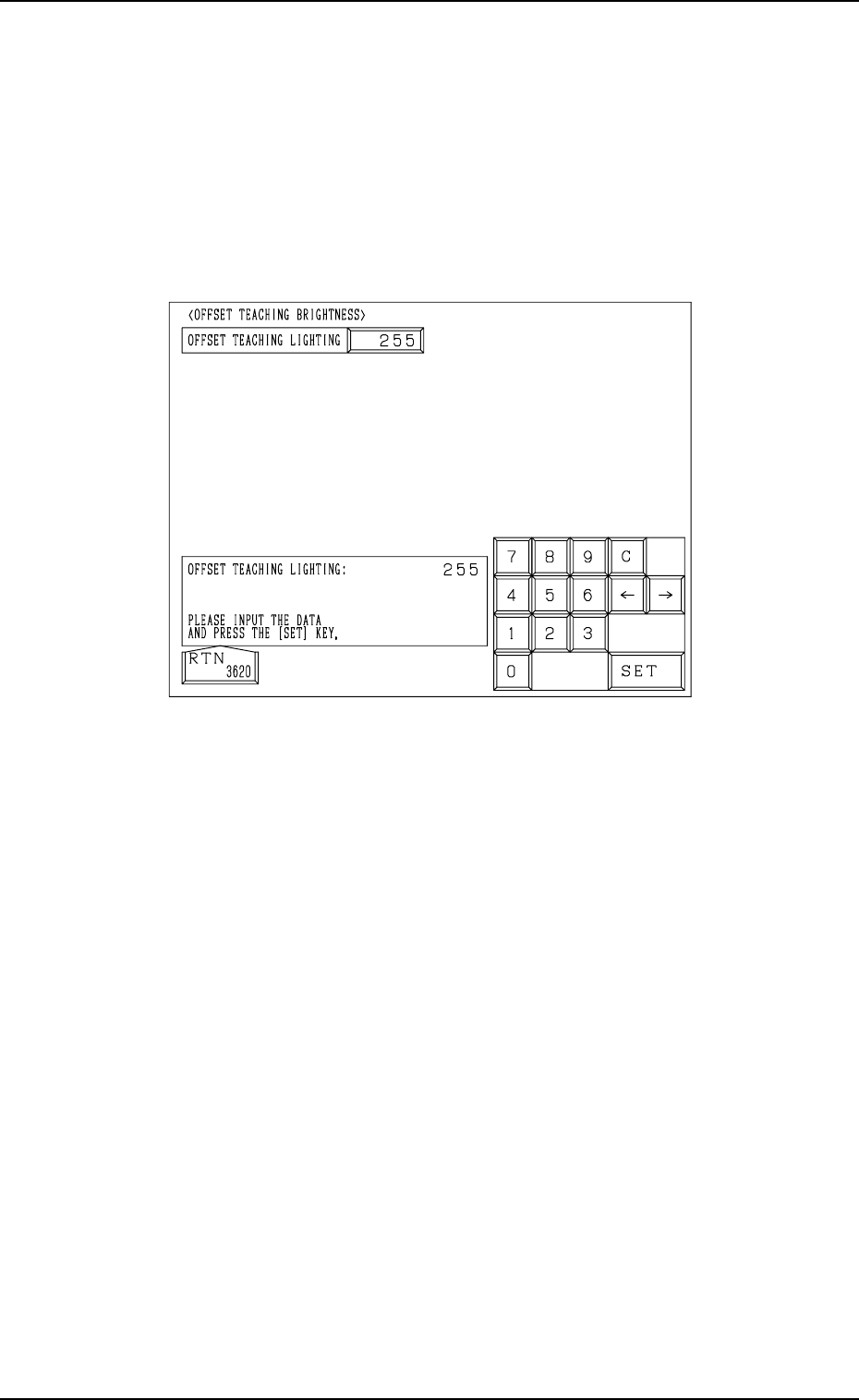
When the [OFFSET TEACHING BRIGHTNESS] key is pressed at the “OFF-
SET DATA” display, the following display appears on the screen.
Note: The values in Fig. 5.38 are determined through automatic teaching op-
eration. It is not necessary for the customer to directly enter any val-
ues.
The values differ depending upon which machine is used.
These values are used only for your reference.
12. OFFSET TEACHING BRIGHTNESS Display
Fig. 5.38
The lighting system for offset teaching is used to teach the offset data for the
component recognition camera.
The brightness values are set through automatic teaching operation based on
the image captured using the lighting system for offset teaching.
The brightness values are determined so that the best brightness is obtained for
the lighting system.
9910-001 5-43 Tg0247-PM-PM