2OM-1064-002.pdf - 第22页
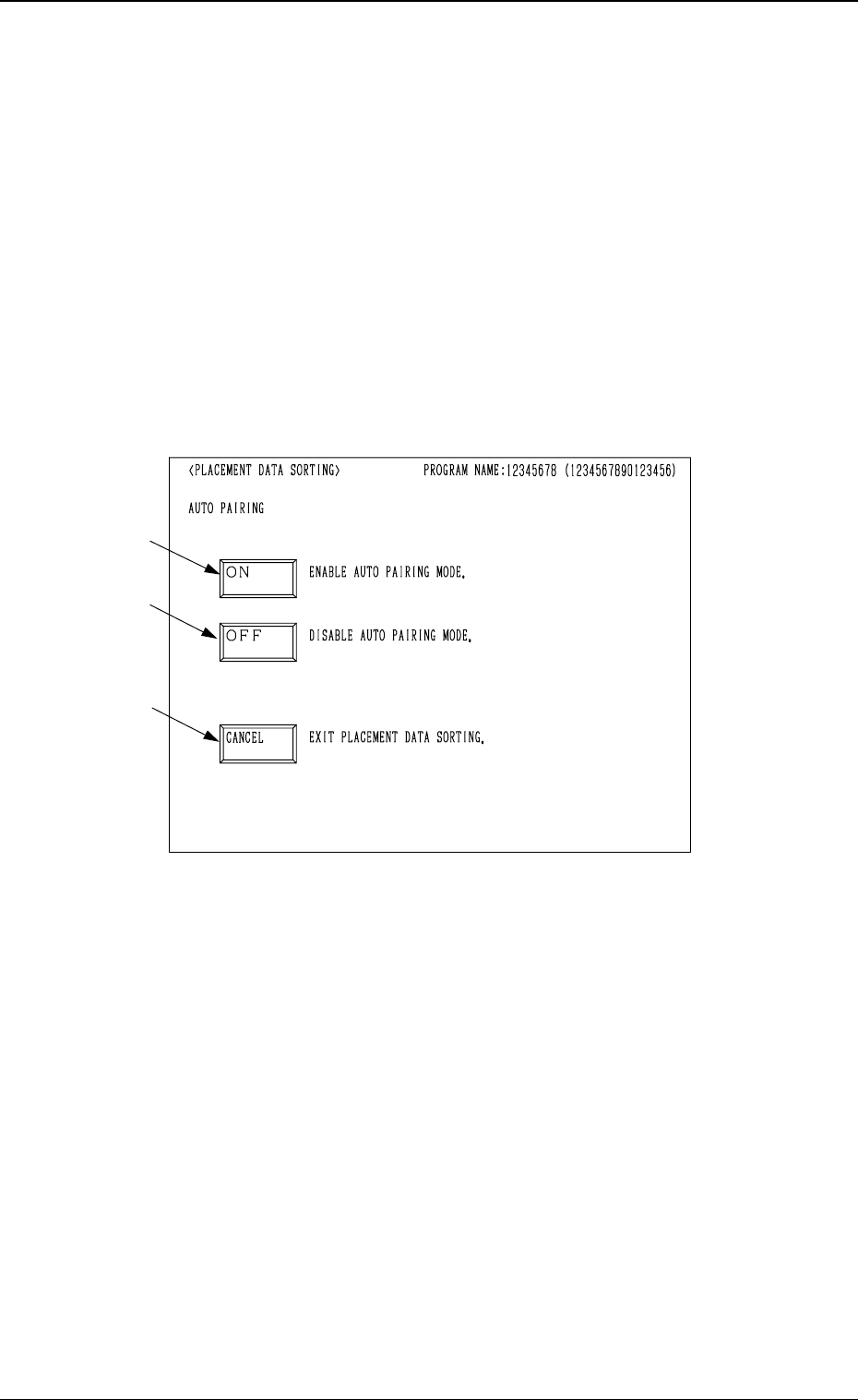
When the [ON] or the [OFF] key is pressed at the “PLACEMENT DA T A SOR T- ING” display (Fig. 2.4-1), the following display appears on the screen and the program check operation is performed. 2. Pattern Program 9910-001 2…
*2
*1
*3
2.1.4 PLACEMENT DATA SORTING Display
• When the created placement data (U-No.) is used without any modification,
the machine cannot perform its component placement operation efficiently,
concluding that longer time may be required to finish one P.C.B.
Such placement data can be re-arranged in the most effective order at this
display.
Requirements for Placement Data Sorting
Number of Nozzle Change Operations
• This placement data sorting function shortens the time for the machine to
read the data, improving the productivity.
When the “NAME (XX/XX)” key of the program data to be sorted is selected
and the [PLACEMENT DATA SORTING] key is pressed at the “PATTERN
PROGRAM” display (Fig. 2.1), the following display appears on the screen.
2. Pattern Program
Fig. 2.4-1
*1 [ON] Key
Select this key when the automatic pairing function should be used. The
“S-DATA” of the placement data is initialized and the pairing operations
are performed for the simultaneous pick-up and pick-up priority functions,
and then the program is optimized.
*2 [OFF] Key
Select this key when the automatic pairing function should not be used.
The program is optimized, keeping the current “S-DATA” of the placement
data intact (not initialized).
*3 [CANCEL] Key
Select this key to interrupt the placement data sorting.
9910-001 2-9 Tg0247-PM-PM
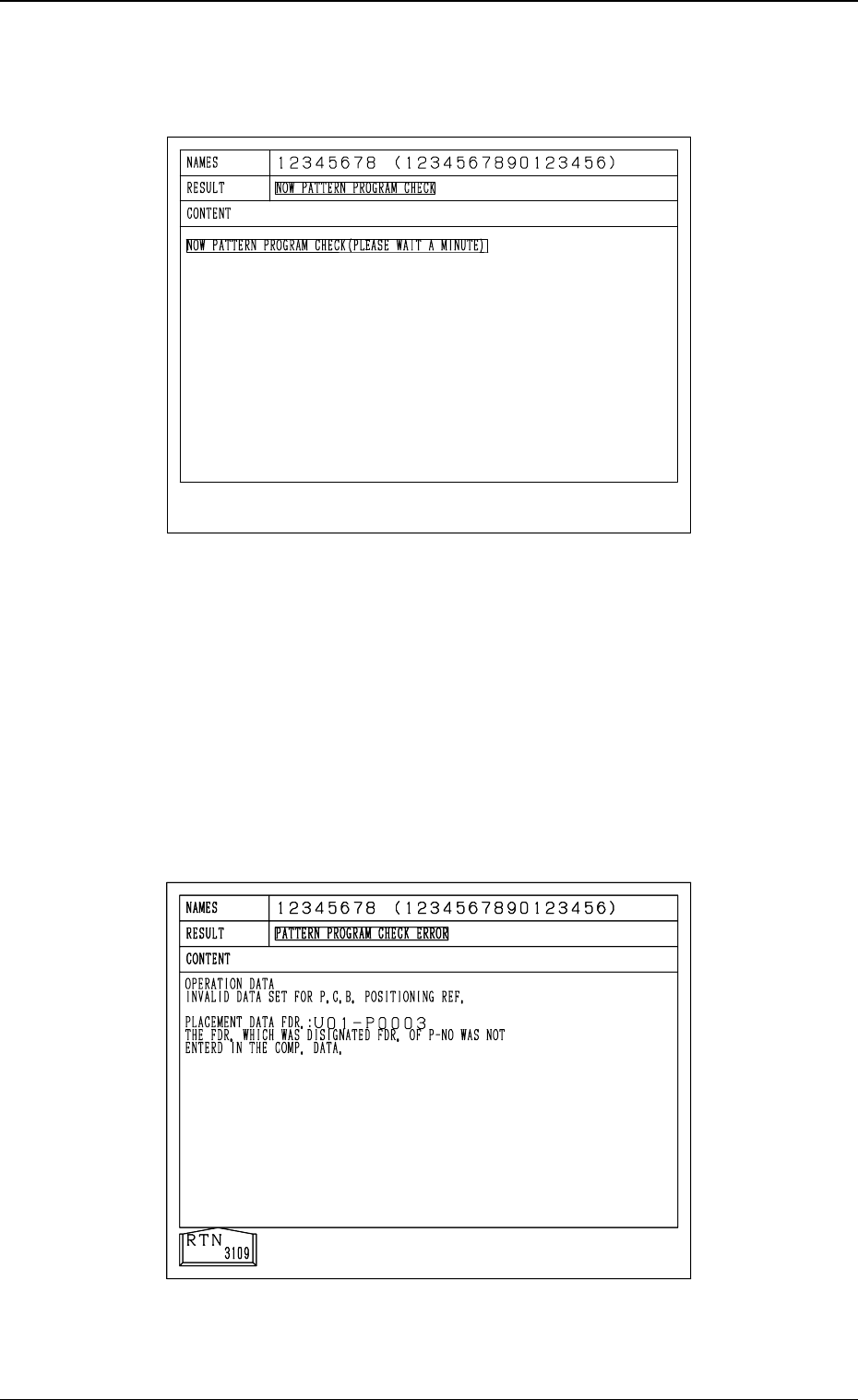
When the [ON] or the [OFF] key is pressed at the “PLACEMENT DATA SORT-
ING” display (Fig. 2.4-1), the following display appears on the screen and the
program check operation is performed.
2. Pattern Program
9910-001 2-10 Tg0247-PM-PM
Fig. 2.4-2
The program is checked “OK”, the placement data sorting is implemented.
When the sorting is completed normally, the program is checked again.
When the second program check operation is completed normally, the “PAT-
TERN PROGRAM EDIT” display appears on the screen.
• When the program is checked “NG” (No Good), the contents of the error are
displayed as shown in Fig. 2.4-3.
When an error is found during sorting, the contents of the error are also
displayed.
Correct the error data and perform the sorting again.
Fig. 2.4-3
2.2 PATTERN PROGRAM EDIT Display
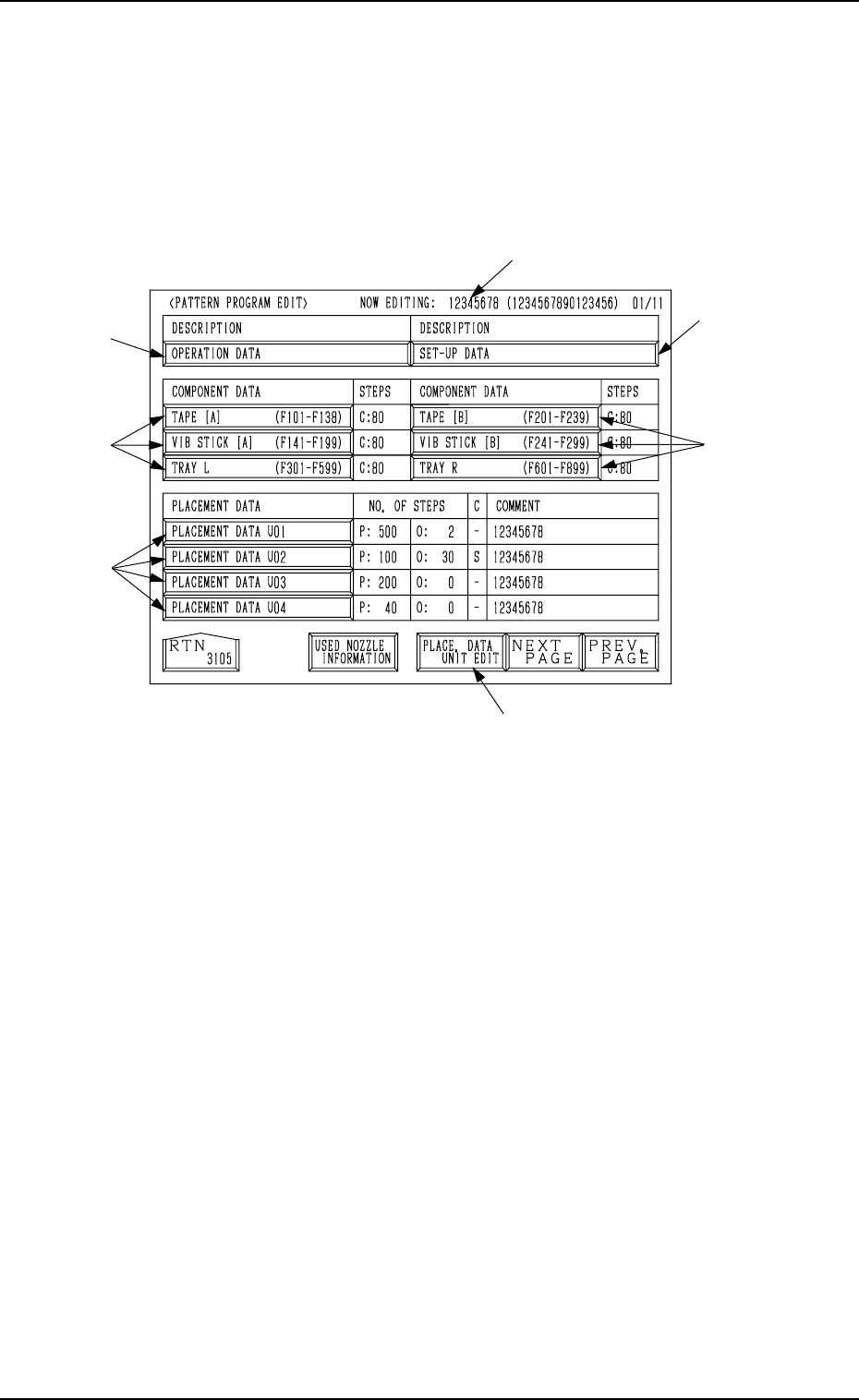
When the “NAME (XX/XX)” key of the program data to be edited is selected
and the [PROGRAM EDIT] key is pressed at the “PATTERN PROGRAM”
display (Fig. 2.1), the following display appears on the screen.
From this display, the edit display for each pattern program data
can be opened.
*1
*4
*6
*5
*2
*3
*3
2. Pattern Program
Fig. 2.5
*1 NOW EDITING: XXXXXXXX (XXXXXXXXXXXXXXXX)
Object Pattern Program Name and Comment 1 for Editing
*2 [OPERATION DATA] Key
Press this key to shift to the display for operation data editing.
*3 TAPE [A] (F101-F138), TAPE [B] (F201-F239),
VIB STICK [A] (F141-F199), VIB STICK [B] (F241-F299),
TRAY L (F301-F599), TRAY R (F601-F899)
Press one of the keys to open the desired display for editing the component
data related to each feeder.
*4 [PLACEMENT DATA UXX] Keys
Press one of the keys to open the desired display for editing the placement
data.
*5 [PLACE. DATA UNIT EDIT] Key
Press this key to open the display for delete, copy, or move operation of
blocked placement data (placement data divided into some blocks accord-
ing to U-Nos.).
*6 [SET-UP DATA] Key
Press this key to open the display for editing the set-up data.
9910-001 2-11 Tg0247-PM-PM