YSM20R_YSM20WR_Ope_E.pdf - 第114页
2-11 2 Basic operation About error screen 1 2 3 6 7 4 5 Error screen Mark detection error [Error Switching] button 24202-KMK-00 1. Error count display Shows the currently displa yed error and the total number of errors. …
2-10
2
Basic operation
n
Buttons and parameter input boxes
Various types of buttons, selection tabs and parameter input boxes are used on the operation screen.
1
1
2
3
4
5
6
7
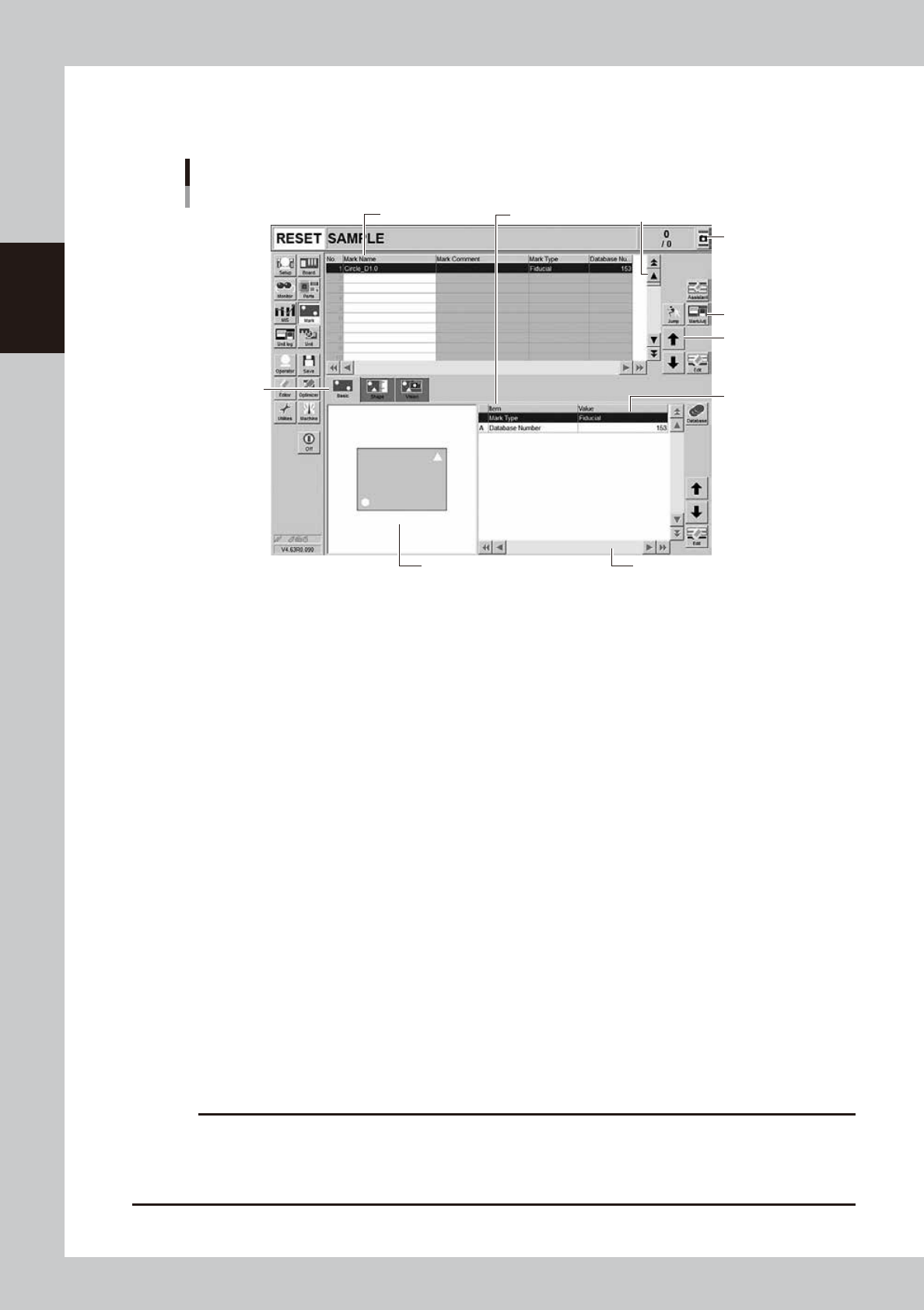
Operation screen basic elements
Mark screen
Parameter listData No. list
24201-KMK-00
1. Scroll bar and button (up/down, left/right)
Use the scroll bars or arrow buttons to see hidden items in the data No. list or parameter list.
2. Operation button
Press these buttons to open the next operation screen or dialog box.
3. Line up/down button
Use these buttons to move the cursor up or down through the data No. list or parameter list.
4. Parameter input box
Select, enter or edit parameters here. When the keyboard is used, double-click on a parameter input box to enter or edit
the data.
To operate the touch panel for data entry, press the corresponding “Edit” buttons on the right side of the screen to have
the edit box pop up.
5. Selection tab
Select this tab to switch the parameter input screen.
6. Assistant screen
Shows an illustration or information useful for parameter input or editing.
Alphabet characters shown in the parameter list and in the illustration on this screen correspond to each other.
7. Capture button
Captures the displayed image. The captured data (JPEG format) is stored in the D:\ScreenShot folder (maximum folder
size: approx. 10MB), with a file name consisting of the date and time.
When a USB memory device is inserted into the machine’s USB port and system backup is performed, a “ScreenShot”
folder is created in the root of the USB memory device to acquire the captured data stored in the machine. (The captured
data stored in the machine is moved to the USB memory device.)
c
CAUTION
• When saving data in a USB flash memory, make sure to use the USB flash memory designated by YAMAHA.
• If you specify the destination to save the data on the “Screen Shot Setting” window (Press the [Setup] – [Software
Setting] – [Information] – [Screen Shot Setting] buttons), the captured data cannot be saved in the USB flash memory
even by performing System backup.
2-11
2
Basic operation
About error screen
1
2
3
6 7
4 5
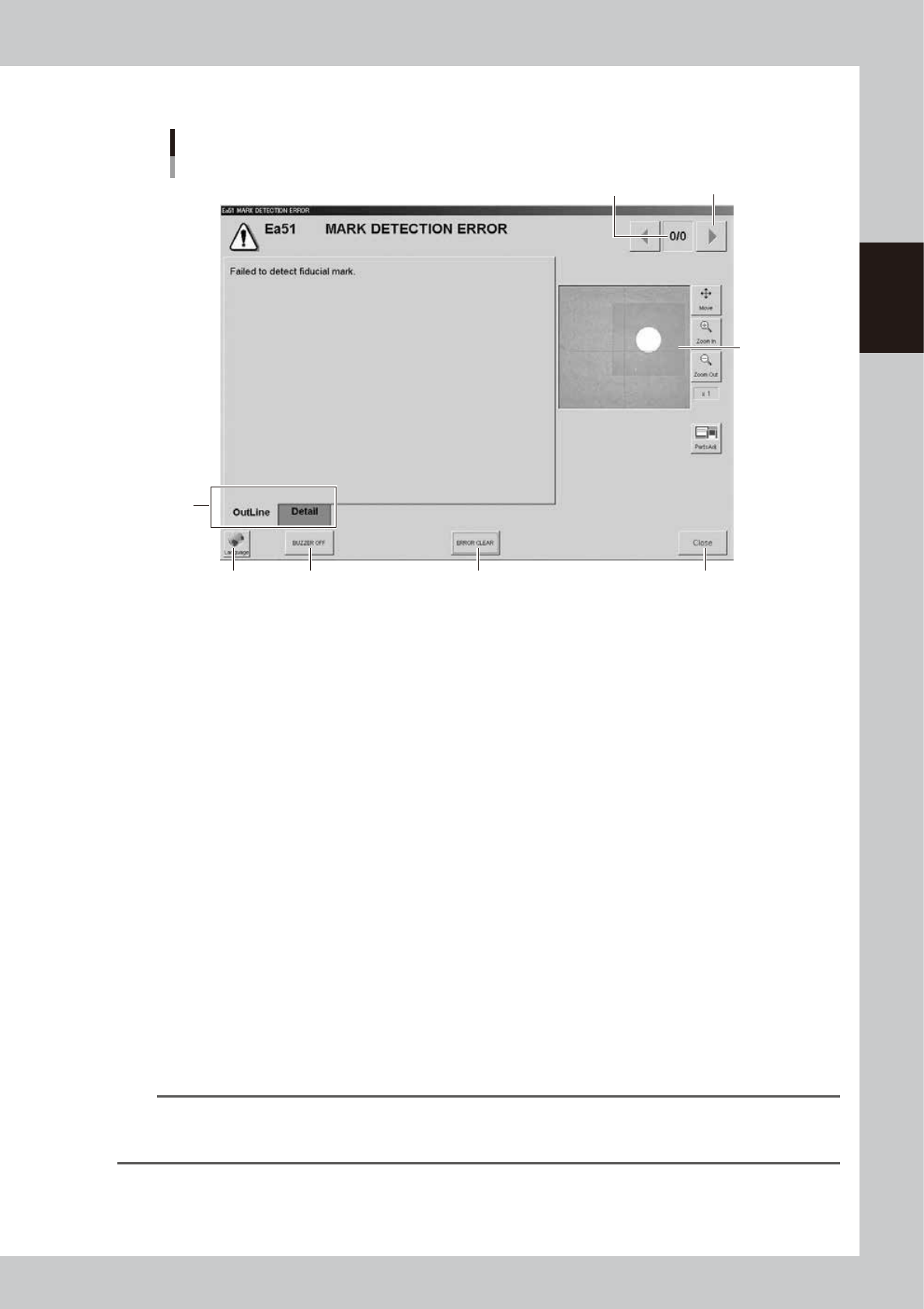
Error screen
Mark detection error
[Error Switching] button
24202-KMK-00
1. Error count display
Shows the currently displayed error and the total number of errors. If two or more errors occurred, use the [Error
Switching] buttons (right/left arrow buttons) to switch to other error screens.
2. Message switching tab
Outline:
Displays a message for the operator.
Detail:
Displays a message for the administrator/supervisor or service personnel. This tab does not appear unless a message is
available.
3. Recognition image display (component pickup error and mark recognition error screens)
If an error has occurred in image processing during component pickup or mark recognition, the error image is displayed
here.
4. [BUZZER OFF]
Turns off the buzzer.
5. [ERROR CLEAR]
Clears the error that has occurred.
6. [Language] button
Switches the language of the message displayed on the error screen.
7. [Close] button
Closes the error screen without clearing the error.
TIP
The positions where errors occurred can be checked graphically by opening the [Monitor] - [Production] tab after
closing the error screen by pressing the [Close] button. Pressing the [Error Detail] button on the [Production] screen
redisplays the error message. See "3.1 Production" in this chapter for the [Production] screen.
2-12
2
Basic operation
2.2 Setup screen
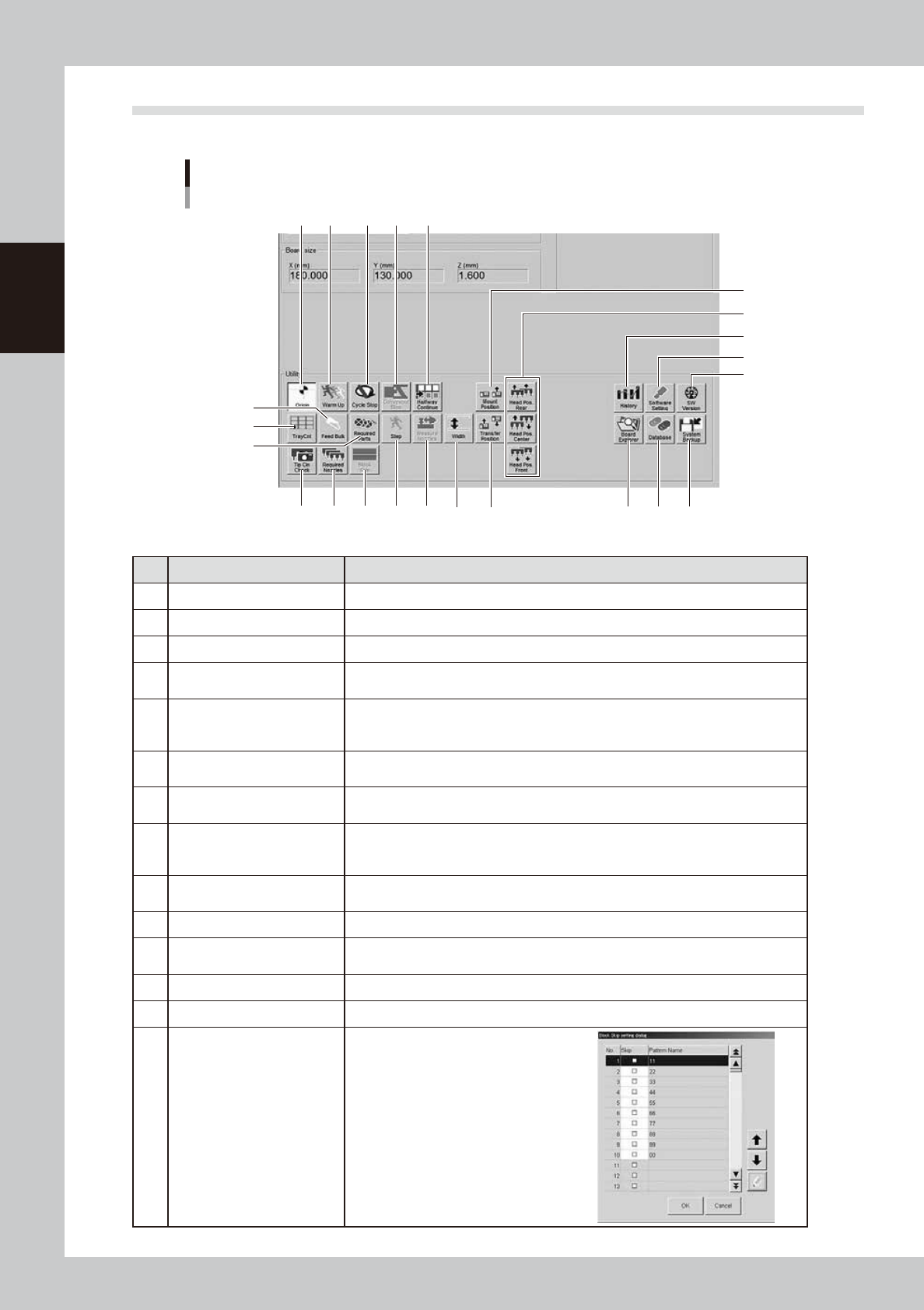
This section describes the operation buttons displayed on the "Setup" screen.
18
19
20
23
2221
3 4
9 10
11
16
8
12
7
6
15
17
5
1 2
13 14
Setup screen
24203-KMK-00
Button name Function
1 Origin Move all the axes other than the W-axis of the machine to their respective origins.
2 Warm Up Warms up the machine. Specifying the desired time is available.
3 Cycle Stop Stops the machine without flowing a mounted board to downstream.
4 Convey-out Stop
Stops machine operation after mounting components on all boards on the conveyor
and transferring them to the downstream machine.
5 Halfway Continue
Resumes mounting components on the board that reset the suspended machine
operation due to an error. See chapter 3, "1.13 Resuming operation from the stopped
point" for more details.
6 Tray Cnt
Displays the number of tray components that have been used. (Single - lane / Dual -
lane+sATS
II
)
7 Feed Bulk
This button is operable only when using the bulk feeder (custom-made). It is not
used in normal operation.
8 Required Parts
Displays the component types and feeder positions that are set up for the production
to be started. Regarding dual-lane type, the required parts for both lanes are
displayed.
9 Step
Temporarily stops the machine at a specific position, for example, during initial
component mounting, test mounting, or trouble analysis.
10 Nozzle type acquisition The scan camera (side view camera) acquires the nozzle shape.
11 Width
Aligns the conveyor width with the board surface for production. It is the same
function as the [Width] button of the [Unit] – [Conveyor] screen.
12 Tip Cln Check Checks if nozzle tips are dirty or clogged.
13 Required Nozzles Displays a list of nozzles to be used.
14 Block skip
This button becomes active when
board data with block distribution
performed is loaded.
Pressing this button displays the
"Block Skip Utility" dialog box that
allows you to set whether to skip
mounting components in each block.
Refer to Chapter 3 "1.13 Resuming
operation from the stopped point" for
more details.