YSM20R_YSM20WR_Ope_E.pdf - 第212页
3-24 3 Flow fr om starting up machine to production 1.9 Confirming nozzles Confirm the nozzles before starting the production. T his procedure description in this section assumes that the board data to be used for produc…
3-23
3
Flow from starting up machine to production
n
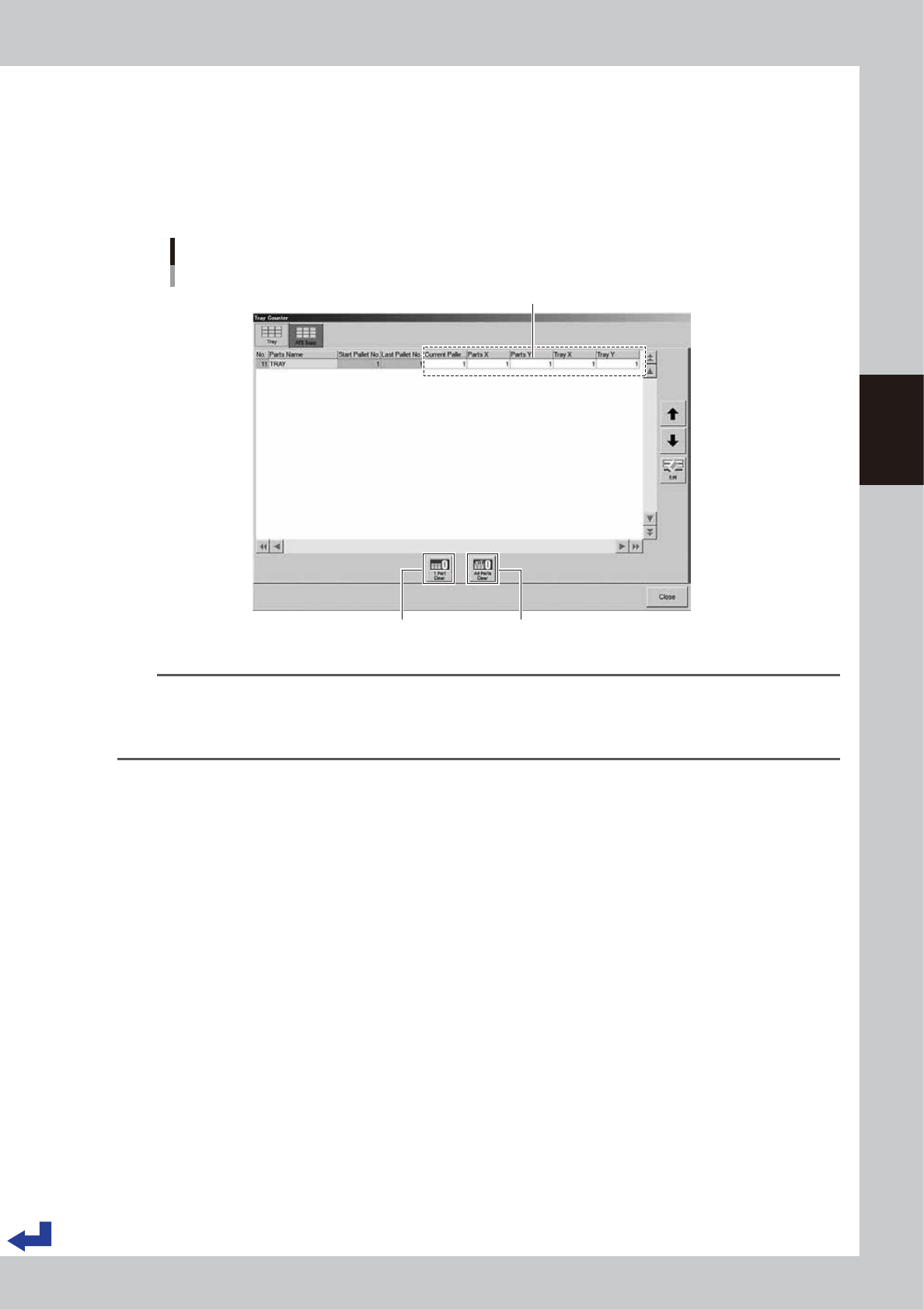
“Tray Counter” – “Tray” screen
The “Tray” tab on the “Tray Counter” screen enables to designate the pallet loaded with the components to be picked up
first, tray and components location. You do not have to change the parameters on the screen when setting a pallet fully
loaded with the tray components. However, you need to enter parameters on this screen to use a pallet where some of
the components have been used such as for another production.
Enter the “Current Pallet No.”, “Parts X, Y” and “Tray X, Y” of the object components.
Designating the tray component position to start picking up
“Tray Counter” - ”Tray” screen
[1 Part Clear] button
Enter any “Current Pallet No.”, “Parts X, Y” and “Tray X, Y”.
[All Parts Clear] button
Current Pallet No. : The pallet number to be used first
Parts X, Y : The location of component to be picked up first
Tray X, Y : The location of tray to be picked up first
(If two or more trays are present in a same pallet.)
24315-KMK-00
TIP
After selecting the object components, pressing [1 Part Clear] button sets the both parameters of “Parts X, Y” and
“Tray X, Y” to “1” of that particular component and “Current Pallet No.” is set to the pallet starting number.
Pressing [All Parts Clear] button resets the parameters of all the components on the “Tray Counter” screen, same as
above.
3-24
3
Flow from starting up machine to production
1.9 Confirming nozzles
Confirm the nozzles before starting the production. This procedure description in this section assumes that the
board data to be used for production has been read out. Note that Steps 1 and 2 are not necessary where the
setting is such that all the heads go through the automatic nozzle changing process.
1
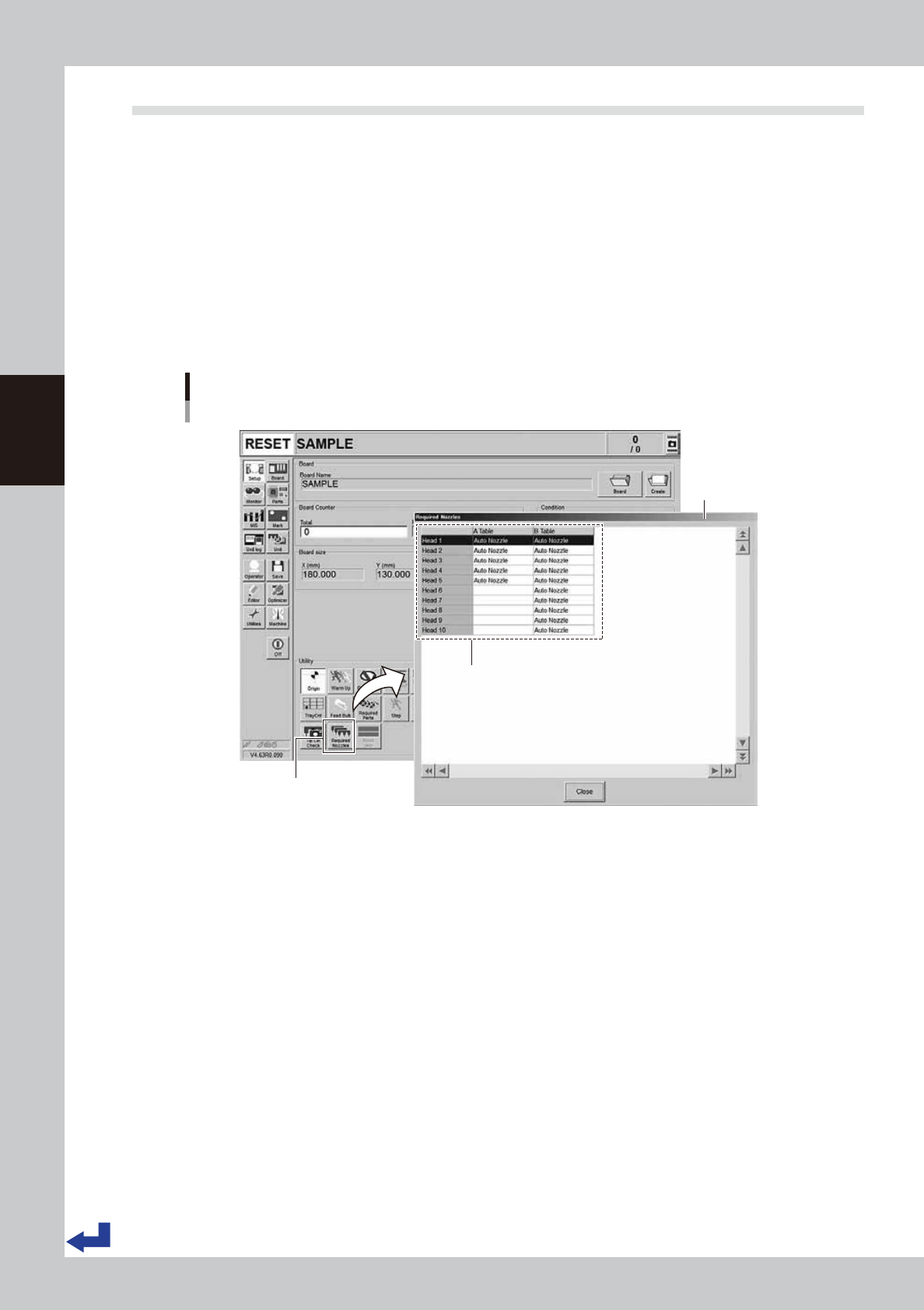
Call up the “Required Nozzles” screen.
Press the [Required Nozzles] button on the “Setup” screen calls up the “Required Nozzles” screen.
2
Confirm the nozzle types.
If the machine is not equipped with the nozzle station or the machine has a head that does not go
through the automatic nozzle changing process, the types of nozzles appear on the “Nozzle Type” list.
Check that these nozzles in the list match the nozzles that are currently attached on the heads. Note
that this process is not necessary if set to “AUTO”.
Confirming the nozzle types
[Setup] screen - “Required Nozzles” screen
[Required Nozzles] button
“Required Nozzles”
screen
Check that these nozzles in the list match the nozzles
that are currently attached on the heads.
* This process is not necessary if set to “AUTO”.
24316-KMK-00
3-25
3
Flow from starting up machine to production
3
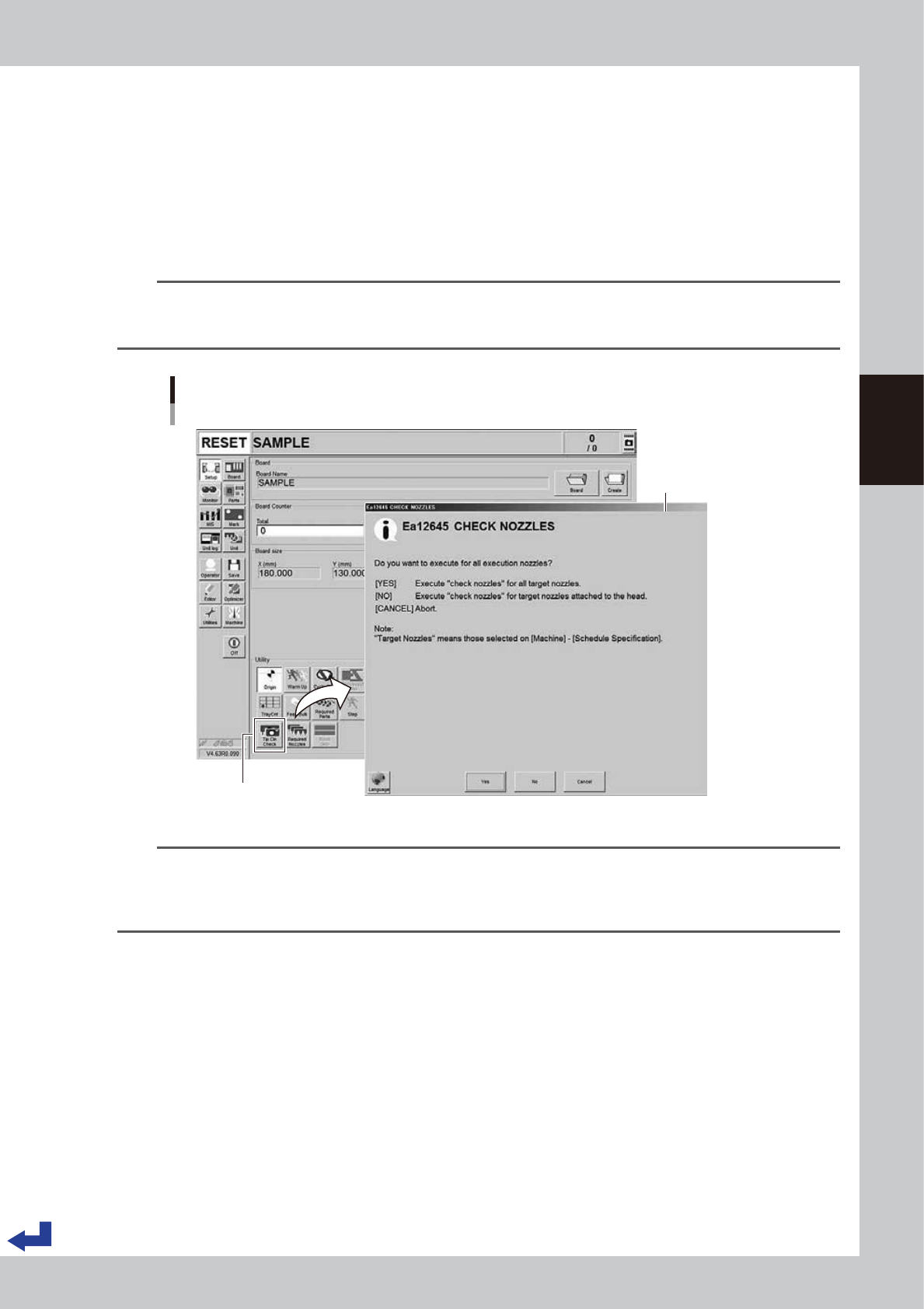
Call up the “CHECK NOZZLES” screen.
Pressing the [Tip Cln Check] button on the “Setup” screen calls up the “CHECK NOZZLES” screen.
4
Check the cleanness on the nozzle tips.
Check the contents on the “CHECK NOZZLES” screen and then select any of the following buttons.
[Yes]: Automatic nozzle change process takes place to confirm all the object nozzles to be checked.
[No]: Of the nozzles currently attached to the heads, only the nozzles to be checked are confirmed.
[Cancel]: Cancel the operation.
n
NOTE
The “Nozzle Tip Cleanness Check” is a function that the camera views the nozzle tips without components to judge
the nozzle cleanness. Since the camera recognizes the reflection of light coming from solder deposited around the
nozzle tips, the camera works for small tip nozzles such as 301A, 302A, 311A, 312A and the like.
Nozzle Tip Cleanness Check
[Setup] - “CHECK NOZZLES” screen
[Tip Cln Check] button
“CHECK NOZZLES”
screen
24317-KMK-00
n
NOTE
• The “Nozzle Tip Cleanness Check” is available if it is specified on the "Machine setting".
• Since dirt deposits gradually, the check may turn out to be OK or NG if checking a few times at the initial stage of
accumulating dirt.
• It is recommended to clean the nozzles periodically. See the maintenance manual, chapter 3, "1.2 Nozzle cleaning".