PathMaster-REV-L-4.5-1.pdf - 第159页
Machine Operati on Manual Revision L / February 2020 Page 159 of 200 DMC Programming Basics • All commands must be in upper case letters. • Positio ns are gi ven in counts. I n most case s there are 5080 co unts per inch…
Machine Operation Manual
Revision L /
February 2020
Page 158 of 200
Variable Watch
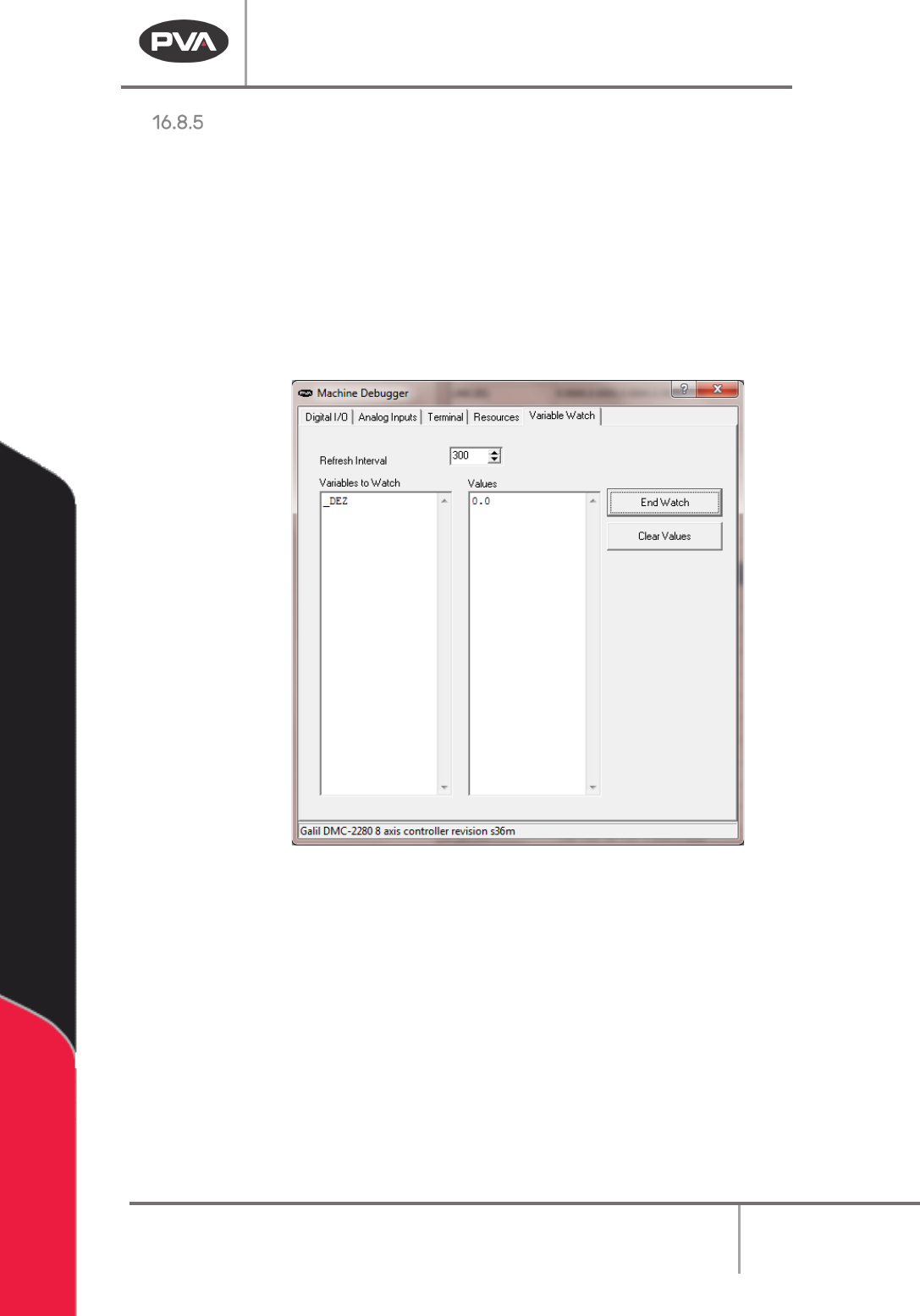
The Variable Watch tool will monitor a list of program variables entered by the user.
3. Type a valid program variable name into the watch list on the left.
4. Select
“
Start Watch
”
and the value of the variable will be displayed on the right.
Multiple variables can be monitored at the same time. The refresh interval is the frequency
of the tool display refresh in milliseconds.
5. Select “Clear Values” to erase the value shown.
6. Select “End Watch” to no longer watch that variable.
Figure 194: Variable Watch
Machine Operation Manual
Revision L /
February 2020
Page 159 of 200
DMC Programming Basics
• All commands must be in uppercase letters.
• Positions are given in counts. In most cases there are 5080 counts per inch, 200
counts per millimeter.
• No line of code may contain more than 80 characters.
• A semicolon (;) is used as a carriage return. This allows for multiple commands on
the same line and can be used to save space in the program.
Labels
Sections of a program (subroutines) are defined by labels. PathMaster® generates its own
labels for programs. These labels do not appear in the edit window, so the operator cannot
alter them.
• Labels start with the pound (#) sign followed by a maximum of seven characters.
• The first character must be a letter, after there can be numbers.
• There can be no spaces.
• There can be no duplicate labels anywhere in memory. The
Main
program and
PathMaster® are written without any duplicate labels.
• If the operator must put special labels into programs it can cause duplicate labels. If
any duplicate labels occur, the operator must find the duplication and fix it.
This usually happens when a section of code has been copied and pasted. There can be no
duplicates anywhere within a project, which includes all 30 programs in that project.
• Labels must be at the start of a line. When code is entered manually, make sure
there are no labels in the middle of a line. This causes an error when the program is
run.
Important Commands
The DMC programming language contains over 135 commands. The program for the
workcell does not use most of these commands, and even fewer are used to create a
dispense path.
The commands in the table below are the most important for an advanced operator to
know. A complete list of commands can be found in the separate DMC-4000 or 4200
manual that came with the machine. Any reference to manually changing or querying in
the examples below requires the use of the terminal option in PathMaster® to
communicate directly with the controller.

Machine Operation Manual
Revision L /
February 2020
Page 160 of 200
Cmd
Description
Example
Tips
AC Acceleration for
independent moves are in
counts per second squared
AC*=100000 (sets all
axes) ACX=100000
(only sets the X axis
acceleration)
Make sure the acceleration is
large enough to get the
motion to speed in a
reasonable amount of time
AM
After move. This command
holds the program until the
movement on the specified
axes is completed
AM (wait for all axes to
finish its motion)
AMS (wait for
coordinate sequence
to finish motion)
The AM command tests for
profile completion. Use the AM
command to separate multiple
movements
AV
After vector distance. This
command holds the program
until a specified distance
has been traveled with a
coordinated move, the units
are in counts
AV1000 (wait until the
axes have moved 1000
counts)
The AV command resets to
zero after every use. It can be
calculated by summing the
distances between each point
on the coordinated move
BG Begin. BG starts a motion on
an axis or a sequence
BGX (begin motion on
the X axis), BGS (begin
motion sequence), BG
(begin motion on all
axes)
A second BG command
cannot be given until the first
BG motion is finished. The AM
command can hold the
program until the first motion
is done. The exact axes to put
in motion must be given. The
BG command starts all the
axes according to the last
specified motions
BL
Reverse Software Limit
CB
Clear bit. Clears a bit on the
output port
CB40 (clears the bit for
the buzzer)
Clearing a bit in DMC
terminology turns the bit on.
The opposite of CB is SB (set
bit). A complete list of the
outputs can be found in the
Operating Guide