2OM-1075-002.pdf - 第70页
2.13 Feeder Alternate Function When a feeder becomes short of components, this function selects a prepared spare feeder . After all components are picked up from the spare feeder , another spare feeder is selected. The p…
0206-002 2-20 AHB01ESPP
2.10 Component Carriage Data Edit Function
This function enables the operator to easily change the component car-
riage data in the current pattern program.
The function can be used when the packaged posture of the supplied
component differs from that of the component being used so far due to
unavailability, etc.
Only the limited data for the packaged posture can be changed.
Table 2B10
Step Reference
1. Temporary Change of "4.2 "Comp Carriage Dt Edit" Tab" in "Section 5"
Component Carriage Data
2.11 Pick-Up Location Teaching Function
This function enables the operator to teach and correct the component
pick-up location through manual alignment operation.
After the function is performed, the pick-up rate might be improved.
Table 2B11
Step Reference
1. Pick-Up Location Teaching "5.1 "Pick-Up Location" Tab" in "Section 6"
Function
2.12 Library Teaching Function
This function enables the operator to automatically create component
library data or manually create and correct the component library data.
In addition, the recognition test function also makes it possible to make
a recognition test of the component library data.
Table 2B12
Step Reference
1. Library Teaching "5.2 Library Teaching" in "Section 6"
2.10 Component Carriage Data Edit Function
Note
2.13 Feeder Alternate Function
When a feeder becomes short of components, this function selects a
prepared spare feeder. After all components are picked up from the spare
feeder, another spare feeder is selected. The prepared spare feeders
must contain the components of frequently used types.
When a component shortage error occurs and this function is activated,
the interval time for component replenishment can be prolonged and
the feeders short of components can be replenished with components
collectively.
To Implement the Alternate Feeder Mode
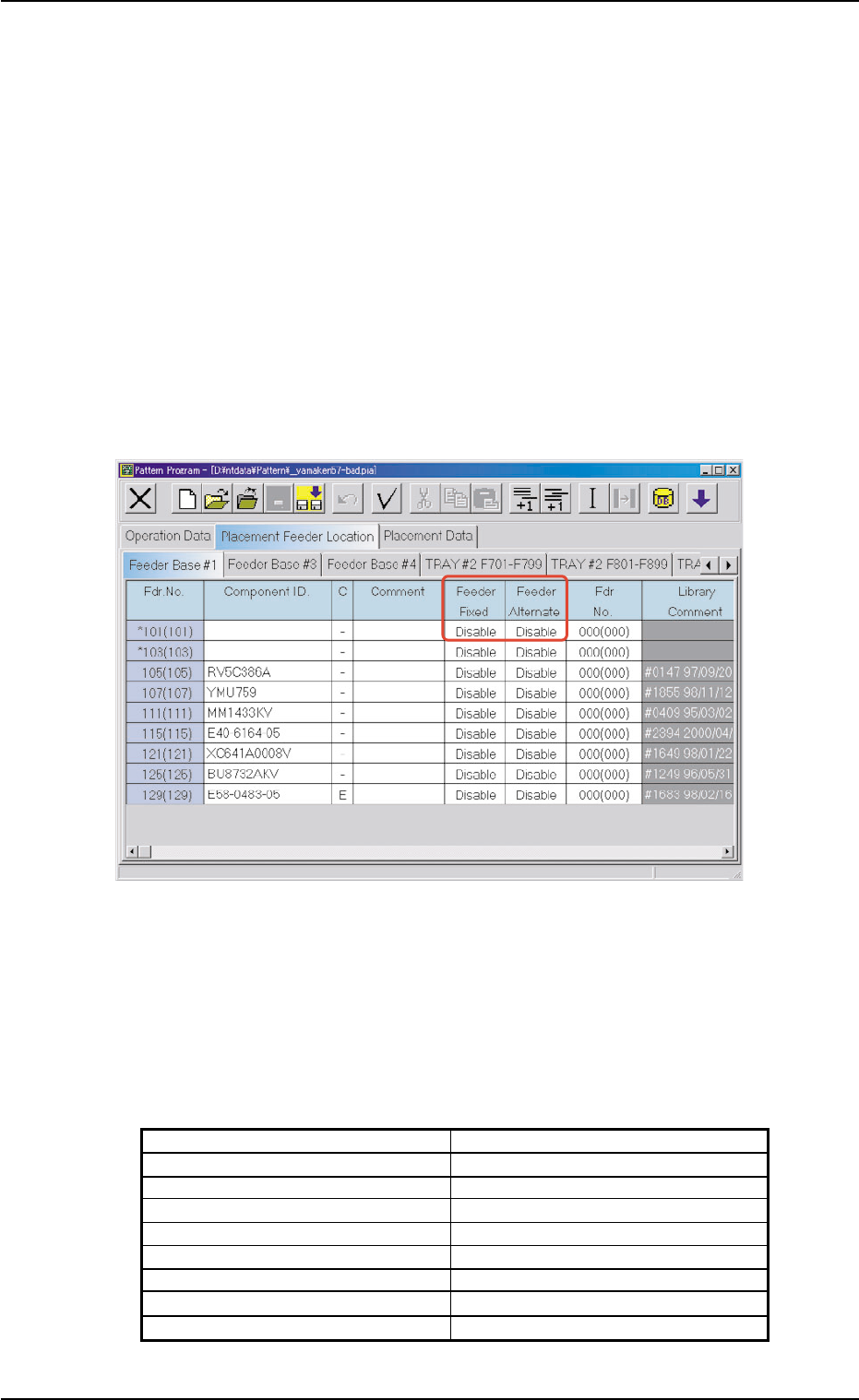
(1) Set "Enable" in the "Feeder Alternate" text box and specify the feeder
No. (destination feeder No.) in the "Fdr No." text box of the "Place-
ment Feeder Location" tab sheet in the "Pattern Program" edit win-
dow.
Fig. 2B23 "Placement Feeder Location" Tab Sheet in "Pattern Program" Edit Window
Requirements for "Fdr. No." Setting
• The component IDs must be identical between the feeder No. where
the alternate feeder mode is set (alternate source feeder No.) and
the alternate destination feeder No.
• The alternate destination feeder Nos. (Fdr No.) must be specified in
the following ranges.
Table 2B13
Feeder Base #1 101 to 132
Feeder Base #3 301 to 332
Feeder Base #4 401 to 432
FB #3 VIB Feeder #1 341 to 349
FB #3 VIB Feeder #2 351 to 359
FB #3 VIB Feeder #3 361 to 369
FB #4 VIB Feeder #1 441 to 449
FB #4 VIB Feeder #2 451 to 459
FB #4 VIB Feeder #3 461 to 469
2.13 Feeder Alternate Function
0308-002 2-21 AHB01ESPP
• The alternate destination should be terminated. (The feeder Nos.
should not be looped.)
• Neither "S" nor "X" should be set in the "C (Control Command)" text
box of the destination feeder carriage # in the "Placement Feeder
Location" tab sheet.
• When "S" or "X" is set in the "C (Control Command)" text box of the
source feeder carriage # (Placement Feeder Location Data), the com-
ponent placement actions for this feeder No. are all bypassed. (No
components are placed.)
All alternate feeder modes designated from this feeder become in-
valid.
• It is possible to designate the same alternate destination feeder from
different feeder Nos.
• The number of alternated feeder links is not limited.
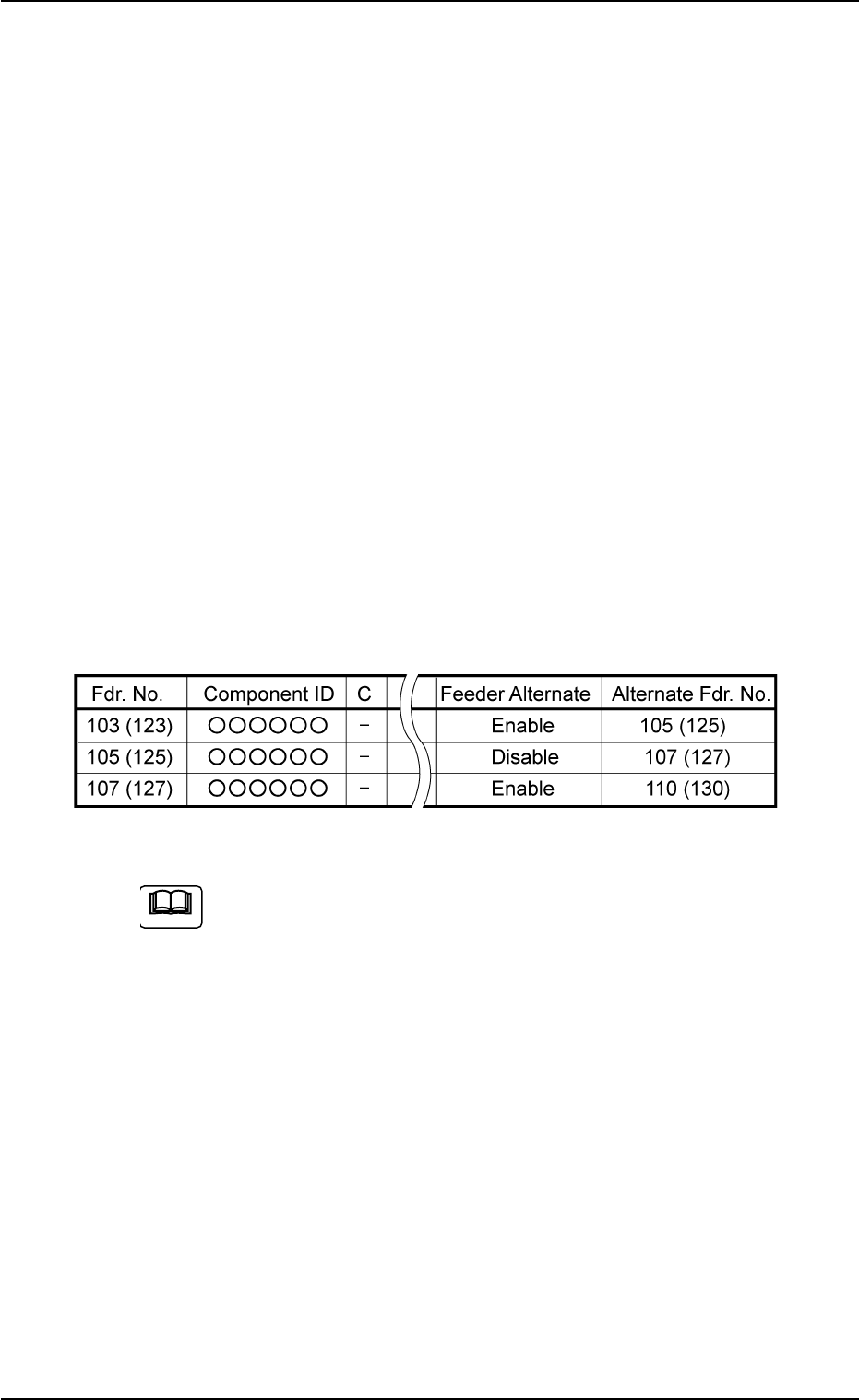
• When "Disable" is set in the "Feeder Alternate" text box for the desti-
nation feeder No., the alternate feeder mode stops working at this
feeder.
Example: In the following cases, the feeder alternate mode is termi-
nated in "Fdr. No. 103 (123)".
Fig. 2B24
When P.C.B.’s are produced using the feeders containing the
same types of components (same IDs) installed on two or more
feeders and each feeder No. is designated (dispersed feeder
designation), these feeders can be linked together by the alter-
nate feeder mode.
Load the feeders undesignated in the feeder data of the place-
ment data (P) with the same type of components (component
ID) and set them in the destination "Fdr. No." for the alternate
mode.
The machine starts automatic operation using the feeders on
the dispersed feeders. Every time a feeder becomes short of
components, the other available feeders are consolidated. Af-
ter the same types of components are used up, the machine
stops in the component shortage error condition.
2.13 Feeder Alternate Function
0206-001 2-22 AHB01ESPP
Note