00196044-05 - sg x und x4i fse_en.pdf - 第212页
Gantry Gantry Reference Run (with A364) Searchi ng for the X and Y Commutation Position (A364) S tudent Guide (FSE) SI PL ACE X Series and X4I Gantry Edition 01/2009 EN 212 6.2.2 Searching for the X and Y Commut ation Po…
Gantry
Reference Run Sequence at X and Y Axis (A364) Gantry Reference Run (with A364)
Student Guide (FSE) SIPLACE X Series and X4I
Edition 01/2009 EN Gantry
211
6.1.1.1 Description
The head mounting plate with the placement head is moved in the X direction by the linear guidances,
which are mounted above and below the secondary part of the linear motor. The Y axis moves the entire
X axis gantry with the placement head.
For X and Y axis position recognition we use incremental metal scales. These are positioned above the
secondary part for the X axis and below the secondary part of the Y axis. An incremental encoder reads
the increments, which are then sent to the axis controller boards, for determination of the axis positions
and for motor control.
Each X and Y axis has a rubber bumper as hardware stop at its ends.
6.2 Gantry Reference Run (with A364)
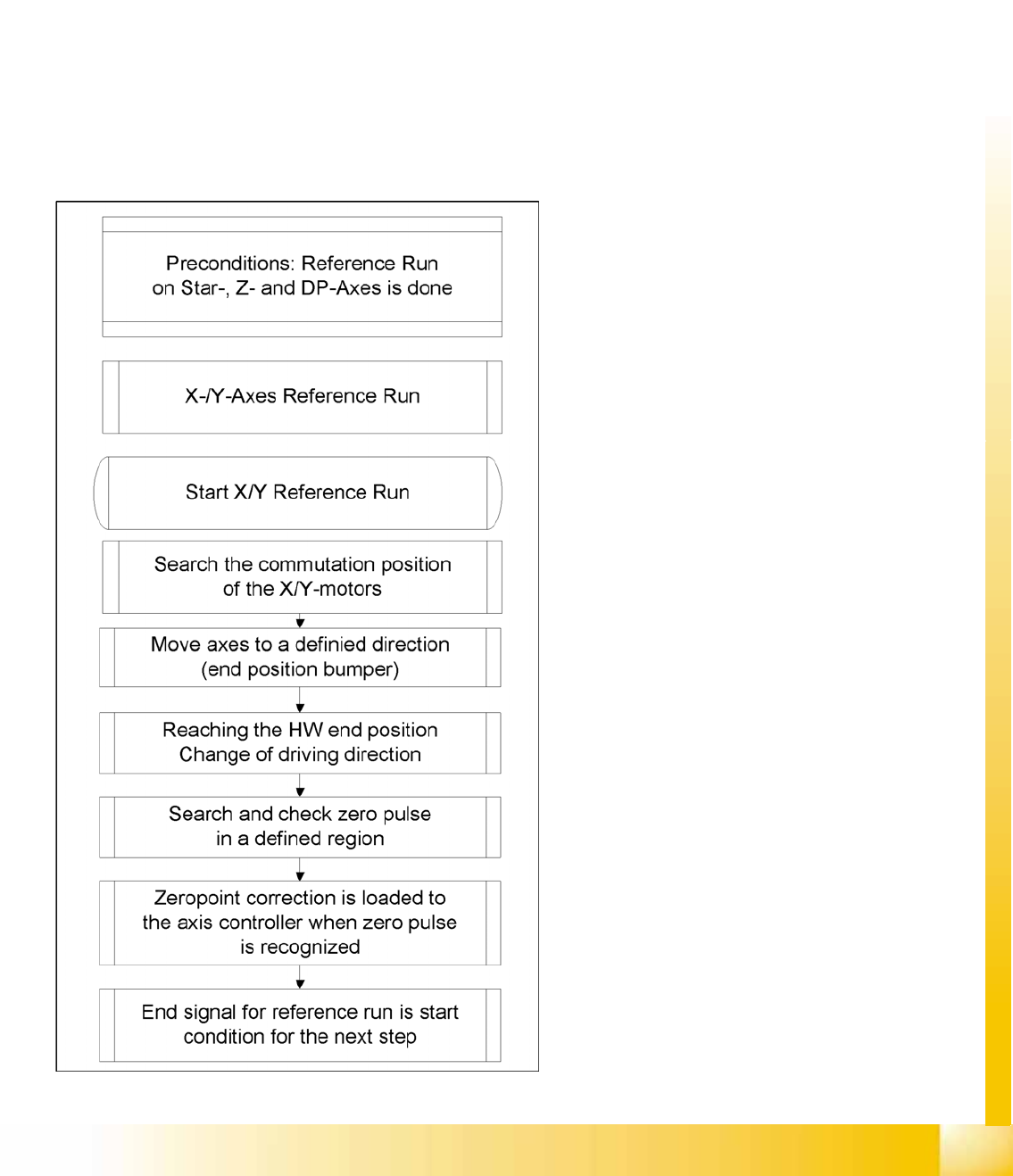
6.2.1 Reference Run Sequence at X and Y Axis (A364)
6-3: Reference run sequence
After the commutation search, the motor is in an
undefined position for the control system. When
referencing with bumper recognition (hardware
end stops), the axis moves successively against
the bumpers. For this purpose, fixed target values
are set by the axis controller, which are
increasingly nearer to the mechanical end stop.
After a certain time, this approach function
reaches a state in which the set target position is
no longer reached (actual position ≠ target
position, the axis is at the hardware end stop
(bumper)).
After a certain time (approx. 10 ms) and after
reaching a certain motor current, the direction of
travel is reversed and the axis searches for the
zero pulse within a specified range. This zero
pulse must be found within a predefined travel
range. If the zero pulse has been found in this
area, further zero pulses will be searched for in an
area of approx. 2.5 mm
After reaching and checking the zero pulse, the
axis is in a defined position.
The reference run for the main axes is started
simultaneously at all 4 gantries.
Gantry
Gantry Reference Run (with A364) Searching for the X and Y Commutation Position (A364)
Student Guide (FSE) SIPLACE X Series and X4I
Gantry Edition 01/2009 EN
212
6.2.2 Searching for the X and Y Commutation Position (A364)
A commutation position search for the 3 phases AC-drives on the gantry starts right after the head axes
reference run is succesfully finished.
1. Commutation position search during initial reference run:
Preconditions and function:
Axis reference run must be successfully completed at the relevant placement heads.
2 motor phases are switched to the power supply of the servo amplifier.
The 3-phase AC motor moves to the next suitable magnetic position.
2 other motor phases are switched to the servo power supply and the axis moves further.
These switching steps are repeated multiple times.
The axis reference run is continued with a reference position search for the position measuring system.
6.2.3 Reference Run at X and Y Axis (A364)
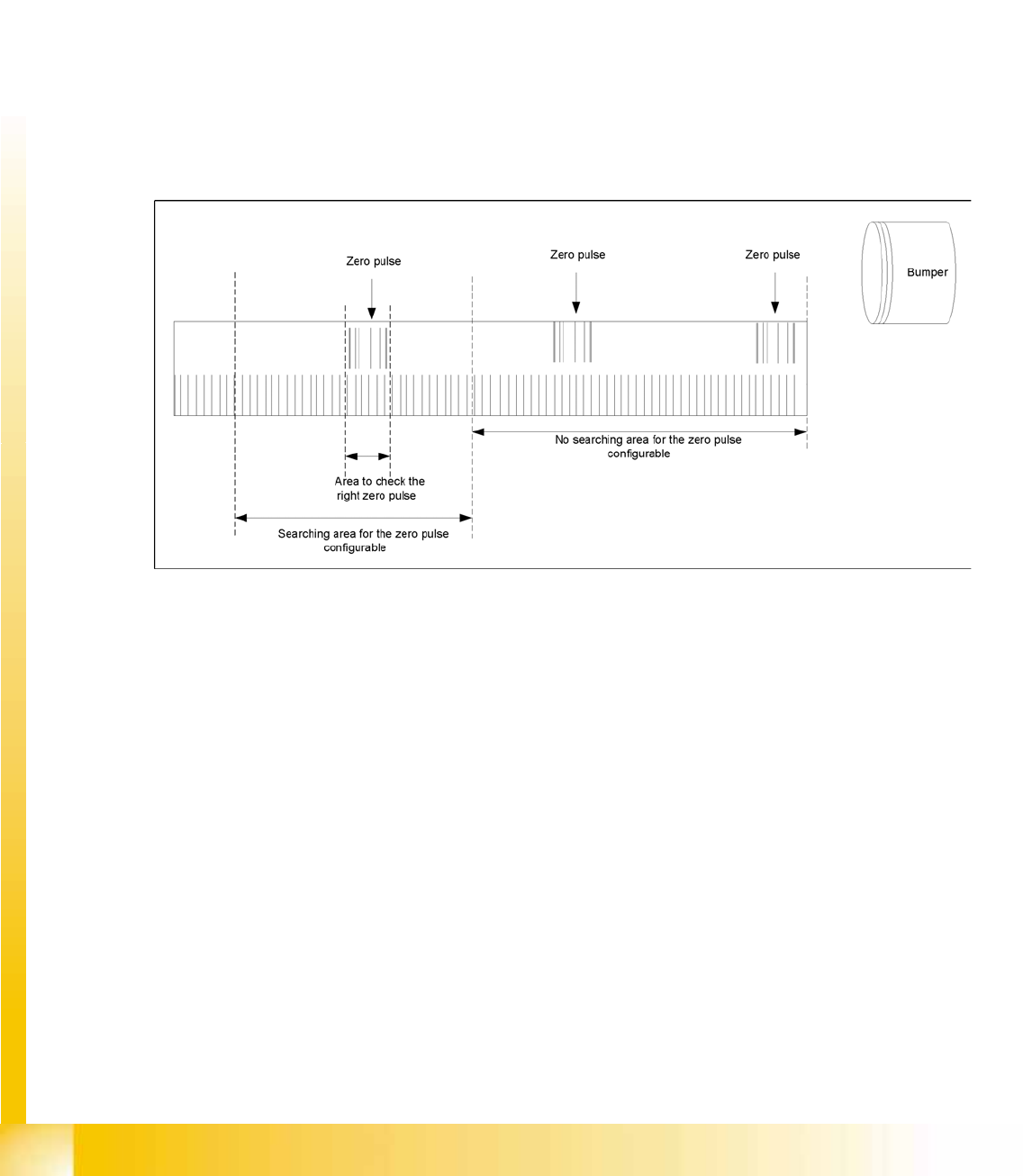
6-4: Zero pulse
Description of zero pulse search:
Requirements:
– The commutation point search has been completed.
– The motor is in position control.
1. After the hardware end stop has been reached and the axis has moved in the opposite direction, the
search for a zero pulse is prohibited within a certain distance of the bumper (approx. 25 mm).
2. After moving out of this prohibited area, the search begins. If the zero pulse is found in this area,
further pulses will be searched for in an area of approx. 2.5 mm If only one zero pulse is found, an
end position message is issued and the reference run is completed.
In the event of a fault, multiple zero pulses or no zero pulses may occur in the defined area. In this
case, the axis will stop and an error message with be issued.
3. The axes are now in a defined position. After finding and checking the zero pulse, the zero point
correction is loaded.
4. The reference run for the main axes has now been completed. The vacuum and height reference
runs will begin.
Gantry
Travel Ranges and Speed Monitoring Settings
Student Guide (FSE) SIPLACE X Series and X4I
Edition 01/2009 EN Gantry
213
6.3 Settings
6.3.1 Travel Ranges and Speed Monitoring
The travel range of the X and Y axes will be determined during machine calibration.
This means that, during travel range calibration, the axis concerned moves as far as possible towards
the minimum or maximum position, until the set axis card target value is no longer reached. It is then
assumed that the hardware end position switch (bumper) has been reached. In a time window of approx.
10 ms, the greatest actual value achieved is taken to calculate the travel range.
To guarantee an appropriate safety gap before the hardware end switch is touched, a certain distance
is deducted from the set travel range. This enables the axis to brake in time, even when errors occur.
The X axis moves to the left and right bumper and measures their positions with a safety distance of 2.0
mm. The SW also deducts a value of 0.5 mm from the maximum or minimum travel range.
The Y axis only moves to its minimum position (gantry 1/2) or to its maximum position (gantry 3/4).
The position opposite is then calculated.
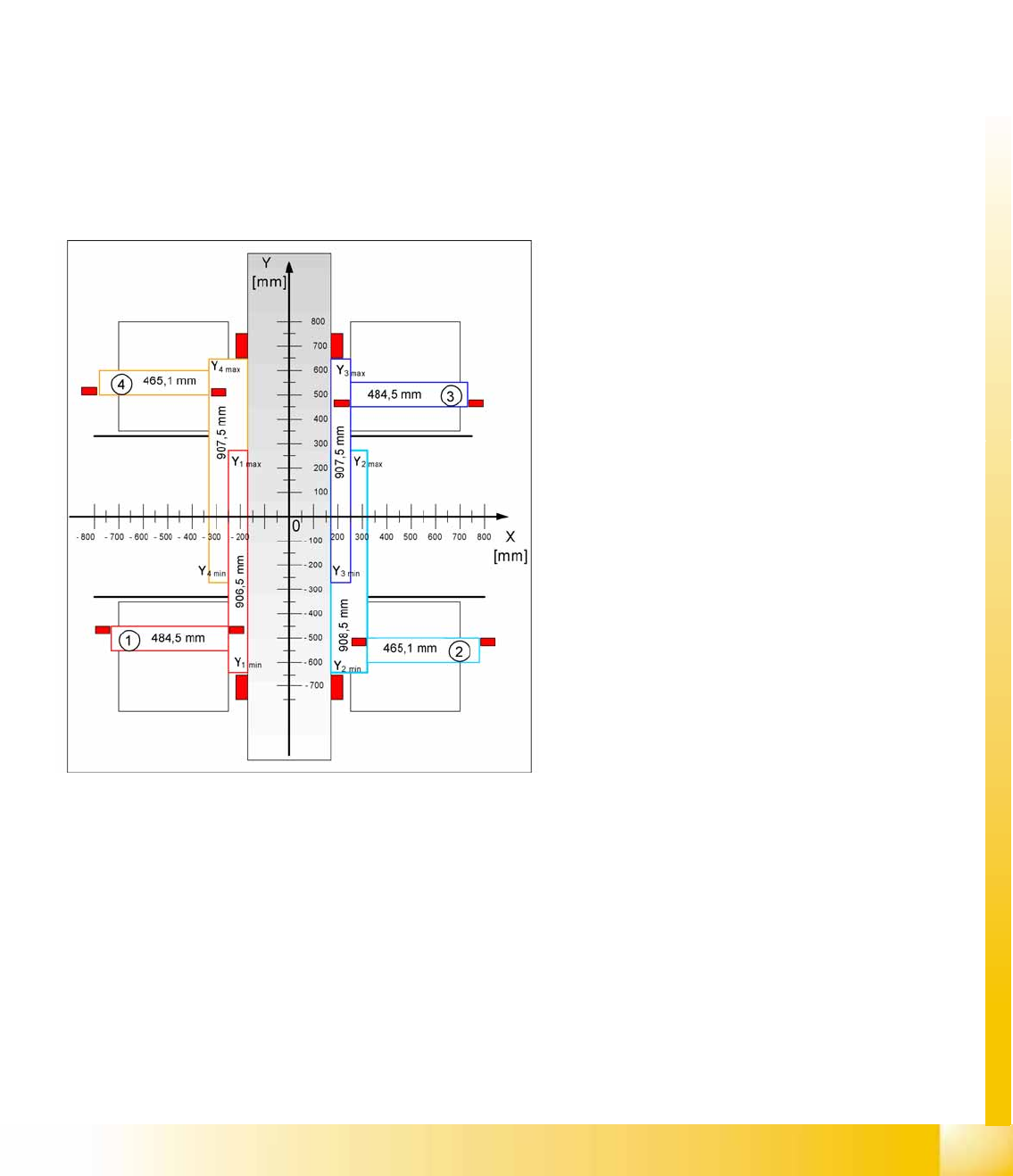
6-5: Travel ranges for X and Y axes (X4I)
Legend
1 - 4 = gantry 1 to 4
The end of the X axis travel range is + or -
0.5 mm before the software limit switch, which is
1.5 mm before the bumper. A safety distance of
2.0 mm to the bumper is adequate, if the X axis
moves into this area with excessive speed.
The end of the Y axis travel range is + or -
2.0 mm before the software limit switch. The Y
axis travel range for a particular placement area is
monitored in one direction by the software limit
switch and a bumper. In the other direction, there
is a permanent exchange of communication
between the axes and their positions, via the SPI
Bus (see description of the anticrash function).