00196044-05 - sg x und x4i fse_en.pdf - 第79页
Overview C&P20A Head Overview of Components S tudent Guide (FSE) SIPL ACE X Series and X4I Edition 01/2009 EN Overview 79 Star station 12: Vacuum measurement for h olding circuit By rotating the star axis, the va…
Overview
Overview of Components C&P20A Head
Student Guide (FSE) SIPLACE X Series and X4I
Overview Edition 01/2009 EN
78
3.2.9.1 Description
The C&P20A head works according to the Collect&Place principle (C&P), meaning that twenty
components are picked from the feeder modules (X feeders only) in one cycle. The component sensor
checks the pickup/place positions, to see whether a component has been taken by the nozzle or placed
on a board. On the way to the placement position, the components are rotated into the correct placement
position and optically centered. Before placement is performed, the angle and X/Y position correction,
determined by the Vision system, is applied. The X/Y position correction is calculated into the placement
position, while the angle correction is applied separately to each segment. This is possible as each
segment can be rotated independently of the star position. The components are then carefully and
accurately placed down on the board, with an air blast.
The component camera is still integrated into the C&P20A head. This saves additional travel to the
external centering cameras.
Each segment has its own DP drive for rotating the components into the correct position. The segments
are therefore no longer rotated into the correct angle in one single star position but can now be rotated
separately from one another.
Each segment has its own vacuum generator.
The Z drive for the segments is realized via a linear motor with linear position measuring system, which
makes it highly accurate. In the pickup/place position, the Z axis moves the segments up or down
(vertical direction).
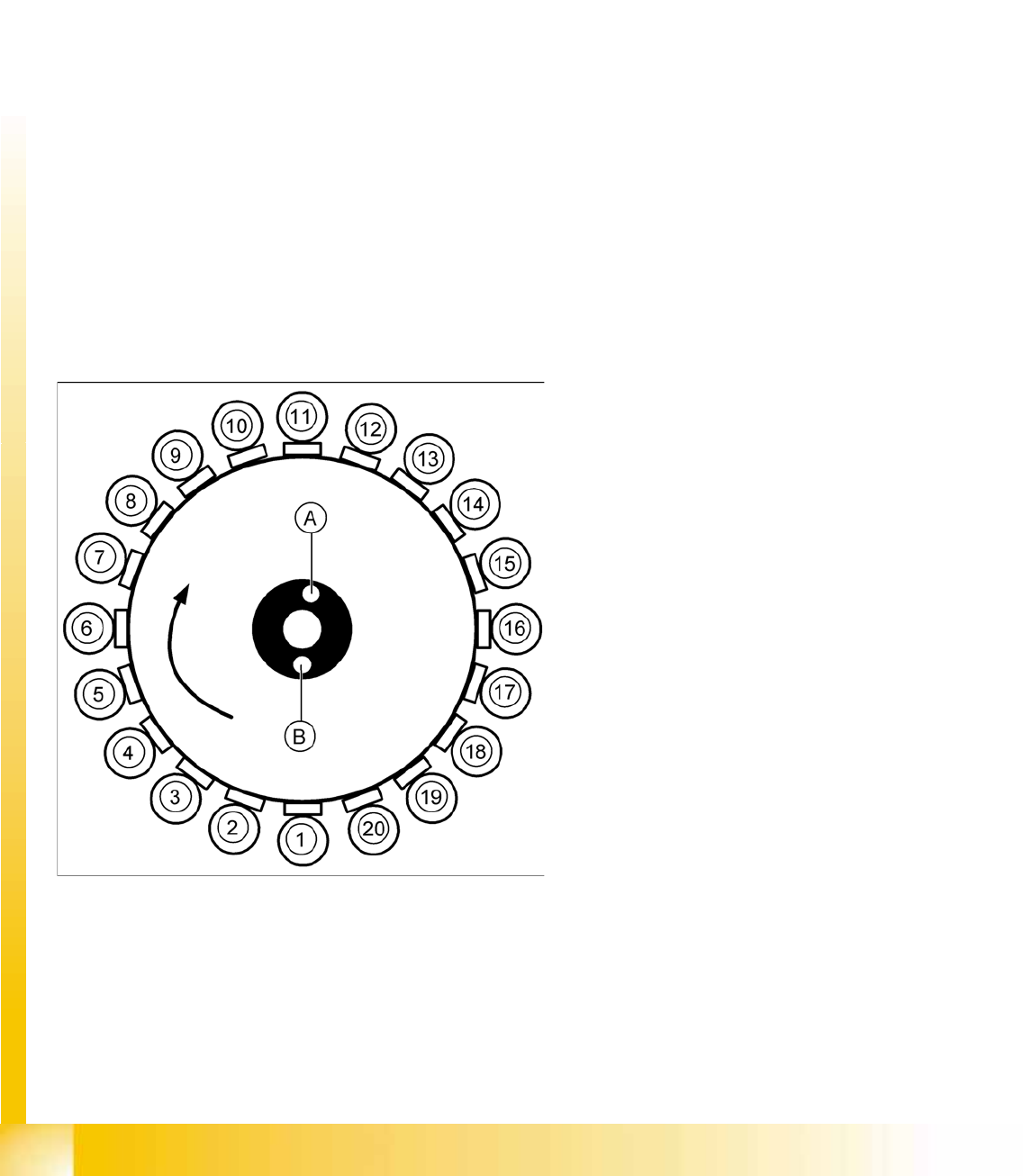
3.2.9.2 Overview of Functions for Star Stations 1 - 20
Star station 1:
Component pickup, placement or rejection
Component sensor: Checks whether component is present after pickup and before placement.
Component sensor: Checks whether no component is present after pickup and before placement.
Vacuum/air blast measurement for pickup/placement circuit
3-25: Overview of functions for star stations 1 - 20
Legend
1 to 20: star stations 1 to 20
A : Vacuum measurement holding circuit
B : Measurement of pickup/place circuit
Overview
C&P20A Head Overview of Components
Student Guide (FSE) SIPLACE X Series and X4I
Edition 01/2009 EN Overview
79
Star station 12:
Vacuum measurement for holding circuit
By rotating the star axis, the vacuum value can be measured at each segment.
Star station 11:
Optical measurement of components
Star station 2 - 10 and 12 - 20
In these star stations, the component at the segment can be rotated into the correct position.
In star stations 2 - 10, the component is rotated into the placement position.
In star stations 12 - 20, angular correction is performed after optical measurement.
Rotation to the correct angle position can be performed at any of the star stations, except 1 and 11.
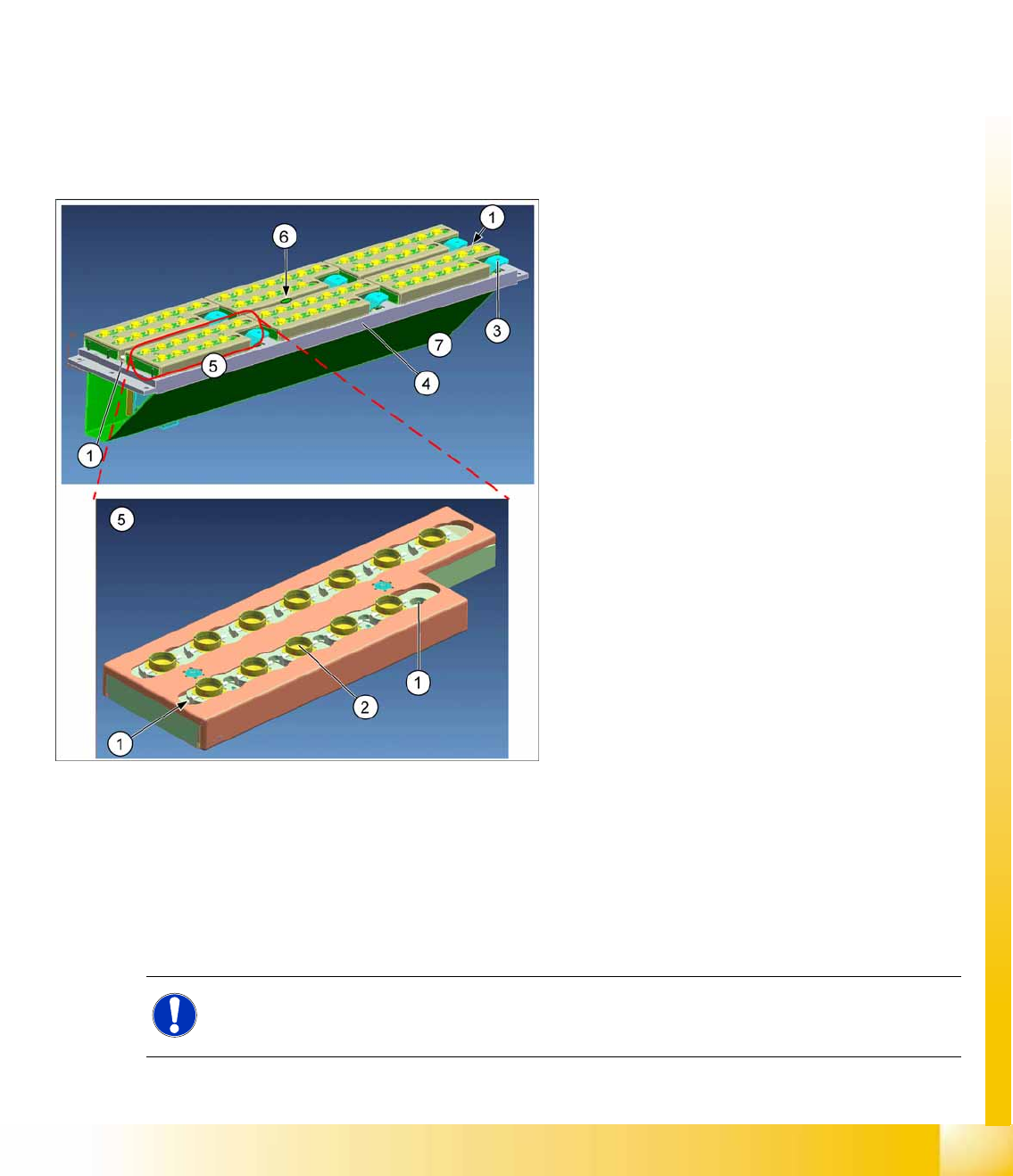
3.2.9.3 Nozzle Changer for C&P20 Head
The nozzle changer consists of at least six and up to twelve magazines, each of which has twelve nozzle
garages. The magazines are seated on a support. Each magazine is fixed with the help of a snap
fastener and can be released with a lever.
Each garage can be configured with different nozzle types.
Head Modularity Note
3-26: Nozzle changer and nozzle magazines
Legend
1. Calibration fiducials
2. Nozzle garage
3. Unlocking lever
4. Magazine support
5. Magazines
6. LED green (magazine query)
7. Changeover table side
Between changeover table and 1st row. The
nozzle reject bin is located on the right, next to
the 1st row.
Optionally, a nozzle changer can be installed for
the placement heads. This enables the nozzle
configuration to be changed quickly, thus allowing
the Collect&Place head to be quickly adapted to
the needs of the placement process.
NOTE:
The new nozzle changer carriers are identical for the C&P20A and CPP heads. This means that
you only need to change the magazines for head modularity.
Overview
Overview of Components Twin Head
Student Guide (FSE) SIPLACE X Series and X4I
Overview Edition 01/2009 EN
80
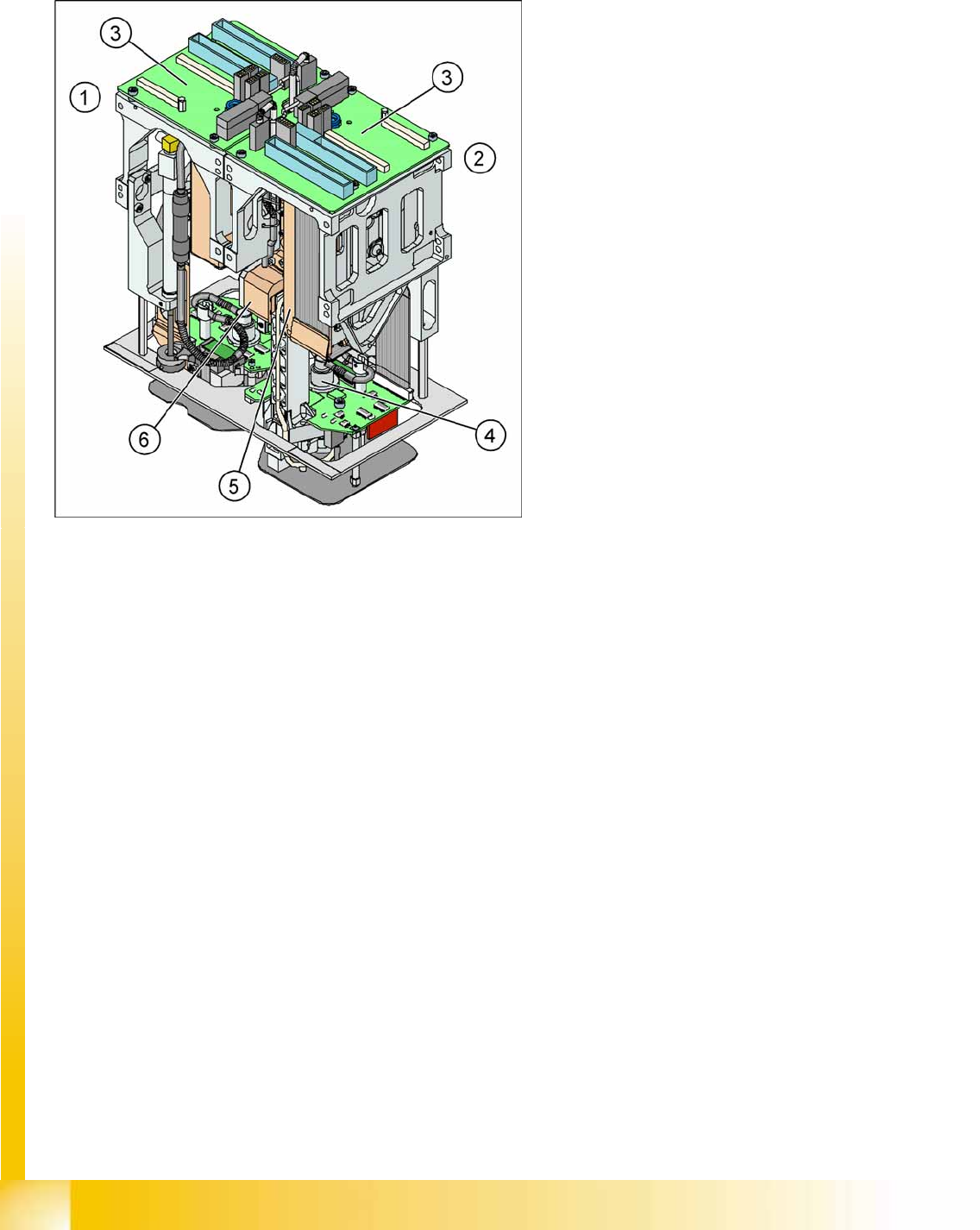
3.2.10 Twin Head
3.2.10.1 Description
3-27: Twin Head
Legend
1. Module 1
2. Module 2, rotate by 180 ° compared to module
1.
3. Main board on modul 1 and modul 2
4. D Axis
5. Linear motorZ Axis
6. Z axis incremental measurement system
The Twin head consists of two P&P heads of the
same model, which work according to the
Pick&Place principle. The second P&P head is
installed on the gantry, at a rotation of 180
degrees. One component after another can be
picked up per P&P, from the feeder module and be
optically centered by the stationary camera. On
the way to the placement position, the
components are rotated into the correct position.
They are then carefully positioned onto the board,
with great precision and with the help of a
regulated air blast and preset force.
Type 5xx nozzles are used for the Twin head.
Type 4xx nozzles for the P&P head and type 8xx
and 9xx nozzles for the C&P heads can be used
with an adapter.