JX-350_EPU使用说明书.pdf - 第101页
EPU Instruction M anual C hapter 4 Creating a Production Progr am 4- 53 (7) Center ing method S pecif y the method of obtaining the cent er of the component. Select this method ac cording to t he component ( in considera…
EPU Instruction Manual Chapter 4 Creating a Production Program
4-52
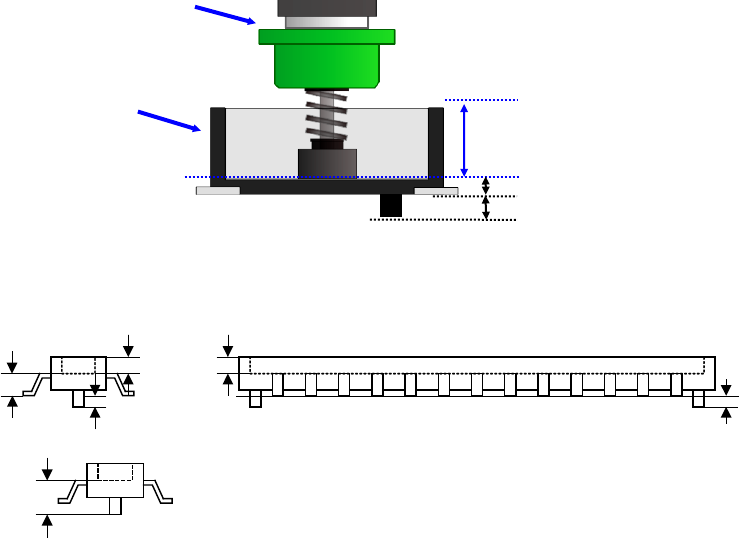
(6) Other dimensions
1) Pick depth
Enter the height from the nozzle pick surface to the top surface of the component.
Usually, the default value is used for operation.
2) Boss height
Enter the boss height (projection height on the bottom surface) of the connector.
Usually, the default value is used for operation.
Component height=Component height measured with laser-Boss height
Example) If the picking surface of the nozzle is located at the lower position than the top
surface of the component, such as connector component, enter the distance from
the nozzle tip to the top surface of the component. In this case, the "Component
height" will be the distance from the nozzle tip to the bottom surface of the
component.
Nozzle
Connector
Component height
Pick depth
Boss height
Component height
Pick depth
Boss height
Boss height
Component height
measured with laser
EPU Instruction Manual Chapter 4 Creating a Production Program
4-53
(7) Centering method
Specify the method of obtaining the center of the component.
Select this method according to the component (in consideration of specifications,
accuracy, and tact). However, available centering methods are limited depending on
the component type.
* JX-350 is not applicable to the vision centering.
Component type
Laser
Component type
Laser
Square chip O TSOP2 O
Square chip p (LED) O BGA O
Melf O QFN O
Elec. Cap. (Aluminum electrolytic
capacitor)
O One-direction lead connector O
SOT O Two-direction lead connector O
Trimmer O Z-lead connector O
RNA (Network resistor) O J-lead socket O
SOP O Gull-wing socket O
HSOP O Socket with bumper O
SOJ O Other O
QFP O
GaAsFET O
PLCC O
PQFP O
TSOP O
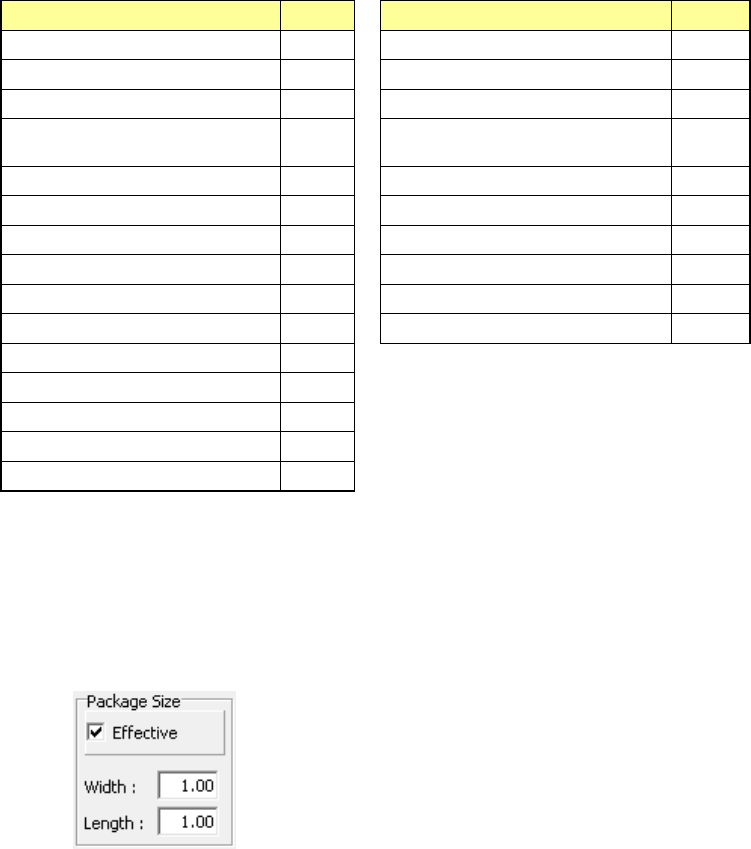
(8) Package size
When using the boss LED lens component, the package portion (body) may be in
contact with the disposal box when disposing of components or adjacent
components may interfere with each other when picking up components. Therefore,
enter the package size length (PL) and width (PW).
You can enter the package size length and width when [Effective] is checked on.
(9) <OK> button and <Cancel> button
When you press the <OK> button, the system validates your editing and quits the
“Form” screen.
When you press the <Cancel> button, the system discards your editing and quits the
“Form” screen.
When you quit the “Form” screen, the system redisplays the “Placement” data screen
if you invoke the “Form” screen from the “Placement” screen, or the “Component”
data list screen if you invoke the “Form” screen from the “Component” data list
screen.
If you quit the “Form” screen with any method other than buttons (by the menu
command or by selecting a tab), the system executes the same process as when you
press the <OK> button.
EPU Instruction Manual Chapter 4 Creating a Production Program
4-54
4.1.4.2.2 Packaging style
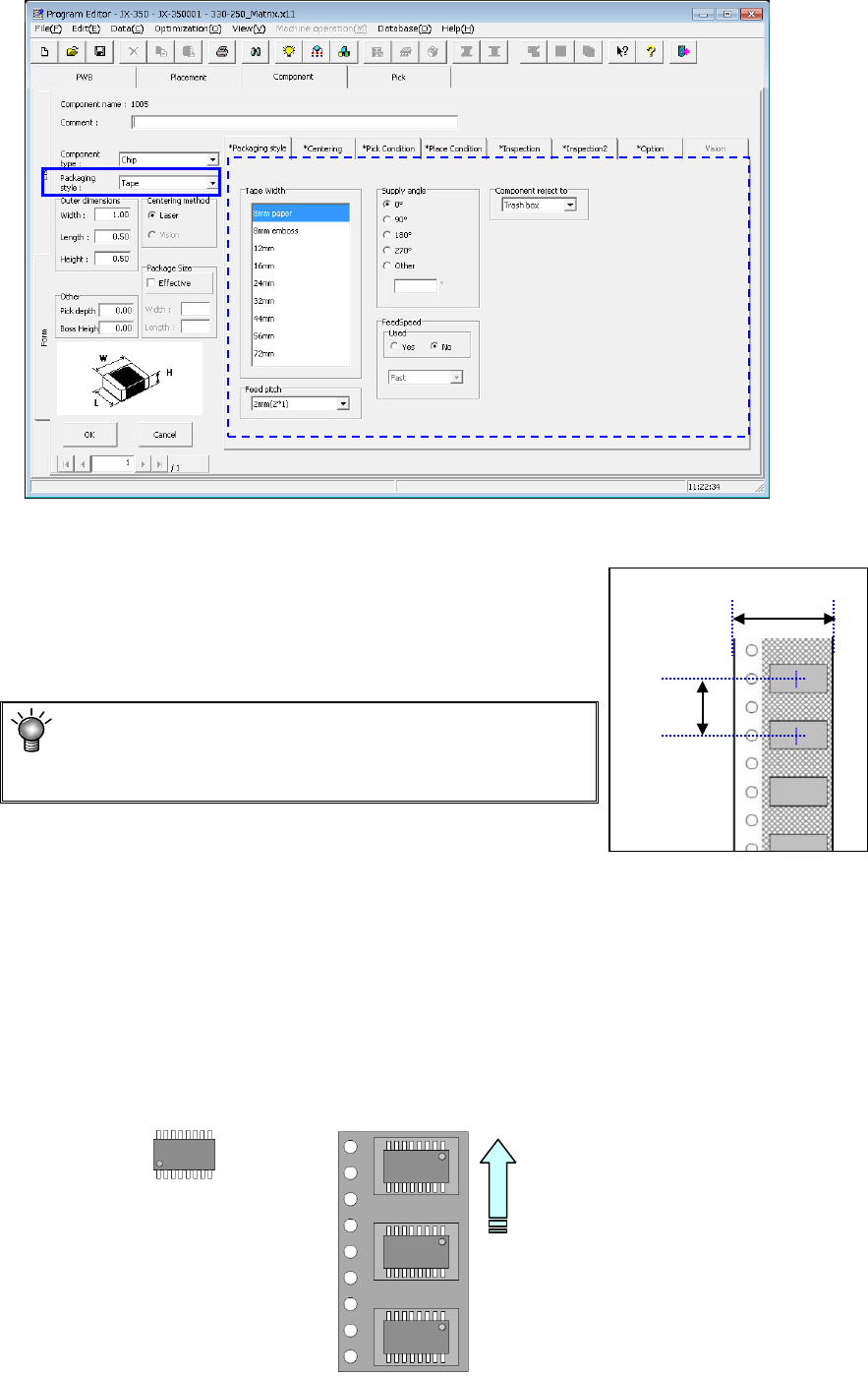
(1) How to enter data if you select “Tape” as the “Packaging style”
1) Feed unit
A list of selectable feed units is displayed in the list box. Select a feed unit in this
list.
2) Feed pitch
Select the tape feeding pitch.
In the case of a 12 mm to 72 mm tape, set the pitch of
component data according to the feed pitch setting of
the tape feeder side.
Example: To make an 8 mm feed of a 12 mm tape
8 mm (4*2) Pitch = 8 mm (feed amount 4 mm x 2 times)
For the setting on the tape feeder side, refer to the "Instruction Manual for Tape
Feeder."
3) Component supply angle
Enter the angle of a component package on the tape feeder with respect to the
component placement angle, 0 degrees.
When you select “Other,” enter the angle in the edit field. (0° to 359.9875°)
Tape width
Pitc
Angle definition 0°
Feed angle 180°
Feed direction