JX-350_EPU使用说明书.pdf - 第61页
EPU Instruction M anual C hapter 4 Creating a Production Progr am 4- 13 * Restrict ions on Longer sized PWB - For a Longer sized PW B, optim ization considering twice clamp (including opt ional thric e clamp) cannot be e…
EPU Instruction Manual Chapter 4 Creating a Production Program
4-12
CAUTION
If a designed value (CAD data) of mark coordinate exists, NEVER
teach the X and Y coordinates. If these values are taught, all
component placement coordinates will be deviated from the designed
values.
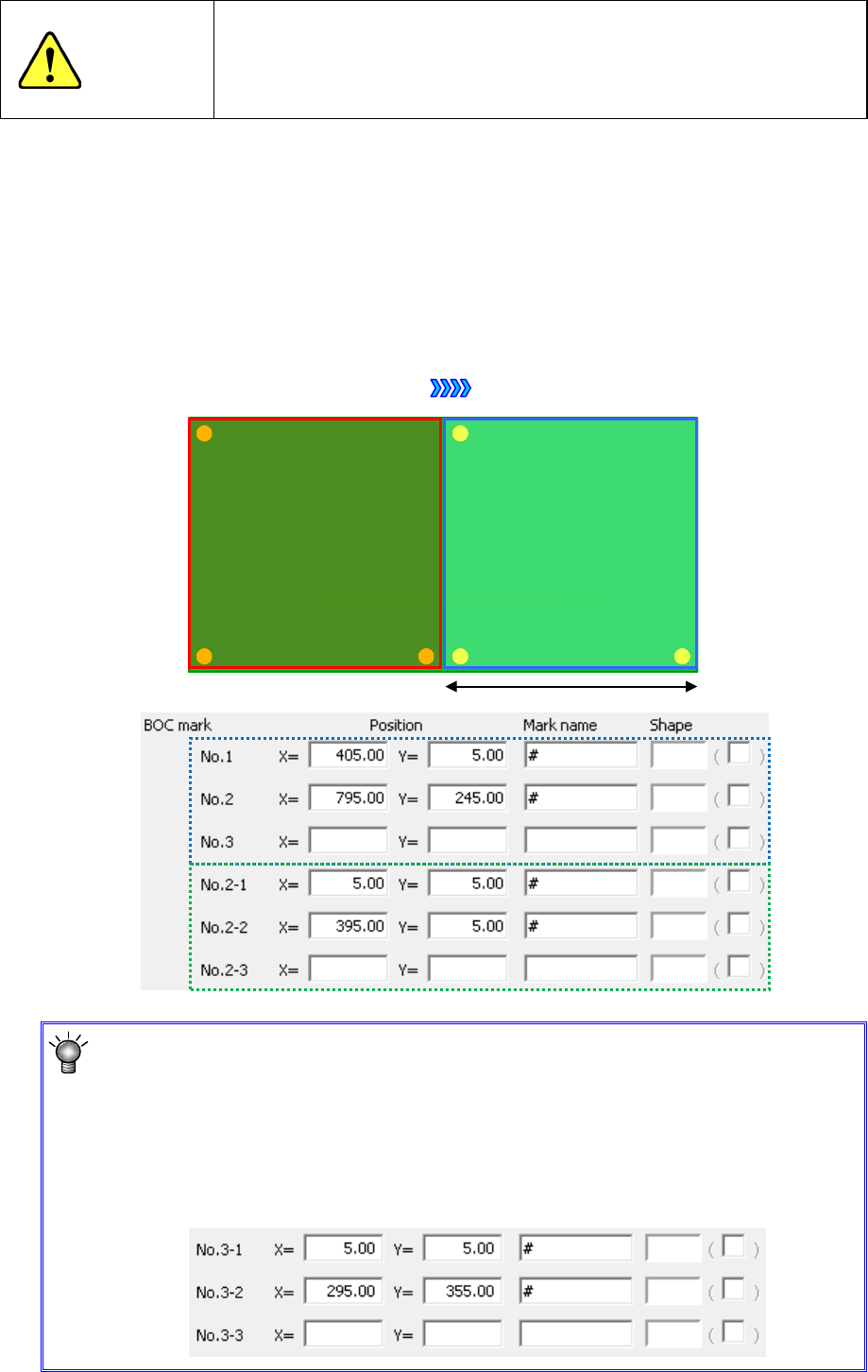
* For using a large-shaped PWB whose external length X exceeds 650mm:
For a large-shape PWB whose PWB external length exceeds 650mm, set the BOC mark in
the range of placement by first clamp (hereafter referred to as the first BOC mark) and the
BOC mark in the range of placement by second clamp (hereafter referred to as the second
BOC mark).
Example: When a single-circuit left-to-right transport is performed and the PWB size is 800
mm, enter the first BOC mark setting and second BOC mark setting.
Transport direction
① First
placement area
② Second
placement area
①
②
* For using a large-shaped PWB whose external length X exceeds 1200mm
(option):
For a large
-shaped PWB whose external length X exceeds 1200mm
, set the BOC
mark in the range
to be placed by the third clamp (hereafter referred to as the
third
BOC mark)
, besides the first BOC mark and the second BOC mark.
The third BOC mark setting items are displayed only when “Long board option” is
set enabled by selecting [EPU Setup]
-[Station Profile]-[Option 2].
EPU Instruction Manual Chapter 4 Creating a Production Program
4-13
* Restrictions on Longer sized PWB
- For a Longer sized PWB, optimization considering twice clamp (including optional
thrice clamp) cannot be executed if “Replacement with the optimization result” of the
optimization option is selected for optimization. Select “Order assigned from the
production program input order” for optimization.
- In the case of a circuit whose placing point bestrides two clamps (including optional
thrice clamp), set the bad mark position in the first placement area.
(8) Bad mark position
You do not have to enter this item for a single-plane PWB (setting is disabled).
(9) PWB height
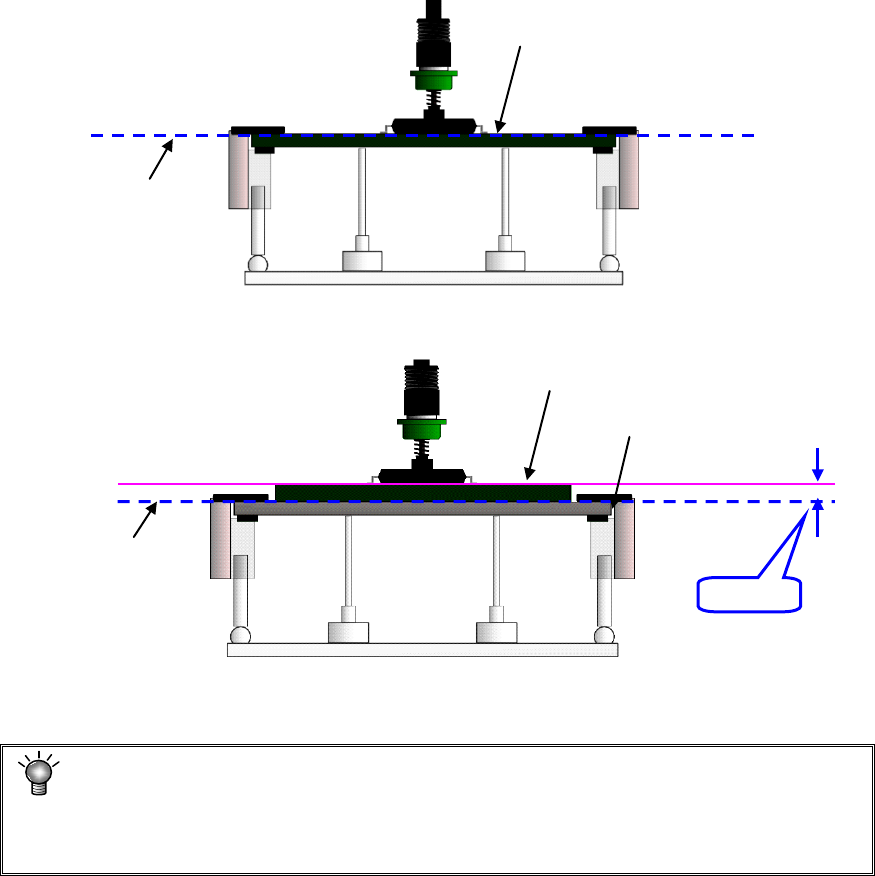
Enter the length of the top plane of the PWB from the transport reference plane
(reference height. This is the initial value (= 0.00) of the Z axis).
Usually, enter the initial value. When the transport reference plane is different in
height from the PWB top plane, enter the PWB height.
Example: Odd-shape PWBs or flexible PWBs are manufactured by piling the jig
(carrier board). In this case, enter “+t” for the PWB height.
• Normal case(Transport reference plane = PWB top plane height)
• Using the jig (Transport reference plane ≠ PWB top plane height)
If “+1” is not entered in this case, the component is pushed over the placement plane
(by the length of t) at placement, thereby damaging the component.
The nozzle height at component placement depends on the PWB height.
Accordingly if an incorrect value is set, the placement may lose uniformity. (The
component is released from a position remote to the PWB or the component is
pushed in too much in the PWB.)
+t
Transport reference plane
PWB top plane height
Jig (carrier board)
Transport reference plane
PWB top plane height
EPU Instruction Manual Chapter 4 Creating a Production Program
4-14
(10) PWB thickness
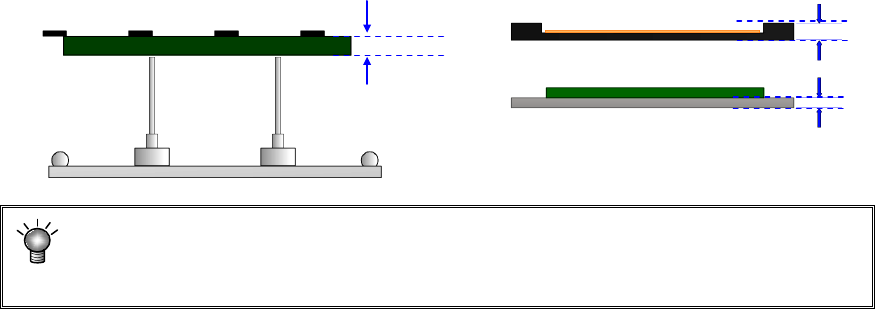
Enter the thickness of a PWB. The value you entered here is used to determine how
much the system should move up the support table when it is centering a PWB.
If an incorrect value is entered, the support pin pushes the PWB too much, thereby
damaging the PWB, and the placement may lose uniformity because the support pin
does not touch the PWB.
(11) Back height
Enter the height of the tallest component among the components placed on the back
side of a PWB (you have to enter a value that causes components on the back side
not to interfere with the support pin if components are placed on both sides of a
PWB).
* Not used in JX-350.
PWB thickness