JX-350_EPU使用说明书.pdf - 第87页
EPU Instruction M anual C hapter 4 Creating a Production Progr am 4- 39 ( 5) Component name Enter the nam e of a com ponent (up to 60 char acters). Each time a component name is entered, component data is created. If the…

EPU Instruction Manual Chapter 4 Creating a Production Program
4-38
4.1.3.2 Entry items
Enter a value in each of the “Component ID,” “X,” “Y, ” “Angle” and “Component name”
fields. The corresponding initial value is automatically entered in the other fields (the
“Head,” “Mark,” “AreaBM,” “Skip,” “Trial” and “Layer” fields). Change the value(s) in
these fields when necessary only.
Note that each coordinate indicates the distance from the “PWB origin” determined on the
“PWB” data screen (“Circuit origin” of the reference circuit for a multi-plane PWB).
(1) Pick
The component pick-up position set when you open the “Placement” data list screen
is shown here.
An asterisk mark (“*”) appears when the component pick-up position is not
determined.
When there are multiple feeders for the same component, the pick position is
determined by executing optimization.
When there are not multiple feeders for the same component, the pick position is
determined without executing optimization.
When there are two or more pick data records for the same component type, the
pick-up position of the first one appears, and a plus mark (“+”) appears to the left of
this position. You cannot enter any value in this field.
(2) Component ID
Enter the placement location as a reference notation. Therefore, this does not have
any influence over placement.
When this item is entered, the default value is applied to each item in which the
default value can be entered, and then displayed.
You can enter up to 16 characters (alphanumeric characters only).
In addition, this item can be omitted by clicking another item (such as an X
coordinate) without entering any data.
In this case, a "#" mark will be entered here automatically.
(3) X and Y
Enter the placement position (X, Y). You can enter a value from the keyboard or
with a teaching operation.
* Be sure to perform a BOC alignment operation before teaching it.
As a coordinate, enter the distance from the “PWB origin” (or circuit origin for a
multi-plane PWB) determined on the “PWB” data screen to the component placement
position (center of a coordinate).
・Entry of an absolute position:
Enter a numeric value from a keyboard.
You can assign a sign, “+” or “–“ (minus) for a value.
・Entry of a relative position:
When you enter “++” before a numeric value, the entered value is added to a
value displayed in the field on which the cursor is located.
When you enter “—“ before numeric value, the entered value is subtracted
from a value displayed in the field on which the cursor is located.
When you enter “+=” before a numeric value, the entered value is added to a
value in the field one line above the field on which the cursor is located.
When you enter “-=” before a numeric value, the entered value is subtracted
from a value displayed in the field one line above the field on which the cursor
is located.
Note: You cannot enter a space between two symbols, ++, --, += or -=.
(4) Angle
Enter the component placement angle with regarding the “Supply angle” specified on
the “Component” data screen as the reference angle.
(See Section 4.1.4.2.2 (1) How to enter data if you select “Tape” as the “Packaging
style” )
EPU Instruction Manual Chapter 4 Creating a Production Program
4-39
(5) Component name
Enter the name of a component (up to 60 characters).
Each time a component name is entered, component data is created.
If the use of database is set when a component name is entered, the database is
searched. Then, if the same component name is detected, the component data is
fetched into the program.
Upper-case characters and lower-case characters are handled as the same data but
are indicated with distinction on the display unit.
If the component name is registered in the database in advance, it is replaced with a
component name of the registered characters in the database.
(If the component name is a new one, it is displayed as it is entered. If the
component name already exists, this existing component name is displayed.)
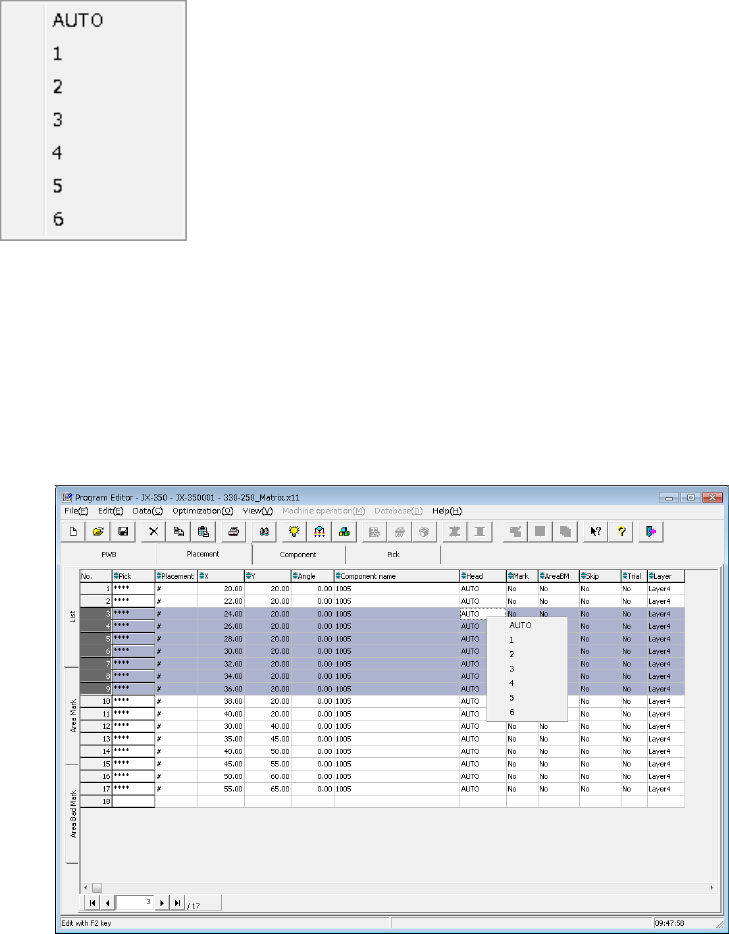
(6) Head
Specify a head to be used for placing a component on a board.
You can select from a pop-up menu a head that is to be used to place a component
when a PWB is produced in Input order.
“AUTO” is selected as the initial setting. When you execute the “Optimization” utility
after creating a production program, the system automatically selects the optimal
head.
To select a head, press the Edit key (<F2> key of the keyboard) or the right button of
a mouse to display the pop-up menu, and then select a head from this menu. If you
specify a head from the pop-up menu when two or more lines are selected, the heads
of all the selected records are changed to the head you specified. (The following
figure shows an example of multiple-line selection.)
Auto selection: A head to be used is automatically selected.
Head 1: Head 1 is specified.
Head 2: Head 2 is specified.
Head 3: Head 3 is specified.
Head 4: Head 4 is specified.
Head 5: Head 5 is specified.
Head 6: Head 6 is specified.
EPU Instruction Manual Chapter 4 Creating a Production Program
4-40
(7) Mark (Mark ID)
Specify whether to correct a component placement position with an area mark before
the system places a component.
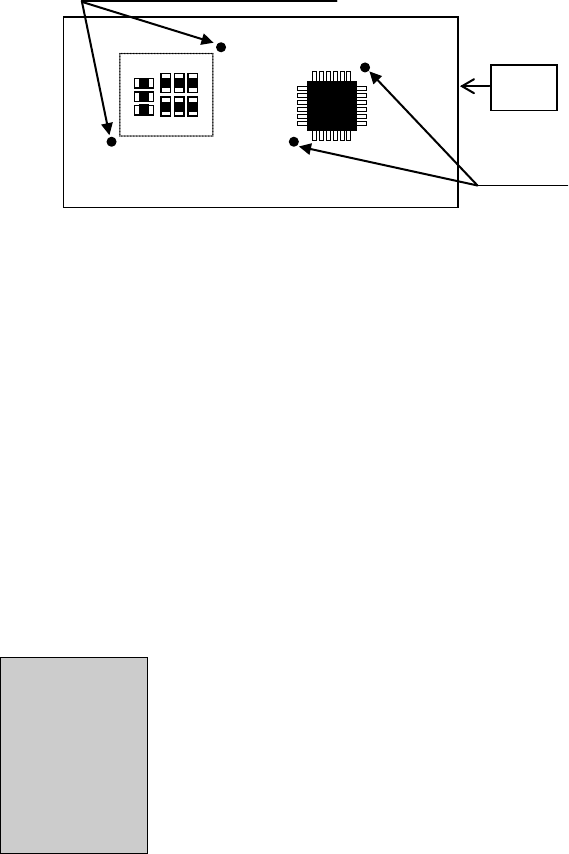
Since the system can correct a component placement position with these area marks
affixed near this position, use these marks for a component that requires high
accuracy of placement.
As the default, [No] (Not use) is set.
[No] or the specified mark ID is displayed. (Up to 8 half-byte characters)
An area mark allows you to correct two or more number of placement data records
(i.e. component placement points) with only a single set of marks.
(Two marks per one set of mark, or three marks per one set of mark)
[Option that recognizes the LED as one point circuit mark is enabled.]
Specify whether to recognize the placed LED during placement and correct the
placement position. Since the correction is made with one LED mark, the tact
can be shortened. (One set uses one mark.)
1) Displayed items
“No”: The system does not correct a component placement position.
Mark ID: The system corrects a component placement position.
2) Changing your choice
To change the setting: whether to correct a component placement position, click
the “Mark” field whose setting you want to change on the “Placement” data
screen with the right button, and select one of the choices displayed on the menu
as shown below.
No.
No: Specify that any marks are not to be used.
Edit (E)
Edit: Opens the area mark input screen to allow you
to edit the area mark data.
Browse (B)
Browse: Opens the area mark input screen to allow you
to select an area mark.
Note that the choice “Edit” does not appear on the screen shown above when you
display the menu after selecting two or more lines on the “Placement” data
screen.
Area marks (To be specified at multiple placement points)
PWB
IC marks (To be specified at a single
placement point)