JX-350_EPU使用说明书.pdf - 第77页
EPU Instruction M anual C hapter 4 Creating a Production Progr am 4- 29 Specification of a circuit t o be placed on a board has the f ollowing funct ions. (1) Setting circ uits by specifying the r ange of the orig in coo…
EPU Instruction Manual Chapter 4 Creating a Production Program
4-28
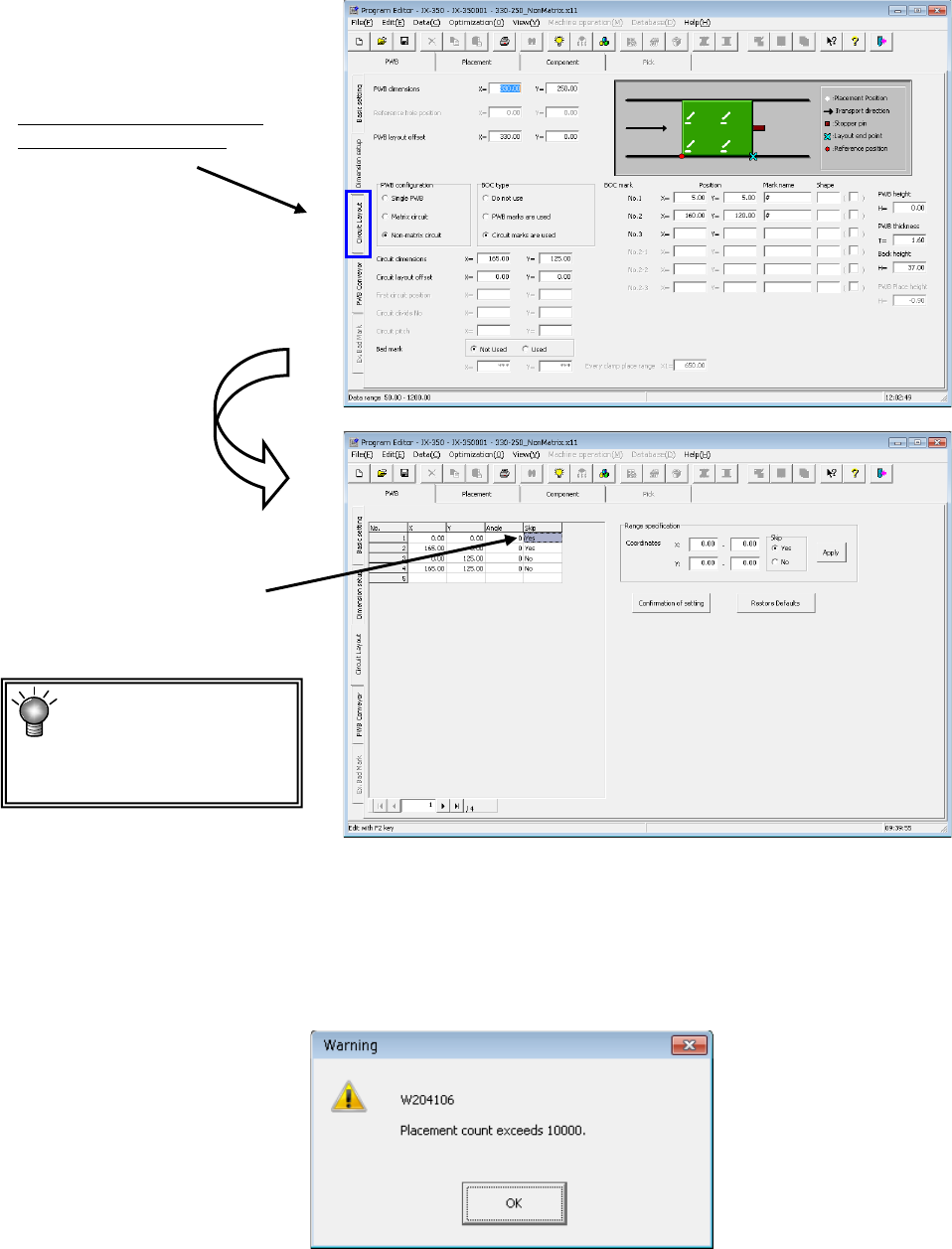
3) Skip
You can set this item only if you select the “Used” radio button for the menu item “Circuit
Mapping” on the “Basic setting” tab.
Yes: The system does not place any component on this circuit.
No: The system places a component(s) on this circuit.
“No” is set to all circuits initially.
*You cannot set “Yes” to all circuits.
You have to enter the coordinates of at least one circuit.
If you do not set any coordinates, the data is not completed.
If you move to another page of the screen without entering data completely, edition of the
record is discarded.
If the total number of component placements exceeds 10,000 even though the number of
circuits is below the limit, the following message appears on the screen.
Select this tab and the "Circuit
layout" screen will appear.
Set “Yes” to a circuit on
which any component is
not placed.
The maximum number
of circuits you can
create on a non-matrix
board is 200.
EPU Instruction Manual Chapter 4 Creating a Production Program
4-29
Specification of a circuit to be placed on a board has the following functions.
(1) Setting circuits by specifying the range of the origin coordinates
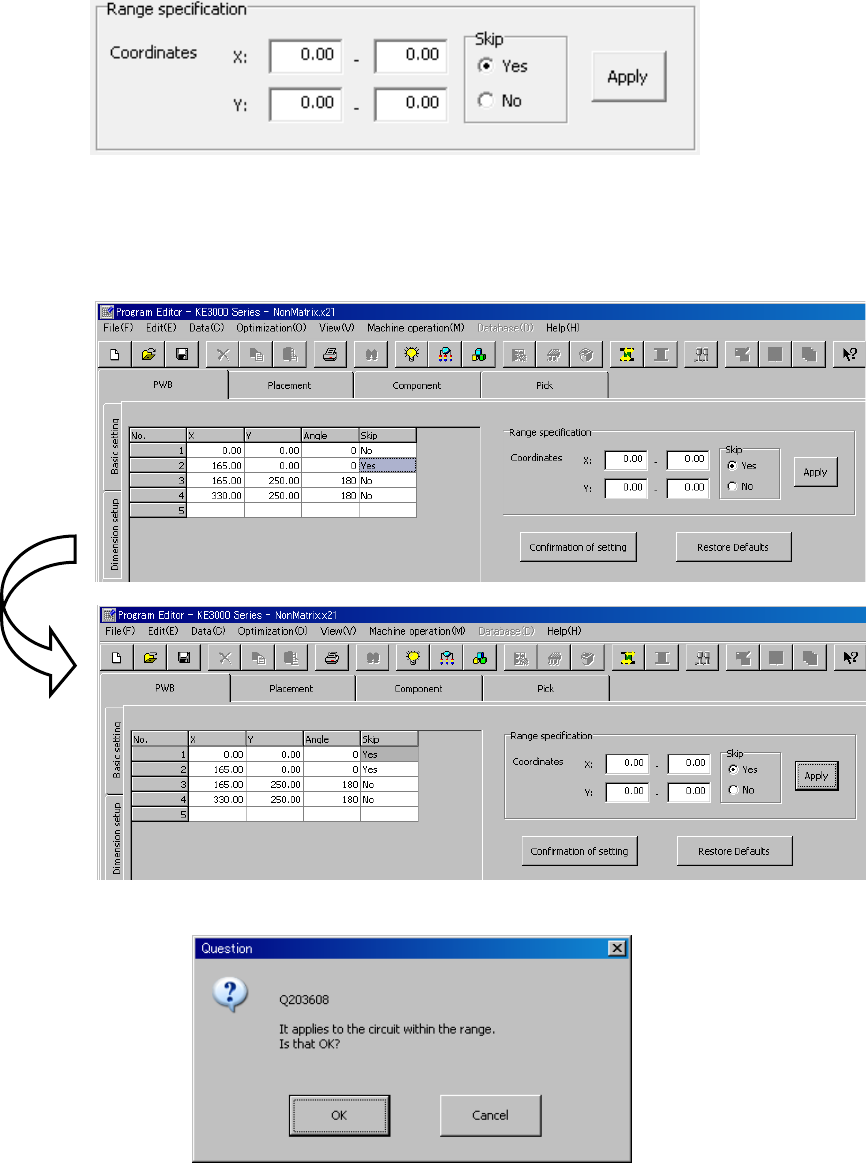
This function sets all circuits whose origin coordinates are located in the specified range
of the X coordinate and in the specified range of the Y coordinate respectively so that
they will be placed on a board. Enter the X coordinate range and the Y coordinate range
respectively, and then select the “Yes” radio button or the “No” radio button for the menu
item “Skip.” Next, press the [Apply] button to specify whether all circuits located in the
specified range will be placed on a board or not.
When you press the [Apply] button on the figure above, the settings of circuits in the list
are changed as shown below.
Note that although the “Skip” setting of the circuit whose origin is in the specified range,
the circuit “No. 1,” is changed to “Yes,” the setting of any other circuits does not change.
Therefore, the “Skip” setting of circuits other than this circuit is not changed to “No” either.
Note that when you press the [Apply] button, the following “Question” dialog box appears
on the screen.
EPU Instruction Manual Chapter 4 Creating a Production Program
4-30
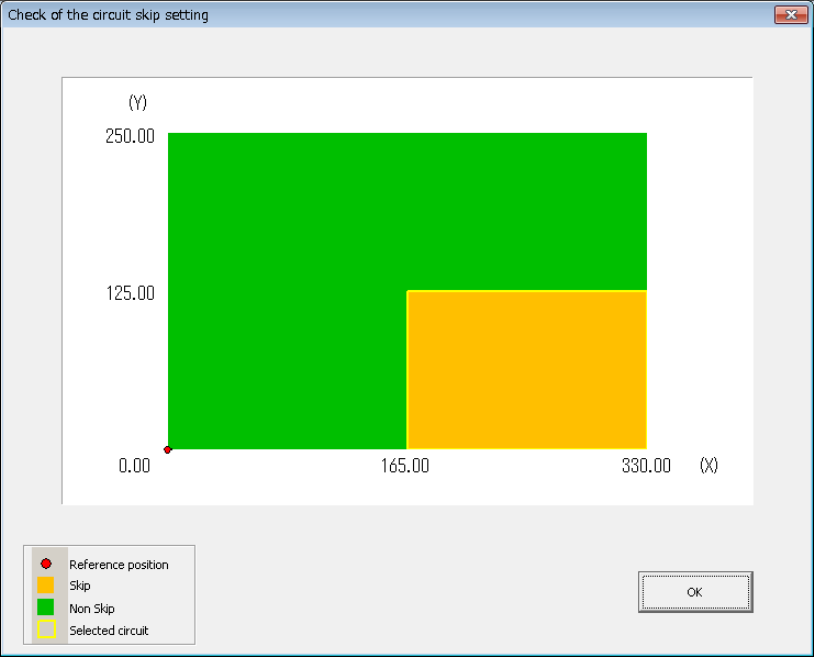
(2) Checking the settings of circuits to be placed on a board
To check the settings of circuits to be placed on a board, press the [Confirmation of
setting] button. The “Check of the circuit skip setting” screen shows the board reference
position, a circuit(s) to be skipped and a circuit selected currently.
(3) Restore Defaults
When you press the [Restore Defaults] button, the “Skip” settings of circuits are returned
to the default settings. All circuits are not to be skipped (“No”) by default.