IPC-TM-650 EN 2022 试验方法--.pdf - 第100页
IPC-TM-650 IPC-TM-650 The Institute for Int erconnecting and Packaging E lectronic Circuits 2215 Sanders Road • Northbrook, IL 60062 Material in this T est M ethods Manual was vol untaril y establis hed by T echni cal Co…

IPC-TM-650
Number
Subject Date
Revision
Page 2 of 2
2.2.18
Determination
of
Thickness
of
Laminates
by
Mechanical
Measurement
12/94
5.3.2.2.2.1
Calculate
the
overall
nominal
thickness
by
add¬
ing
to
the
base
nominal
thickness
the
total
thickness
of
the
metallic
cladding.
Thickness
of
metallic
cladding
shall
be
based
on
.035
mm
[0.0014
in]
per
45.7
g
[1.0
oz],
or
as
sup¬
plied
by
the
foil
supplier.
5.3.2.2.2.2
Calculate
the
minimum
and
maximum
limits
by
subtracting
and
adding
the
required
tolerance
from
the
over¬
all
nominal
thickness.
5.3.2.2.2.3
Measurements
taken
after
specimen
prepara¬
tion
per
5.1
.2
shall
be
compared
with
the
minimum
and
maxi¬
mum
limits
as
determined
in
5.
3.2.2.
2.
5.4
Report
Unless
otherwise
specified,
report
the
average,
minimum
and
maximum
readings,
and
compliance
with
requirements,
if
applicable.
6.0
Notes
6.1
Use
of
hand
or
manual
micrometers
should
be
carefully
administered.
Pressure,
anvil
shape,
and
other
features
of
the
micrometer
and
its
use
must
follow
accepted
industry
practices,
if
not
defined
in
the
applicable
specification.
IPC-TM-650
IPC-TM-650
The Institute for Interconnecting and Packaging Electronic Circuits
2215 Sanders Road • Northbrook, IL 60062
Material in this Test Methods Manual was voluntarily established by Technical Committees of the IPC. This material is advisory only
and its use or adaptation is entirely voluntary. IPC disclaims all liability of any kind as to the use, application, or adaptation of this
material. Users are also wholly responsible for protecting themselves against all claims or liabilities for patent infringement.
Equipment referenced is for the convenience of the user and does not imply endorsement by the IPC.
Page 1 of 1
IPC-TM-650
TEST
METHODS
MANUAL
1
.0
Scope
This
test
method
is
designed
to
determine
the
minimum
and
maximum
thickness
of
the
base
material
of
metallic
clad
laminates
by
microsectioning
and
optical
mea¬
surement.
2
.0
Applicable
Documents
Method
2.1
.1
,
Microsectioning
Method
2.2.18,
Determination
of
Thickness
of
Laminates,
by
Mechanical
Measurement
3
.0
Test
Specimens
3.1
Size
Unless
otherwise
specified,
a
specimen
measuring
25.4
X
12.7
mm
[1.0
X
0.5
in]
shall
be
taken
from
the
laminate
sample.
3.2
Quantity
and
Sampling
Unless
otherwise
specified,
two
samples
shall
be
taken
from
the
lot
that
represent
the
centermost
area
and
the
edges,
but
no
closer
than
25.4
mm
[1
.0
in]
from
the
edge,
of
the
as-
manufactured
sheet.
4
.0
Apparatus
or
Material
4.1
Any
optical
inspection
measuring
device
with
a
capabil¬
ity
of
1
00X
and
200X
with
an
accuracy
to
0.0025
mm
[0.0001
in].
4.2
A
microsectioning
system
capable
of
preparing
speci¬
men
mounts
that
can
be
used
for
this
procedure.
5
.0
Procedure
5.1
Preparation
of
Specimens
Each
specimen
to
be
measured
shall
be
microsectioned
in
accordance
with
IPC-
TM-650,
Method
2.1.1
.
The
long
dimension
of
the
specimen
shall
be
in
the
plane
of
examination.
Specimens
may
be
ganged
in
accordance
with
the
sampling
procedure.
5.2
Evaluation
Examine
the
entire
length
of
the
specimen.
Determine
and
record
the
minimum
and
maximum
thickness
of
each
specimen
to
the
nearest
0.0025
mm
[0.0001
in]
using
100X
magnification
and
in
accordance
with
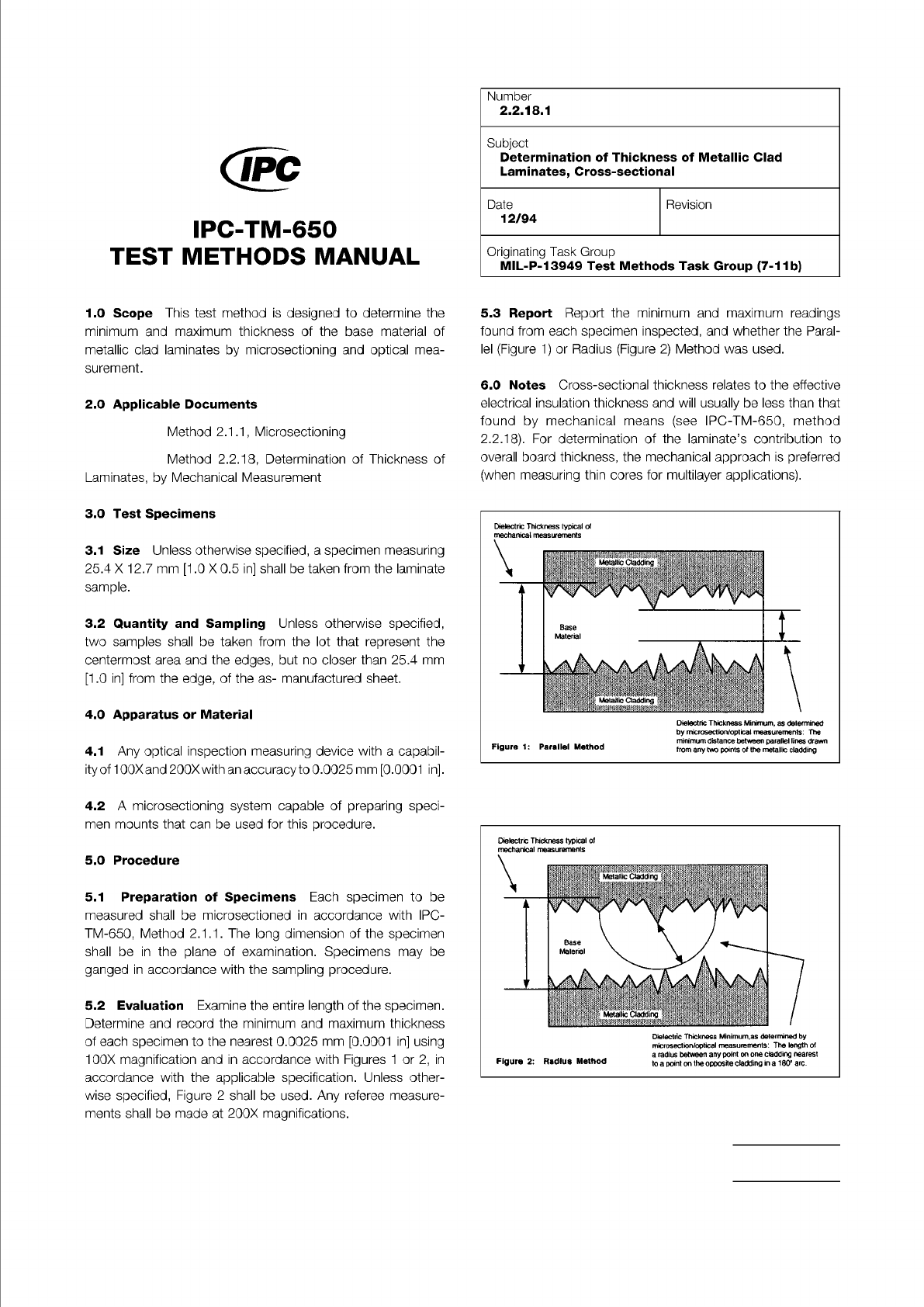
Figures
1
or
2,
in
accordance
with
the
applicable
specification.
Unless
other¬
wise
specified,
Figure
2
shall
be
used.
Any
referee
measure¬
ments
shall
be
made
at
200X
magnifications.
Number
2.2.18.1
Subject
Determination
of
Thickness
of
Metallic
Clad
Laminates,
Cross-sectional
Date
12/94
Revision
Originating
Task
Group
MIL-P-13949
Test
Methods
Task
Group
(7-1
1b)
5.3
Report
Report
the
minimum
and
maximum
readings
found
from
each
specimen
inspected,
and
whether
the
Paral¬
lel
(Figure
1)
or
Radius
(Figure
2)
Method
was
used.
6
.0
Notes
Cross-sectional
thickness
relates
to
the
effective
electrical
insulation
thickness
and
will
usually
be
less
than
that
found
by
mechanical
means
(see
IPC-TM-650,
method
2.2.18).
For
determination
of
the
laminate's
contribution
to
overall
board
thickness,
the
mechanical
approach
is
preferred
(when
measuring
thin
cores
for
multilayer
applications).
minimum
distance
between
parallel
lines
drawn
from
any
two
points
of
the
metallic
cladding
Dielectric
Thickness
typical
of
mechanical
measurements
Figure
1:
Parallel
Method
Dielectric
Thickness
typical
of
Figure
2:
Radius
Method
a
radius
between
any
point
on
one
cladding
nearest
to
a
point
on
the
opposite
cladding
in
a
180°
arc.
The Institute for Interconnecting and Packaging Electronic Circuits
2215 Sanders Road • Northbrook, IL 60062
Material in this Test Methods Manual was voluntarily established by Technical Committees of the IPC. This material is advisory only
and its use or adaptation is entirely voluntary. IPC disclaims all liability of any kind as to the use, application, or adaptation of this
material. Users are also wholly responsible for protecting themselves against all claims or liabilities for patent infringement.
Equipment referenced is for the convenience of the user and does not imply endorsement by the IPC.
Page 1 of 1
IPC-TM-650
TEST
METHODS
MANUAL
1
.0
Scope
This
method
is
designed
to
determine
dimen¬
sional
conformance
to
specification
of
production-cut
panels
of
laminate
or
prepreg
for
length,
width,
and
perpendicularity.
2
.0
Applicable
Documents
IPC-PC-90
3
.0
Test
Specimens
3.1
Size
Production
cut
panels
in
the
dimensions
intended
for
shipment
shall
be
used.
3.2
Sampling
Sampling
rates
shall
be
in
accordance
with
the
applicable
specification.
(Also
see
6.1.)
4
.0
Apparatus
or
Material
Unless
otherwise
specified,
precision
of
measurement
apparatus
shall
be
in
accordance
with
the
applicable
specification.
4.1
Vernier
calipers
capable
of
measuring
up
to
914
±
6.4
mm
[36.0
±
0.25
in]
or
equivalent.
4.2
Tape
measure
capable
of
measuring
up
to
1829
mm
[72.0
in]
4.3
Carpenters
square,
or
equivalent
4.4
Pin
gauges,
dial
indicators
or
equivalent
5
.0
Procedure
5.1
Length
Measure
the
length
of
the
edges
of
the
panel
that
are
parallel
to
the
grain
direction
using
a
vernier
caliper.
5.2
Width
Measure
the
length
of
the
edges
of
the
panel
that
are
perpendicular
to
the
grain
direction
using
a
vernier
caliper.
5.3
Perpendicularity
5.3.1
Method
A:
by
diagonals
5.3.1.
1
Measure
the
diagonals
of
the
panel
using
vernier
caliper
or
tape
measure.
Number
2.2.19.1
Subject
Length,
Width
and
Perpendicularity
of
Laminate
and
Prepreg
Panels
Date
Revision
12/94
Originating
Task
Group
MIL-P-13949
Test
Methods
Task
Group
(7-1
1b)
5.3.1.
2
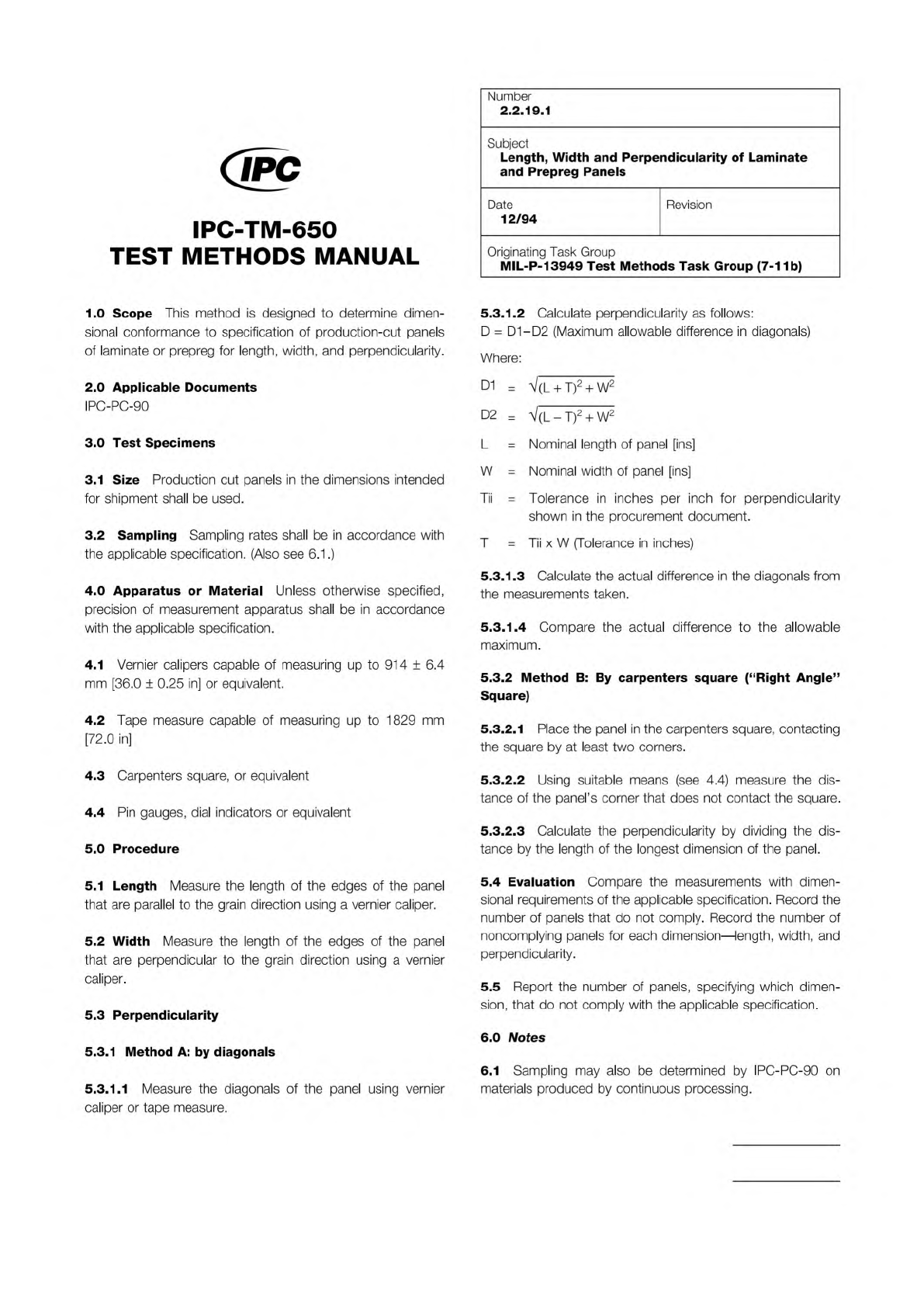
Calculate
perpendicularity
as
follows:
D
=
D1-D2
(Maximum
allowable
difference
in
diagonals)
Where:
di
二
D2
二
^/(L-T)2
+
W2
L
二
Nominal
length
of
panel
[ins]
W
二
Nominal
width
of
panel
[ins]
Tii
=
Tolerance
in
inches
per
inch
for
perpendicularity
shown
in
the
procurement
document.
T
二
Tii
x
W
(Tolerance
in
inches)
5.3.1.
3
Calculate
the
actual
difference
in
the
diagonals
from
the
measurements
taken.
5.3.1.
4
Compare
the
actual
difference
to
the
allowable
maximum.
5.3.2
Method
B:
By
carpenters
square
(“Right
Angle”
Square)
5.3.2.1
Place
the
panel
in
the
carpenters
square,
contacting
the
square
by
at
least
two
corners.
5.3.2.2
Using
suitable
means
(see
4.4)
measure
the
dis¬
tance
of
the
panel's
comer
that
does
not
contact
the
square.
5.3.2.3
Calculate
the
perpendicularity
by
dividing
the
dis¬
tance
by
the
length
of
the
longest
dimension
of
the
panel.
5.4
Evaluation
Compare
the
measurements
with
dimen¬
sional
requirements
of
the
applicable
specification.
Record
the
number
of
panels
that
do
not
comply.
Record
the
number
of
noncomplying
panels
for
each
dimension
—
length,
width,
and
perpendicularity.
5.5
Report
the
number
of
panels,
specifying
which
dimen¬
sion,
that
do
not
comply
with
the
applicable
specification.
6
.0
Notes
6.1
Sampling
may
also
be
determined
by
IPC-PC-90
on
materials
produced
by
continuous
processing.