IPC-TM-650 EN 2022 试验方法--.pdf - 第699页
IPC-TM-650 Page 2 of 2 Number 2.6.8 Subject Thermal Stress, Plated-Through Holes Date 05/04 Revision E 5.7.1 After cleaning, microsection the specimen as defined in IPC-TM-650, Method 2.1 .1 or Method 2.1 .1 .2. 5.7.2 Ex…
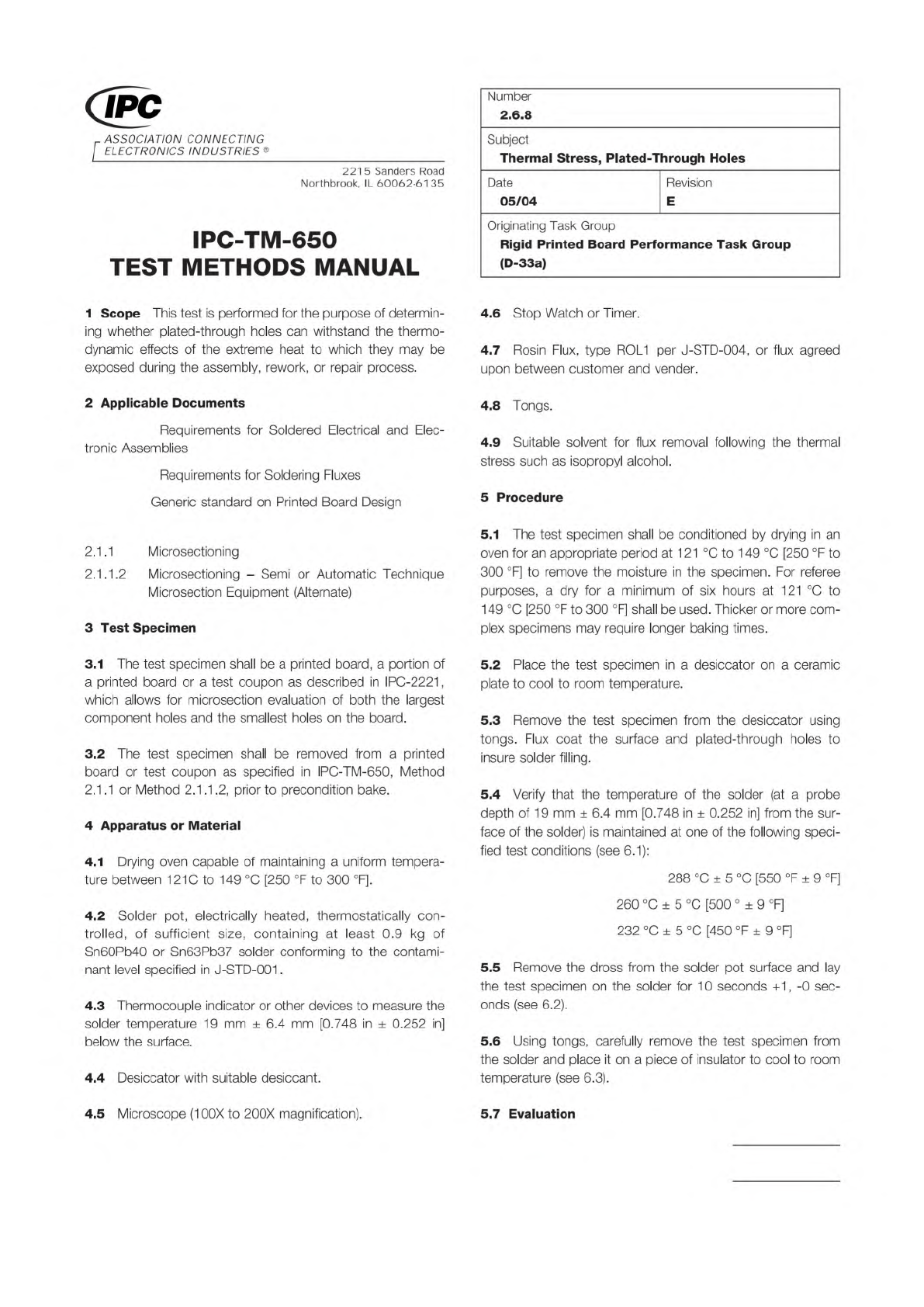
J-STD-001
J-STD-004
IPC-2221
IPC-TM-650 Test Methods Manual
(a) Test Condition A (default)
(b) Test Condition B
(c) Test Condition C
Material in this Test Methods Manual was voluntarily established by Technical Committees of IPC. This material is advisory only
and its use or adaptation is entirely voluntary. IPC disclaims all liability of any kind as to the use, application, or adaptation of this
material. Users are also wholly responsible for protecting themselves against all claims or liabilities for patent infringement.
Equipment referenced is for the convenience of the user and does not imply endorsement by IPC.
Page 1 of 2
r
ASSOCIATION
CONNECTING
/
ELECTRONICS
INDUSTRIES
®
221
5
Sanders
Road
Northbrook,
IL
60062-6135
IPC-TM-650
TEST
METHODS
MANUAL
1
Scope
This
test
is
performed
for
the
purpose
of
determin¬
ing
whether
plated-through
holes
can
withstand
the
thermo¬
dynamic
effects
of
the
extreme
heat
to
which
they
may
be
exposed
during
the
assembly,
rework,
or
repair
process.
2
Applicable
Documents
Requirements
for
Soldered
Electrical
and
Elec¬
tronic
Assemblies
Requirements
for
Soldering
Fluxes
Generic
standard
on
Printed
Board
Design
2.1
.1
Microsectioning
2.1
.1
.2
Microsectioning
-
Semi
or
Automatic
Technique
Microsection
Equipment
(Alternate)
3
Test
Specimen
3.1
The
test
specimen
shall
be
a
printed
board,
a
portion
of
a
printed
board
or
a
test
coupon
as
described
in
IPC-2221
,
which
allows
for
microsection
evaluation
of
both
the
largest
component
holes
and
the
smallest
holes
on
the
board.
3.2
The
test
specimen
shall
be
removed
from
a
printed
board
or
test
coupon
as
specified
in
IPC-TM-650,
Method
2.1
.1
or
Method
2.
1.1.
2,
prior
to
precondition
bake.
4
Apparatus
or
Material
4.1
Drying
oven
capable
of
maintaining
a
uniform
tempera¬
ture
between
121ct
o
149
[250
°F
to
300
°F].
4.2
Solder
pot,
electrically
heated,
thermostatically
con¬
trolled,
of
sufficient
size,
containing
at
least
0.9
kg
of
Sn60Pb40
or
Sn
63Pb
37
solder
conforming
to
the
contami¬
nant
level
specified
in
J-STD-001
.
4.3
Thermocouple
indicator
or
other
devices
to
measure
the
solder
temperature
19
mm
土
6.4
mm
[0.748
in
±
0.252
in]
below
the
surface.
4.4
Desiccator
with
suitable
desiccant.
Number
2.6.8
Subject
Thermal
Stress,
Plated-Through
Holes
Date
Revision
05/04
E
Originating
Task
Group
Rigid
Printed
Board
Performance
Task
Group
(D-33a)
4.6
Stop
Watch
or
Timer.
4.7
Rosin
Flux,
type
ROL1
per
J
-STD-004,
or
flux
agreed
upon
between
customer
and
vender.
4.8
Tongs.
4.9
Suitable
solvent
for
flux
removal
following
the
thermal
stress
such
as
isopropyl
alcohol.
5
Procedure
5.1
The
test
specimen
shall
be
conditioned
by
drying
in
an
oven
for
an
appropriate
period
at
121
to
149
[250
°F
to
300
°F]
to
remove
the
moisture
in
the
specimen.
For
referee
purposes,
a
dry
for
a
minimum
of
six
hours
at
121
to
149
[250
°F
to
300
°F]
shall
be
used.
Thicker
or
more
com¬
plex
specimens
may
require
longer
baking
times.
5.2
Place
the
test
specimen
in
a
desiccator
on
a
ceramic
plate
to
cool
to
room
temperature.
5.3
Remove
the
test
specimen
from
the
desiccator
using
tongs.
Flux
coat
the
surface
and
plated-through
holes
to
insure
solder
filling.
5.4
Verify
that
the
temperature
of
the
solder
(at
a
probe
depth
of
19
mm
±
6.4
mm
[0.748
in
±
0.252
in]
from
the
sur¬
face
of
the
solder)
is
maintained
at
one
of
the
following
speci¬
fied
test
conditions
(see
6.1):
288
±
5
[550
°F
±9
°F]
260
±
5
[500
°
±
9°F]
232
±
5
[450
°F
±
9
°F]
5.5
Remove
the
dross
from
the
solder
pot
surface
and
lay
the
test
specimen
on
the
solder
for
10
seconds
+1
,
-0
sec¬
onds
(see
6.2).
5.6
Using
tongs,
carefully
remove
the
test
specimen
from
the
solder
and
place
it
on
a
piece
of
insulator
to
cool
to
room
temperature
(see
6.3).
4.5
Microscope
(100X
to
200X
magnification).
5.7
Evaluation
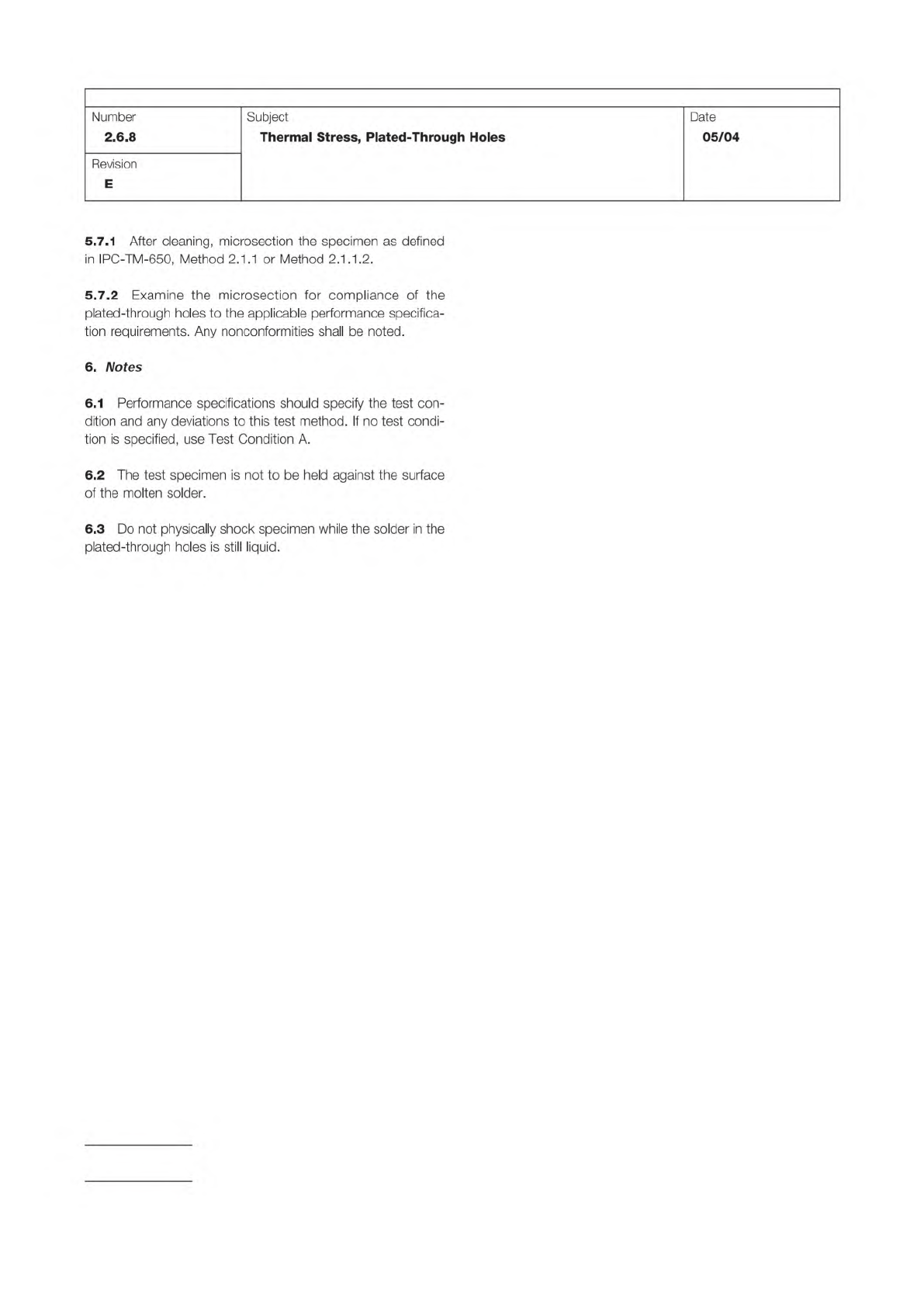
IPC-TM-650
Page 2 of 2
Number
2.6.8
Subject
Thermal
Stress,
Plated-Through
Holes
Date
05/04
Revision
E
5.7.1
After
cleaning,
microsection
the
specimen
as
defined
in
IPC-TM-650,
Method
2.1
.1
or
Method
2.1
.1
.2.
5.7.2
Examine
the
microsection
for
compliance
of
the
plated-through
holes
to
the
applicable
performance
specifica¬
tion
requirements.
Any
nonconformities
shall
be
noted.
6.
Notes
6.1
Performance
specifications
should
specify
the
test
con¬
dition
and
any
deviations
to
this
test
method.
If
no
test
condi¬
tion
is
specified,
use
Test
Condition
A.
6.2
The
test
specimen
is
not
to
be
held
against
the
surface
of
the
molten
solder.
6.3
Do
not
physically
shock
specimen
while
the
solder
in
the
plated-through
holes
is
still
liquid.
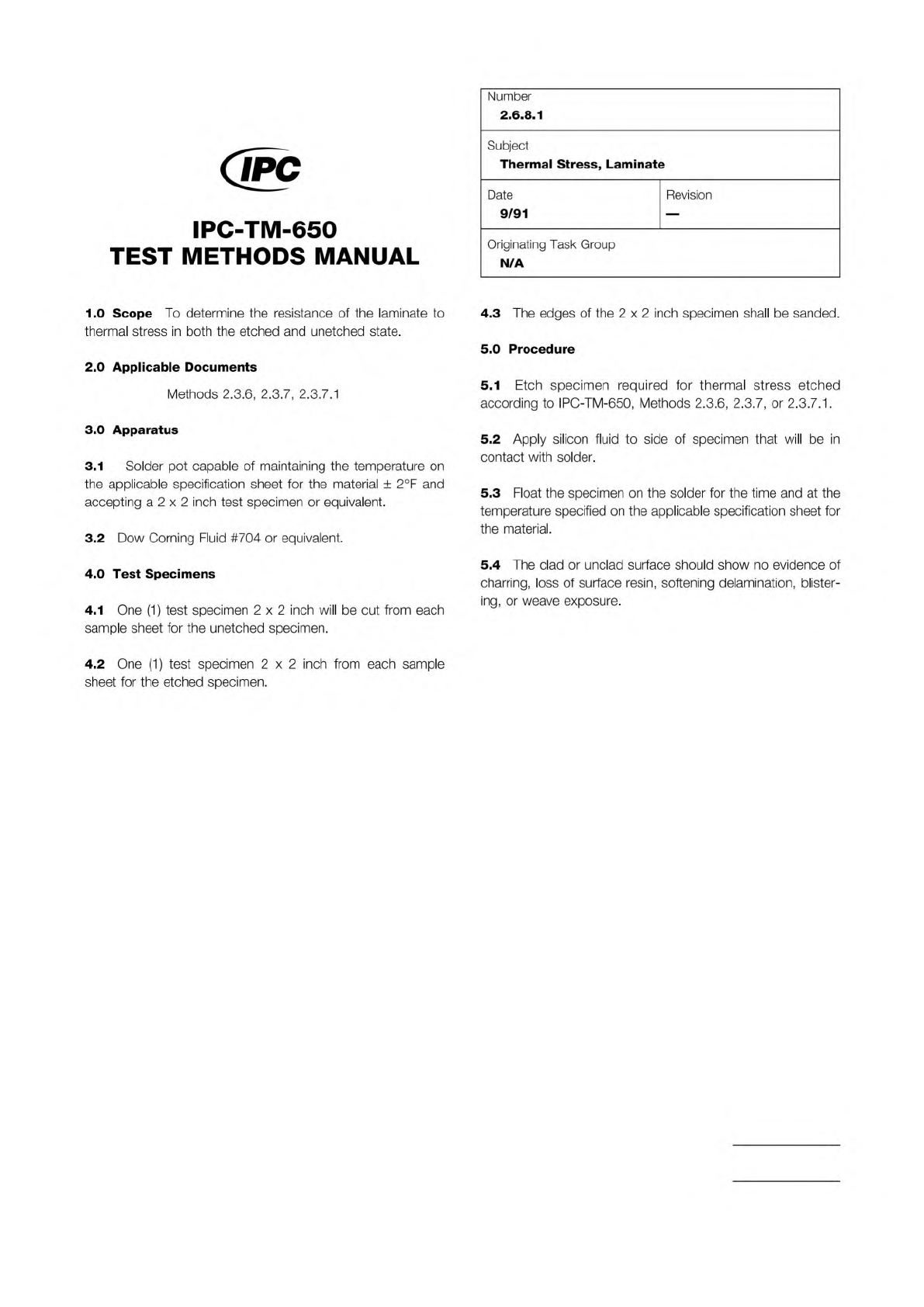
IPC-TM-650
The Institute for Interconnecting and Packaging Electronic Circuits
2215 Sanders Road • Northbrook, IL 60062-6135
Material in this Test Methods Manual was voluntarily established by Technical Committees of the IPC. This material is advisory only
and its use or adaptation is entirely voluntary. IPC disclaims all liability of any kind as to the use, application, or adaptation of this
material. Users are also wholly responsible for protecting themselves against all claims or liabilities for patent infringement.
Equipment referenced is for the convenience of the user and does not imply endorsement by the IPC.
Page 1 of 1
IPC-TM-650
TEST
METHODS
MANUAL
1
.0
Scope
To
determine
the
resistance
of
the
laminate
to
thermal
stress
in
both
the
etched
and
unetched
state.
2
.0
Applicable
Documents
Methods
2.3.6, 2.3.7,
2.3.7.
1
3
.0
Apparatus
3.1
Solder
pot
capable
of
maintaining
the
temperature
on
the
applicable
specification
sheet
for
the
material
±
2°F
and
accepting
a
2
x
2
inch
test
specimen
or
equivalent.
3.2
Dow
Corning
Fluid
#704
or
equivalent.
4
.0
Test
Specimens
4.1
One
(1)
test
specimen
2x2
inch
will
be
cut
from
each
sample
sheet
for
the
unetched
specimen.
Number
2.6.8.
1
Subject
Thermal
Stress,
Laminate
Date
Revision
9/91
—
Originating
Task
Group
N/A
4.3
The
edges
of
the
2
x
2
inch
specimen
shall
be
sanded.
5
.0
Procedure
5.1
Etch
specimen
required
for
thermal
stress
etched
according
to
IPC-TM-650,
Methods
2.3.6, 2.3.7,
or
2.
3.7.1.
5.2
Apply
silicon
fluid
to
side
of
specimen
that
will
be
in
contact
with
solder.
5.3
Float
the
specimen
on
the
solder
for
the
time
and
at
the
temperature
specified
on
the
applicable
specification
sheet
for
the
material.
5.4
The
clad
or
unclad
surface
should
show
no
evidence
of
charring,
loss
of
surface
resin,
softening
delamination,
blister¬
ing,
or
weave
exposure.
4.2
One
(1)
test
specimen
2x2
inch
from
each
sample
sheet
for
the
etched
specimen.