IPC-TM-650 EN 2022 试验方法--.pdf - 第14页
Material in this T est M ethods Manual was voluntarily establis hed by T echni cal Committees of IPC. Thi s mat erial is a dvisory only and its use or adaptation is entirely voluntary . IPC disclaims all lia bility of an…
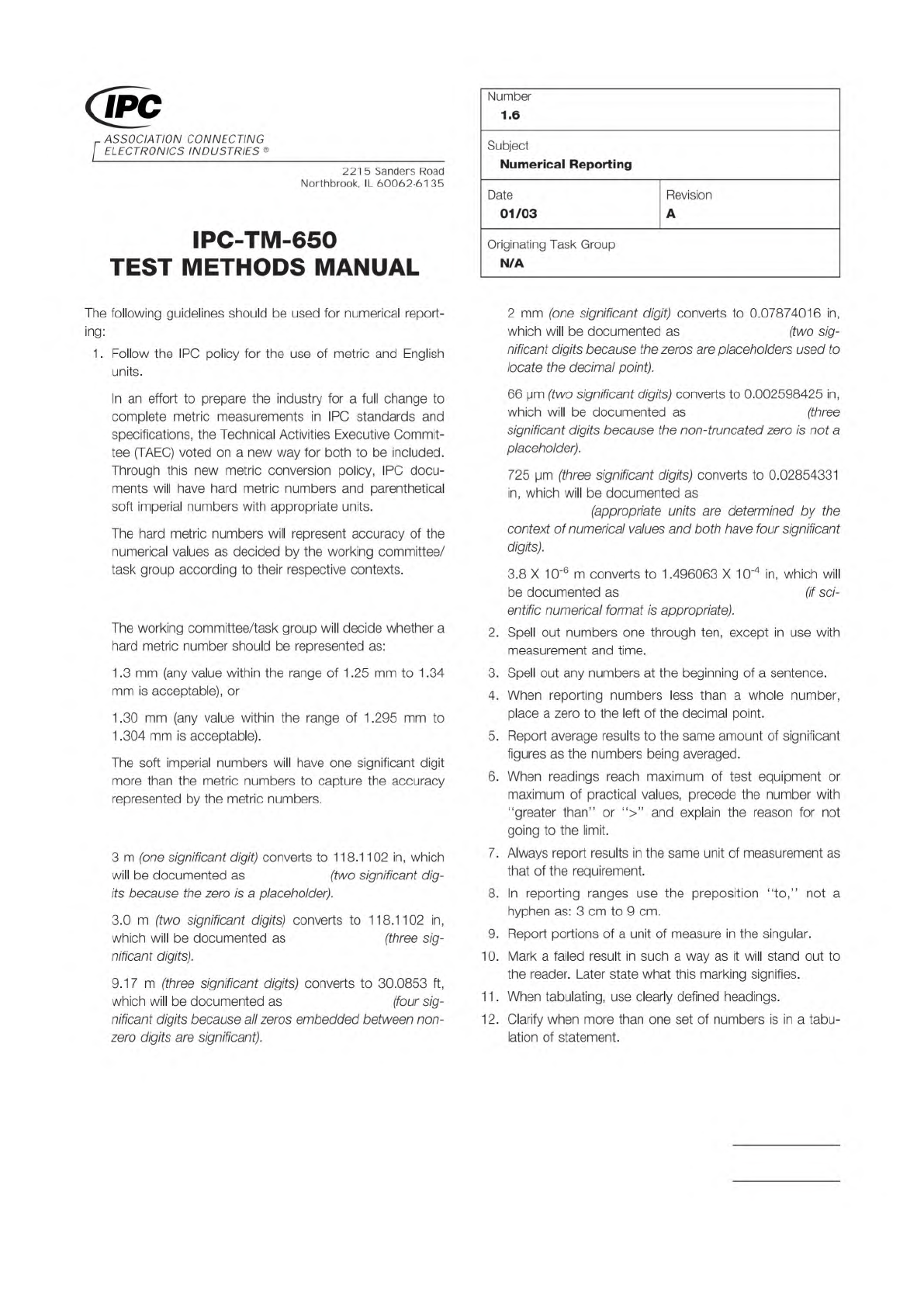
For example:
For example:
3 m [120 in]
3.0 m [118 in]
9.17 m [30.09 ft]
2 mm [0.079 in]
66 µm [2.60 mil]
725 µm [28.54 mil] or
[0.02854 in]
3.8 X 10
-6
m [1.50 X 10
-4
in]
Material in this Test Methods Manual was voluntarily established by Technical Committees of IPC. This material is advisory only
and its use or adaptation is entirely voluntary. IPC disclaims all liability of any kind as to the use, application, or adaptation of this
material. Users are also wholly responsible for protecting themselves against all claims or liabilities for patent infringement.
Equipment referenced is for the convenience of the user and does not imply endorsement by IPC.
Page 1 of 1
r
ASSOCIATION
CONNECTING
/
ELECTRONICS
INDUSTRIES
®
221
5
Sanders
Road
Northbrook,
IL
60062-6135
IPC-TM-650
TEST
METHODS
MANUAL
The
following
guidelines
should
be
used
for
numerical
report¬
ing:
1
.
Follow
the
I
PC
policy
for
the
use
of
metric
and
English
units.
In
an
effort
to
prepare
the
industry
for
a
full
change
to
complete
metric
measurements
in
I
PC
standards
and
specifications,
the
Technical
Activities
Executive
Commit¬
tee
(TAEC)
voted
on
a
new
way
for
both
to
be
included.
Through
this
new
metric
conversion
policy,
IPG
docu¬
ments
will
have
hard
metric
numbers
and
parenthetical
soft
imperial
numbers
with
appropriate
units.
The
hard
metric
numbers
will
represent
accuracy
of
the
numerical
values
as
decided
by
the
working
committee/
task
group
according
to
their
respective
contexts.
The
working
committee/task
group
will
decide
whether
a
hard
metric
number
should
be
represented
as:
1
.3
mm
(any
value
within
the
range
of
1
.25
mm
to
1.34
mm
is
acceptable),
or
1
.30
mm
(any
value
within
the
range
of
1
.295
mm
to
1.304
mm
is
acceptable).
The
soft
imperial
numbers
will
have
one
significant
digit
more
than
the
metric
numbers
to
capture
the
accuracy
represented
by
the
metric
numbers.
3
m
(one
significant
digit)
converts
to
1
18.1
102
in,
which
will
be
documented
as
(two
significant
dig¬
its
because
the
zero
is
a
placeholder).
3.0
m
(two
significant
digits)
converts
to
1
18.1
102
in,
which
will
be
documented
as
(three
sig¬
nificant
digits).
9.17
m
(three
significant
digits)
converts
to
30.0853
ft,
which
will
be
documented
as
(four
sig¬
nificant
digits
because
all
zeros
embedded
between
non¬
zero
digits
are
significant).
Number
1.6
Subject
Numerical
Reporting
Date
Revision
01/03
A
Originating
Task
Group
N/A
2
mm
(one
significant
digit)
converts
to
0.07874016
in,
which
will
be
documented
as
(two
sig¬
nificant
digits
because
the
zeros
are
placeholders
used
to
locate
the
decimal
point).
66
pm
(two
significant
digits)
converts
to
0.002598425
in,
which
will
be
documented
as
(three
significant
digits
because
the
non-truncated
zero
/s
not
a
placeholder).
725
pm
(three
significant
digits)
converts
to
0.02854331
in,
which
will
be
documented
as
(appropriate
units
are
determined
by
the
context
of
numerical
values
and
both
have
four
significant
digits).
3.8
X
10-6
m
converts
to
1
.496063
X
10-4
in,
which
will
be
documented
as
(if
sci¬
entific
numerical
format
is
appropriate).
2.
Spell
out
numbers
one
through
ten,
except
in
use
with
measurement
and
time.
3.
Spell
out
any
numbers
at
the
beginning
of
a
sentence.
4.
When
reporting
numbers
less
than
a
whole
number,
place
a
zero
to
the
left
of
the
decimal
point.
5.
Report
average
results
to
the
same
amount
of
significant
figures
as
the
numbers
being
averaged.
6.
When
readings
reach
maximum
of
test
equipment
or
maximum
of
practical
values,
precede
the
number
with
greater
than''
or
and
explain
the
reason
for
not
going
to
the
limit.
7.
Always
report
results
in
the
same
unit
of
measurement
as
that
of
the
requirement.
8.
In
reporting
ranges
use
the
preposition
"to,''
not
a
hyphen
as:
3
cm
to
9
cm.
9.
Report
portions
of
a
unit
of
measure
in
the
singular.
10.
Mark
a
failed
result
in
such
a
way
as
it
will
stand
out
to
the
reader.
Later
state
what
this
marking
signifies.
11
.
When
tabulating,
use
clearly
defined
headings.
12.
Clarify
when
more
than
one
set
of
numbers
is
in
a
tabu¬
lation
of
statement.
Material in this Test Methods Manual was voluntarily established by Technical Committees of IPC. This material is advisory only
and its use or adaptation is entirely voluntary. IPC disclaims all liability of any kind as to the use, application, or adaptation of this
material. Users are also wholly responsible for protecting themselves against all claims or liabilities for patent infringement.
Equipment referenced is for the convenience of the user and does not imply endorsement by IPC.
Page 1 of 1
r
ASSOCIATION
CONNECTING
/
ELECTRONICS
INDUSTRIES
®
221
5
Sanders
Road
Northbrook,
IL
60062-6135
IPC-TM-650
TEST
METHODS
MANUAL
In
interpreting
test
results,
it
is
essential
that
all
values
are
known
to
be
valid.
Usually
the
values
are
placed
in
one
of
the
three
following
categories
and
evaluated
to
ultimately
arrive
at
a
sound
decision:
a.
Results
are
declared
valid.
A
decision
can
be
made
imme¬
diately
b.
Results
obviously
must
be
discarded.
Specimens
that
break
or
otherwise
fail
because
of
some
obvious
flaw,
or
that
do
not
behave
in
the
same
general
manner
as
the
other
specimens,
should
be
discarded.
Retests
should
be
performed
on
new
specimens.
c.
Results
deviate
from
the
mean
value.
All
test
data
obtained
from
properly
performed
tests
must
be
included
in
deter¬
mining
mean
and
standard
deviation
unless
there
is
an
assignable
cause
not
to
do
so.
The
above
information
is
to
be
used
if
not
found
in
an
indi¬
vidual
test
method.
Number
1.7
Subject
Reporting,
Invalid
Test
Results
Date
Revision
01/03
A
Originating
Task
Group
N/A
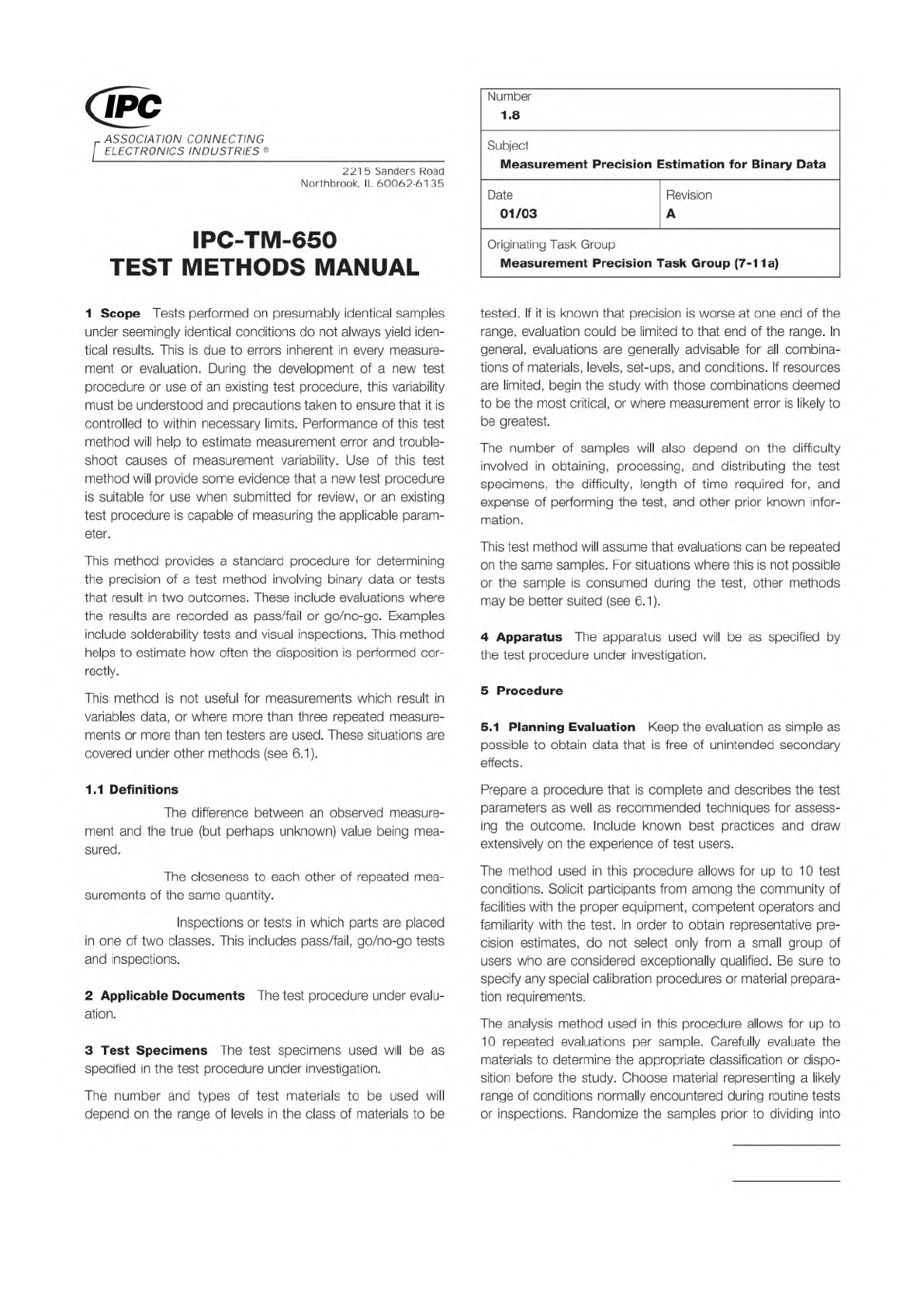
Accuracy –
Precision –
Binary Data –
Material in this Test Methods Manual was voluntarily established by Technical Committees of IPC. This material is advisory only
and its use or adaptation is entirely voluntary. IPC disclaims all liability of any kind as to the use, application, or adaptation of this
material. Users are also wholly responsible for protecting themselves against all claims or liabilities for patent infringement.
Equipment referenced is for the convenience of the user and does not imply endorsement by IPC.
Page 1 of 6
r
ASSOCIATION
CONNECTING
/
ELECTRONICS
INDUSTRIES
®
221
5
Sanders
Road
Northbrook,
IL
60062-6135
IPC-TM-650
TEST
METHODS
MANUAL
Number
1.8
Subject
Measurement
Precision
Estimation
for
Binary
Data
Date
01/03
Revision
A
Originating
Task
Group
Measurement
Precision
Task
Group
(7-1
1a)
1
Scope
Tests
performed
on
presumably
identical
samples
under
seemingly
identical
conditions
do
not
always
yield
iden¬
tical
results.
This
is
due
to
errors
inherent
in
every
measure¬
ment
or
evaluation.
During
the
development
of
a
new
test
procedure
or
use
of
an
existing
test
procedure,
this
variability
must
be
understood
and
precautions
taken
to
ensure
that
it
is
controlled
to
within
necessary
limits.
Performance
of
this
test
method
will
help
to
estimate
measurement
error
and
trouble¬
shoot
causes
of
measurement
variability.
Use
of
this
test
method
will
provide
some
evidence
that
a
new
test
procedure
is
suitable
for
use
when
submitted
for
review,
or
an
existing
test
procedure
is
capable
of
measuring
the
applicable
param¬
eter.
This
method
provides
a
standard
procedure
for
determining
the
precision
of
a
test
method
involving
binary
data
or
tests
that
result
in
two
outcomes.
These
include
evaluations
where
the
results
are
recorded
as
pass/fail
or
go/no-go.
Examples
include
solderability
tests
and
visual
inspections.
This
method
helps
to
estimate
how
often
the
disposition
is
performed
cor¬
rectly.
This
method
is
not
useful
for
measurements
which
result
in
variables
data,
or
where
more
than
three
repeated
measure¬
ments
or
more
than
ten
testers
are
used.
These
situations
are
covered
under
other
methods
(see
6.1).
1.1
Definitions
The
difference
between
an
observed
measure¬
ment
and
the
true
(but
perhaps
unknown)
value
being
mea¬
sured.
The
closeness
to
each
other
of
repeated
mea¬
surements
of
the
same
quantity.
Inspections
or
tests
in
which
parts
are
placed
in
one
of
two
classes.
This
includes
pass/fail,
go/no-go
tests
and
inspections.
2
Applicable
Documents
The
test
procedure
under
evalu¬
ation.
3
Test
Specimens
The
test
specimens
used
will
be
as
specified
in
the
test
procedure
under
investigation.
The
number
and
types
of
test
materials
to
be
used
will
depend
on
the
range
of
levels
in
the
class
of
materials
to
be
tested.
If
it
is
known
that
precision
is
worse
at
one
end
of
the
range,
evaluation
could
be
limited
to
that
end
of
the
range.
In
general,
evaluations
are
generally
advisable
for
all
combina¬
tions
of
materials,
levels,
set-ups,
and
conditions.
If
resources
are
limited,
begin
the
study
with
those
combinations
deemed
to
be
the
most
critical,
or
where
measurement
error
is
likely
to
be
greatest.
The
number
of
samples
will
also
depend
on
the
difficulty
involved
in
obtaining,
processing,
and
distributing
the
test
specimens,
the
difficulty,
length
of
time
required
for,
and
expense
of
performing
the
test,
and
other
prior
known
infor¬
mation.
This
test
method
will
assume
that
evaluations
can
be
repeated
on
the
same
samples.
For
situations
where
this
is
not
possible
or
the
sample
is
consumed
during
the
test,
other
methods
may
be
better
suited
(see
6.1).
4
Apparatus
The
apparatus
used
will
be
as
specified
by
the
test
procedure
under
investigation.
5
Procedure
5.1
Planning
Evaluation
Keep
the
evaluation
as
simple
as
possible
to
obtain
data
that
is
free
of
unintended
secondary
effects.
Prepare
a
procedure
that
is
complete
and
describes
the
test
parameters
as
well
as
recommended
techniques
for
assess¬
ing
the
outcome.
Include
known
best
practices
and
draw
extensively
on
the
experience
of
test
users.
The
method
used
in
this
procedure
allows
for
up
to
10
test
conditions.
Solicit
participants
from
among
the
community
of
facilities
with
the
proper
equipment,
competent
operators
and
familiarity
with
the
test.
In
order
to
obtain
representative
pre¬
cision
estimates,
do
not
select
only
from
a
small
group
of
users
who
are
considered
exceptionally
qualified.
Be
sure
to
specify
any
special
calibration
procedures
or
material
prepara¬
tion
requirements.
The
analysis
method
used
in
this
procedure
allows
for
up
to
10
repeated
evaluations
per
sample.
Carefully
evaluate
the
materials
to
determine
the
appropriate
classification
or
dispo¬
sition
before
the
study.
Choose
material
representing
a
likely
range
of
conditions
normally
encountered
during
routine
tests
or
inspections.
Randomize
the
samples
prior
to
dividing
into